
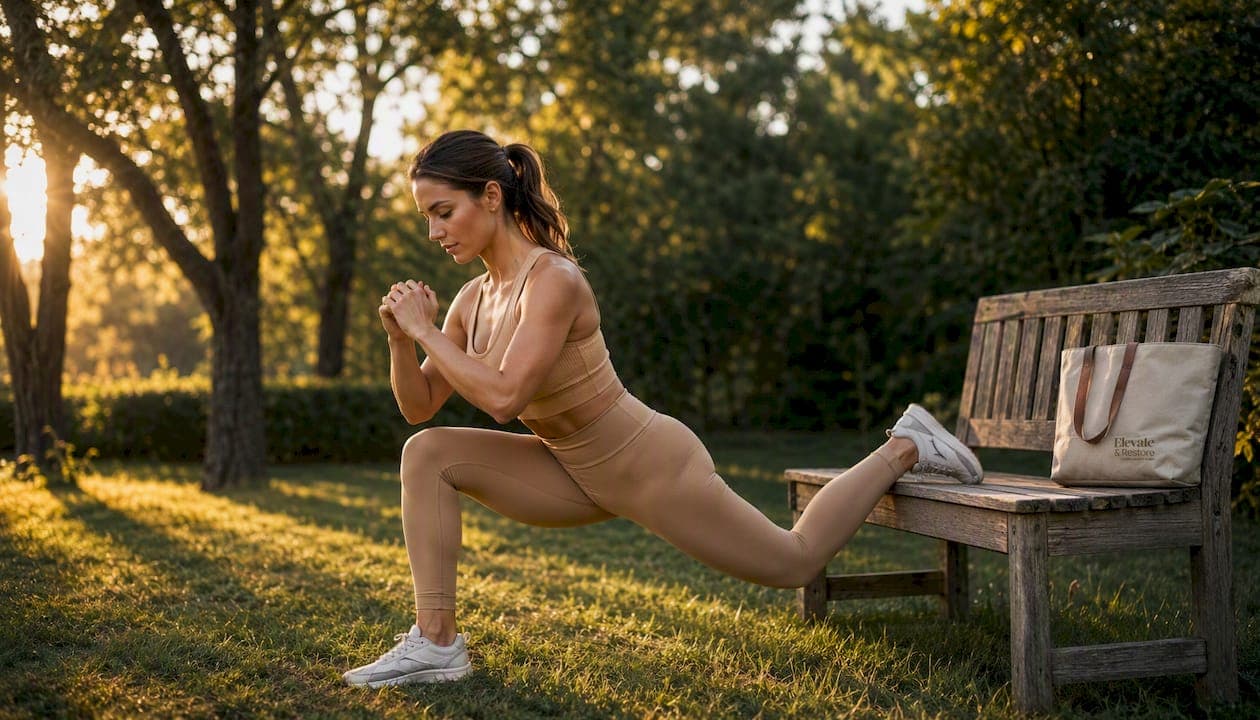
Single-limb training builds strength that bilateral lifts simply cannot replicate on their own. Unilateral exercises improve limb-specific force output, reduce harmful asymmetry, and place greater demand on the stabilising muscles that protect joints under load. The practical upshot: add one unilateral set per leg after your main compound lifts this week and you will immediately expose any strength gap between sides. Research published in Frontiers in Physiology and reviewed by the NSCA confirms that both unilateral and bilateral training have distinct, complementary roles, and the evidence is clear that dropping one for the other leaves performance on the table.
Table of Contents
- What does the research actually show about single-limb strength?
- The concrete benefits of training one limb at a time
- Unilateral versus bilateral training: when should you prioritise each?
- How to programme unilateral training: sets, reps and progressions
- Top unilateral exercises with cues, regressions and progressions
- Common mistakes, red flags and when to modify
- How Elevateandrestore applies unilateral training in studio practice
- Key takeaways
- The case for single-limb training that most programmes miss
- Elevateandrestore's small-group classes bring this to life
- Further reading and key sources
What does the research actually show about single-limb strength?
The most useful summary comes from a systematic review and meta-analysis comparing unilateral (UNI) and bilateral (BIL) resistance training across strength, jump, speed and change-of-direction outcomes. The headline finding: UNI training produced a large effect on improving unilateral jumping performance, while BIL training produced a small but meaningful effect on bilateral maximal strength. Neither approach dominated across all outcomes. Both belong in a well-designed programme.
A separate Frontiers meta-analysis reinforced this, showing UNI training was more effective for jumping ability in unilateral power patterns, while BIL training held the edge for bilateral strength expression. A 2026 systematic review focused on athletes found UNI work can improve rapid force production and single-limb explosive measures, though effects vary by sport, athlete level and the test used.
Statistic callout: The Frontiers 2023 meta-analysis (28 papers) found UNI training produced a statistically significant effect on jumping ability in unilateral power patterns (ES = 0.61, p = 0.002), while BIL training held the advantage for bilateral maximal strength expression.
The bilateral force deficit explained
The bilateral force deficit (BLFD) is the gap between what each limb can produce independently and what both produce together. When you test each leg separately and add the totals, the combined figure often exceeds what you can generate in a bilateral squat. The NSCA Strength & Conditioning Journal identifies BLFD as a key reason to include unilateral work, particularly for athletes whose sport demands single-leg propulsion. Addressing it means each limb learns to recruit motor units fully without relying on the other side to compensate.
Neuromuscular mechanisms that drive the gains
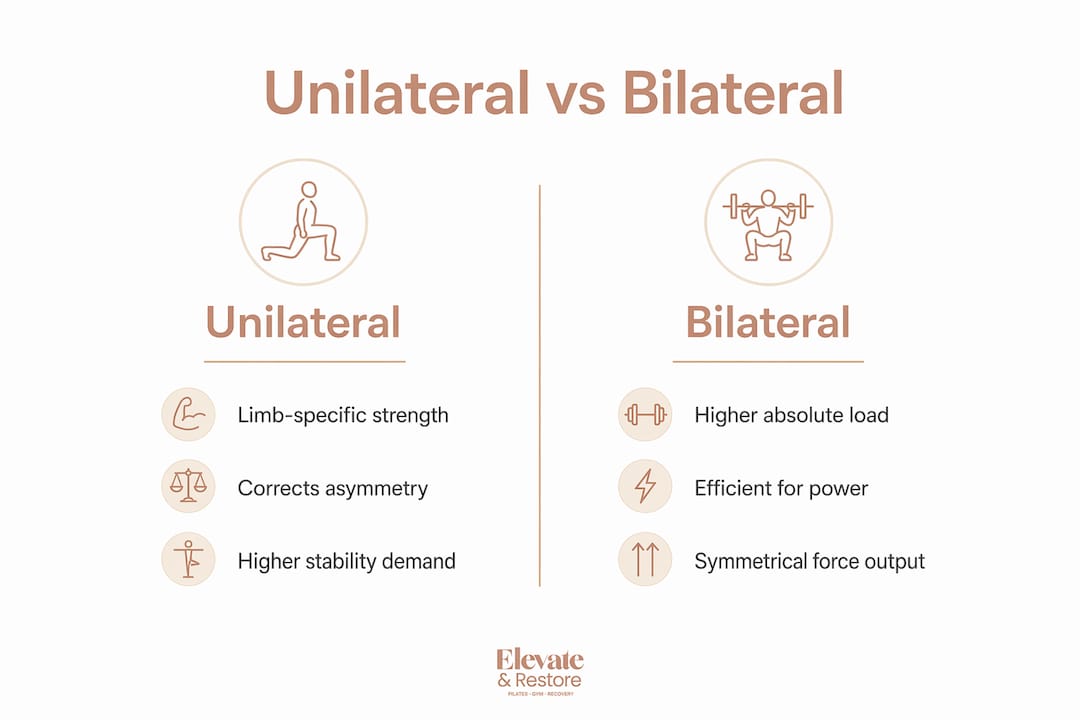
Three mechanisms explain why unilateral work produces strength adaptations that bilateral training misses. First, motor unit recruitment: single-limb movements recruit more muscle groups relative to load, particularly fast-twitch fibres, because the nervous system cannot distribute effort across two limbs. Second, neuromuscular efficiency improves through interhemispheric transfer, where training one side produces neural adaptations in the opposite limb. Third, stability demands: unilateral movements place higher anti-rotation and anti-flexion load on the core, forcing secondary stabilisers to work harder than they ever do under a barbell.
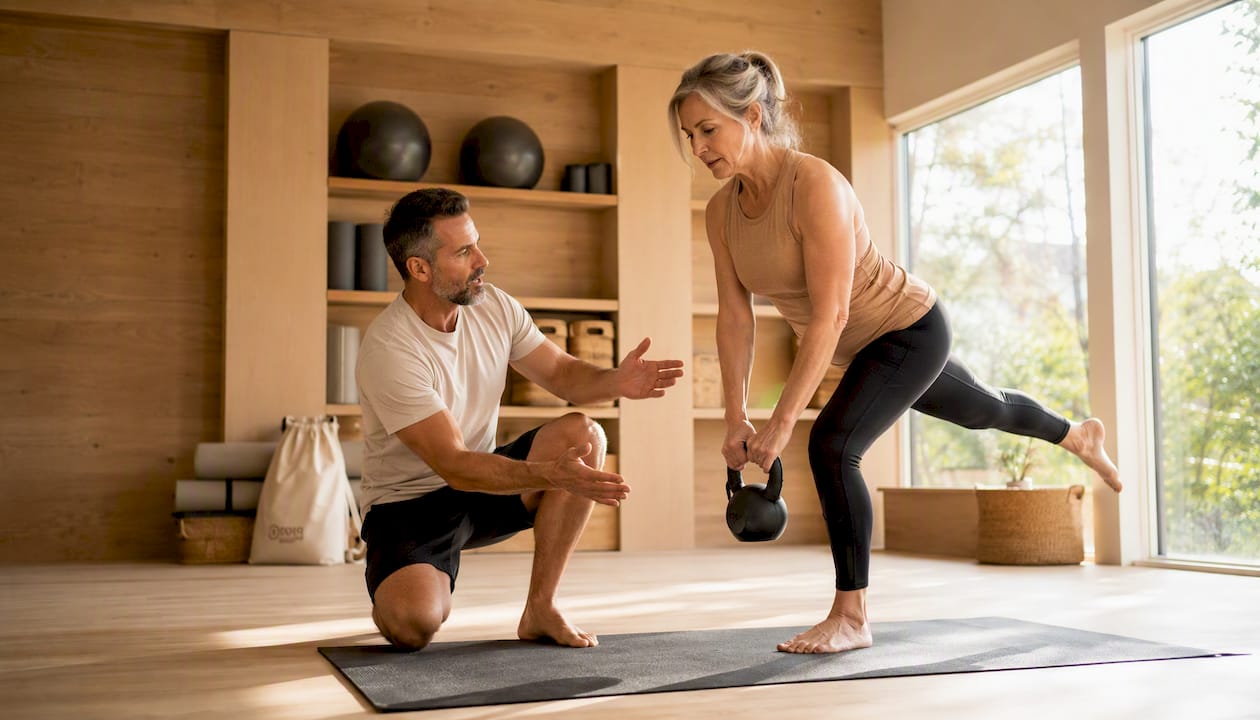
Cross-education is the most clinically useful of these mechanisms. Training one limb produces neural gains in the contralateral homologous muscle, which is why physios use single-limb work during immobilisation. Eccentric contractions amplify this effect, making eccentric-emphasis unilateral sets the preferred tool during rehab phases.
The concrete benefits of training one limb at a time
The advantages of unilateral training go beyond sport performance. For active adults over 30, the practical benefits are often more immediately relevant than any athletic metric.
- Corrects asymmetry. Most people have a dominant side that compensates during bilateral lifts. Unilateral work identifies and corrects muscle imbalances by forcing each limb to meet the same standard independently.
- Reduces overuse on the dominant side. When the stronger leg or arm always leads, the weaker side underloads and the stronger side accumulates disproportionate stress. Single-limb loading distributes work more evenly.
- Improves single-leg power. Running, stair climbing, getting up from a chair — nearly every functional movement is unilateral. Training specifically for these patterns transfers directly to daily life and sport.
- Boosts core stabilisers. The anti-rotation demand of a single-arm press or single-leg RDL activates the obliques, quadratus lumborum and deep stabilisers more than their bilateral equivalents. This means unilateral work can replace separate high-volume core sessions.
- Supports rehab via cross-education. When one limb is injured or immobilised, training the healthy side preserves or partially maintains strength in the affected limb through neural pathways.
- Gives immediate symmetry feedback. Coaches consistently note that unilateral movements reveal movement faults that bilateral lifts mask — a hip drop, a knee cave, a lateral trunk shift — making them a diagnostic tool as much as a training stimulus.
One important limitation: unilateral exercises cap the absolute load you can use. A Bulgarian split squat will never load the quads as heavily as a barbell back squat. That is not a flaw; it is a design feature. UNI work is a strategic complement to bilateral lifts, not a replacement for them.
Unilateral versus bilateral training: when should you prioritise each?
The choice is not either/or. It is about emphasis at the right time.
| Dimension | Unilateral focus | Bilateral focus |
|---|---|---|
| Best for | Single-limb power, sport transfer, imbalance correction, rehab | Maximal absolute strength, muscle mass, hormonal response |
| When to prioritise | In-season, rehab phases, hypertrophy with stability demand, plateau-breaking | Off-season strength blocks, 1RM development, early training base |
| Load | Moderate (RPE 6–8), relative to limb capacity | Heavy (RPE 7–8), absolute load maximised |
| Sets/reps | 3–4 sets × 8–15 reps per side | 3–5 sets × 3–8 reps |
| Tempo | Controlled eccentric (3–4 sec), useful for rehab | Standard or explosive concentric |
| Frequency | 2–3 × per week per pattern | 2–4 × per week per pattern |
Decision flow by goal:
- Reduce BLFD or address a side-to-side gap: run a 4–6 week block with UNI as the primary lower-body exercise.
- Increase 1RM squat or deadlift: keep BIL as the primary lift; add UNI as accessory work.
- In-season sport: shift toward UNI to maintain single-limb power and reduce bilateral loading stress.
- Returning from injury: start with eccentric UNI on the healthy side, then progress to loaded UNI on the recovering side.
Research suggests UNI adaptations can appear faster in the early weeks of a training block, particularly for jump and power outcomes, while BIL strength gains tend to accumulate more gradually and sustainably over longer cycles. Practically, this means a short UNI-emphasis block (4–6 weeks) can break a plateau before returning to a BIL-dominant phase.
How to programme unilateral training: sets, reps and progressions
Templates by goal
Strength and hypertrophy (general) 3–4 sets × 8–12 reps per side, moderate load (RPE 7–8), 60–90 seconds rest between sides. Pair one UNI lower-body exercise (e.g. Bulgarian split squat) and one UNI upper-body exercise (e.g. single-arm row) per session. Place after bilateral main lifts.
Power and sport transfer 3–4 sets × 4–6 reps per side, explosive intent, full recovery (90–120 seconds). Use single-leg explosive exercises such as single-leg box jumps or split-stance jumps. Best placed early in the session when the nervous system is fresh.
Rehab and imbalance correction 2–3 sets × 10–15 reps per side, light-to-moderate load, eccentric emphasis (3–4 second lowering phase). Prioritise range of motion and symmetry over load. Progress by adding load only when both sides match within roughly 10% of each other.
Progression checklist
- Master bodyweight form before adding external load.
- Progress range of motion before increasing weight (e.g. deeper split squat before adding dumbbells).
- Match both sides before progressing the stronger side further.
- Introduce tempo manipulation (slower eccentric) before adding complexity (unstable surface, cable resistance).
- Track side-to-side load and rep quality each session.
Pro Tip: Never try to match your bilateral squat numbers one-for-one on a single-leg variation. Use RPE and rep quality as your guide instead. A Bulgarian split squat at RPE 7 with clean mechanics will build more usable strength than grinding through a heavy set with a collapsing hip.
Pairing UNI and BIL work in the same session is straightforward: lead with the bilateral compound lift (squat, deadlift, bench), then move to UNI accessory work. This preserves maximal strength stimulus while adding the symmetry and stability benefits of single-limb loading. For functional training strength gains, this sequencing is the standard approach.
Top unilateral exercises with cues, regressions and progressions
Bulgarian split squat
Purpose: Primary unilateral quad and glute developer; exposes side-to-side strength differences immediately.
Cues: Keep the front shin vertical; drive through the heel; keep the torso upright without arching the lower back.
Regression: Elevated rear foot removed — perform as a standard split squat with both feet on the floor.
Progression: Add dumbbells, then a barbell; increase rear foot elevation; introduce a pause at the bottom.
Equipment: Bodyweight, dumbbells, barbell, kettlebells. A bench or box for rear foot elevation — standard in any Australian gym.
Single-leg Romanian deadlift (RDL)
Purpose: Posterior chain strength and hip hinge patterning; high demand on balance and hamstring length.
Cues: Hinge at the hip, not the spine; keep the working leg slightly soft; the non-working leg drives back in line with the torso.
Regression: Use a wall or TRX for balance support; reduce range of motion.
Progression: Add a dumbbell or kettlebell in the opposite hand (contralateral load); progress to a barbell.
Equipment: Bodyweight, dumbbell, kettlebell, cable machine.
Single-leg hip thrust
Purpose: Isolated glute strength and hip extension; useful for correcting glute dominance asymmetry.
Cues: Drive through the heel of the working leg; keep the pelvis level; squeeze at the top without hyperextending the lumbar spine.
Regression: Bilateral hip thrust with a pause to feel each side.
Progression: Add a barbell or plate across the hip; elevate the working foot on a box.
Equipment: Bench or box, barbell, plate. Reformer footbar works well as a studio alternative.
Single-arm dumbbell row
Purpose: Unilateral upper-back and lat strength; reveals pulling asymmetry between sides.
Cues: Brace the core; avoid rotating the torso to pull; drive the elbow back, not up.
Regression: Seated cable row with one arm.
Progression: Increase load; progress to a single-arm cable row with a split stance for added anti-rotation demand.
Equipment: Dumbbell, cable machine.
Single-arm overhead press
Purpose: Unilateral shoulder strength and overhead stability; demands significant anti-lateral-flexion core work.
Cues: Brace the obliques before pressing; keep the wrist stacked over the elbow; avoid side-bending the torso.
Regression: Seated single-arm dumbbell press (removes core demand).
Progression: Standing single-arm kettlebell press; add a contralateral carry (farmer's carry in the opposite hand).
Equipment: Dumbbell, kettlebell.
Reverse lunge
Purpose: Knee-friendly unilateral quad and glute work; lower shear force than a forward lunge.
Cues: Step back far enough that the front shin stays vertical; control the descent; drive through the front heel to return.
Regression: Assisted reverse lunge holding a TRX or rack upright.
Progression: Add dumbbells; progress to a walking lunge; introduce a knee drive at the top.
Equipment: Bodyweight, dumbbells, barbell.
Single-leg box step-up
Purpose: Functional unilateral strength that transfers directly to stair climbing and running mechanics.
Cues: Drive through the heel of the working leg; avoid pushing off the trailing foot; control the lowering phase.
Regression: Lower box height; use a wall for balance.
Progression: Add load (dumbbells or barbell); increase box height; add a knee drive at the top.
Equipment: Plyo box or step. Available in virtually every Australian gym and studio.
Single-arm cable chest press
Purpose: Unilateral horizontal push with high anti-rotation demand; exposes pressing asymmetry.
Cues: Set the cable at chest height; stagger the stance; brace the core before pressing.
Regression: Single-arm dumbbell press on a bench.
Progression: Increase load; narrow the stance to increase stability demand.
Equipment: Cable machine.
Common mistakes, red flags and when to modify
Mistakes to fix:
- Loading too heavy too soon. The most common error. Unilateral movements require more stability than bilateral equivalents; form breaks down before strength does. Start lighter than feels necessary.
- Letting the pelvis drop. A hip drop during single-leg work signals weak hip abductors or gluteus medius. Reduce load and strengthen stabiliser muscles before progressing.
- Rushing the eccentric. Dropping quickly through the lowering phase removes the most productive part of the movement. Use a deliberate 2–3 second lowering tempo.
- Ignoring range of motion. Partial reps with heavy load build partial-range strength. Train through a full, controlled range before adding weight.
- Skipping the weaker side. Always start sets on the weaker limb and match the reps on the stronger side, not the other way around.
Red flags that warrant a pause:
- Sharp joint pain (not muscle fatigue) during or after a set.
- Neurological symptoms: pins and needles, numbness, or weakness that is disproportionate to the load.
- Marked postural asymmetry that worsens with load, suggesting a structural issue rather than a strength gap.
If any of these appear, stop loading and seek assessment from a physiotherapist or exercise physiologist before continuing. For adults over 30, functional training and injury prevention go hand in hand, and ignoring early warning signs is the fastest route to a longer layoff.
Return-to-load and rehab notes: Prioritise isometric holds first (e.g. isometric split squat hold), then eccentric-emphasis work, then full concentric loading. The cross-education effect means training the healthy limb during immobilisation is genuinely useful, not just a placeholder.
How Elevateandrestore applies unilateral training in studio practice
Elevateandrestore integrates unilateral work across its small-group classes at its West Footscray studio, where sessions are capped at six clients. That cap matters: a coach can actually watch each person's hip position, foot pressure, and trunk alignment in real time, which is exactly the kind of feedback unilateral movements demand.
A typical functional training session flow:
- Warm-up: single-leg balance drills, hip CARs (controlled articular rotations), and bodyweight reverse lunges to prime the stabilisers.
- Main block: one bilateral compound movement (e.g. goblet squat or trap bar deadlift) followed by two unilateral accessory exercises (e.g. Bulgarian split squat and single-arm row), with load matched to each client's current capacity.
- Finisher: single-leg hip thrusts or step-ups for posterior chain reinforcement.
- Cool-down: targeted mobility for the hip flexors and thoracic spine.
Reformer Pilates sessions at the studio add a different dimension. The reformer's spring resistance and moving carriage create an inherently unstable surface, which amplifies the core and stabiliser demands of single-leg footwork, side-lying leg series and kneeling arm work. These movements build the same anti-rotation and anti-flexion capacity described in the research, without the compressive load of a barbell.
Recovery integration: After a session heavy in unilateral overload, the studio's recovery hub supports the adaptation process directly. Infrared sauna promotes circulation and reduces delayed onset muscle soreness. Cold plunge and contrast therapy (alternating hot tub and cold plunge) support the neuromuscular recovery that single-limb training demands. Compression boots address lower-limb swelling and promote lymphatic clearance, which is particularly relevant after high-volume split squat or step-up work. Pairing training stimulus with structured recovery methods for strength training is how the studio tracks progression over weeks, not just sessions.
The studio monitors side-to-side symmetry informally across sessions, noting when a client's weaker leg catches up to the stronger one in load or rep quality. That moment, when both sides match, is a reliable signal that the programme is working.
Key takeaways
Unilateral training builds limb-specific strength, corrects asymmetry, and raises stability demands in ways bilateral lifts cannot replicate alone.
| Point | Details |
|---|---|
| Add unilateral work this week | Start with one set per leg after your main bilateral lift to expose and address side-to-side gaps. |
| Prioritise by goal | Use UNI as the primary focus during rehab, in-season, or plateau-breaking phases; keep BIL primary for 1RM development. |
| Monitor symmetry, not just load | Track whether both sides match in rep quality and load before progressing the stronger limb further. |
| Use eccentric emphasis for rehab | Slow eccentric unilateral sets amplify cross-education effects and are the preferred tool when one limb is recovering. |
| Elevateandrestore for guided implementation | Small-group classes (max six) at the West Footscray studio integrate unilateral programming with reformer Pilates and a full recovery hub. |
The case for single-limb training that most programmes miss
The conventional wisdom treats unilateral exercises as accessory work — something you do after the "real" lifts to tick a box. The research does not support that framing, and neither does what happens in practice with clients over 30.
The more accurate picture is this: bilateral lifts are excellent at building absolute force, but they are also excellent at hiding problems. A barbell squat will let a stronger leg quietly dominate for months while the weaker side atrophies relative to it. The asymmetry compounds. Then a knee starts complaining, or a hip flexor tightens, and the person assumes it is age. Often it is not. It is a load distribution problem that a few sets of split squats would have flagged immediately.
What gets underestimated is the diagnostic value. Every unilateral set is a test. When one side wobbles, drops the hip, or fatigues three reps earlier than the other, that is information. Bilateral training rarely gives you that signal until the asymmetry is large enough to cause pain.
For adults over 30, the goal is not just getting stronger in the short term. It is building a body that stays strong and functional for decades. Unilateral work, done consistently and progressively, is one of the most reliable tools for that. Not because it is trendy, but because it matches how the body actually moves and where it actually breaks down.
Elevateandrestore's small-group classes bring this to life
Knowing the theory is one thing. Having a coach watch your hip position during a Bulgarian split squat is another entirely.
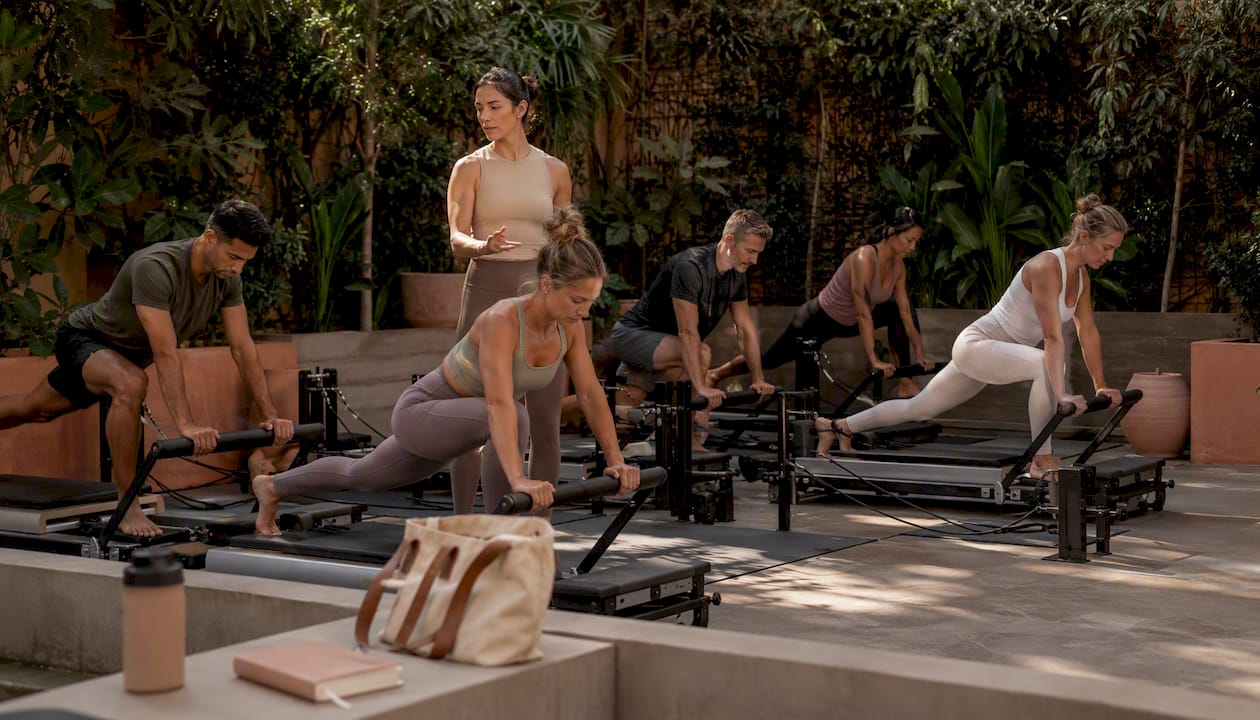
At Elevateandrestore in West Footscray, small-group reformer Pilates and functional training classes (maximum six people per session) are built around exactly the principles covered in this article: unilateral loading, symmetry monitoring, and progressive overload matched to each person's capacity. The recovery hub, including infrared sauna, cold plunge, hot tub and compression boots, is available after every session to support the adaptation process.
If you have been training consistently but suspect a side-to-side imbalance is holding you back, or you want a structured programme that integrates unilateral work with proper recovery, this is a practical next step. Book a reformer Pilates class or explore the recovery lounge to see what a session looks like.
Further reading and key sources
The sources below underpin the claims in this article. They are listed by relevance to the sections they support most directly.
| Source | What it contributes | Most relevant section |
|---|---|---|
| PMC systematic review and meta-analysis | Compares UNI vs BIL on strength, jump, speed and COD; confirms specificity principle | Evidence summary, comparative analysis |
| Frontiers in Physiology meta-analysis | 28-paper meta-analysis; UNI superior for unilateral jump, BIL for bilateral strength | Evidence summary, programming |
| Frontiers in Physiology systematic review (2026) | Athlete-focused; UNI improves rapid force production and single-limb explosive measures | Evidence summary, exercise collection |
| NSCA Strength & Conditioning Journal (2016) | Explains BLFD, stability demands, and positions UNI as a strategic complement to BIL | Evidence summary, comparative analysis, programming |
| ACE Fitness: benefits of unilateral training | Practitioner-backed overview of cross-education, imbalance correction and rehab application | Benefits, safety, programming |
| BarBend: seven biggest benefits of unilateral training | Practical coaching perspective on symmetry feedback and movement quality | Benefits, studio application |