
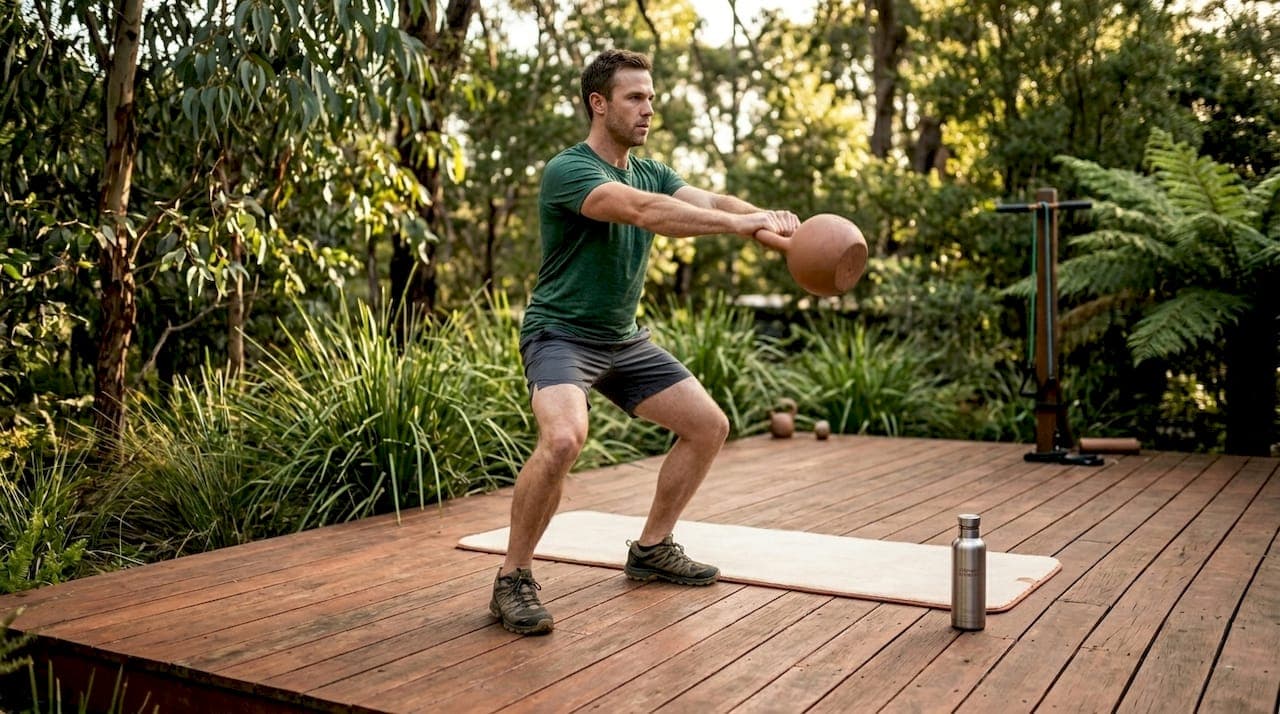
Functional strength training is the practice of training movements that replicate everyday actions so your body performs daily tasks safely and efficiently. Unlike traditional gym work that targets single muscles in isolation, functional training uses multi-joint, multi-muscle movements that mirror what you actually do outside the gym. Think standing up from a chair, lifting a bag of groceries, carrying a child, or reaching overhead. For adults over 30, this approach is particularly relevant because strength and coordination for real-world tasks directly affect quality of life. The goal is not a bigger bicep. The goal is a body that works well for you every single day.
What is functional strength training and how does it differ from traditional lifting?
Functional strength training is defined as a method of strength development that prioritises movement patterns over muscle isolation. The Cleveland Clinic describes it as training movements used in daily life rather than targeting individual muscles in a controlled, fixed range. This distinction matters more than most gym programmes acknowledge.
Traditional strength training, the kind built around machines and isolation exercises, has genuine value. A leg extension builds quad strength. A bicep curl builds arm strength. But neither teaches your body how to coordinate multiple muscle groups under load, which is exactly what happens when you carry shopping bags up a flight of stairs or lower yourself onto a low couch.
The table below shows the core differences between the two approaches:
| Feature | Functional strength training | Traditional strength training |
|---|---|---|
| Movement focus | Multi-joint, compound patterns | Single-joint, isolated muscles |
| Real-life transfer | High. Mirrors daily tasks directly | Lower. Builds strength in fixed planes |
| Nervous system demand | High. Trains coordination and balance | Moderate. Less proprioceptive challenge |
| Equipment | Bodyweight, dumbbells, kettlebells | Machines, cables, barbells |
| Best suited for | Daily movement, ageing well, injury prevention | Muscle hypertrophy, sport-specific strength |
Functional training also integrates multiple planes of movement including sagittal (forward and back), frontal (side to side), and transverse (rotational). Most traditional gym routines operate almost exclusively in the sagittal plane. That gap leaves people strong in the gym but underprepared for the unpredictable demands of real life.
The most useful way to think about it: functional training is a lens for evaluating whether your fitness transfers to everyday life. It is not a replacement for other forms of training. It is the piece that makes everything else more useful.
What are the proven benefits of functional training for adults over 30?
The benefits of functional training go well beyond aesthetics. For adults over 30, the physical changes that matter most are the ones that protect independence, reduce injury risk, and make daily life feel easier.
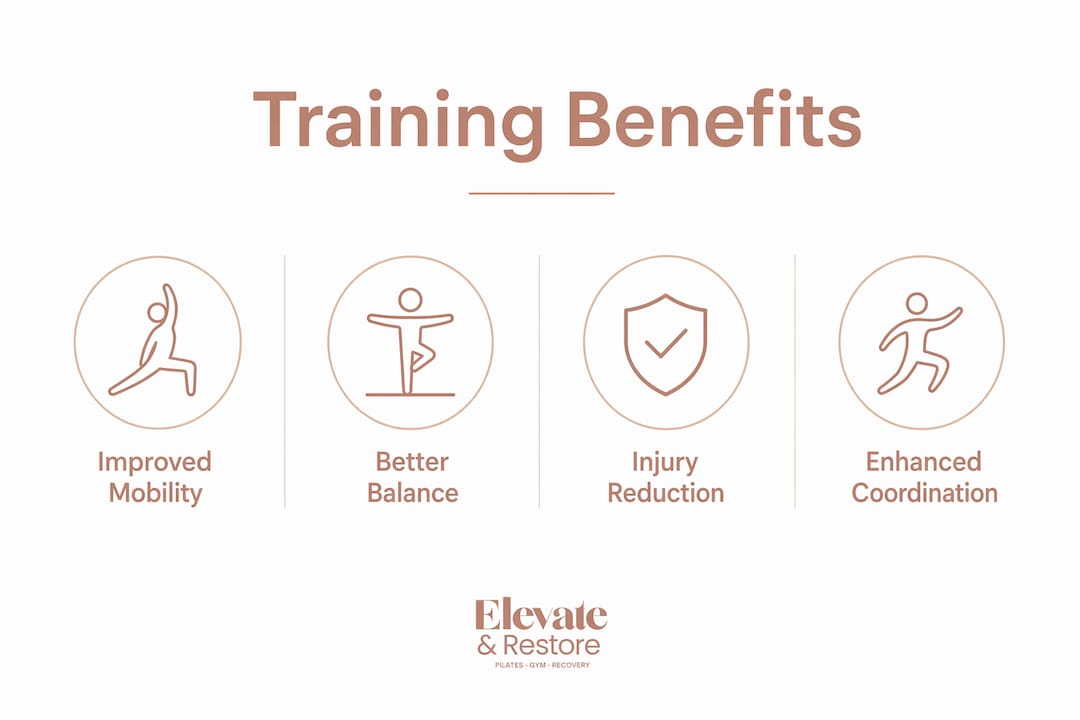
Dartmouth Health confirms that functional training improves mobility, coordination, and balance while reducing injury risk by encouraging full range of motion and multi-muscle coordination. These are not abstract fitness outcomes. They translate directly to things like getting up off the floor without help, carrying luggage through an airport, or recovering quickly when you trip.
The research on short-duration programmes is particularly striking. The FAST-2 trial, conducted at Penn State University, found that a 12-week daily 4-minute programme significantly improved functional performance in older adults. Participants improved their Five-Times Sit-to-Stand time by 2.3 seconds, their One-Legged Stance Test by 3.6 seconds, and increased chair stands by 4.2 repetitions. Four minutes a day. That result reframes the idea that meaningful functional progress requires long gym sessions.
The key benefits for adults over 30 include:
- Improved ease of daily movement. Squatting, bending, lifting, and carrying become less effortful and less risky when trained regularly.
- Better balance and coordination. Multi-planar training and proprioceptive challenges reduce fall risk, which becomes increasingly significant after 40.
- Reduced injury risk. Training movement patterns rather than muscles teaches the body to stabilise joints under load, protecting knees, hips, and the lower back.
- Greater independence over time. Functional capacity is the strongest predictor of how well people age physically. Training it directly is the most logical strategy.
- Faster recovery from fitness breaks. Returning to exercise after time off is safer and more confidence-building when the focus is on daily movement patterns rather than maximum load.
Functional strength training suits people over 30 especially well because the gap between gym performance and real-world capability tends to widen with age unless it is specifically addressed.
Which movements form the foundation of functional strength workouts?
Every functional strength training programme is built on six fundamental movement patterns. These are the squat, the hinge, the push, the pull, the carry, and the rotate. Together, they cover the full range of what the human body does in daily life.
- Squat. Sitting down, standing up, getting in and out of a car. Exercises include goblet squats, bodyweight squats, and split squats.
- Hinge. Picking something up from the floor, loading the dishwasher, lifting a child. Exercises include Romanian deadlifts, kettlebell swings, and good mornings.
- Push. Pushing open a heavy door, placing something on a high shelf. Exercises include push-ups, overhead press, and dumbbell chest press.
- Pull. Opening drawers, pulling yourself up, carrying bags. Exercises include rows, lat pulldowns, and resistance band pulls.
- Carry. Walking with groceries, moving furniture, carrying luggage. Exercises include farmer's carries, suitcase carries, and waiter's walks.
- Rotate. Reaching across your body, twisting to reverse a car, swinging a racquet. Exercises include woodchops, pallof press, and rotational medicine ball throws.
Most people who exercise regularly practise the squat and push patterns without realising it. The hinge and carry patterns are the most commonly neglected, and they are also the ones most associated with lower back injury when left untrained.
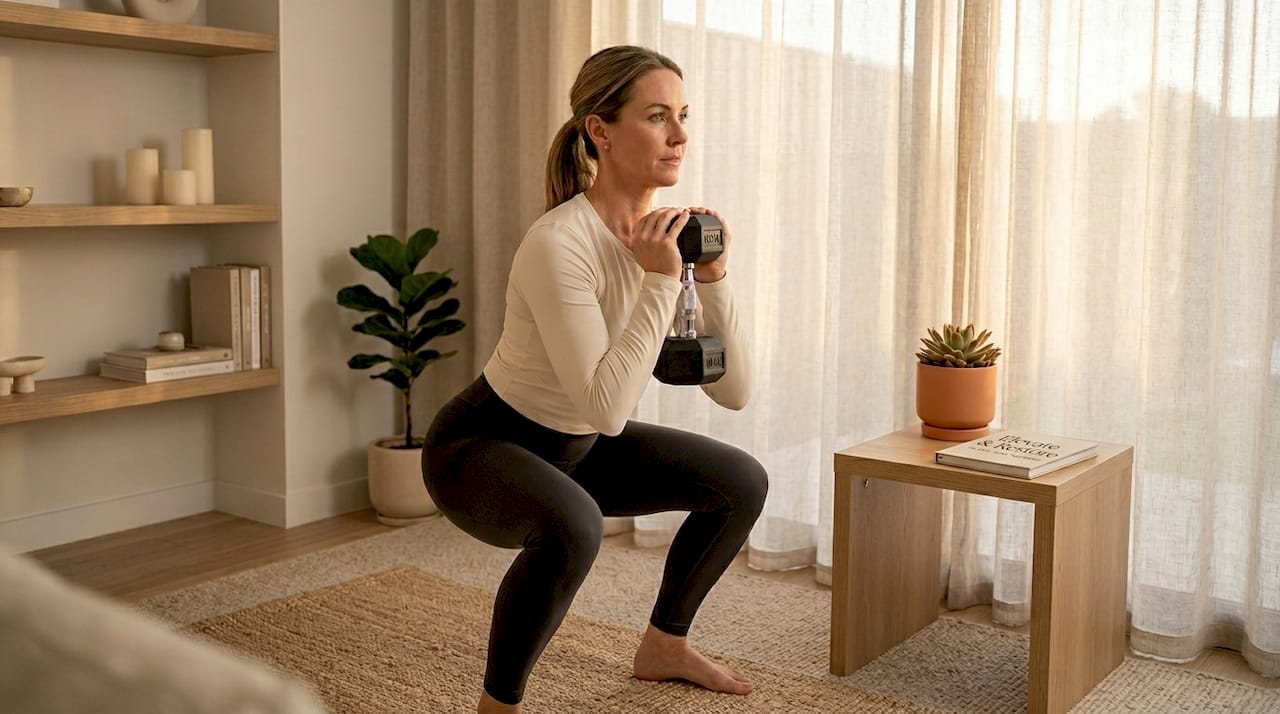
Exercises like squats, lunges, and step-ups build strength while enhancing nervous system efficiency for quick, coordinated movements. That neurological adaptation is what separates functional training from simply lifting heavy things. A multifunctional dumbbell is a practical tool for training several of these patterns at home without a full equipment setup.
Pro Tip: If you are unsure where to start, audit your own day. Write down five physical tasks you do regularly, then identify which of the six movement patterns each one uses. The patterns you cannot name an exercise for are the ones to prioritise first.
How to do functional strength training safely if you are over 30
Starting a functional strength training programme after 30 does not require a complete overhaul of your current routine. The most effective approach is to layer functional movement work into what you already do, then build from there.
The Cleveland Clinic is clear that functional training must be individually tailored to everyday life demands and physical capabilities. That means your programme should reflect your joint history, your balance demands, your available equipment, and what you actually do each day. A person who sits at a desk for eight hours has different functional priorities than someone who works on their feet.
The FAST-2 research also confirms that movement quality must precede load. Rushing to add weight before movement control is established leads to ineffective training at best and injury at worst.
Here is a practical starting framework:
- Assess your movement first. Can you squat to parallel without your heels lifting? Can you hinge at the hip without rounding your lower back? These are your baselines, not your limitations.
- Start with bodyweight. Master the pattern before adding load. A bodyweight squat done well is more valuable than a weighted squat done poorly.
- Add load gradually. Once movement quality is consistent, introduce light resistance using dumbbells, kettlebells, or resistance bands.
- Train three to four times per week. Cover all six movement patterns across your sessions. You do not need to hit every pattern in every session.
- Pair with recovery. Functional training creates real demand on joints and connective tissue. Sleep, nutrition, and active recovery all support the adaptation process.
- Seek coaching feedback. A qualified coach can identify movement compensations you cannot see yourself, which is the fastest way to progress safely.
Pro Tip: Functional performance is best measured by task-relevant tests like sit-to-stand speed and single-leg balance, not by how much you lift. Track these markers every four to six weeks to see real progress.
Group training environments can also accelerate progress. Group fitness increases accountability and consistency, two factors that matter more than programme design for most adults returning to regular exercise.
Key takeaways
Functional strength training builds physical capability that transfers directly to daily life, making it the most practical investment adults over 30 can make in their long-term health.
| Point | Details |
|---|---|
| Definition is movement-based | Functional training targets movement patterns, not individual muscles, to improve real-life physical capability. |
| Six patterns cover everything | Squat, hinge, push, pull, carry, and rotate are the foundation of every effective functional programme. |
| Short sessions produce results | The FAST-2 trial showed meaningful gains from just four minutes of daily functional training over 12 weeks. |
| Quality before load | Movement control must be established before adding resistance to avoid injury and maximise transfer. |
| Tailoring is non-negotiable | The most effective programme matches your daily tasks, joint history, and current physical capacity. |
Why functional training is the most honest form of fitness
At Elevateandrestore, we work with a lot of people over 30 who have spent years training hard without ever asking whether their fitness was actually making their life easier. They could bench press well but struggled to carry their kids without back pain. They had strong quads but poor hip hinge mechanics that made picking anything up off the floor feel risky.
The uncomfortable truth about most gym programmes is that they are designed around aesthetics and performance metrics that have very little to do with how you actually use your body. Functional training forces a different question: does what I am doing in here translate to out there?
In our small group sessions at Elevateandrestore, we see this shift happen quickly. When someone realises that the goblet squat they have been practising makes getting up from the floor feel effortless, the motivation to train changes completely. It stops being about burning calories and starts being about building a body that works.
The other thing worth saying plainly: functional training is not easy, and it is not gentle. Done properly, it is demanding. But the demand is purposeful. Every rep has a direct analogue in daily life, which means the effort is never wasted.
If you are over 30 and you have not yet asked whether your training transfers to your actual life, that is the question to start with.
— Elevate
Train smarter with Elevateandrestore
Elevateandrestore is a functional training and Pilates studio in Melbourne's inner west, built specifically for adults who want their fitness to mean something beyond the gym. Small group sessions of six people mean every participant gets genuine coaching attention, not just a spot in a crowded class. The boutique fitness programmes are designed around the six fundamental movement patterns, with progressive coaching that prioritises movement quality before load. The recovery hub, including sauna, cold plunge, hot tub, and compression boots, supports the physical adaptation that makes training sustainable long-term. If you are ready to build strength that actually carries over to your daily life, Elevateandrestore is the place to start.
FAQ
What is functional strength training in simple terms?
Functional strength training is a method of exercise that trains movement patterns used in everyday life, such as squatting, hinging, pushing, pulling, carrying, and rotating. The goal is to build strength and coordination that transfers directly to daily tasks, not just gym performance.
How is functional training different from traditional strength training?
Traditional strength training typically isolates single muscles using machines or fixed movements. Functional training uses compound, multi-joint exercises that train multiple muscle groups and the nervous system together, producing strength that is more applicable to real-world movement.
How often should adults over 30 do functional strength training?
Three to four sessions per week is a practical target for most adults over 30. The FAST-2 trial demonstrated that even four minutes of daily functional training produced measurable improvements in balance and functional performance over 12 weeks.
Can functional training help prevent injury?
Functional training reduces injury risk by teaching the body to stabilise joints under load across multiple planes of movement. Dartmouth Health confirms that full range of motion training and multi-muscle coordination directly support safer daily movement and long-term independence.
Do I need a gym or special equipment to start?
No. Many functional strength exercises, including bodyweight squats, push-ups, lunges, and carries, require no equipment at all. As movement quality improves, adding tools like kettlebells or a multifunctional dumbbell increases the training stimulus without requiring a full gym setup.