

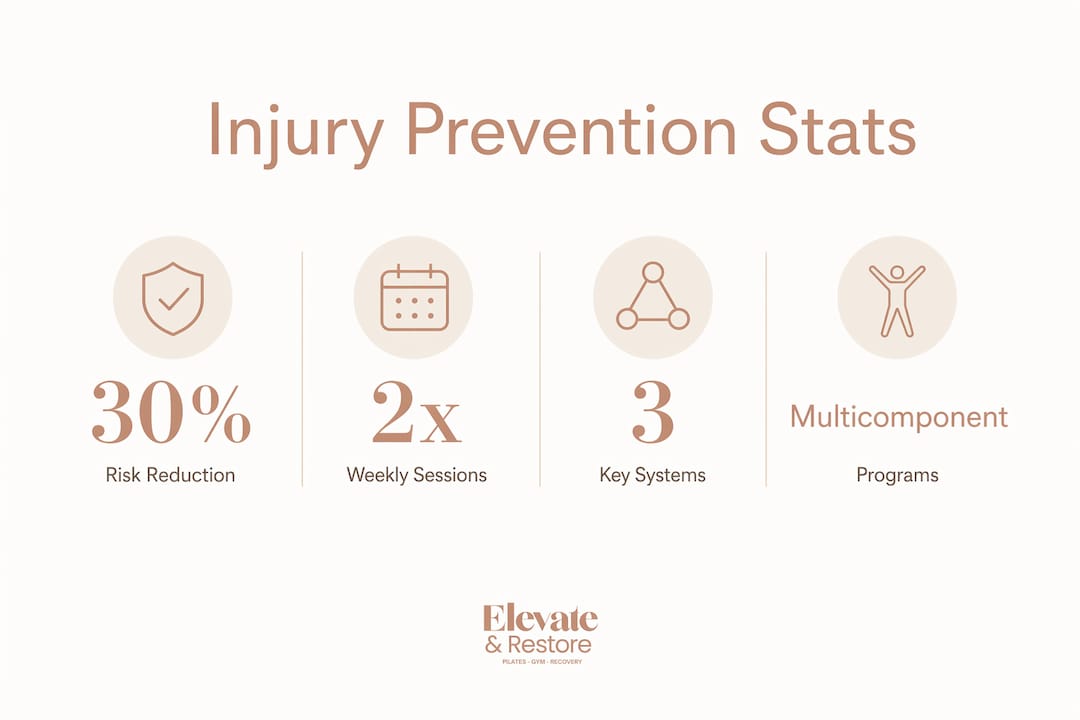
Functional training is defined as exercise that trains the body through movement patterns it uses in real life, and it reduces lower-limb injury risk by approximately 30% in adults. A 2026 JSAMS meta-analysis covering 37 trials and 36,385 participants found a risk ratio of 0.70, confirming that neuromuscular and stability-focused programmes deliver consistent, measurable protection. The Cleveland Clinic and a Frontiers in Physiology systematic review both support the same conclusion: training your body to move well, not just to lift heavy, is the most direct path to staying injury-free past 30.
Why functional training prevents injury: the core mechanisms
The protective effect of functional training comes from three interconnected systems: neuromuscular control, joint stability, and coordinated movement. When these systems work together, your body can respond to unexpected demands, like a sudden step off a kerb or catching yourself mid-fall, without breaking down.
Neuromuscular training improves sensory processing, postural control, and muscular pre-activation. A Frontiers in Physiology systematic review reported a large effect size (SMD=0.96) for dynamic postural stability, which means the nervous system learns to issue faster, more accurate motor commands. That speed of correction is what prevents a rolled ankle from becoming a ligament tear.

Functional exercises also train multiple muscle groups to fire in sequence, which mirrors how the body actually moves. Isolated exercises like a leg extension machine train one muscle in one plane. A single-leg squat trains your glutes, quads, calves, and core to coordinate across multiple planes simultaneously. That coordination is what Dartmouth Health describes as improved brain-muscle communication, and it is the reason functional training primes the body for rapid, smooth movement corrections during sudden position changes.
Core, hip, and ankle control are particularly important for adults over 30. These proximal-to-distal chains govern how force travels through the body during walking, lifting, and reaching. When any link in that chain is weak or poorly coordinated, the load shifts to passive structures like tendons and ligaments, which is where injuries begin.
Pro Tip: If you are new to functional training, start with single-leg balance holds for 30 seconds per side before adding any loaded movement. This simple drill activates the sensory feedback loops that protect your ankles and knees.
How does adherence and programme design affect injury prevention?
The 2026 JSAMS meta-analysis00129-5/abstract) found a clear dose-response relationship: every 10% increase in adherence to functional stability training corresponds to a 10% reduction in injury risk. That is not a coincidence. It reflects the fact that neuromuscular adaptations require repeated, consistent stimulus to become automatic. Miss sessions regularly and the nervous system simply does not consolidate the movement patterns that protect you.
Programme structure matters just as much as attendance. Multicomponent programmes00129-5/abstract) delivered at least twice weekly produced a risk ratio of 0.67, compared to 0.85 for single-component or once-weekly programmes. That difference is statistically significant (p=0.03) and practically meaningful. A programme combining balance, core stability, and plyometrics gives the central nervous system far more varied stimuli than one that focuses on a single modality.
| Programme type | Injury risk ratio | Key advantage |
|---|---|---|
| Multicomponent, ≥2x per week | 0.67 | Trains multiple CNS pathways simultaneously |
| Single-component or once weekly | 0.85 | Easier to start, but significantly less protective |
The Frontiers review confirms that no single modality dominates. Balance work, core stability, and plyometric elements each contribute unique stimuli, and their combination maximises outcomes. Popular frameworks like FIFA 11+ demonstrate similar benefits when delivered consistently, regardless of the specific label attached to the programme.
Accountability is a practical lever that most people underestimate. Group fitness settings increase adherence by creating social commitment, which directly translates to better injury prevention outcomes based on the dose-response data above.
Pro Tip: Schedule your functional training sessions in your calendar the same way you would a work meeting. Consistency is the single biggest driver of the neuromuscular adaptations that keep you injury-free.
Why is functional training particularly beneficial for people over 30?
Muscle mass decline begins around age 25 and accelerates through the 30s and 40s. The Cleveland Clinic notes that functional strength training slows this decline by maintaining strength through movement, not just through isolated loading. The distinction matters because movement-based strength preserves the coordination and range of motion that protect joints during daily activities.
For adults over 30, the injury prevention mechanisms shift away from pure muscle size and towards improved core, hip, and ankle control combined with better sensory feedback. These systems govern balance, posture, and the ability to recover from unexpected perturbations. When they decline, the risk of strains, falls, and overuse injuries rises sharply.
Functional training addresses this directly by practising full-range, real-life movement patterns. Consider what your body does when you lift a bag of groceries from the floor, reach overhead to a high shelf, or step off an uneven footpath. Each of these tasks requires coordinated strength across multiple joints. Functional exercises replicate these demands in a controlled setting so the body is prepared when they occur in real life.
The benefits for this age group include:
- Improved balance and fall prevention through repeated single-leg and multi-directional loading
- Greater joint integrity from muscular pre-activation that protects cartilage and ligaments
- Maintained movement independence by practising the exact patterns used in daily tasks
- Reduced overuse injury risk through better load distribution across muscle groups rather than passive structures
Women aged 30 to 50 in particular benefit from task-specific preparation that accounts for hormonal changes affecting joint laxity and recovery capacity. Functional training adapted to these factors provides protection that generic gym programmes often miss.
For a deeper look at how this applies specifically to your age group, the functional strength training guide at Elevateandrestore covers the key principles in detail.
What practical steps make functional training effective for injury prevention?
Effective functional training for injury prevention follows a clear progression. Starting with complex movements before building foundational control is the most common mistake, and it is also the one most likely to cause the injury you are trying to prevent.
Follow these steps to build a programme that actually protects you:
- Begin with foundational movement patterns. Squats, lunges, step-ups, and hip hinges train the largest functional chains in the body. Master these with bodyweight before adding load.
- Add balance and proprioception challenges. Single-leg variations, unstable surfaces, and eyes-closed balance work force the nervous system to develop the rapid correction ability that prevents sprains and strains.
- Introduce core stability as a foundation, not an afterthought. Planks, dead bugs, and Pallof presses teach the trunk to stabilise under load, which protects the lower back and hips during every other movement.
- Progress to agility and multi-directional tasks. Lateral shuffles, reactive drills, and change-of-direction exercises prepare the body for the unpredictable demands of real life and sport.
- Train at least twice per week, consistently. The dose-response evidence00129-5/abstract) is clear: frequency and adherence drive the neuromuscular adaptations that reduce injury risk.
- Progress exercise complexity gradually. Functional rehabilitation research shows that failure to progress through proprioceptive and agility stages significantly increases reinjury risk by leaving the body unprepared for higher-velocity demands.
If you are returning from an injury or starting from a low fitness base, working with a qualified trainer or exercise physiologist is worth the investment. A personalised programme accounts for existing movement limitations and ensures progression is safe and appropriate.
Pro Tip: Record a short video of yourself performing a squat or lunge once per month. Watching your own movement patterns is one of the fastest ways to identify compensations before they become injuries.
Functional training vs traditional strength training for injury prevention
Traditional isolated strength training builds muscle in specific planes and ranges of motion. A leg press makes your quads stronger, but it does not train your nervous system to stabilise your knee during a lateral cut or a stumble on uneven ground. That gap between gym strength and real-world movement competence is where most injuries occur.
| Training type | Injury prevention mechanism | Limitation |
|---|---|---|
| Functional training | Trains coordinated movement, CNS integration, multi-planar stability | Requires skilled coaching to progress safely |
| Isolated strength training | Builds muscle mass and single-joint strength | Does not train movement patterns or rapid correction ability |
Functional training challenges the nervous system to integrate signals from multiple joints simultaneously. This is what neuromuscular research identifies as the primary driver of dynamic postural stability improvements. Isolated exercises simply do not produce the same CNS adaptations because they remove the coordination demand entirely.
This does not mean traditional strength work has no place. Compound lifts like deadlifts and rows build the foundational strength that functional training then teaches the body to apply. The most protective programmes combine both, with functional, multi-joint, multi-plane work forming the majority of training volume.
The JSAMS meta-analysis00129-5/abstract) reinforces this point directly: the injury prevention benefit comes from neuromuscular and movement-focused content, not from simply labelling exercises as functional. A programme that isolates muscles and avoids coordination challenges will not deliver the 30% risk reduction the evidence supports, regardless of what it is called.
Key takeaways
Functional training prevents injury by building neuromuscular control, joint stability, and coordinated movement patterns that protect the body during real-life demands, and these benefits are strongest when programmes are multicomponent and practised at least twice weekly.
| Point | Details |
|---|---|
| 30% injury risk reduction | Multicomponent functional programmes reduce lower-limb injury risk by approximately 30% across 37 trials. |
| Adherence drives outcomes | Every 10% increase in programme adherence produces a 10% reduction in injury risk. |
| Twice-weekly minimum | Training at least twice per week significantly outperforms once-weekly delivery in injury prevention. |
| Over-30 priority | Adults over 30 benefit most from core, hip, and ankle control work that offsets age-related neuromuscular decline. |
| Progression is non-negotiable | Skipping proprioceptive and agility progression stages significantly increases reinjury risk. |
What I have seen working with adults over 30 at Elevateandrestore
The clients who get the most out of functional training are rarely the ones who push hardest in the first month. They are the ones who show up consistently, take the progression seriously, and stop treating balance work as a warm-up they can skip.
What surprises most people when they start is how quickly their daily life improves before their gym numbers do. Carrying shopping, getting up from the floor, walking on uneven ground without hesitating. These changes happen within weeks, and they are the clearest sign that the neuromuscular adaptations are taking hold.
The biggest mistake I see is people underestimating how much the nervous system drives injury prevention. They focus on how much weight they are lifting and ignore whether their hip is dropping on a single-leg squat or their knee is caving on a step-up. Those compensations are where injuries are born. Movement quality is not a beginner concern. It is the whole point.
Recovery also matters far more than most people account for. At Elevateandrestore, the sauna, cold plunge, and compression boots are not extras. They are part of the programme. The body adapts during recovery, not during the session itself, and adults over 30 need to take that seriously.
My honest advice: prioritise movement quality over intensity, train with people who hold you accountable, and give the process at least 12 weeks before judging the results. The evidence supports it. The outcomes speak for themselves.
— Elevate
Train smarter and stay injury-free with Elevateandrestore

Elevateandrestore is a boutique functional training and Pilates studio in Melbourne's inner west, running small group sessions of six people so every participant gets genuine coaching attention. The programme combines functional strength, reformer Pilates, and structured progression designed specifically for adults who want to move better and stay injury-free. The recovery hub, including sauna, cold plunge, hot tub, and compression boots, supports the adaptation process that makes training stick. If you are ready to train with purpose and a clear plan, explore the boutique fitness options at Elevateandrestore and find the programme that fits your goals.
FAQ
How much does functional training reduce injury risk?
Functional stability programmes00129-5/abstract) reduce lower-limb injury risk by approximately 30%, based on a 2026 meta-analysis of 37 trials involving over 36,000 participants. Multicomponent programmes delivered at least twice weekly achieve the strongest results.
How often should I do functional training to prevent injury?
At least twice per week is the evidence-based minimum. The dose-response relationship00129-5/abstract) shows that each 10% increase in adherence produces a corresponding 10% reduction in injury risk, so consistency matters more than intensity.
Is functional training better than weights for injury prevention?
Functional training outperforms isolated weight training for injury prevention because it trains coordinated movement and CNS integration across multiple planes. The most effective programmes combine both, with functional work forming the majority of training volume.
Why is functional training important for adults over 30?
Muscle mass and neuromuscular function begin declining around age 25. Functional strength training slows this decline by maintaining strength through real-life movement patterns, improving balance, joint stability, and coordination that directly reduce injury risk.
What exercises are most effective for functional injury prevention?
Squats, lunges, step-ups, single-leg balance work, and core stability exercises form the foundation. Progressing to agility and proprioception tasks is critical for reducing reinjury risk and preparing the body for unpredictable real-world demands.