

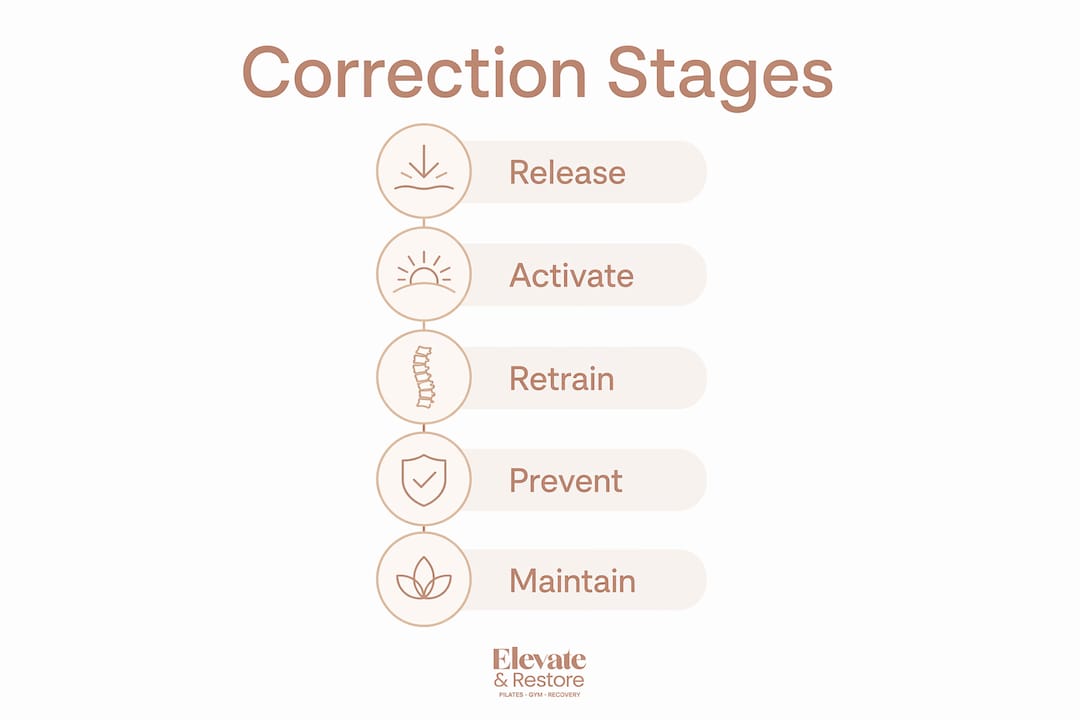
Muscle imbalances happen when some muscles are tight and overactive while opposing muscles are weak and underused. The result is uneven loading across joints, compensatory movement patterns, and, eventually, pain or injury. The most effective way to correct this is through a three-stage approach: release tight muscles, activate weak ones, then retrain functional movement patterns that reinforce the correction.
This is not about chasing perfect symmetry. Functional movement correction aims for effective, pain-free movement in daily life and sport, not identical strength on both sides. That distinction matters practically: it keeps the work focused on what your body actually needs rather than an arbitrary aesthetic target.
Here is what this guide covers:
- How to recognise the signs and causes of muscle imbalances
- How functional movement screening identifies where your body compensates
- Corrective exercises for releasing, activating, and retraining
- Prevention habits and recovery strategies
- When to see a physiotherapist or exercise physiologist
- How Elevateandrestore approaches this work in a structured studio setting
Table of Contents
- How do you know if you have a muscle imbalance?
- Using functional movement screening to assess muscle imbalances
- Corrective exercises that actually fix muscle imbalances
- How to prevent muscle imbalances from coming back
- What Elevateandrestore's approach to functional training reveals
- How long does it take to correct a muscle imbalance?
- How to weave functional movement correction into daily life and sport
- When should you see a physiotherapist or exercise physiologist?
- Precautions worth knowing before you start
- Apps and technology that help you assess and correct imbalances
- Elevateandrestore: structured correction in a small-group setting
- Key takeaways
How do you know if you have a muscle imbalance?
Most people notice something is off before they can name it. One shoulder sits higher. One hip feels tighter after a run. A knee tracks inward during a squat. These are not random quirks; they are signs of muscle imbalance worth paying attention to.
Common signs include:
- Noticeable strength or flexibility differences between your left and right sides
- Persistent tightness or soreness in one area, especially around the hips, shoulders, or lower back
- Postural deviations such as a forward head, rounded shoulders, or uneven hip height
- Joint discomfort during otherwise normal movements like squatting, pressing, or walking
- One limb doing more work than the other during bilateral exercises
The causes are largely behavioural. Prolonged sitting tightens hip flexors and weakens glutes, a pattern so common it has its own clinical name: lower crossed syndrome. Repetitive unilateral activities, like carrying a bag on one shoulder or favouring one leg when standing, compound the problem over time. Unbalanced training, where you push more than you pull or train one movement plane exclusively, creates the same effect in the gym.
Pro Tip: Spend one week noticing which side you favour during everyday tasks: which foot you lead with on stairs, which hand you use to carry groceries, which hip you shift your weight onto when standing. That observation alone will tell you more about your imbalances than most assessments.
Using functional movement screening to assess muscle imbalances
Functional movement screening (FMS) is a structured assessment that uses specific movement tests to reveal where your body compensates, restricts, or loses stability. Rather than isolating muscles in a clinical setting, FMS tests like the deep squat and in-line lunge expose how your whole system moves under load and through range.

Key screening tests and what to watch for:
| Test | What it assesses | Signs of imbalance |
|---|---|---|
| Deep squat | Hip, knee, and ankle mobility; thoracic extension | Heels rise, torso collapses forward, knees cave inward |
| In-line lunge | Hip and ankle stability; single-leg control | Trunk rotation, knee wobble, loss of balance |
| Hurdle step | Hip flexor and glute strength; pelvic stability | Lateral hip shift, forward lean, asymmetry between sides |
| Shoulder mobility | Thoracic rotation; shoulder flexibility | Significant side-to-side difference in hand placement |
| Rotational stability | Core control; cross-body coordination | Inability to maintain spinal alignment during rotation |
You can run a basic self-assessment at home. Film yourself from the front and side performing a bodyweight squat, a single-leg deadlift, and a push-up. Watch for asymmetries, compensations, and any position your body avoids. What you see on video is often surprising compared to what you feel.
A trained coach or exercise physiologist can score these tests formally and build a corrective programme from the results. That structured approach is where personalised exercise programmes consistently outperform generic workouts for reducing injury risk.
Corrective exercises that actually fix muscle imbalances
The three-stage sequence matters here. Strengthening a weak muscle before releasing the tight one opposing it rarely works; the tight muscle simply dominates and the weak one stays inhibited. Work in order.
Stage 1: Release tight muscles
- Hip flexor stretch (kneeling): Drop into a half-kneeling position, tuck your pelvis under, and shift your weight forward until you feel a stretch at the front of the rear hip. Hold the stretch for a duration that feels effective and comfortable per side.
- Thoracic foam rolling: Place a foam roller across your mid-back and extend over it, moving segment by segment from the lower thoracic to the upper. Spend time on any stiff areas until you feel relief and mobility improve.
- Pec minor stretch: Stand in a doorway with your arm at 90 degrees and lean forward gently. This directly counters the rounded-shoulder pattern driven by desk work.
Stage 2: Activate and strengthen weak muscles
- Glute bridge: Lie on your back, feet flat, and drive your hips up by squeezing your glutes. Pause at the top for two seconds. Progress to single-leg once you can do multiple clean repetitions with no hip drop.
- Dead bug: Lying on your back, extend opposite arm and leg while keeping your lower back pressed to the floor. This trains deep core stability without loading a compensating spine.
- Scapular rows (band or cable): Pull your shoulder blades together and down before initiating the row. Most people skip this cue and end up using their traps instead of the intended mid-back muscles.
- Single-leg Romanian deadlift: Builds hip stability and glute strength on each side independently, which bilateral deadlifts cannot replicate.
Stage 3: Retrain functional movement patterns
This is where the correction becomes permanent. Once tight muscles are released and weak ones are firing, you need to practise the movement patterns that reinforce the new balance. Bodyweight squats with deliberate knee tracking, split squats, and step-ups all qualify. The goal is movement quality and foundational muscle endurance, not load.

Pro Tip: Film your corrective exercises from the front every two weeks. Progress is often invisible from the inside but obvious on video. Seeing your knee track better over your second toe, or your hips staying level during a single-leg deadlift, is the kind of feedback that keeps you consistent.
How to prevent muscle imbalances from coming back
Correction is only half the work. Without changing the habits that created the imbalance, you will be back where you started within months.
Daily habits that make a real difference:
- Take regular movement breaks if you sit for work. Stand, walk, or do five glute bridges. Behavioural change like movement breaks is what makes correction last.
- Vary your movement patterns. If you run, add lateral and rotational work. If you lift, include unilateral training alongside bilateral movements.
- Check your workstation setup. Monitor height, chair support, and keyboard position all influence how your body holds itself for hours at a time.
- Prioritise sleep and protein intake. Muscle tissue repairs during sleep, and adequate protein supports the adaptation process.
Pro Tip: Set a phone reminder every hour during your workday. When it goes off, do ten glute squeezes and roll your shoulders back three times. It takes 20 seconds and directly counters the two most common desk-posture imbalances.
For a deeper look at postural imbalance correction and how daily movement habits sustain muscle balance, that resource covers the mechanics in detail.
What Elevateandrestore's approach to functional training reveals
Muscle imbalances are not purely muscular problems. They are pattern problems, ingrained by years of habitual posture and movement choices. That framing changes how you approach correction.
The goal of functional training is not to make both sides identical. It is to restore the movement capacity your body needs to function well, stay out of pain, and keep doing the things you love. Chasing perfect symmetry often leads people to overtrain the weaker side and create new problems. The smarter target is coordinated, efficient movement.
Elevateandrestore works from this principle directly. Small-group sessions of six people allow coaches to observe individual movement patterns and apply targeted cues, something that gets lost in a class of twenty. The Pilates-based programming builds deep stabiliser strength, which is exactly the tissue that goes quiet during prolonged sitting and unbalanced training. Recovery modalities including sauna, cold plunge, and compression boots support the adaptation process between sessions, reducing the soreness and stiffness that otherwise interrupts training consistency.
The combination of structured movement correction and deliberate recovery is what separates a programme that produces lasting change from one that just keeps you busy.
How long does it take to correct a muscle imbalance?
There is no single answer, but there is a useful framework. Minor imbalances caught early, like a tight hip flexor from a few months of desk work, can shift noticeably within four to six weeks of consistent corrective work. Longer-standing patterns, particularly those involving compensatory movement habits, typically need 8–12 weeks of low-load, frequent training before the neuromuscular changes become reliable.
The factors that most affect timeline are consistency, severity, and age. Doing corrective exercises three times a week beats one long session on the weekend, every time. Severity matters because a structural issue like a significant leg-length discrepancy requires a different approach than a functional one. And while age does not prevent correction, tissue adaptation takes longer after 40, which means the process rewards patience more than intensity.
The most common mistake is stopping too early. People feel better after three weeks and return to the habits that caused the problem. The correction has not yet become automatic at that point; the neuromuscular pattern is still fragile. Staying with the programme through the full 8–12 weeks is what makes the change stick.
How to weave functional movement correction into daily life and sport
Corrective exercises work best when they are not treated as a separate category from your normal training. The most effective approach is to embed them.
Warm up with your corrective work rather than doing it as an afterthought. Hip flexor stretches and glute activation before a run or a lifting session means you are training the corrected pattern under load, which accelerates the retraining process. For sport-specific training, identify the movement demands of your sport and map your imbalances against them. A swimmer with a tight thoracic spine and weak external rotators needs different corrections than a cyclist with hip flexor dominance.
Daily life offers more opportunities than most people use. Standing and walking become easier when hip and scapular stability improve, so practising single-leg balance while brushing your teeth or doing a wall slide before you sit at your desk are not trivial habits. They are low-load repetitions of the patterns you are trying to reinforce. For adults over 30 looking at functional training for injury prevention, integrating this work into existing routines is far more sustainable than adding a separate corrective session.
When should you see a physiotherapist or exercise physiologist?
Self-directed corrective work handles most functional imbalances well. But there are situations where professional assessment is the right first step, not an optional extra.
See a physiotherapist if you have pain during movement, not just tightness or fatigue. Pain is a signal that something structural may be involved, and loading into pain without understanding the cause can make things worse. A physio can rule out joint pathology, nerve involvement, or structural issues that change the corrective approach entirely.
An exercise physiologist is the right choice when the imbalance is functional rather than painful, but you are not making progress on your own. They can run a formal movement screen, identify which stage of the three-stage correction you are stuck at, and build a programme specific to your patterns. In Australia, exercise physiologists are accredited through Exercise and Sports Science Australia (ESSA), so you can verify credentials before booking.
If you are managing a chronic condition, recovering from surgery, or have had a previous injury in the affected area, start with a professional assessment regardless of current pain levels.
Precautions worth knowing before you start
A few things can derail a well-intentioned corrective programme.
Strengthening before releasing is the most common error. If your hip flexors are tight and you load your glutes without addressing that tightness first, the hip flexors will dominate and the glutes will stay inhibited. The three-stage sequence exists for this reason.
Asymmetric conditions like lateral pelvic tilt need an asymmetric rehab approach: releasing the tight side and activating the weak side are different protocols, not the same exercise done on both sides. Treating them symmetrically is a common mistake that produces no change.
Overtraining the weaker side in an attempt to catch it up quickly can create new imbalances or aggravate the joint it crosses. Progress it at the rate the tissue can adapt, not the rate your patience demands.
Finally, corrective exercises done with poor form reinforce the compensation rather than correcting it. Slow, deliberate, low-load repetitions with good form beat fast, heavy reps every time in this context.
Apps and technology that help you assess and correct imbalances
Technology has made self-assessment more accessible without replacing professional judgement.
Motion analysis apps like Hudl Technique and Coach's Eye let you film movements and annotate them frame by frame, which is genuinely useful for spotting asymmetries in a squat or deadlift that are invisible in real time. Physitrack is used by Australian physiotherapists and exercise physiologists to deliver personalised exercise programmes with video demonstrations, making it easier to follow a corrective protocol correctly at home.
Wearable devices like the Garmin body battery and Whoop track recovery metrics that inform when your body is ready for corrective loading versus when it needs rest. This matters more than most people realise: corrective work done on a fatigued nervous system tends to reinforce compensatory patterns rather than correct them.
For a broader view of how functional fitness connects to long-term movement health, that resource covers the principles well. And for those focused on mobility and athletic longevity, the overlap with corrective movement work is significant.
Elevateandrestore: structured correction in a small-group setting
If you have read this far, you know what needs to happen. The harder part is doing it consistently, with enough feedback to know you are doing it right.
Elevateandrestore is a functional training and Pilates studio in West Footscray that keeps sessions to six people, which means your movement patterns actually get seen and corrected, not just observed from across a room. The programming targets the deep stabilisers and movement quality that generic gym work misses, and the recovery hub, including sauna, cold plunge, hot tub, and compression boots, means the adaptation work continues after the session ends.
This is not a drop-in fitness class. It is a structured environment built around the same three-stage correction approach this article covers: release, activate, retrain. If you are dealing with persistent tightness, asymmetry, or movement patterns that keep leading to the same niggles, this is the kind of setting where that actually changes.
Book a session at Elevateandrestore's Reformer Pilates studio in West Footscray, or explore the recovery lounge to support your corrective work between sessions.
Key takeaways
Fixing muscle imbalances requires a sequenced approach: release tight muscles first, then activate weak ones, then retrain functional movement patterns consistently over 8–12 weeks.
| Point | Details |
|---|---|
| Follow the three-stage sequence | Release tight muscles before strengthening weak ones, then retrain movement patterns to make the correction last. |
| Consistency beats intensity | Low-load, frequent sessions over 8–12 weeks build neuromuscular efficiency more effectively than occasional hard efforts. |
| Screening reveals compensation | Functional movement tests like the deep squat and in-line lunge expose where your body compensates, guiding targeted correction. |
| Prevention requires habit change | Movement breaks, unilateral training, and postural awareness are what stop imbalances from returning after correction. |
| Elevateandrestore applies this directly | Small-group functional training and Pilates sessions at Elevateandrestore provide the structured, coached environment where this correction actually sticks. |