
Functional training strength gains are defined as measurable improvements in force production achieved through multi-joint, movement-based exercises that transfer directly to real-world physical demands. The American College of Sports Medicine confirms that progressive resistance training at loads of 80% or more of your one-rep maximum, performed at least twice weekly, reliably enhances muscle strength across healthy adults. For people over 30, this matters beyond aesthetics. Functional strength keeps you lifting, carrying, bending, and moving without pain or injury. The difference between feeling strong at 40 and feeling broken at 50 often comes down to how well your training mirrors the way your body actually moves.
1. The six movement patterns behind real functional training strength gains
Programming around movement patterns rather than isolated muscles is the single most effective structural decision you can make in a functional training programme. The six foundational patterns are squat, hinge, push, pull, rotate, and carry. Each one maps directly to something you do outside the gym.
- Squat: Goblet squats and barbell back squats build quad, glute, and core strength for sitting, standing, and climbing stairs.
- Hinge: Deadlifts and Romanian deadlifts (RDLs) develop posterior chain power for picking things up safely from the floor.
- Push: Overhead press and push-ups build shoulder and chest strength for lifting objects above your head.
- Pull: Rows and pull-ups develop the upper back and biceps, countering the forward-rounded posture most adults develop from desk work.
- Rotate: Pallof presses and cable woodchops train the obliques and deep core for twisting movements in sport and daily life.
- Carry: Farmer's carries and suitcase carries build grip, core, and total-body stability for carrying groceries, luggage, or children.
Functional strength training treats the body as a cohesive unit, not a collection of parts. Training these six patterns also develops neuromuscular coordination that machines simply cannot replicate. Your brain has to work harder to stabilise and control free-weight and bodyweight movements, and that demand produces superior strength adaptations over time.
Pro Tip: If you skip the rotate and carry patterns, you are leaving significant core and stability gains on the table. Most adults over 30 have never trained these movements deliberately.

2. Why multi-planar training is non-negotiable after 30
Training in all three movement planes — sagittal (forward and back), frontal (side to side), and transverse (rotational) — is the most commonly overlooked element in functional strength programming. Traditional gym routines focus almost entirely on the sagittal plane. That means squats, bench press, and deadlifts cover you well in one direction, but leave your body vulnerable in the other two.
Frontal plane movements like lateral lunges and side-lying hip abductions build the hip stability that protects your knees and lower back. Transverse plane work like rotational medicine ball throws and cable rotations develops the anti-rotation strength that keeps your spine safe during sport and sudden movements. Adults over 30 who ignore these planes tend to accumulate small movement imbalances that eventually become injuries. Addressing all three planes is not advanced programming. It is basic injury prevention dressed up in technical language.
3. Six functional strength workouts proven to build strength after 30
The best functional strength workouts combine heavy compound lifts with multi-joint movements that challenge your whole body. Here are six proven options.
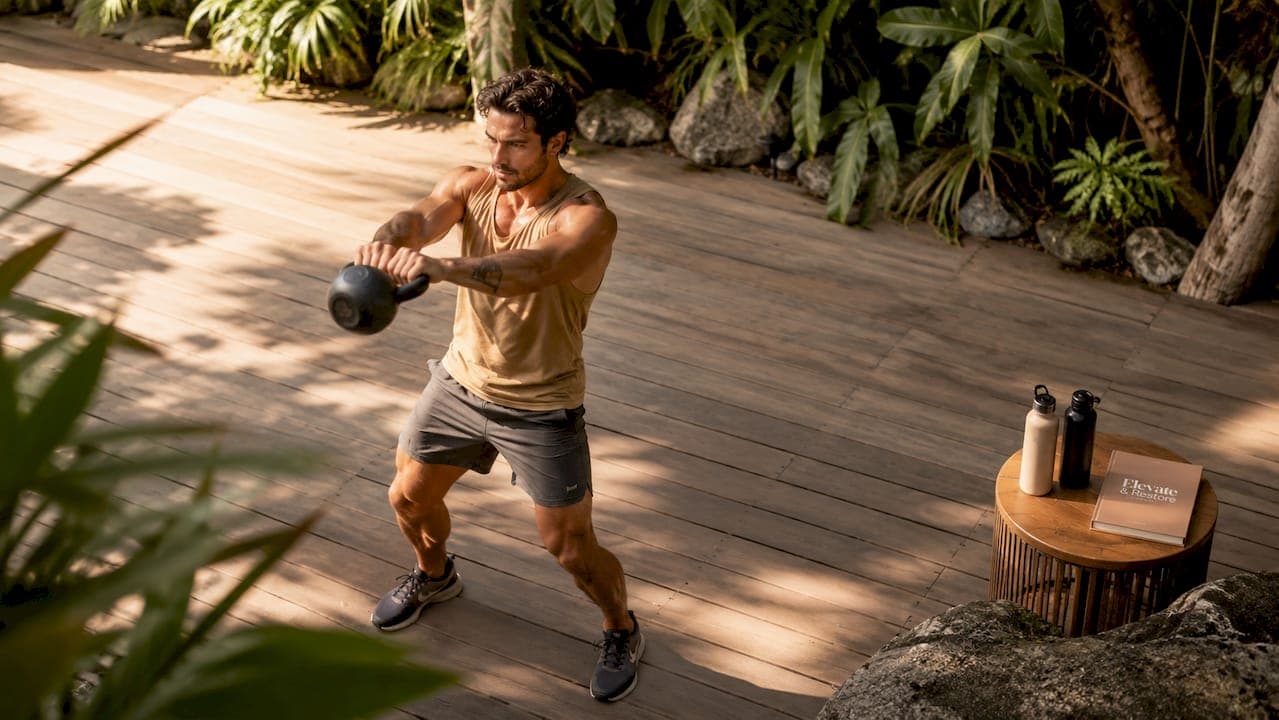
- Kettlebell swings: A hinge-pattern power exercise that builds posterior chain strength and cardiovascular capacity simultaneously. Use a load that challenges you for 10–15 reps with full hip extension.
- Barbell deadlifts: The most direct path to total-body strength. Heavy compound lifts like deadlifts transfer directly to real-world activities and produce the greatest hormonal response for strength adaptation.
- Dumbbell thrusters: A squat-to-press combination that trains the full kinetic chain. Ideal for building strength and conditioning in a single movement.
- Suspension trainer rows: Research shows that suspension and free-weight training produce equivalent upper-body functional strength gains over eight weeks. Suspension rows are an excellent option when barbell access is limited.
- Farmer's carries: Load two heavy dumbbells or kettlebells and walk. This single exercise builds grip strength, core stability, and total-body tension in a way no machine can match.
- Barbell overhead press: A push-pattern staple that builds shoulder strength and forces core engagement to stabilise the spine under load.
Research finding: Six weeks of high-intensity functional training performed three times per week produced a 3–6% increase in one-rep maximum shoulder press and measurable improvements in core endurance. That result held regardless of nutritional differences between participants, confirming the training protocol itself drives the gains.
For adults over 30, two to three sessions per week using these movements at challenging loads produces consistent strength progress without excessive recovery demand.
4. How to structure a functional training programme for maximal strength gains
Structure determines whether your training produces results or just fatigue. The core principles are straightforward.
- Progressive overload: Increase load, volume, or movement complexity over time. The ACSM position recommends at least two sessions per week with 2–3 sets per exercise at loads of 80% or more of your one-rep maximum. That threshold is where meaningful strength adaptation begins.
- Block periodisation: Block periodisation effectively builds maximal strength in functional training without compromising conditioning. A six-week block focused on strength, followed by a block emphasising power or endurance, prevents plateaus and keeps adaptation happening.
- Movement pattern balance: Each session should include at least one push, one pull, one hinge or squat, and one carry or rotate. This prevents the imbalances that accumulate when people train only what they enjoy.
- Mobility and core stability: Integrate core stability work and mobility drills into your warm-up, not as an afterthought. Stiff hips and a weak core limit how much load you can safely use in compound movements.
- Frequency and recovery: Two to three sessions per week with 48 hours between sessions gives most adults over 30 enough stimulus and enough recovery. Training more frequently without adequate rest produces diminishing returns.
Pro Tip: Track your loads and reps every session. You cannot apply progressive overload if you cannot remember what you lifted last week. A simple notebook works as well as any app.
The most important variable is consistency. Experts confirm that set structure and equipment type matter far less than showing up regularly with challenging loads and a clear progression plan.
5. Common mistakes and myths that limit your strength gains
Most adults over 30 who plateau in functional training are making one of a small number of predictable errors.
- Myth: Functional training means light weights on unstable surfaces. This is the most damaging misconception in the field. True functional strength comes from heavy, compound, multi-joint movements. Bosu ball squats with a five-kilogram dumbbell do not build meaningful strength.
- Myth: Machines are safer than free weights. Machines isolate muscles and remove the stabilisation demand that makes functional training effective. They have a place in rehabilitation, but they should not dominate a strength programme.
- Mistake: Training fewer than twice a week. One session per week produces maintenance at best. Strength adaptation requires a minimum training frequency to accumulate enough stimulus.
- Mistake: Ignoring movement quality. Adding load to a broken movement pattern accelerates injury, not strength. Assess your squat depth, hinge mechanics, and shoulder mobility before adding weight.
- Mistake: Skipping the rotate and carry patterns. Most adults train push, pull, squat, and hinge reasonably well. Rotate and carry are almost universally neglected, which leaves core strength and stability underdeveloped.
"Functionality in strength training means training your body as a cohesive unit, emphasising movement quality and stability, not just muscle size."
Recognising these errors early saves months of wasted effort. If your programme has not changed in six months and your strength has not improved, the problem is almost certainly one of the above.
6. How to adapt functional strength training for your individual needs after 30
Long-term success in functional training depends on matching your programme to your current capacity, not copying someone else's advanced routine. Here is how to approach that practically.
- Beginners: Start with bodyweight versions of the six movement patterns. Goblet squats, hip hinges with a dowel rod, push-ups, and band-assisted rows build the motor patterns and baseline strength needed before adding load.
- Intermediate adults: Add load progressively and introduce carries and rotational work. RDLs are an excellent hinge variation for adults with limited hamstring mobility. Plank variations build core stability before moving to loaded carries.
- Adults with injury history: Work with a qualified coach to assess movement restrictions before programming. A hip impingement changes how you squat. A shoulder injury changes how you press. Modifications exist for every pattern.
- Recovery integration: Recovery methods like contrast therapy, compression, and adequate sleep are not optional extras after 30. They are part of the programme. Without recovery, progressive overload produces breakdown, not adaptation.
- Listen to your body: Soreness is normal. Sharp joint pain is not. Distinguishing between the two and adjusting accordingly is a skill that protects your long-term training capacity.
The goal is not to train like a 22-year-old. The goal is to build strength that serves your life at 35, 45, and 55. That requires a programme built around your body, not a generic template.
Key takeaways
Functional training strength gains come from consistent progressive overload applied to the six foundational movement patterns across all three planes of motion.
| Point | Details |
|---|---|
| Train at least twice weekly | The ACSM confirms two or more sessions per week at 80%+ of one-rep maximum drives reliable strength gains. |
| Prioritise movement patterns | Structure sessions around squat, hinge, push, pull, rotate, and carry rather than isolated muscle groups. |
| Train all three planes | Include sagittal, frontal, and transverse movements to prevent imbalances and reduce injury risk. |
| Apply progressive overload | Increase load or complexity gradually within natural movement patterns to keep adaptation happening. |
| Recovery is part of the programme | Adequate rest, sleep, and recovery modalities are non-negotiable for adults over 30 seeking consistent gains. |
What I have learned coaching functional strength after 30
The most common thing I see in adults who come to Elevateandrestore after years of gym training is this: they have worked hard, but they have worked in one plane. They can squat and deadlift reasonably well, but ask them to do a lateral lunge or a Pallof press and they fall apart. That gap is where most injuries live.
The research on block periodisation and high-intensity functional training is genuinely exciting, but the practical truth is simpler. The adults who make the best strength gains are not the ones with the most sophisticated programmes. They are the ones who show up twice a week, add a little weight when the last session felt manageable, and do not skip the movements they find uncomfortable.
Progressive overload applied to the six foundational patterns, consistently, over months and years, produces strength that changes how you move through daily life. That is not a complicated idea. The difficulty is in the execution, which is exactly why small-group coaching in a structured environment produces better results than solo training for most people over 30. Accountability and expert eyes on your movement quality are worth more than any programme design tweak.
— Elevate
Functional strength training at Elevateandrestore
Elevateandrestore is a functional training and Pilates studio in West Footscray built specifically for adults who want to train with purpose. Sessions run in small groups of six, which means every participant gets genuine coaching attention, not just a spot in a class.
The gym at Elevateandrestore is programmed around the six foundational movement patterns with progressive overload built into every training block. After your session, the recovery lounge gives you access to sauna, cold plunge, hot tub, and compression boots. That combination of structured training and deliberate recovery is what produces consistent strength gains after 30. Get in touch to book a trial session and see what a properly structured functional programme feels like.
FAQ
What is functional training and how does it build strength?
Functional training builds strength through multi-joint, movement-based exercises that mirror real-world physical demands. It develops force production, neuromuscular coordination, and stability simultaneously, which transfers directly to daily activities and sport.
How often should adults over 30 do functional strength training?
The ACSM recommends at least two sessions per week at challenging loads to produce reliable strength gains. Two to three sessions per week with 48 hours of recovery between them suits most adults over 30.
Is functional training better than traditional weight training for strength?
Functional training and traditional weight training both build strength when progressive overload is applied consistently. Functional training adds the benefit of improved movement quality, multi-planar stability, and injury resilience that isolated machine-based training does not provide.
What are the best functional exercises for adults over 30?
Deadlifts, goblet squats, kettlebell swings, overhead press, farmer's carries, and suspension rows are among the most effective functional gym exercises for adults over 30. Each targets multiple movement patterns and transfers directly to daily life demands.
How long does it take to see strength gains from functional training?
Research shows measurable strength gains from high-intensity functional training in as little as six weeks when training three times per week at adequate intensity. Consistent training over three to six months produces the most significant and lasting improvements.