
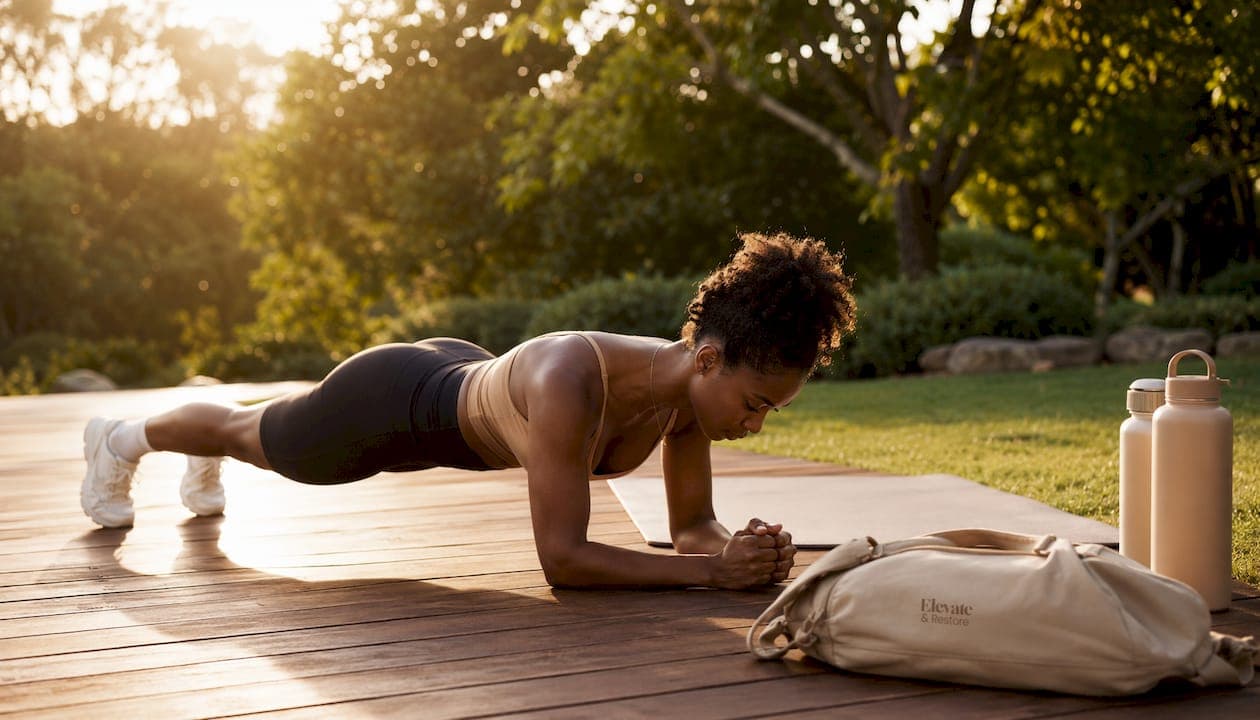
The fastest way to strengthen stabiliser muscles as a lifter is to add a 10-minute activation block before your heavy sets, then programme 2–3 targeted accessory exercises per session using unilateral work, anti-movement drills and slow eccentrics. That prescription works because stabilisers are predominantly slow-twitch fibres that respond to time under tension and progressive complexity, not to heavy overload.
Start here:
- Add a 10-minute activation warm-up before every heavy session (banded clamshells, dead bugs, band pull-aparts).
- Programme 2–3 stabiliser-focused accessory exercises per session, 2–3 times per week.
- Prioritise unilateral movements, isometric holds and slow eccentrics over bilateral machine work.
- Progress complexity first (harder positions, reduced base of support), then add small resistance increments.
Table of Contents
- What are stabiliser muscles, and why should lifters care?
- Why stabiliser strength directly affects your lifts
- How do you know if your stabilisers are weak?
- Training principles that actually work for stabilisers
- The exercise library: region by region
- A two-week sample programme for lifters
- Common mistakes and how to fix them fast
- How Elevateandrestore implements stabiliser training for lifters
- Key takeaways
- The case for putting stabilisers first
- Guided stabiliser training at Elevateandrestore
- Useful sources
What are stabiliser muscles, and why should lifters care?
Stabiliser muscles are not the muscles doing the heavy lifting. They are the ones keeping your joints in the right position so your prime movers can do their job. Split them into two groups: local stabilisers sit close to the joint and control fine movement and joint compression (transverse abdominis, multifidus, rotator cuff); global stabilisers span larger segments and manage load transfer between regions (gluteus medius, serratus anterior, ankle stabilisers).
The named examples that matter most for lifters:
- Rotator cuff (supraspinatus, infraspinatus, teres minor, subscapularis): centres the humeral head during pressing and pulling.
- Serratus anterior: keeps the scapula pinned to the ribcage; critical for overhead and bench press.
- Transverse abdominis and multifidus: the deep core duo that creates intra-abdominal pressure and spinal stiffness under load.
- Gluteus medius: controls hip and knee alignment in every single-leg phase of a squat, deadlift or lunge.
- Ankle stabilisers (peroneals, tibialis posterior): maintain the base of support during squats and carries.
Because these muscles are largely slow-twitch, they fatigue differently to your quads or lats. They are built for endurance and control, not peak torque. That distinction shapes every programming decision in this guide.
Why stabiliser strength directly affects your lifts
Stabilisers create the stiffness that lets prime movers transfer force efficiently. Without that stiffness, energy leaks at every joint, and the bar slows down or your technique breaks down before your prime movers are anywhere near their limit.
The connection shows up clearly in common lifting faults:
- Hip hike on the deadlift: weak quadratus lumborum and gluteus medius let the pelvis tilt laterally as the bar leaves the floor.
- Shoulder sag on the bench press: insufficient serratus anterior control lets the scapula wing, reducing the stable base the pec needs to push from.
- Valgus knee collapse in the squat: gluteus medius fatigue allows the femur to internally rotate under load, a pattern that loads the ACL and medial knee.
Research on core stability and injury prevention consistently shows that limits in stabilisation training can impede performance and may ultimately lead to injury or pain. For lifters, that means a plateau that feels like a strength problem is often a stability problem in disguise.
Short targeted stabiliser blocks support heavier compound training rather than competing with it. Think of them as the maintenance work that keeps the machine running at higher outputs.
How do you know if your stabilisers are weak?
The most reliable signs appear under load, not in isolation. Watch for form breakdown as intensity climbs, visible asymmetry between sides, nagging joint aches that persist between sessions, and a wobble or shift that was not there at lighter weights. Uncontrolled movement patterns and inability to maintain form as intensity increases are the clearest indicators of stabiliser deficits.
Four quick field tests you can run in the gym:
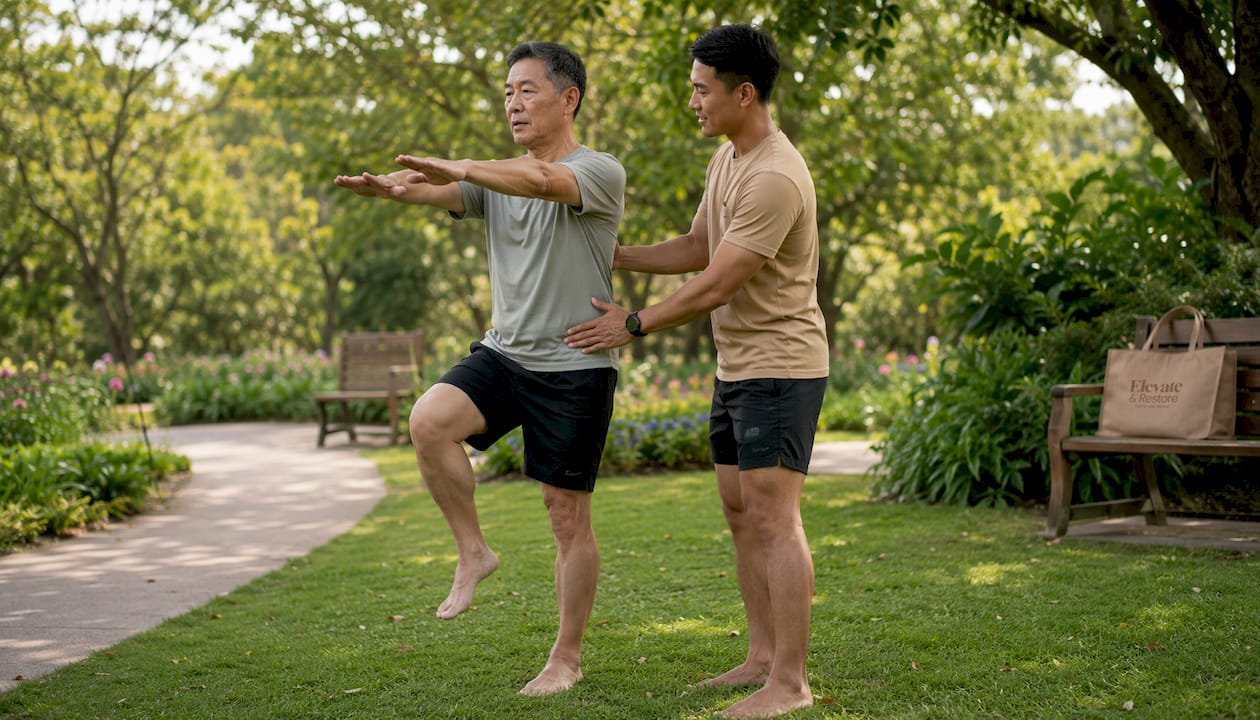
- Single-leg stance with reach: stand on one leg and reach the opposite foot forward, sideways and back. A hip drop, trunk lean or ankle roll points to gluteus medius or ankle stabiliser weakness.
- Single-arm press stability test: perform a single-arm dumbbell press on a flat bench. Excessive trunk rotation or shoulder elevation signals serratus and rotator cuff gaps.
- Pallof hold timed test: set a cable at chest height, step sideways and hold the handle at your sternum for 30 seconds each side. Shaking, rotation or a shortened hold time on one side flags a core anti-rotation deficit.
- Overhead squat observation: hold a dowel overhead and squat to depth. Forward lean, arm drop, heel rise or knee cave each point to a different stabiliser chain.
A failed test is useful data, not a diagnosis. If you find a marked asymmetry or any sharp joint pain during these tests, get a physiotherapist to assess before loading those patterns further. Persistent aches that do not settle within 48 hours after training also warrant professional input.
For a broader look at common training imbalances and how to address them systematically, that resource covers corrective strategies in detail.
Training principles that actually work for stabilisers
Lead with the rule: train stabilisers for control and endurance, not maximal force. That means higher reps, slower tempo and progressive complexity. Heavy overload is for your prime movers.
The progression pyramid
Move through these phases in order. Rushing ahead before control is established is the single most common programming error.
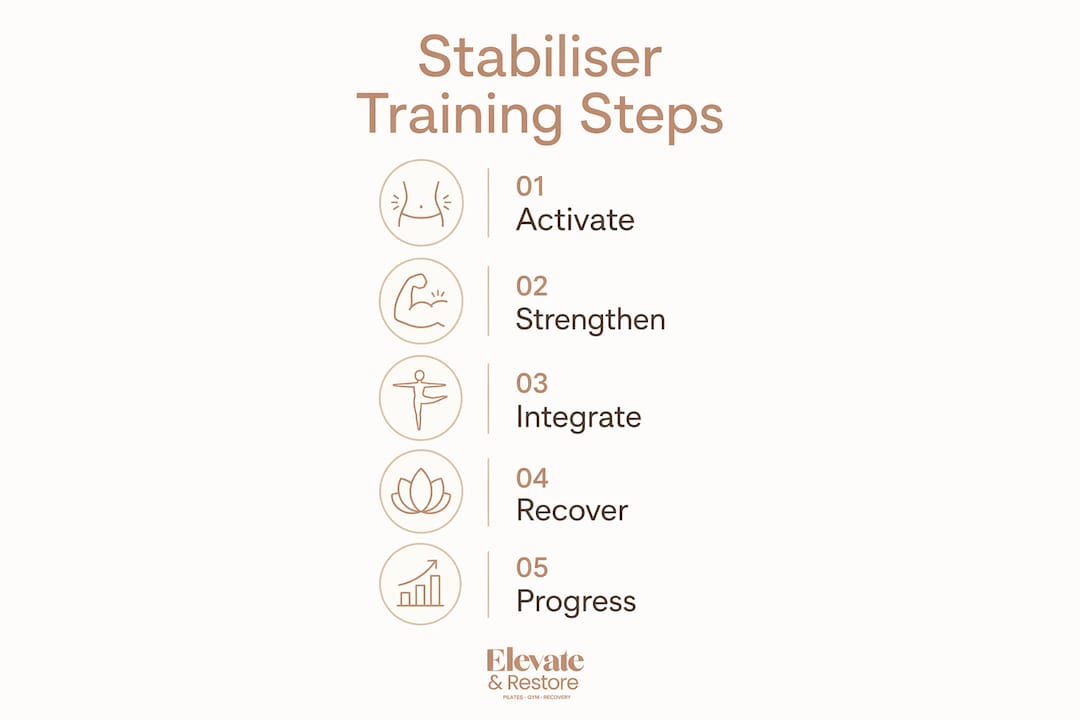
- Activation: low-load, high-rep, bodyweight or band-resisted. Goal is motor recruitment, not fatigue.
- Isometric holds: timed holds under tension (planks, Pallof holds, wall sits). Builds endurance in the stabilising position.
- Slow eccentrics: 3–5 second lowering phases on unilateral exercises. Slow eccentric lowering maximises time under tension for stabiliser fibres.
- Unilateral loaded variations: single-leg RDLs, single-arm rows, split squats with a pause.
- Integrated carry and compound transfer: farmer's carries, suitcase carries, asymmetrically loaded compound lifts.
Sets, reps and tempo by phase
| Phase | Sets | Reps / Hold | Tempo (ecc–iso–con) | Load |
|---|---|---|---|---|
| Activation | 2–3 | 12–20 | 2–0–2 | Bodyweight / light band |
| Isometric hold | 2–3 | 20–45 sec hold | Sustained | Bodyweight / light load |
| Strength-endurance | 3–4 | 10–15 | 3–1–2 | Light to moderate |
| Transfer / loaded unilateral | 3–4 | 8–12 | 3–2–1 | Moderate; small increments |
Frequency and recovery
Short focused stabiliser blocks of 10–30 minutes, two to three times per week, are sufficient for strength athletes. Research points to a sweet spot around 3–5 sessions per week for dedicated stabiliser programmes; beyond five sessions weekly, the returns diminish rapidly. Place activation work before your heavy compound sets, not after, so the stabilisers are primed rather than pre-fatigued.
Stabilisers recover differently to prime movers. Because they are slow-twitch dominant, they tolerate higher frequency but are sensitive to accumulated fatigue from heavy compound sessions. Monitor soreness in the shoulder girdle and hip abductors specifically; if either is still aching 48 hours after a session, reduce volume before adding complexity. For practical recovery strategies that complement stabiliser work, that guide covers post-session management in detail.
Rotator cuff note: progress shoulder stabiliser loading in very small increments at a time, with a practical ceiling for most isolation drills. Rapid load jumps are the primary cause of rotator cuff irritation in lifters.
The exercise library: region by region
Shoulders and rotator cuff
Band external rotation (side-lying or standing) Target: infraspinatus, teres minor. Progression: bodyweight side-lying → light band standing → cable with slow eccentric → prone dumbbell at 90°. Sets/reps/tempo: 3 × 15–20, 2–0–2. Cue: lead the movement from the back of the shoulder, not the elbow. Red flag: sharp anterior shoulder pain — stop and assess.
Prone Y-T-W raises Target: lower trapezius, serratus anterior, posterior rotator cuff. Progression: bodyweight prone → incline bench → light plate (0.5–1 kg). Sets/reps/tempo: 3 × 10–12 each position, 2–1–2. Cue: keep the neck long; the movement comes from the shoulder blades, not the neck.
Scapular stabilisers and serratus anterior
Wall push-up plus (serratus punch) Target: serratus anterior. Progression: wall → incline → floor push-up plus → loaded cable punch. Sets/reps/tempo: 3 × 12–15, 2–1–2. Cue: at the top of the push-up, push the floor away and let the shoulder blades spread around the ribcage. Red flag: visible scapular winging that does not reduce with cueing.
Band pull-apart Target: posterior deltoid, mid-trapezius, rhomboids. Progression: light band → medium band → cable face pull. Sets/reps/tempo: 3 × 15–20, 2–0–2. Cue: finish with the thumbs pointing back, not just the arms wide.
Deep core and anti-movement
Anti-movement core drills are the most direct way to train the transverse abdominis and multifidus for lifting. Crunches do not replicate the demands of a deadlift or squat; a Pallof press does.
- Dead bug: 3 × 8–10 per side, 3-second lowering. Opposite arm and leg extend slowly while the lower back stays flat. Progress by adding a light dumbbell to the extended arm.
- Bird dog: 3 × 10 per side, 2-second hold at extension. For beginners, bird dog, dead bug and glute bridge give maximum benefit with low injury risk.
- Pallof press: 3 × 10–12 per side, 2–1–2 tempo. Cable or band anchored at chest height; press straight out and resist rotation. Progress by stepping further from the anchor or kneeling.
- Side plank with hip abduction: 3 × 30–45 sec hold or 10 controlled reps. Adds gluteus medius demand to the lateral core.
Red flag: any lumbar flexion or breath holding during anti-movement drills signals a load or complexity that exceeds current control.
Lateral hip and gluteus medius
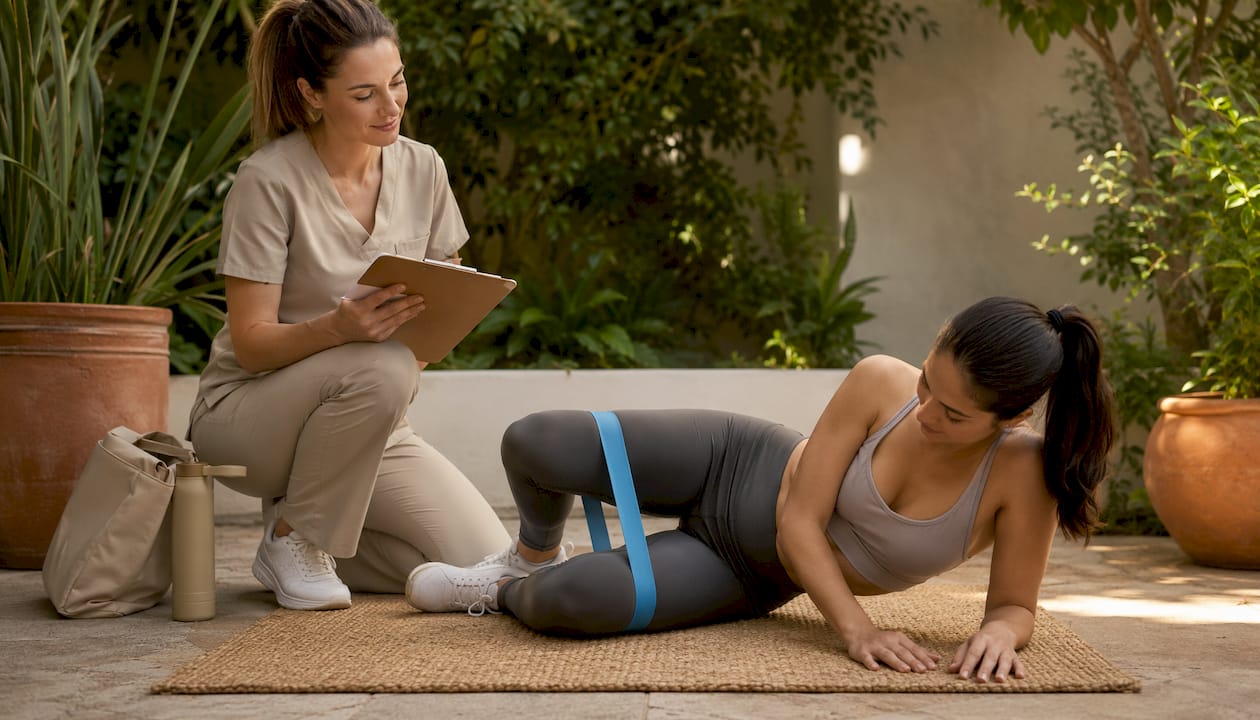
Banded clamshell Progression: no band → light band → side-lying hip abduction with ankle weight → lateral band walk. Sets/reps/tempo: 3 × 15–20, 2–1–2. Cue: keep the pelvis stacked; the top hip should not roll back.
Single-leg Romanian deadlift (RDL) Unilateral exercises like single-leg RDLs force stabilisers to maintain balance and resist uneven loads. Progression: bodyweight → single dumbbell ipsilateral → single dumbbell contralateral → barbell. Sets/reps/tempo: 3 × 8–10 per side, 3–1–1. Cue: the hip of the standing leg drives back; the torso and floating leg move as one unit.
Ankle stabilisers and integrated carries
Single-leg balance with perturbation: stand on one leg on a firm surface; have a partner or band add light perturbations. 3 × 30 sec per side. Progress to eyes closed or a slight foam pad.
Suitcase carry: free-weight unilateral carries recruit significantly more stabiliser activity than machine equivalents. Load one side only with a kettlebell or dumbbell; walk 20–30 metres. 3–4 sets. Cue: resist the lean — stay tall.
Farmer's carry: bilateral loaded carry for integrated trunk and shoulder girdle stiffness. 3–4 × 20–30 metres. Progress load gradually; the grip and shoulder girdle are the limiting factors, not the legs.
Home/minimal equipment alternatives: replace cables with resistance bands for Pallof press and pull-aparts; use a single dumbbell for RDLs and suitcase carries; bodyweight dead bugs and bird dogs need no equipment at all.
A two-week sample programme for lifters
The short answer on placement: activation blocks go before heavy compound sets; longer stabiliser accessory sessions replace one lower-priority accessory slot on main training days. One dedicated 20–30 minute stabiliser session per week fills the gaps.
| Day | Session type | Stabiliser work |
|---|---|---|
| Monday | Heavy lower (squat focus) | 10-min activation: banded clamshells 3×15, dead bug 3×8/side, single-leg balance 2×30 sec |
| Tuesday | Heavy upper (press focus) | 10-min activation: band pull-aparts 3×15, serratus punch 3×12, Pallof hold 2×20 sec/side |
| Wednesday | Rest or light cardio | Optional: 20-min stabiliser session (Y-T-W, side plank, bird dog, suitcase carry) |
| Thursday | Heavy lower (deadlift focus) | 10-min activation: banded clamshells 3×15, single-leg RDL bodyweight 3×8/side |
| Friday | Heavy upper (pull focus) | 10-min activation: band external rotation 3×15, prone Y-T-W 3×10 |
| Saturday | Accessory / conditioning | 15-min stabiliser block: Pallof press 3×10/side, single-arm DB press 3×10/side, farmer's carry 3×20 m |
| Sunday | Full rest | Recovery: sauna, compression, mobility |
| Monday | Heavy lower | Same activation; increase clamshell band resistance one level; add 1-sec hold at top of dead bug |
| Tuesday | Heavy upper | Same activation; move Pallof hold to Pallof press (dynamic); add 0.5 kg to Y-T-W |
| Wednesday | Rest or light cardio | 20-min stabiliser session: progress to unilateral loaded RDL (light dumbbell), side plank with hip abduction |
| Thursday | Heavy lower | Add contralateral dumbbell to single-leg RDL; 3×8/side at 3–1–1 tempo |
| Friday | Heavy upper | Add light cable to external rotation; maintain 15–20 reps |
| Saturday | Accessory / conditioning | Increase suitcase carry load by 2–4 kg; add eyes-closed single-leg balance 2×20 sec |
| Sunday | Full rest | Recovery |
Pressed for time? A 10-minute activation block before every session, three days per week, covers the minimum effective dose. Pick one exercise per region (hip, core, shoulder) and rotate them across the week.
Common mistakes and how to fix them fast
The most frequent error lifters make is treating stabiliser work like prime-mover training: too heavy, too explosive, and not enough attention to what is actually working. Here is what that looks like in practice, and how to correct it.
Mistakes to stop making:
- Loading too heavy too soon, particularly on rotator cuff drills, where a jump of even 2 kg can shift the work from the small stabilisers to the deltoid.
- Overusing unstable surfaces. BOSU and wobble boards can reduce force production transfer to main lifts if overused; use them sparingly as a warm-up tool, not as the centrepiece of a session.
- Skipping unilateral work because it feels awkward. That awkwardness is the stabiliser deficit showing itself.
- Treating stabiliser sessions as an afterthought, bolted on at the end of a session when fatigue is highest.
Coaching cues that work immediately:
- Brace before you move: draw the navel in slightly and tighten the obliques before any anti-movement drill begins.
- Scapula first: on any pressing or pulling movement, set the shoulder blades down and back before the arm moves.
- Knee over second toe: on single-leg work, track the knee over the second toe from the start of the movement, not as a correction after the collapse happens.
- Slow the lowering: if you cannot control a 3-second eccentric, the load is too heavy.
Pro Tip: To check whether you are genuinely loading the stabiliser rather than the prime mover, reduce the weight by 30–40% and slow the eccentric to 4 seconds. If the target area suddenly works much harder, you were compensating with the prime mover at the heavier load.
Red flags requiring a programme reset or professional assessment: sharp joint pain (not muscle burn) during any drill; a persistent asymmetry that does not improve after four weeks of targeted work; any neurological symptom (tingling, numbness) during shoulder or core exercises.
How Elevateandrestore implements stabiliser training for lifters
At Elevateandrestore, stabiliser work is built into every session from the first warm-up, not added as an optional extra. The small-group format, capped at six people per session, means the coach can watch every rep and catch the subtle compensations that a larger class would miss entirely.
A typical lifter's session starts with a 10-minute movement assessment and activation block: banded hip work, serratus activation and a timed Pallof hold. That data informs which exercises are prescribed for the accessory block. Progressions are tracked by hold time, movement quality and the ability to maintain position under increasing complexity, not just by how much weight is on the bar.
The studio pairs this with its reformer Pilates programme, which is particularly effective for building serratus anterior control, deep core endurance and hip stabiliser strength in a low-load, high-tension environment. For lifters who want to add Pilates to their lifting programme without disrupting their strength schedule, the studio's approach integrates both without compromising either.
Recovery is treated as part of the training plan. The recovery lounge includes sauna, cold plunge, hot tub and compression boots, all of which support the faster turnover that stabiliser-dense sessions require. Slow-twitch fibres accumulate fatigue differently; deliberate recovery accelerates the adaptation.
Key takeaways
Stabiliser training works when it is progressive, frequent and placed before heavy compound work, not after it.
| Point | Details |
|---|---|
| Train for control, not load | Use higher reps (8–20), slow eccentrics and isometric holds rather than heavy overload for stabiliser muscles. |
| Frequency sweet spot | Two to three short sessions (10–30 minutes) per week is sufficient; beyond five sessions weekly, returns diminish. |
| Unilateral work is non-negotiable | Single-leg RDLs, single-arm presses and suitcase carries recruit stabilisers in ways bilateral machine work cannot replicate. |
| Progress complexity before load | Master movement quality and hold times first; only then add small resistance increments, especially for rotator cuff drills. |
| Elevateandrestore | Small-group sessions (six maximum) pair assessment-driven stabiliser programming with reformer Pilates and a full recovery lounge for lifters. |
The case for putting stabilisers first
Most lifters treat stabiliser work as the boring stuff they will get to eventually. The pattern is consistent: a lifter hits a plateau on their squat or press, adds more volume to the prime movers, and wonders why the number does not move. The actual bottleneck is almost always a stabiliser chain that has not kept pace with the prime-mover strength gains.
What gets overlooked is that stabiliser training is not remedial work for injured people. It is the infrastructure that lets you express the strength you already have. A lifter with a strong gluteus medius will squat more than a lifter with a stronger quad but a collapsing hip, because the force actually reaches the bar. The neuromuscular control built through slow eccentrics, isometrics and mind-muscle focus is more durable and more transferable than anything built through novelty tools or high-intensity instability drills.
The other thing practitioners consistently underestimate is how quickly stabiliser deficits show up as injury rather than performance loss. The shoulder that aches after bench pressing, the knee that tracks inward on every squat rep, the lower back that tightens on deadlift day: these are stabiliser problems presenting as pain. Addressing them directly, with the right exercises at the right intensity, resolves them faster than rest alone.
If your form is breaking down before your prime movers are fatigued, start the 10-minute activation protocol today and add one unilateral exercise per region per session. Give it four weeks before judging the result.
Guided stabiliser training at Elevateandrestore
Knowing the exercises is one thing. Having a coach watch your Pallof hold and tell you that your left hip is drifting before you feel it is something else entirely.
Elevateandrestore runs small-group functional training and Pilates sessions, capped at six people, so every lifter gets the coaching attention that stabiliser work actually requires. Your first session includes a movement assessment that identifies which stabiliser chains are limiting your lifts, followed by a tailored programme that progresses week by week. The reformer Pilates classes are particularly effective for building the deep core and shoulder girdle control that transfers directly to heavier compound lifts. After your session, the recovery lounge is there: sauna, cold plunge, hot tub and compression boots, all under one roof.
Book your assessment at Elevateandrestore and find out exactly where your stabiliser gaps are.
Useful sources
- How to Strengthen Stabilizer Muscles for Injury Prevention — covers training frequency, rotator cuff progression increments and identifying stabiliser weakness through movement patterns.
- 4 Effective Ways to Strengthen Your Stabilizer Muscles — practical guidance on unilateral training, slow eccentrics and time under tension for stabiliser fibres.
- Core Stability Exercises: Targeting Progressive Core Training (NASM) — NASM's OPT model applied to core stabilisation, including anti-rotation exercises and progression logic.
- Ab Training for Powerlifters (Powerlifting.com) — explains the stiffness and force-transfer role of stabilisers in the context of heavy compound lifting.
- Stabilizer Muscles: What They Are and How to Train Them (Marathon Handbook) — emphasises neuromuscular control, slow deliberate tension and why consistency beats novelty tools.
- How to Train Your Stabiliser Muscles for Increased Performance (Fitness Volt) — covers the risks of overusing unstable surfaces and how to integrate stabiliser work as accessory training.
- How to Train Your Stabiliser Muscles for Strength (Biology Insights) — free-weight versus machine stabiliser activation data and practical progression rules.
- PubMed: Core Stability Research — peer-reviewed research on core stabilisation and its relationship to injury prevention and performance.
- Elevateandrestore: Reformer Pilates — studio page describing how reformer Pilates supports stabiliser control and movement quality for lifters.
- Elevateandrestore: Recovery Lounge — details the sauna, cold plunge, hot tub and compression boot services that support stabiliser training recovery.
This article is general information for educational purposes. If you are experiencing joint pain, persistent asymmetry or any neurological symptoms, consult a physiotherapist or sports medicine professional before modifying your training.