
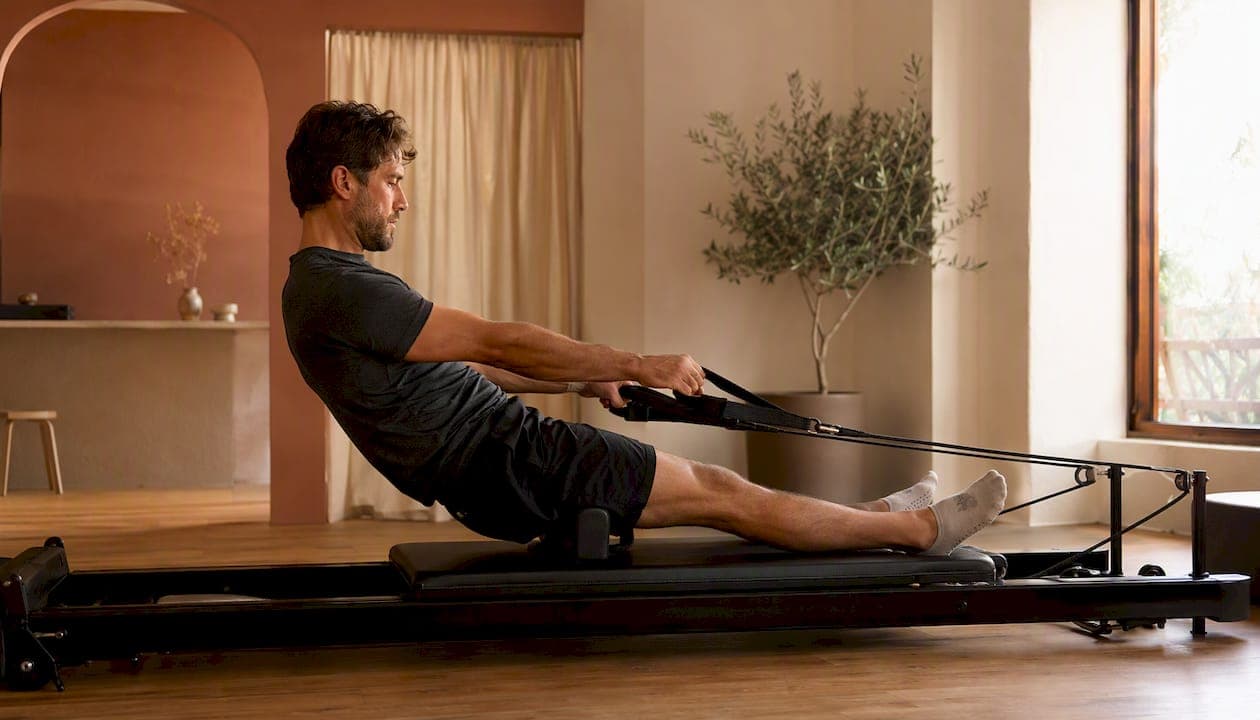
Yes, reformer Pilates is worth doing. It builds deep core strength, improves hip and thoracic mobility, and closes the gaps that heavy lifting leaves behind, and it does this faster than most men expect. Regular sessions over several weeks can produce measurable gains in hamstring flexibility and muscular endurance, according to a review reported by Healthline. That's not a marketing line. It's the kind of timeframe worth planning around if you're serious about seeing a change rather than just trying a class once and forgetting about it.
Here's the part that matters for your first move: don't overthink it.
- If you're coordinated and want feedback fast: book two private sessions to learn the machine before joining a group.
- If you're comfortable learning alongside others: book a beginner small-group reformer class and let the instructor correct your form in real time.
- Either way: commit to at least three sessions before judging whether it's for you. One class tells you almost nothing.
Quick fact: Practitioners report that many clients notice improved body awareness by their tenth session, with visible physical changes showing up around the three-week mark for those training consistently, per InsideHook.
Elevate and Restore runs small-group reformer classes capped at six people, which means you're not lost in a room of twenty and the instructor actually sees what your hips are doing on the carriage. For a lot of men, that's the difference between wasting six months and getting a return on the first month.
Key Takeaways
Reformer Pilates works for men because it trains the deep stabilisers, mobility, and movement control that heavy lifting alone never reaches.
| Point | Details |
|---|---|
| Verdict | Reformer Pilates is worth it for men seeking core strength, mobility, and injury prevention alongside lifting. |
| Top benefit: core control | Deep stabiliser training corrects imbalances that repetitive strength work creates. |
| Top benefit: mobility | Hip and thoracic mobility work directly counters desk posture and tight hip flexors. |
| Starter-plan timeline | An 8-week plan of 2–3 sessions weekly builds visible change, with many noticing shifts by session ten. |
| Recommended next step | Book a beginner class or two private sessions at Elevate and Restore to start. |
Table of Contents
- Is reformer Pilates good for men? The physical case
- What happens in your first reformer Pilates class?
- How often should men train and which class type fits?
- Can reformer Pilates actually build muscle?
- What mistakes do beginner men make on the reformer?
- An 8-week reformer Pilates plan for men starting out
- Ready to try reformer Pilates? Here's how to start
- Sources
Is reformer Pilates good for men? The physical case
Short answer: it targets exactly what most men's training ignores. Lifting builds the muscles you can see in a mirror. It rarely trains the deep stabilisers that keep your spine and hips doing their job when you're not thinking about it, and that's precisely where reformer Pilates operates.
The reformer uses a sliding carriage and adjustable springs to load your body in positions a barbell simply can't reach, including single-leg work, rotational control, and slow eccentric loading through the hips and shoulders. This is a resistance-based system built around control, breath, and precision rather than moving maximum weight, notes InsideHook. That distinction is why it complements a lifting program instead of duplicating it.
Four benefits show up consistently for men who stick with it:
- Deep core strength — not just visible abs, but the transverse abdominis and pelvic floor muscles that stabilise your spine under load.
- Hip and thoracic mobility — reformer positions stretch the hip flexors and open the upper back most desk-bound men have let go stiff.
- Muscular endurance — high-rep, low-load work builds staying power in muscles that fatigue fast under repetitive strength training.
- Better movement symmetry — unilateral exercises expose and correct left-right imbalances that heavy lifting tends to mask.
If you spend your week hunched at a desk or grinding through bench press and squats, you likely have an overdeveloped front-of-body, tight hip flexors, and rounded shoulders. Reformer work directly counters all three. The same 12-week protocol that improved hamstring flexibility also built abdominal and upper-body endurance, giving you a concrete before-and-after benchmark rather than a vague promise.
Pro Tip: Track one simple marker, like how long you can hold a forearm plank on the reformer footbar with control, and retest it every two weeks. It's a better progress signal than how sore you feel.
What happens in your first reformer Pilates class?
The reformer looks intimidating the first time you see it: a long carriage on rails, a set of colour-coded springs, straps for your hands and feet, and a footbar you'll push against constantly. It's simpler than it looks. The springs adjust resistance, the carriage slides on the rails, and the straps let you work your arms and legs independently while your torso stays braced.
A typical beginner class follows a predictable shape:
- Warm-up (5 to 10 minutes): breathing drills and gentle spinal articulation to wake up the muscles you'll use.
- Foundational exercises (20 to 25 minutes): footwork on the carriage, bridging, and basic core sequences using lighter spring loads.
- Progression (10 to 15 minutes): more complex full-body moves once you've got the coordination down.
- Cool-down (5 minutes): stretching using the straps and reformer's range of motion.
Expect your legs and deep core to shake in ways heavy squats never triggered. That's normal. It's your stabilisers firing under a type of load they're not used to, and the shaking usually settles within a few sessions as your nervous system adapts.
Breath matters more than you'd think. Instructors will cue you to exhale on the effort phase of a move, which sounds trivial until you realise how much tension you've been holding in your shoulders and jaw without noticing. Wear fitted athletic clothing (nothing baggy that catches on the carriage), grip socks if the studio requires them, and arrive 10 minutes early on your first visit so the instructor can walk you through the machine before class starts.
How often should men train and which class type fits?
Deciding between private tuition and small-group classes comes down to how fast you want to learn the machine versus how much you're willing to spend per session.
Choose private sessions if:
- You're brand new to Pilates and want to learn the equipment without holding up a group.
- You're returning from an injury and need modifications tailored to you.
- You want to fast-track your form before joining a class.
Choose small-group classes if:
- You're reasonably coordinated and comfortable following instructor cues alongside others.
- You want the energy and accountability of training with people at a similar level.
- Budget matters and you want more sessions for your money.
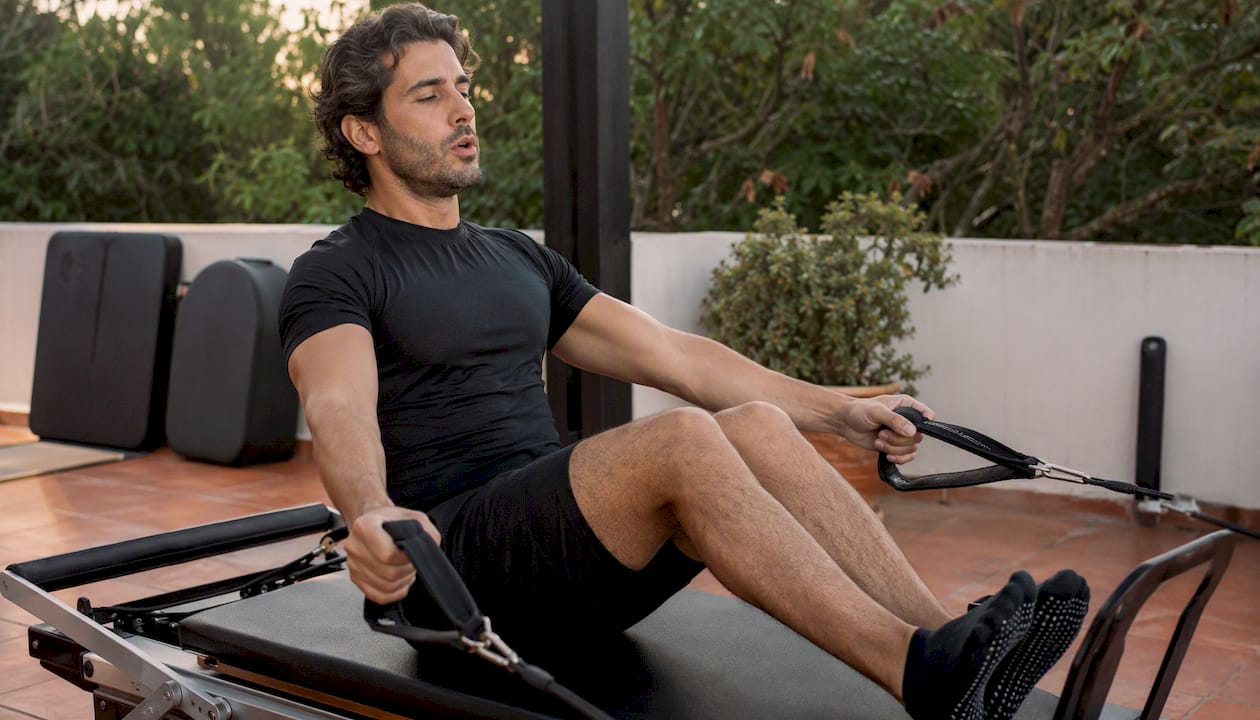
Coaches commonly recommend three classes a week for the first month as the sweet spot for building familiarity and motor control fast, according to InsideHook. After that, most men settle into a maintenance rhythm.
Progression should be gradual: add one spring of resistance at a time, extend hold times before adding new exercises, and let your instructor bump you up rather than pushing yourself into advanced moves too early. If you're also lifting, keep reformer sessions on separate days from heavy leg or back work so you're not stacking fatigue on the same stabilisers twice.
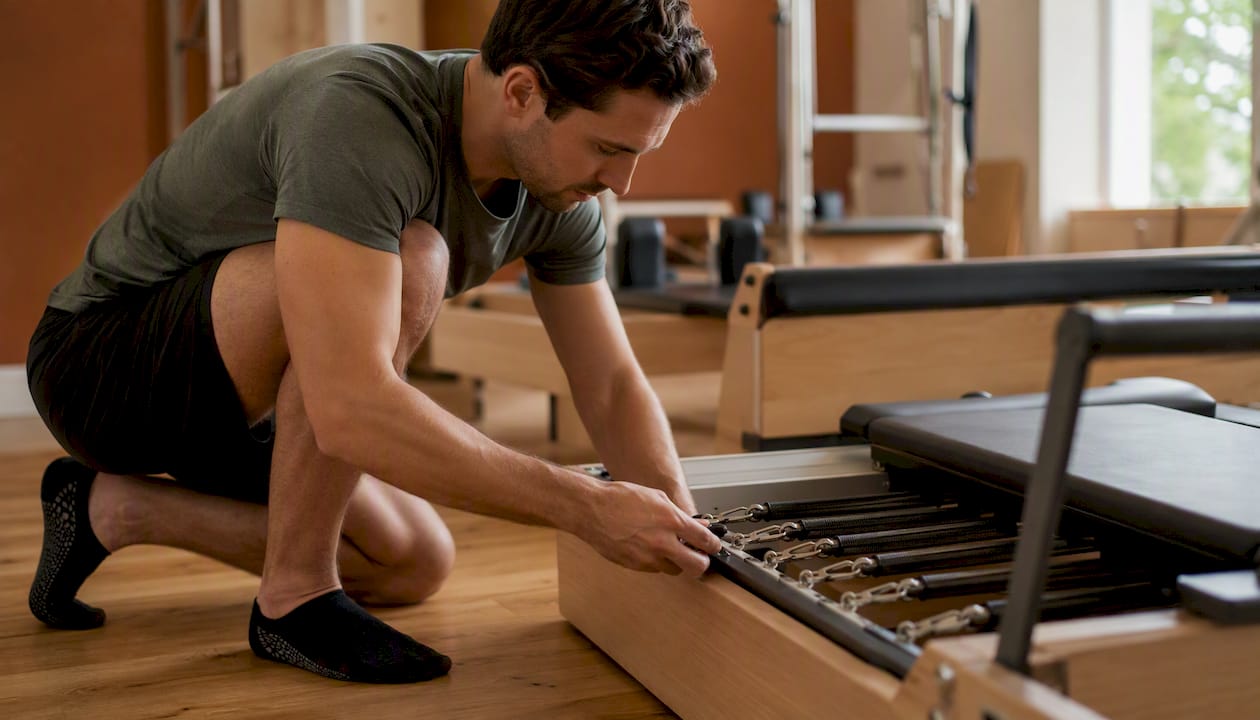
On attire: wear socks with grip on the sole (most studios sell or supply them), fitted shorts or leggings that won't snag on the carriage strap, and skip the loose singlet that flops into your face during overhead moves.
Pro Tip: If you're sore from a heavy squat session the day before, tell your instructor. They'll adjust your reformer program so you're not loading the same stabilisers twice in 24 hours.
Can reformer Pilates actually build muscle?
Not in the way a barbell back squat does, and it's worth being upfront about that. Reformer Pilates does not match high-volume, heavy-load training for pure muscle size, but it significantly improves muscular endurance, motor control, and joint integrity, positioning it as a complement to strength training rather than a replacement, according to NordicTrack. If your goal is bigger arms, the reformer isn't your tool.
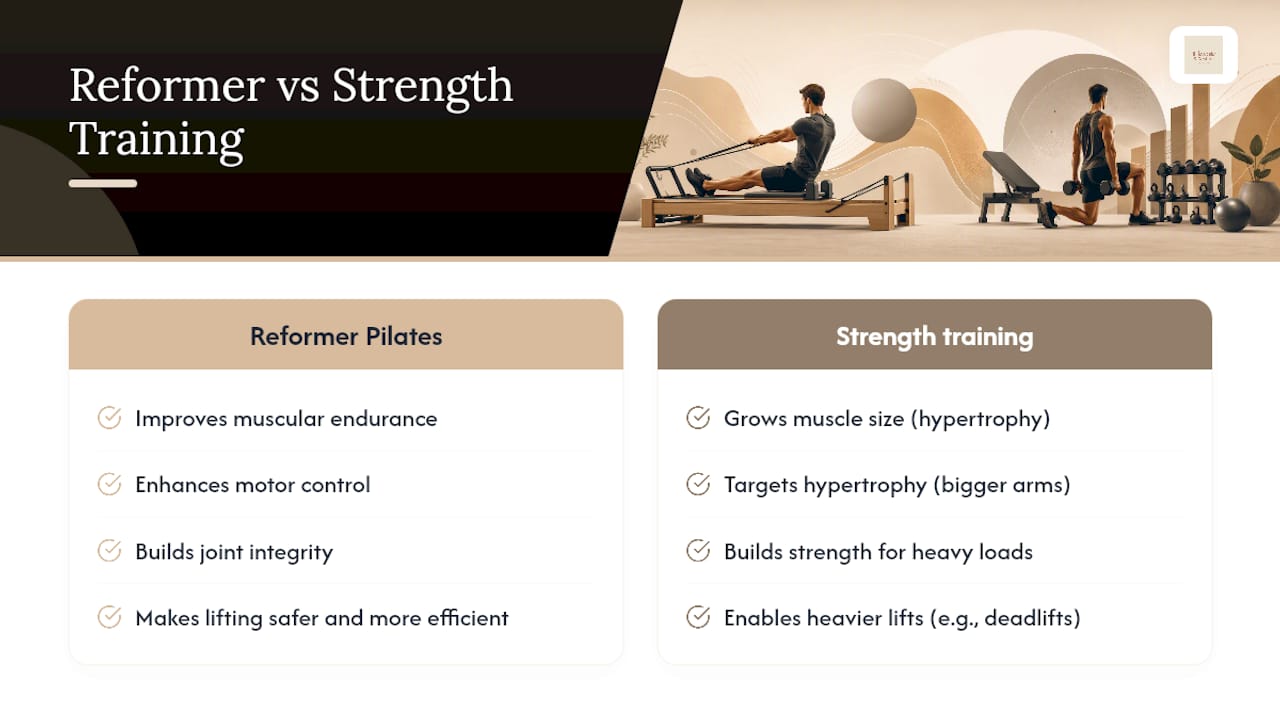
What it does deliver is a foundation that makes your lifting safer and more efficient. Better spinal bracing means heavier deadlifts without the lower back doing damage control. Improved hip stability means your squat depth doesn't collapse inward on the last rep. These aren't hypothetical; they're the direct outcome of training the same muscles that hold your form together under load.
A realistic weekly split for a man already lifting might look like two reformer sessions and two to three strength sessions, spaced so the reformer work falls on lighter training days or acts as active recovery. This mirrors how athletes increasingly use reformer Pilates to correct imbalances and support recovery rather than as a stand-alone replacement for sport-specific training. If you want a deeper look at pairing the two, Elevate and Restore's guide to increasing strength through Pilates breaks down programming in more detail.
What mistakes do beginner men make on the reformer?
The most common error is rushing. Men used to grinding through sets tend to move fast on the reformer, which defeats the entire point. The exercises are slow and controlled by design, and speeding through them just means the carriage does the work instead of your muscles.
Watch for these habits in your first few weeks:
- Overgripping the straps or footbar with your shoulders instead of your core, which creates neck tension and poor form.
- Holding your breath through the hard part of a movement instead of exhaling on effort.
- Ignoring foot position on the footbar, which throws off your alignment through the whole exercise.
- Skipping the warm-up because it feels too easy, then straining a cold muscle on the first real exercise.
Breathing technique isn't a minor detail here; it changes how much tension you carry and how effectively you brace. Elevate and Restore's guide to breathing techniques for strength training covers this in more depth if you want to get it right from session one.
On safety: sharp joint pain, sudden dizziness, or numbness during any exercise are not things to push through. Stop the movement immediately, tell your instructor, and if the sensation persists after the session, get it checked by a physiotherapist before your next class. A good studio will regress an exercise for you on the spot rather than let you grind through pain, and if a movement consistently causes discomfort, ask for a modification rather than assuming it'll fix itself.
An 8-week reformer Pilates plan for men starting out
This plan assumes you're starting from zero and want a structure that matches the evidence rather than guessing. Clinical reviews on Pilates support gradual, structured progression as the most reliable way to see functional gains, and that's the backbone of this schedule, per findings hosted on PMC and supported by movement-control research published in the Journal of Orthopaedic & Sports Physical Therapy.
- Weeks 1 to 2: Two private sessions in week one to learn the machine, then shift to two small-group classes in week two. Focus entirely on footwork, breath, and basic bracing.
- Weeks 3 to 4: Three sessions a week (the coach-recommended sweet spot). Add intermediate exercises like the hundred and single-leg circles once footwork feels automatic.
- Weeks 5 to 6: Hold at two to three sessions a week. Increase spring resistance on core exercises and extend hold times on stability work.
- Weeks 7 to 8: Two sessions a week, now including full-body sequences and light unilateral loading. This is where most men notice the biggest jump in control and endurance.
Statistic to note: Two 60-minute sessions weekly for 12 weeks produced measurable improvements in hamstring flexibility and abdominal and upper-body endurance, per Healthline. Eight weeks won't match that full 12-week outcome, but it puts you well on the path, with many men noticing gains by session ten regardless of the exact week they land on.
Track progress with simple markers rather than a stopwatch obsession: how steady your carriage is on single-leg footwork, whether your lower back stays neutral through bridging, and how sore you feel the next day compared to week one. If you want a broader look at how Pilates builds injury resilience over time, Elevate and Restore's 2026 guide is worth a read, and for a general overview of the reformer as a beginner, the guide for over 30s covers foundational movements in more detail.
A welcoming word for men trying this for the first time
There's a moment every man hits on the reformer, usually somewhere in the first two or three sessions, where a movement that looked easy exposes a weakness he didn't know he had. Practitioners and studio owners consistently describe this as a "humbling" moment, and Stuff reports it happens to almost everyone who's spent years focused purely on strength numbers. It's not a failure. It's the exact information you need to train smarter.
That's why small groups work better than a packed class for beginners. Six people means an instructor can actually watch your foot position, catch the shoulder creeping up toward your ear, and correct it before it becomes a habit. At Elevate and Restore, that's the whole model: reformer classes capped at six, paired with a recovery hub including an infrared sauna, cold plunge, hot tub, and compression boots, so the muscles you've just worked hard actually get to recover properly instead of staying tight until your next session.
You don't need to be flexible, coordinated, or "a Pilates person" to start. You need to show up, let the shaking happen, and trust that the humbling part fades faster than you'd expect.
Ready to try reformer Pilates? Here's how to start
Elevate and Restore is the local alternative to guessing your way through a generic gym class: small-group reformer sessions capped at six people mean an instructor is actually watching your form, not just running the clock. Pair that with a recovery hub built in, infrared sauna, cold plunge, hot tub, and compression boots, and the muscles you just worked get proper recovery instead of sitting tight until next week.
If you're brand new, the simplest first step is a beginner reformer class or two private sessions to learn the machine before joining a group. Either way, you'll walk in knowing exactly what to expect, because that's what this guide has already covered. Head to the reformer Pilates class page to check session times and book your first spot, and if you want to see what recovery looks like after a session, the recovery lounge is worth a look too. Book your first class this week and give yourself the full eight-week window to feel the difference.
Sources
- Pilates for Men: Benefits, Exercises, and Tips for Getting Started - Healthline
- Pilates for Men: Benefits, How to Start and What to Expect - InsideHook
- JOSPT article (2018) - journal of orthopaedic & sports physical therapy
- Pmc
Elevate and Restore publishes this guide from direct experience running small-group reformer classes for men new to the format; for related reading on building strength and resilience through Pilates, see the studio's guides linked throughout this article.