

Diaphragmatic breathing is your baseline for every lift. Inhale on the eccentric (the lowering phase), exhale on the concentric (the push or pull), and reserve a controlled breath-hold for near-maximal compound work only. Three things to do right now: (1) place your hands on your lower ribs and feel them expand sideways as you inhale, keeping your upper chest still — this is the lateral expansion cue that Cleveland Clinic clinicians use; (2) after your session, run a 4-4-4-4 box breathing cycle for five minutes to shift your nervous system from sympathetic to parasympathetic; (3) if you lose a rhythmic breath mid-set, reduce the load rather than forcing through. At Elevateandrestore, every class opens with diaphragmatic cueing and closes with a guided recovery breathing slot.
Table of Contents
- Why breathing directly affects your strength and stability
- Breathing techniques for strength training: the in-session rules
- Post-workout recovery breathing: the 4-4-4-4 protocol
- Pilates cues and drills that build diaphragmatic breathing for strength
- Common breathing mistakes and when to get help
- Three studio-ready routines you can use straight away
- How to pair breathing with sauna, cold plunge and compression boots
- Key takeaways
- A studio perspective on teaching breath in class
- Elevateandrestore: guided breathing and recovery in one place
- Further reading and key sources
Why breathing directly affects your strength and stability
Breathing controls two things that matter enormously in strength and Pilates work: intra-abdominal pressure (IAP) and autonomic state. IAP is the pressure inside your abdominal cavity that stiffens your spine and transfers force between your lower and upper body. When you breathe and brace correctly, IAP rises and your spine stays stable under load. When you breathe shallowly or hold your breath haphazardly, that pressure leaks and your core loses its anchor.
The autonomic side is equally practical. Heavy training pushes you into sympathetic dominance — elevated heart rate, tight muscles, heightened alertness. Without a deliberate recovery breathing protocol, that state lingers well past your last set, slowing muscle repair and disrupting sleep. Diaphragmatic breathing is the physiological reset button, and it works whether you are in a Pilates reformer class or under a barbell.
Respiratory muscle strength also has a direct performance link. A Frontiers in Physiology study found that professional natural bodybuilders who added six weeks of inspiratory muscle training improved their 1RM compared to a smaller improvement in the control group. The respiratory system is trainable, and the returns show up in the weight room.
Breathing techniques for strength training: the in-session rules
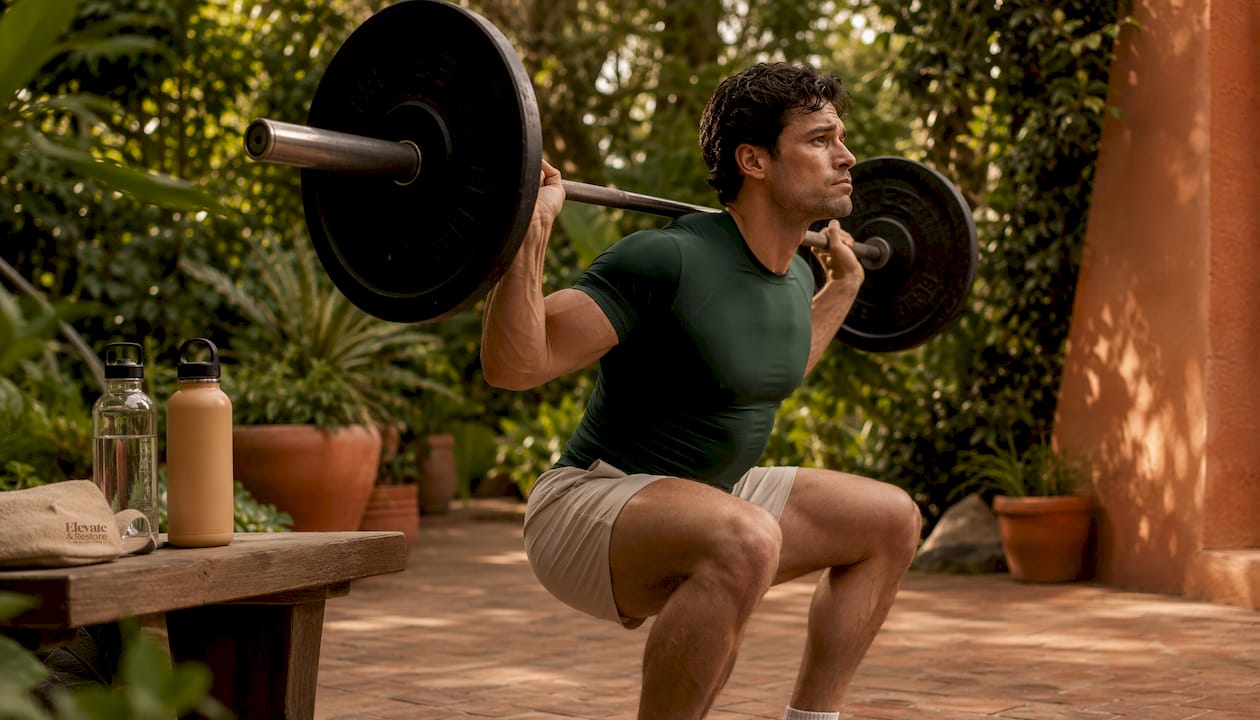
The default rule is straightforward: inhale before or during the eccentric phase, exhale during the concentric. Squat down on the inhale, drive up on the exhale. Lower the bar to your chest on the inhale, press it away on the exhale. This keeps IAP elevated at the right moment and prevents the breath from escaping mid-rep.
The Valsalva manoeuvre changes the equation for heavy compound lifts. You take a deep diaphragmatic breath, brace your entire abdominal wall outward (not sucked in), and hold that pressure through the sticking point of the lift. Research confirms that the Valsalva and pressure-assisted techniques produce shorter sticking-region times during 1RM bench press than other breathing strategies. The trade-off is a transient spike in systolic blood pressure, which is manageable in healthy trained individuals but must be progressed carefully.
| Intensity zone | Breath strategy | Hold duration |
|---|---|---|
| Below 70% 1RM | Inhale eccentric, exhale concentric | No hold |
| Below 70% 1RM | Inhale eccentric, exhale concentric | No hold |
| 70–85% 1RM | Full diaphragmatic brace, short hold | 1–3 seconds through sticking point |
| Above 85% 1RM | Valsalva with full abdominal brace | Hold for entire rep, release at top |
Intensity-zone guidance from PoinT GO supports this three-zone framework. Note that nasal breathing is fine for low-intensity sets but physiologically insufficient above moderate effort — switching to mouth or oronasal breathing at peak intensity is normal, not a technique failure.
Pro Tip: Learn the Valsalva submaximally first. PoinT GO recommends a four-week on-ramp, starting with bodyweight movements before applying the technique to loaded sets. Skipping this progression is one of the most common tactical training errors coaches see.
Post-workout recovery breathing: the 4-4-4-4 protocol
A 4-4-4-4 box breathing pattern for five minutes after training reliably helps shift the nervous system toward parasympathetic dominance. That shift matters because it is when muscle protein synthesis ramps up and cortisol begins to drop.
Here is the protocol:
- Sit or lie down in a comfortable position, ideally in a quiet space away from the gym floor.
- Inhale slowly through your nose for four counts, feeling your lower ribs expand laterally.
- Hold for four counts without clenching your jaw or raising your shoulders.
- Exhale through your mouth for four counts, letting your abdominal wall soften.
- Hold the empty breath for four counts before the next inhale.
- Repeat for five minutes, roughly 15–18 full cycles.
If four counts feels too long initially, start with a 2-2-2-2 pattern for the first two cycles, then extend. People with hypertension or a history of dizziness should skip the breath-hold phases and simply run a slow inhale-exhale cycle instead. The breathwork and recovery connection is well established in studio practice, and this five-minute slot is one of the highest-return habits a Pilates or functional training client can build.
Pro Tip: Pair the post-workout box breathing slot with your time in the recovery lounge. The transition from compression boots to a few minutes of box breathing before a cold plunge is a particularly effective autonomic reset sequence.
Pilates cues and drills that build diaphragmatic breathing for strength
Pilates breathing principles — lateral rib expansion, a neutral rib cage, pelvic floor coordination — are the ideal foundation for strength training breath patterns. The mechanics overlap almost entirely; the difference is load.
Start with these hands-on cues:
- Lateral rib check: place both hands on your lower ribs, fingers pointing toward your navel. Inhale and feel the ribs push your hands apart sideways. If your chest rises first, reset and try again.
- Upper chest quiet: keep your collarbones still during the inhale. Neck tension and upper-trapezius recruitment are the giveaway that breathing has shifted too high.
- Pelvic floor coordination: on the exhale, gently draw the pelvic floor upward. This coordinates the deep canister of stability that core stability training relies on.
Progress through these drills in order:
- Supine three-count breaths: lie on your back, knees bent, hands on ribs. Three slow inhales focusing on lateral expansion, three slow exhales with pelvic floor lift. Five rounds before any loaded work.
- Seated rib expansions: sit tall on a reformer box or chair. Inhale to expand the ribs in all directions, exhale to draw them back. Ten reps.
- Low-load bracing progression: add a light resistance band around the torso at rib height. Breathe into the band, feeling it resist your expansion. This supine hand-on-rib drill builds the proprioception that transfers directly under load.
The role of breathwork in Pilates is well documented, and these drills are the practical bridge between mat cues and barbell work.
Common breathing mistakes and when to get help
The most common errors undermine core stability and raise cardiovascular strain simultaneously. Fix them by simplifying the breath and dropping the load before adding complexity.
Watch for these red flags:
- Breath-holding at moderate loads: holding your breath on sets below 70% 1RM spikes blood pressure without the IAP benefit of a true Valsalva. Research shows the goal is avoiding maladaptive habits, not forcing perfect patterns.
- Shallow chest breathing: the chest rises, the abdomen stays still, the neck tightens. This pattern reduces IAP and fatigues the upper traps.
- Sucking in the stomach: a common Pilates cue that is wrong for strength contexts. Effective bracing requires pushing the abdominal wall outward to maximise IAP, not drawing it in.
- Lost rhythm mid-set: if you cannot maintain a consistent breath pattern, the load is too heavy or the set is too long. Reduce the load rather than grinding through.
- Dizziness or visual disturbance: these are immediate stop signals during any breath-hold technique.
Seek guidance from a coach or clinician if dizziness persists, if you have uncontrolled hypertension, or if you cannot maintain nasal breathing during low-intensity sets. Progressive Valsalva training should always be supervised initially. For athletes managing peak power output, breath control is a key variable that coaches monitor closely.
Three studio-ready routines you can use straight away
Three compact routines cover the most common scenarios in a Pilates or functional training session.
Warm-up breathing (3–5 minutes)
- Five supine lateral rib breaths with hands on ribs.
- Five seated rib expansions, tall spine.
- Three slow box breaths (4-4-4-4) to settle the nervous system before loading.
- Move directly into joint mobilisation, keeping breath nasal and rhythmic.
Between-set reset (30–60 seconds)
- Two to three slow diaphragmatic breaths, exhaling fully before the next set.
- Coach cue: "Breathe in through the nose, feel the ribs open, exhale slowly, let the shoulders drop."
- This restores rhythm, lowers heart rate, and re-establishes core tension before the next rep.
Post-workout cooldown (5 minutes)
Run the full 4-4-4-4 protocol from the recovery section above. Lie on your back or sit supported. If you are using the recovery lounge, do this before entering the sauna or cold plunge for the best autonomic effect. For clients building a Pilates and lifting programme, this cooldown slot is where the two disciplines converge most naturally.
How to pair breathing with sauna, cold plunge and compression boots
Breathwork and recovery modalities work best when sequenced deliberately. Used randomly, hot and cold exposures can overstimulate rather than restore.
Before sauna: run three to five minutes of slow diaphragmatic breathing to lower your resting heart rate. Entering the sauna already calm means your cardiovascular system adapts more gradually to the heat.
Between cold exposures: nasal diaphragmatic breathing in the rest period between cold plunge rounds keeps the parasympathetic system engaged. Mouth breathing or hyperventilating between rounds prolongs the stress response rather than dampening it.
Before compression boots: two to three minutes of 4-4-4-4 box breathing before a compression session primes the nervous system for passive recovery. The combination of rhythmic compression and slow breathing deepens the parasympathetic shift.
Pro Tip: Avoid breath-hold techniques (Valsalva or extended holds) in the sauna or immediately after a cold plunge. The cardiovascular demands of temperature exposure plus breath-holding can cause dizziness in otherwise healthy people. Keep breathing slow, nasal, and continuous in all thermal environments.
Safety note: people with uncontrolled hypertension, pregnancy, or known cardiovascular conditions should consult a clinician before combining breathwork with hot or cold exposure.
Key takeaways
Diaphragmatic breathing is the non-negotiable baseline for strength training, Pilates, and recovery; every other breath strategy builds on top of it.
| Point | Details |
|---|---|
| Diaphragmatic breathing as baseline | Use lateral rib expansion as your default for all sets; keep the upper chest still. |
| Match breath strategy to load | Below 70% 1RM: rhythmic inhale/exhale. 70–85% 1RM: diaphragmatic brace, short hold. Above 85%: controlled Valsalva with full abdominal brace. |
| Post-workout 4-4-4-4 protocol | Five minutes of box breathing after training shifts the nervous system toward parasympathetic recovery. |
| Drop load when rhythm fails | Lost breath rhythm signals inappropriate load or technical fatigue; reduce weight, not willpower. |
| Elevateandrestore guided practice | Small-group Pilates and recovery sessions at Elevateandrestore teach breath integration from warm-up through recovery lounge. |
A studio perspective on teaching breath in class
At Elevateandrestore, every session starts with a diaphragmatic cue and ends with a guided 4-4-4-4 cooldown. That is not incidental — it is the structure. The warm-up breathing slot is where clients who have spent the day at a desk re-learn what lateral rib expansion actually feels like, and the cooldown is where the nervous system gets the signal that the work is done.
What most general fitness content misses is the gap between knowing the cue and applying it under load. A client can nail the lateral rib breath lying on a mat and then revert to shallow chest breathing the moment a barbell is involved. The fix is not more cueing — it is progressive load exposure with breath as the primary feedback signal. If the breath goes, the load comes down. Full stop.
The recovery lounge at Elevateandrestore makes the post-session breathing protocol genuinely easy to follow. Clients move from the studio floor to compression boots or the sauna with a clear breathing sequence, rather than collapsing on a bench and scrolling their phone. That transition is where a lot of the recovery value actually lives.
Elevateandrestore: guided breathing and recovery in one place
If you want to practise these breath patterns with hands-on instruction rather than figuring it out alone, Elevateandrestore's small-group reformer Pilates classes are built around exactly this: diaphragmatic cueing, load-appropriate bracing, and a structured cooldown. Groups cap at six, so instructors can actually watch your rib cage and correct the pattern in real time.
After class, the recovery lounge gives you sauna, cold plunge, hot tub, and compression boots in one space, with the breathing sequences from this article built into how the studio guides you through each modality. Book a session at Elevateandrestore and experience breath-integrated training from warm-up to recovery.
Further reading and key sources
- Diaphragmatic breathing — Cleveland Clinic: clinician guidance on lateral rib expansion and hands-on cues.
- Breathing during exercise — Razfit: practical coaching on the 4-4-4-4 recovery protocol and load-reduction rules.
- Breathing techniques and performance — PoinT GO: intensity-zone framework, Valsalva progression, and IAP evidence.
- Effect of breathing technique on bench press — PMC: peer-reviewed data on Valsalva and sticking-region performance.
- Inspiratory muscle training and 1RM — Frontiers in Physiology: six-week IMT study in natural bodybuilders showing 14.39% 1RM improvement.
- Breathing regulation — Springer: research on avoiding maladaptive breath habits in training.
- Breathing during high-intensity exercise — SportieMade: nasal vs. mouth breathing guidance across intensity zones.
- Respiratory muscle strength training — NCBI StatPearls: clinical overview of respiratory muscle training physiology and protocols.
This article is general information, not medical advice. If you have a cardiovascular condition, hypertension, or any respiratory concern, confirm these techniques with your GP or a qualified health professional before applying them.