

Pilates is a low-impact movement method that builds core strength, flexibility, and body awareness through controlled, precise exercises. Women who start pilates after 30 often find it transforms not just their physical fitness but their relationship with movement entirely. Unlike high-intensity training, pilates works with your body rather than against it, making it one of the most sustainable fitness choices you can make at this stage of life. Research confirms that consistent pilates practice improves core muscle properties, mental health, and blood pressure in women within eight weeks.
What does it take to start pilates after 30?
The barrier to entry is lower than most women expect. For home practice, a quality exercise mat costing $40–60 is the only piece of equipment you genuinely need. A folded blanket or towel provides adequate cushioning if you are not ready to invest yet. You need roughly 6ft x 3ft of clear floor space, which fits in most bedrooms or living rooms.
Beyond equipment, the real prerequisites are body awareness and a willingness to slow down. Pilates rewards attention to detail, not athletic ability. If you have a history of back pain, joint issues, or recent surgery, a brief conversation with your GP before your first session is sensible.
| Equipment | Essential or optional | Approximate cost |
|---|---|---|
| Exercise mat | Essential | $40–60 |
| Resistance band | Optional | $10–20 |
| Pilates ring | Optional | $20–35 |
| Foam roller | Optional | $25–45 |
| Pilates ball | Optional | $15–25 |
Mat pilates at home is equally valid as studio reformer work for building foundations. Mastering fundamental mechanics on a mat before adding props or apparatus means safer, faster progress. Studio reformer classes are worth exploring once you have three to four weeks of mat practice behind you.
Pro Tip: Start with a mat and nothing else. Adding equipment before you understand the basics often creates distraction rather than progress.
Which exercises and routines work best for beginners over 30?
Foundational pilates exercises share three non-negotiable elements: breathing, neutral spine, and core engagement. Skipping any one of these increases injury risk and reduces the effectiveness of every movement. Breath is not decorative in pilates. It drives the work.
A starter routine for your first four weeks
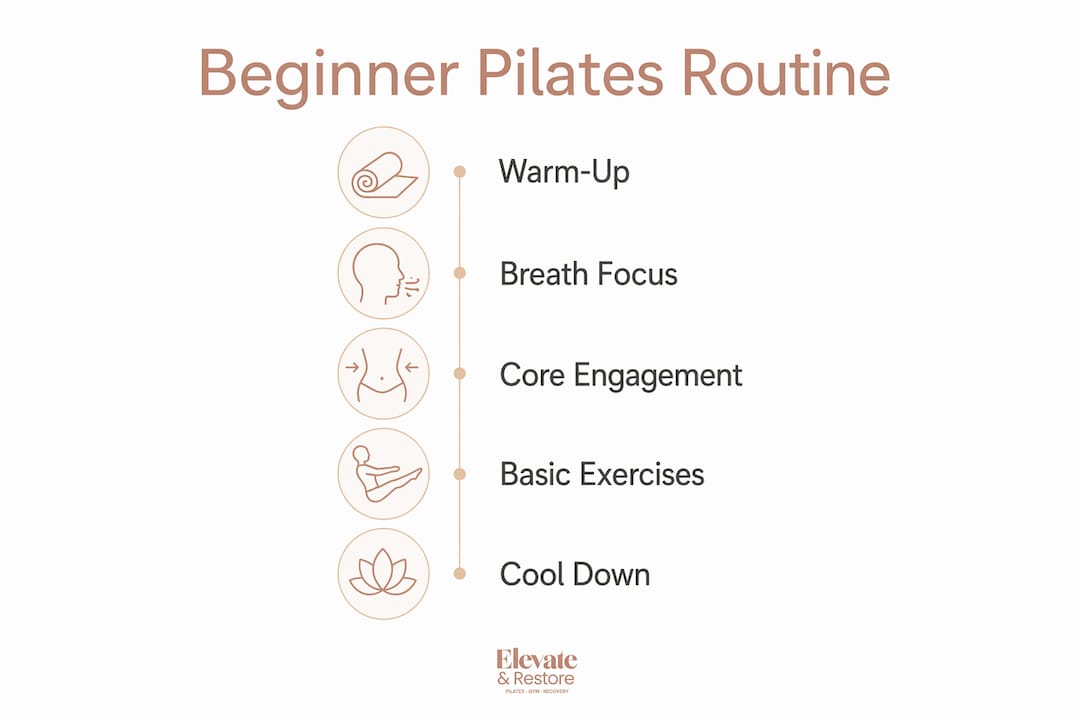
Begin with these five foundational exercises. Each one teaches a core principle before you progress to more complex movements.
- The hundred. Lie on your back, legs in tabletop, arms long by your sides. Pump your arms in small pulses for ten breath cycles. This builds core endurance and breath coordination.
- Pelvic curl. Lie flat, feet hip-width apart. Inhale to prepare, exhale to roll your spine off the mat one vertebra at a time. This teaches spinal articulation, which is the foundation of articulated movement.
- Single leg stretch. Lie on your back, knees to chest. Extend one leg while drawing the other in. Alternate with control. This challenges core stability without loading the spine.
- Swan prep. Lie face down, hands under shoulders. Inhale to lengthen, exhale to lift your chest slightly off the mat. This counters the forward posture most women develop from desk work.
- Side-lying leg series. Lie on your side, body in a straight line. Lift and lower the top leg with control. This targets the hip stabilisers that protect the lower back.
How often should you practise?
Beginner recommendations sit at 2–4 sessions per week, with each session lasting 15–25 minutes when you are starting out. That frequency is enough to build the neuromuscular patterns pilates relies on without overwhelming your recovery. As you progress into weeks five through eight, sessions can extend to 30–60 minutes and include more complex sequences.
Common beginner exercises beyond the starter routine include:
- Roll-down: teaches spinal flexion and hamstring length
- Spine stretch forward: opens the posterior chain with breath support
- Glute bridge: builds posterior chain strength with minimal joint load
- Child's pose with lateral breathing: reinforces the lateral breathing pattern central to pilates
- Supine twist: releases thoracic rotation and supports spinal mobility
Pro Tip: Prioritise form and breath over the number of repetitions. Five clean repetitions of any exercise deliver more benefit than fifteen sloppy ones.
Working with a certified pilates instructor trained in women's health significantly reduces injury risk for beginners. If in-person classes are not accessible, credible online platforms with qualified instructors are a sound alternative. The Elevateandrestore mindful movement guide covers injury-prevention routines designed specifically for women starting after 30.
How does pilates support health and recovery after 30?
Pilates addresses a problem most women over 30 do not realise they have. Compensatory movement patterns develop when certain muscles stop doing their job and others overwork to compensate. The result is chronic tension, joint pain, and back issues that feel unrelated to any single injury. Pilates retrains these patterns by teaching articulated movement that distributes effort evenly across the body.
The physiological benefits extend well beyond posture. An eight-week pilates programme of two to three sessions per week produces measurable improvements in core muscle mechanical properties, blood pressure, and mental health markers in women. Eight weeks is a realistic and achievable timeframe. That is roughly two months of consistent practice.
"Pilates transitions women over 30 from exhausting their bodies to supporting natural, less stressful movement patterns that reduce joint pain and chronic stress." — Wellness with Lou
| Health benefit | What pilates does | Expected timeframe |
|---|---|---|
| Core strength | Improves muscle mechanical properties and endurance | 4–8 weeks |
| Blood pressure | Reduces resting blood pressure with consistent practice | 8 weeks |
| Mental health | Lowers stress and improves mood through breath and movement | 4–6 weeks |
| Joint mobility | Increases range of motion through articulated movement | 6–10 weeks |
| Chronic pain reduction | Retrains compensatory patterns causing tension | 8–12 weeks |
For women dealing with post-pregnancy recovery, pelvic floor dysfunction, or stress-related tension, pilates offers specific therapeutic value. The Elevateandrestore pelvic floor guide explains how targeted pilates work supports pelvic floor rehabilitation in women over 30. Breathwork is central to this process. Understanding how breath drives pilates is one of the fastest ways to accelerate your results.
Common challenges when starting pilates over 30
The most common obstacle is not physical. Feeling 'not fit enough' to start pilates is a mental barrier that has no basis in reality. Pilates is designed to meet you exactly where you are. Every beginner, regardless of age or fitness level, starts with the same fundamental movements.
The second challenge is the nature of the practice itself. Mental control and breath synchronisation are often harder to master than the physical movements. Women who come from gym-based or high-intensity backgrounds frequently find the slowness frustrating at first. That frustration is a sign the practice is working. Pilates demands a different kind of attention.
Physical challenges are real but manageable. Stiffness, muscle fatigue after the first few sessions, and mild soreness in muscles you did not know existed are all normal. The key is distinguishing between productive discomfort and pain that signals a problem.
Common beginner mistakes and how to fix them:
- Holding your breath during effort. Fix: return to the breath cue before every movement.
- Rushing through repetitions. Fix: count to three on each phase of the movement.
- Skipping rest days. Fix: schedule two rest days per week as non-negotiable.
- Comparing your progress to others. Fix: track your own sessions and note what feels easier each week.
- Ignoring pain signals. Fix: stop the movement, rest, and modify before continuing.
Consistency and patience deliver progress. Rushing or overdoing routines leads to setbacks more often than not. Two sessions per week done consistently for eight weeks outperforms five sessions per week done erratically for three.
Pro Tip: If a movement causes sharp or joint pain, stop immediately. Modify the range of motion or ask an instructor for an alternative. Pilates should never hurt.
For women who want to understand how pilates fits alongside other training, the Elevateandrestore article on injury prevention after 30 is worth reading alongside this guide.
Key takeaways
Starting pilates after 30 delivers measurable improvements in core strength, mental health, and joint mobility within eight weeks when practised two to four times per week.
| Point | Details |
|---|---|
| Equipment is minimal | A $40–60 mat is all you need to begin; master fundamentals before adding props. |
| Frequency matters | Practise 2–4 sessions per week, starting at 15–25 minutes per session. |
| Breath and form first | Prioritise breathing and neutral spine over speed or repetition count. |
| Benefits are measurable | Eight weeks of consistent practice improves core strength, blood pressure, and mental health. |
| Mental barriers are the real hurdle | Feeling unfit enough to start is common but unfounded; pilates meets you where you are. |
What I have seen in women who start pilates after 30
The transformation I observe most often is not physical, at least not at first. Women who start pilates in their 30s and 40s describe a shift in how they inhabit their bodies. They stop moving on autopilot. They notice where they hold tension, how they breathe under stress, and which muscles have been switched off for years. That awareness alone changes how they move through daily life.
The women who progress fastest are not the fittest. They are the most consistent and the most willing to slow down. High-intensity training teaches you to push through discomfort. Pilates teaches you to listen to it. That is a genuinely different skill, and it takes time to develop.
What I would tell any woman considering this practice is simple. Do not wait until you feel ready. Start with a mat, two sessions per week, and the five foundational exercises in this guide. The readiness comes from doing, not from preparing to do. Pilates is not a fitness programme you graduate from. It is a movement practice that grows with you for decades.
— Elevate
Start your pilates practice with Elevateandrestore
Elevateandrestore runs small-group reformer pilates classes in West Footscray, with a maximum of six people per session. That size means instructors can correct your form, modify movements for your body, and give you the attention a large class never can. Every class is designed to work for beginners and women over 30 who are building their practice from the ground up. After your session, the recovery lounge includes sauna, cold plunge, hot tub, and compression boots to support muscle recovery and reduce soreness between sessions. Book your first class and experience what pilates feels like when it is taught properly.
FAQ
Is pilates good for women over 30 who have never exercised?
Pilates is one of the most beginner-friendly movement methods available. It starts with fundamental movements that require no prior fitness and builds from there.
How many times a week should I do pilates as a beginner?
Start with 2–3 sessions per week, each lasting 15–25 minutes. Research shows this frequency produces measurable health improvements within eight weeks.
Do I need a reformer machine to start pilates?
No. Mat pilates at home is equally effective for building foundational strength and technique. A quality mat costing $40–60 is all you need to begin.
How long before I see results from pilates after 30?
Most women notice improved posture, reduced tension, and better body awareness within four weeks. Core strength and blood pressure improvements typically appear by week eight with consistent practice.
Can pilates help with back pain and joint stiffness after 30?
Yes. Pilates retrains compensatory movement patterns that cause chronic back pain and joint tension. Articulated movement techniques distribute effort evenly across the body, reducing localised strain over time.