
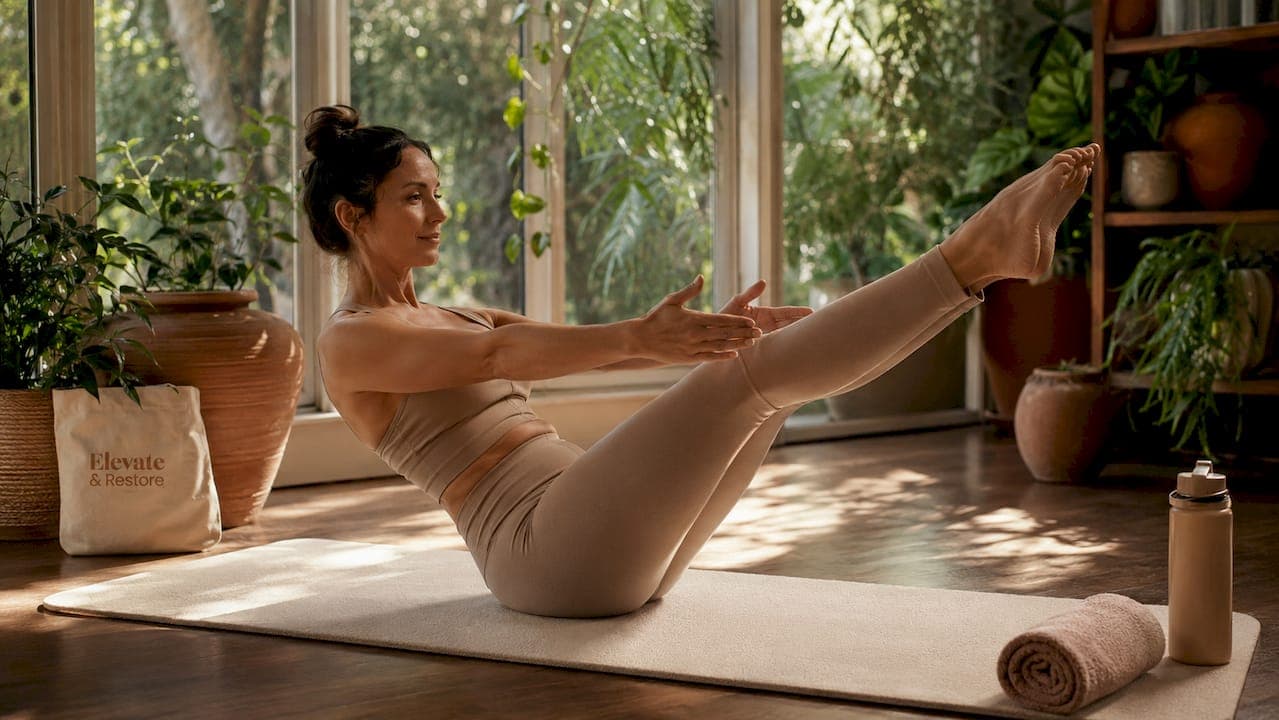
Mindful movement Pilates is the deliberate coordination of breath, focused attention, and precise movement to improve both physical health and mental well-being. In the fitness world, this practice is formally known as "Contrology," the term Joseph Pilates used to describe the coordination of body, mind, and spirit. This mindful movement Pilates guide is built specifically for people over 30 who want more than a workout. A meta-analysis in Frontiers in Psychology found Pilates produced the largest anxiety-reducing effect among all mind-body exercises, with a standardised mean difference of −1.47. That result places mindful Pilates in a category of its own for mental well-being outcomes.
What does a mindful movement pilates guide cover?
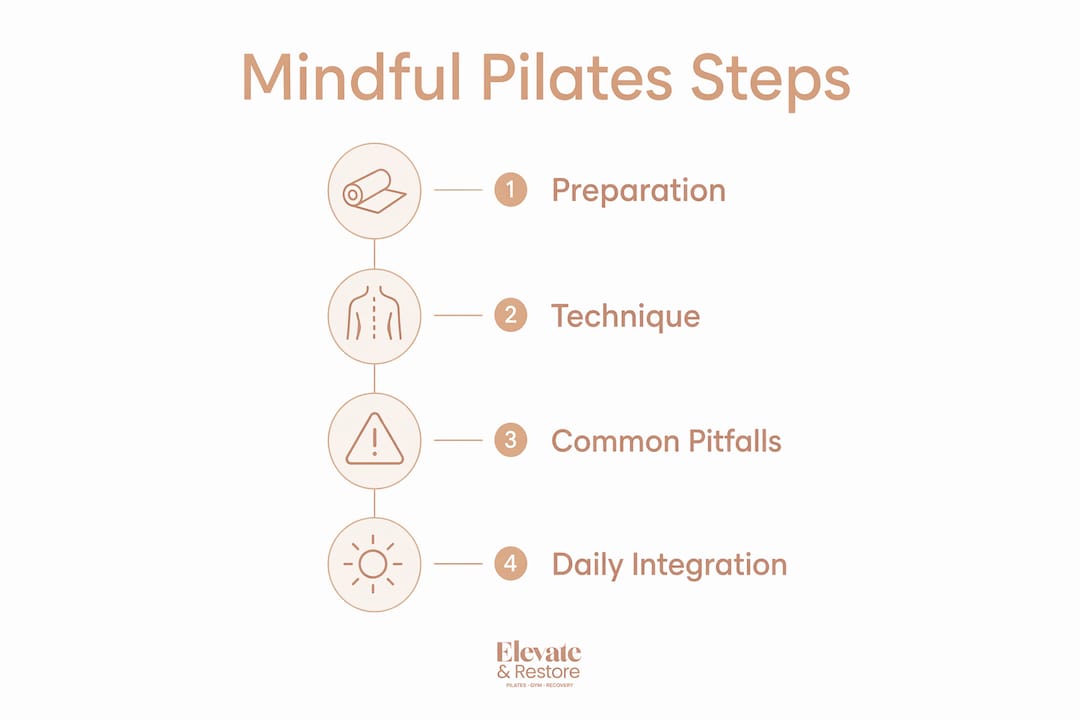
A complete guide to mindful Pilates covers four things: preparation, technique, common pitfalls, and daily integration. This section starts with what you need before your first session.
Pilates is not automatically mindful. Deliberate intention and pacing before, during, and after each session are what separate a mindful practice from a mechanical workout. Without that intention, you are simply doing exercises on a mat.
For people over 30, the stakes are higher and the rewards are greater. Your body has more history, more patterns, and more to gain from slowing down and paying attention.
What do you need to start pilates safely after 30?
The single most important step before starting Pilates after 30 is medical clearance. Harvard Health advises arriving early to your first class so the instructor can assess your individual needs, especially if you have spine issues, osteoporosis, or joint concerns. Skipping this step is the most common mistake beginners make.
Equipment and environment essentials
You do not need much to start. The table below covers what beginners over 30 actually need versus what is optional.
| Item | Purpose | Essential or Optional |
|---|---|---|
| Pilates mat (at least 10mm thick) | Cushions spine and joints during floor work | Essential |
| Grip socks | Prevents slipping on reformer or mat | Essential |
| Reformer machine | Adds resistance and support for modifications | Optional (studio provides) |
| Resistance band | Supports leg and arm exercises at home | Optional |
| Chair or wall | Assists balance in seated or standing work | Essential for modifications |
Reformer Pilates is worth mentioning separately. The reformer adds spring resistance that can support or challenge movement, making it ideal for people managing back pain or recovering from injury. A pilot RCT published in the Journal of Functional Morphology and Kinesiology found Pilates matwork significantly improved pain and disability outcomes in middle-aged women with chronic low back pain after just four weeks. That is a meaningful result for anyone over 30 managing a sore back.
Mindset preparation before you begin
Arrive five to ten minutes early. Use that time to sit quietly, notice your breath, and set a simple intention for the session. This transition ritual is not optional if you want the mindfulness benefits. Mindful Pilates requires deliberate mental cues before class, not just during it.
- Check in with how your body feels today, not how it felt last week
- Choose one physical focus for the session (e.g., rib expansion or pelvic alignment)
- Leave performance goals at the door
Pro Tip: If you practise at home, create a two-minute transition ritual before every session. Turn off notifications, dim the lights, and take three slow breaths before you begin. This signals your nervous system that the session is different from the rest of your day.
How to practise mindful pilates: a step-by-step method
The core technique in mindful Pilates is pairing movement with breath and a specific sensory target. Pilates breathing enhances neuromuscular efficiency at all tested intensity levels, with the greatest gain at 60% of maximum effort. This means breathing correctly is not just calming. It physically improves how your muscles recruit and fire.
The pilates breathing pattern
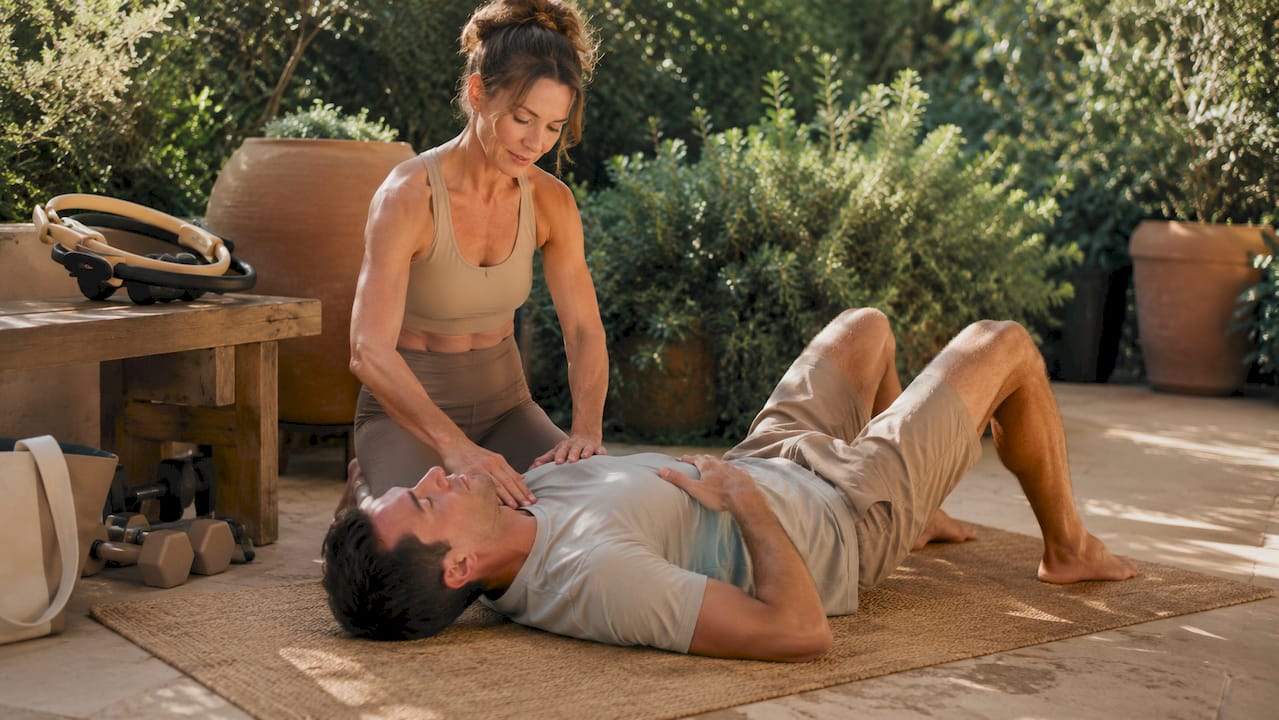
Pilates uses a lateral thoracic breath: you inhale to prepare, then exhale to move. The exhale activates your deep core and stabilises your spine before load is applied. This is the opposite of how most people breathe during exercise.
Here is a step-by-step mini-routine to practise mindful Pilates at home or in a studio:
- Lie on your mat in constructive rest (knees bent, feet flat). Place one hand on your lower ribs. Breathe in through your nose, feeling your ribs expand sideways. Exhale fully through your mouth.
- Imprint your spine. On an exhale, gently draw your lower back toward the mat without forcing it. Notice the contact between your spine and the floor.
- Pelvic tilt. Inhale to neutral. Exhale and tilt your pelvis, rolling your tailbone slightly up. Move slowly enough to feel each vertebra.
- Single leg lift. Inhale to prepare. Exhale and float one knee to 90 degrees, keeping your pelvis still. Inhale to lower. Repeat four times each side.
- Chest lift. Inhale to prepare. Exhale and curl your head and shoulders off the mat, eyes toward your knees. Hold for one breath. Inhale to lower slowly.
- Finish with a body scan. Lie still for 60 seconds. Notice what has changed in your body since you started.
Each step has one sensory target. Do not try to monitor everything at once. Pick one cue per exercise and build from there.
Pro Tip: Work with a qualified instructor for your first four to six sessions, even if you plan to practise at home long-term. A good instructor will give you sensory cues that are specific to your body, not generic instructions from a video.
Working with online classes
Online Pilates has a significant positive effect on psychological outcomes, though in-person classes are preferred for older adults or those at risk of social isolation. If you use online classes, choose formats that include verbal mindfulness cues, not just movement instructions. The difference is a teacher who says "notice the weight in your left hip" versus one who says "now do ten reps."
What are the most common mistakes in mindful pilates?
The biggest mistake in Pilates for people over 30 is performance chasing. Embodiment in Pilates means adapting movements to your body rather than forcing predetermined shapes. When you focus on looking correct instead of feeling the movement, you lose the mindfulness benefit and increase injury risk.
Here are the five most common mistakes, with corrective actions:
- Rushing through repetitions. Fix: Set a tempo of four counts per movement phase. If you cannot maintain breath control at that pace, slow down further.
- Holding your breath during effort. Fix: Exhale on every exertion. If you forget, pause and reset rather than continuing with held breath.
- Ignoring pain signals. Fix: Distinguish between muscle fatigue (acceptable) and sharp or joint pain (stop immediately). Modifications like seated or chair Pilates exist for exactly this reason.
- Comparing yourself to others in class. Fix: Choose one internal sensory cue and keep your attention there. What the person next to you is doing is irrelevant to your practice.
- Skipping the cool-down. Fix: The final five minutes of a session are when integration happens. Leaving early is leaving the most valuable part behind.
"The goal is not to perform Pilates. The goal is to inhabit it." This distinction, drawn from the embodiment framework in Pilates, is what separates people who get lasting results from those who plateau after a few weeks.
Instructors like Susan Czyzo and Tabatha Russell, both recognised for their work in mindful Pilates education, emphasise that pacing is a skill. You build it the same way you build strength: gradually, with attention, and without forcing it.
How do you carry mindful pilates into everyday life?
The mindfulness you build in a Pilates session does not have to stay in the studio. After-class integration through a brief body scan and choosing one micro-habit to carry into your day is the most practical way to extend the benefits. This is where the real long-term value lives.
Pro Tip: Immediately after your session, sit for two minutes and notice three physical sensations: your breath, the contact of your feet on the floor, and the length of your spine. Then choose one thing to carry into your afternoon, such as breathing before you respond to a stressful email.
The table below maps common daily situations to Pilates-derived mindfulness strategies:
| Daily Situation | Pilates-Derived Strategy | Benefit |
|---|---|---|
| Sitting at a desk | Neutral spine check every 30 minutes | Reduces back tension and fatigue |
| Climbing stairs | Exhale on each step, engage core | Reinforces breath-movement pairing |
| Waiting in a queue | Lateral thoracic breath, three cycles | Activates parasympathetic nervous system |
| Waking up in the morning | Pelvic tilt and single leg stretch in bed | Primes body awareness before the day starts |
| Responding to stress | Pause, exhale fully, then act | Reduces cortisol spike and reactive behaviour |
The anxiety-reducing effects of Pilates are strongest when practice is consistent and when mindfulness cues extend beyond the session itself. Three sessions per week over eight to twelve weeks is the evidence-backed threshold for meaningful mental health outcomes.
Key takeaways
Mindful Pilates works because it pairs deliberate breath control, specific sensory attention, and adapted movement to produce measurable physical and mental health benefits for people over 30.
| Point | Details |
|---|---|
| Medical clearance first | Get assessed before starting, especially with back, joint, or bone density concerns. |
| Breath drives everything | Exhale on every exertion to activate your core and improve neuromuscular efficiency. |
| Embodiment over performance | Adapt movements to your body rather than forcing shapes to reduce anxiety and injury risk. |
| Consistency is the threshold | Three sessions per week over eight to twelve weeks produces the strongest mental health outcomes. |
| Integration extends benefits | A post-session body scan and one daily micro-habit carry mindfulness beyond the studio. |
What i have learned teaching pilates to people over 30
The most common thing I see in new clients over 30 is a deep frustration with their own bodies. They come in expecting to perform, and they leave confused when their body does not cooperate the way it did at 25. What I have found, working with small groups at Elevateandrestore, is that the shift from performance to presence is the actual work. The exercises are just the vehicle.
Mindfulness in Pilates is not a soft add-on. It is the mechanism that makes the practice safe, sustainable, and genuinely therapeutic. When a client stops trying to look like they are doing Pilates and starts feeling what is happening in their body, everything changes. Their form improves. Their anxiety drops. They stop dreading sessions and start looking forward to them.
The research backs this up, but I did not need a meta-analysis to see it. I see it every week in our studio. The people who get the most out of Pilates are not the most flexible or the most coordinated. They are the ones who are willing to slow down, pay attention, and trust the process.
My honest advice: give yourself twelve weeks before you judge your progress. The first four weeks are about learning to breathe correctly. The second four are about feeling the difference. The third four are when it becomes yours.
— Elevate
Start your mindful pilates practice at Elevateandrestore
Elevateandrestore runs small-group reformer Pilates classes in West Footscray with a maximum of six people per session. That size is deliberate. It means your instructor can give you the individual cues and modifications that make mindful Pilates work, not a generic class experience. Every session is designed with breath, attention, and body awareness at the centre.
If you are managing an injury, chronic back pain, or simply starting from scratch after 30, the team at Elevateandrestore will build a programme around your body. The studio also includes a recovery hub with sauna, cold plunge, hot tub, and compression boots, so your body gets the full support it needs before and after each session. Book your initial assessment at Elevateandrestore and find out what your practice could look like.
FAQ
What is mindful movement pilates?
Mindful movement Pilates is the practice of combining deliberate breath control, focused sensory attention, and precise movement. Joseph Pilates called this "Contrology," the coordination of body, mind, and spirit.
How often should i practise pilates for mental health benefits?
Three sessions per week over eight to twelve weeks produces the strongest anxiety-reducing outcomes, based on a meta-analysis published in Frontiers in Psychology. Ninety-minute sessions show the largest effect size.
Do i need a reformer to practise mindful pilates?
No. Matwork Pilates is effective on its own, and a pilot RCT found significant improvements in pain and function after four weeks of mat-based core exercises. A reformer adds options but is not required to start.
Is pilates safe if i have back pain or osteoporosis?
Pilates is safe with appropriate modifications. Harvard Health recommends arriving early for an individual assessment and using seated or chair-based alternatives where needed. Always inform your instructor of any existing conditions before your first session.
How is mindful pilates different from regular pilates?
Regular Pilates focuses on movement execution. Mindful Pilates adds deliberate attention to breath, sensation, and internal experience during every repetition. Without that intentional focus, the mental health benefits are significantly reduced.