
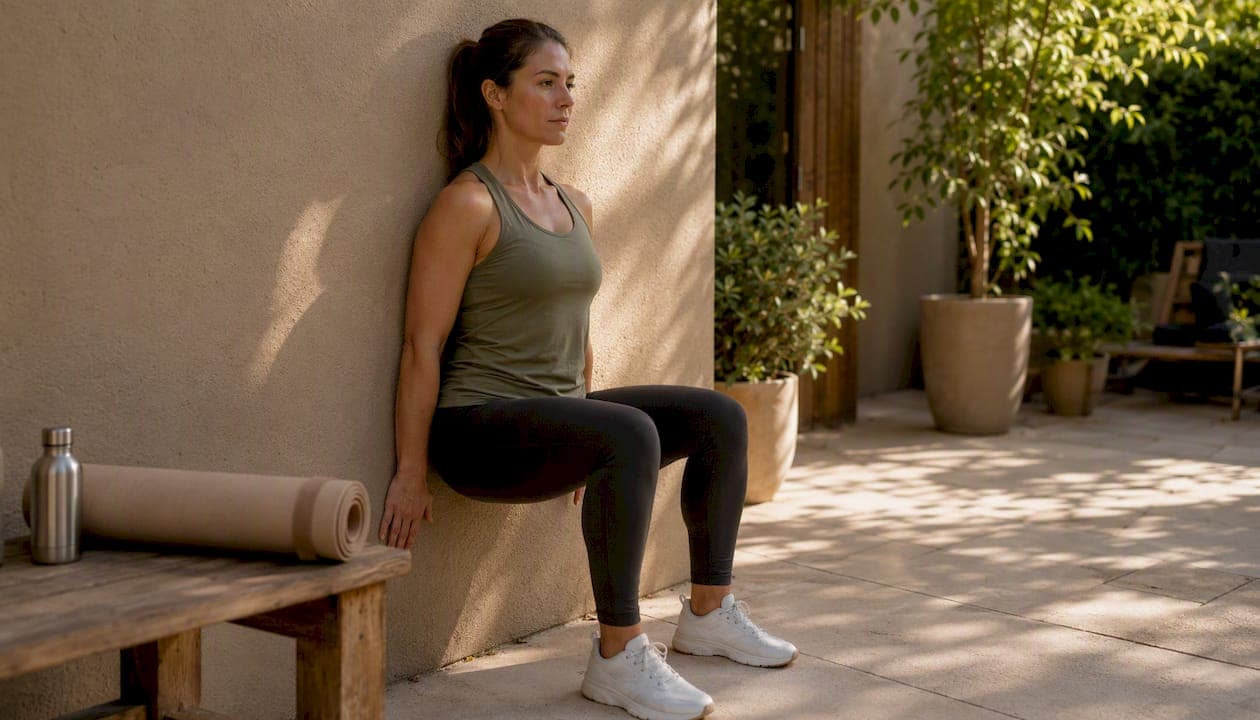
Isometric training is a form of exercise where your muscles contract and generate force without changing length or moving the joint — think holding a wall squat or a plank. The headline benefits are real and well-supported: isometric exercises build strength and joint stability, support injury rehabilitation, and can meaningfully reduce blood pressure through short, time-efficient sessions.
Who gains the most? Broadly:
- Beginners who need muscle activation without complex coordination demands
- People rehabbing an injury or managing joint pain, including knee osteoarthritis
- Athletes targeting a specific sticking point or range of motion
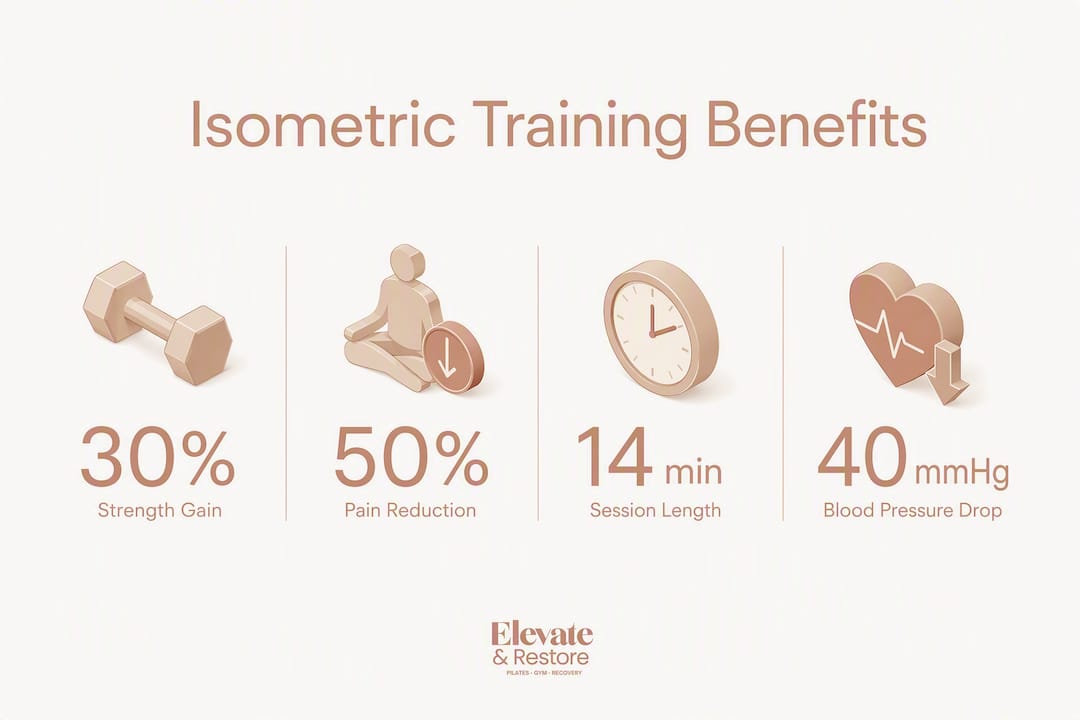
- Anyone with limited training time who wants cardiovascular and strength benefits from sessions as short as 14 minutes
Table of Contents
- What is isometric training and how does it differ from other exercise types?
- How isometric contractions actually produce training adaptations
- What are the evidence-backed benefits of isometric training?
- Five practical isometric exercises to start with
- How to programme isometric training effectively
- Limitations and safety: what isometrics can't do
- Who benefits most from isometric training?
- The strongest evidence and expert tips for real-world application
- Key takeaways
- The case for not overthinking it
- Isometric training at Elevateandrestore: small groups, real coaching
- Useful sources and further reading
What is isometric training and how does it differ from other exercise types?
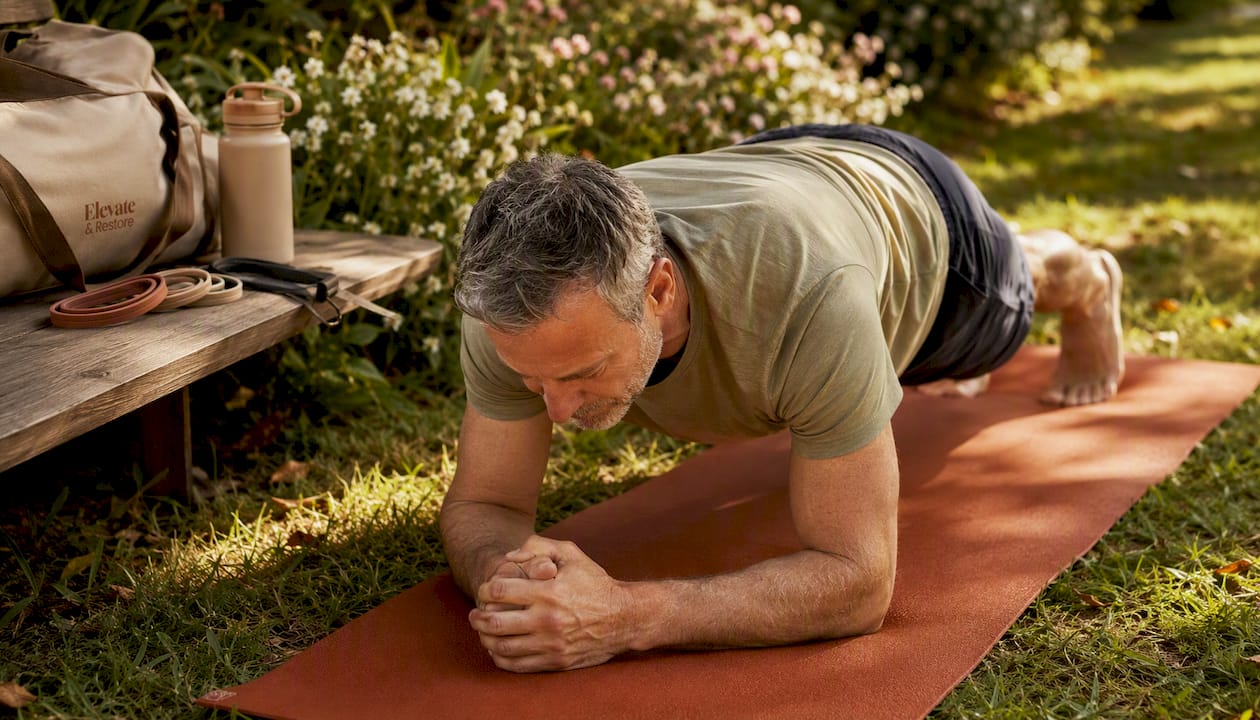
A muscle contraction that produces force without a change in muscle length is called an isometric contraction. When you hold a plank, your core muscles are working hard, but your spine and hips aren't moving. That static quality is the defining feature.
Compare that with isotonic exercise, which covers both concentric (muscle shortening, like the upward phase of a bicep curl) and eccentric (muscle lengthening under load, like lowering the curl). Isokinetic exercise moves a joint at a constant speed, typically on specialised rehabilitation equipment. Isometrics sit apart from both: the joint angle stays fixed, the muscle length stays fixed, and all the work happens internally.
Everyday examples make this concrete. A wall sit, a dead hang from a pull-up bar, squeezing a stress ball, or pressing your palms together — all isometric. In clinical settings, the terms you'll hear include static hold, maximal voluntary contraction (MVC), and submaximal isometric effort, which simply describes how close to your maximum force output you're working.
How isometric contractions actually produce training adaptations
The physiology here is worth understanding, because it explains both why isometrics work and where their limits are.
When you hold an isometric contraction, your nervous system recruits motor units to sustain the force. With repeated training, the brain gets better at firing more motor units simultaneously and synchronising their timing. This neural adaptation is why isometric strength can increase quickly, sometimes within a few weeks, even before significant muscle growth occurs.
At the local level, sustained contractions restrict blood flow to the working muscle, creating a brief hypoxic environment. When the hold releases, blood rushes back in. This repeated vascular response is thought to contribute to the blood-pressure lowering effects observed in trials, likely through improvements in arterial stiffness and endothelial function.
One important physiological constraint: strength gains from isometric training are largely specific to the joint angle trained. If you train your quad hold at 90 degrees of knee flexion, you'll get the strongest gains at or near that angle. Training at multiple angles is the practical fix, and it's a point that shapes how good programmes are written.
A 2019 systematic review published on PubMed found that isometric training produces meaningful morphological and neural adaptations, with outcomes shaped by muscle length, contraction intensity, and training intent — confirming that protocol design matters as much as the exercise itself.
What are the evidence-backed benefits of isometric training?
The evidence base is broader than most people expect. Here's where it's strongest.
Strength and stability
Isometric training can produce substantial isometric and isokinetic strength gains, with outcomes depending on protocol variables including volume, intensity, and the joint angles trained. For joint stability specifically, isometrics are effective at activating the smaller stabiliser muscles that dynamic lifts often underload — the muscles that keep joints controlled under load.
Rehab and pain management
Isometric exercises reduce pain and improve function in people with knee osteoarthritis and are a standard early-stage rehab tool precisely because they allow muscle strengthening with minimal joint stress. For tendinopathy, isometrics are used as a low-load intervention before progressing to eccentric or heavy slow resistance loading — a protocol sequence that's well-established in physiotherapy practice. Exercise-induced hypoalgesia (the pain-reducing effect of exercise itself) is part of why isometric holds can provide immediate relief in tendon pain.

This makes them particularly useful for adults managing joint concerns who need to keep training without aggravating an injury.
Blood pressure reduction
This is where the evidence is arguably most striking.
A meta-analysis covered by BBC Future found that isometric protocols — including handgrip, wall squat, and leg extension holds — produced blood pressure reductions of approximately 8.24/4.00 mmHg, compared with roughly 4.49/2.53 mmHg for aerobic exercise. That's a meaningful gap.
Sports performance
Athletes use isometrics to address sticking points — the specific joint angles where force production drops during a dynamic lift. Holding a squat at the angle where you typically fail, for example, builds strength precisely where you need it. Isometrics also support rate of force development when combined with dynamic work, making them a useful performance tool rather than a standalone method.
| Benefit area | Evidence strength | Key finding |
|---|---|---|
| Blood pressure reduction | Strong (meta-analysis) | ~8.24/4.00 mmHg reduction vs ~4.49/2.53 mmHg for aerobic exercise |
| Isometric strength gains | Strong (systematic review) | Substantial gains; protocol-dependent |
| Rehab and pain (OA, tendinopathy) | Moderate-strong (clinical use) | Reduced pain, improved function with low joint stress |
| Hypertrophy across full range | Moderate | Requires multi-angle programming; less than dynamic training alone |
| Rate of force development | Moderate | Useful when combined with dynamic loading |
Five practical isometric exercises to start with
These five moves require minimal equipment and cover the major muscle groups most people want to train.
-
Wall squat (wall sit) Stand with your back flat against a wall, feet shoulder-width apart, and slide down until your thighs are parallel to the floor (or as close as comfortable). Hold for 30–60 seconds, breathing steadily. Common mistake: letting the knees drift inward. Progression: increase hold duration or add a light load across the thighs. Regression: reduce the knee bend angle to reduce load.
Pro Tip: If you have elevated blood pressure, keep the knee angle above 90 degrees and avoid breath-holding — a shallower hold still produces cardiovascular benefit with less vascular strain.
-
Plank Forearms on the floor, elbows under shoulders, body in a straight line from head to heels. Brace the core as if bracing for a punch. Hold for 20–60 seconds. Common mistake: letting the hips sag or pike. Progression: extend hold time, or lift one foot slightly to increase demand on the obliques. Pairs well with core stability work.
-
Glute bridge hold Lie on your back, knees bent, feet flat. Drive hips to the ceiling and hold at the top, squeezing the glutes. Hold for 20–45 seconds. Common mistake: overextending the lower back instead of using the glutes. Progression: single-leg variation, or add a resistance band above the knees.
-
Isometric calf raise hold Stand on the edge of a step, rise onto your toes, and hold at the top for 30–45 seconds. Keep a slight bend in the knee to load the soleus as well as the gastrocnemius. Common mistake: locking the knee fully. Progression: single-leg hold, or add a light dumbbell.
-
Isometric handgrip squeeze Use a grip trainer or squeeze a firm ball as hard as you can sustain for 30–60 seconds, then switch hands. This is the protocol most studied for blood pressure reduction. Common mistake: holding the breath. Progression: increase resistance of the grip device or extend hold duration.
How to programme isometric training effectively
The good news: effective isometric protocols are short. Sessions totalling around 14 minutes — structured as four 2-minute holds with 1–2 minutes rest between, done three times per week — have produced meaningful cardiovascular and strength results in trials. That's a realistic commitment for most people.
Whether you use submaximal or maximal efforts depends on your goal. Submaximal holds (around 50–70% of your maximum voluntary contraction) suit blood pressure protocols and beginners. Maximal or near-maximal efforts are better for strength and neural adaptation, but require more recovery.
| Goal | Hold duration | Sets | Frequency | Progression |
|---|---|---|---|---|
| Blood pressure reduction | 2 minutes | 4 | 3x per week | Increase intensity gradually; add angles |
| General strength | 5 seconds (maximal) | 3–5 per angle | 2–3x per week | Add angles; increase intensity |
| Rehab / pain management | 20–45 seconds (submaximal) | 3–4 | Daily or 5x per week | Progress to eccentric loading |
| Stability and control | 20–60 seconds | 3 | 2–3x per week | Add instability or load |
For a beginner, a sensible 4–8 week arc looks like this: weeks 1–2, establish positions and breathing with submaximal holds; weeks 3–4, extend hold durations or add a second angle; weeks 5–8, increase intensity and begin pairing with dynamic movements. Measurable strength improvements often appear within 3–4 weeks. Blood pressure changes from consistent protocols have been observed within 4–8 weeks in trial settings.
If you want to build this into a broader routine, a beginner strength programme can show you how isometric blocks fit alongside dynamic lifts without overloading recovery.
Limitations and safety: what isometrics can't do
Isometrics are genuinely useful, but they have real limits and a few specific risks worth knowing.
What they can't do well on their own:
- Build strength across a full range of motion without multi-angle programming. A single-angle hold mostly strengthens that angle.
- Drive significant hypertrophy compared with dynamic training across a full range. Isometrics can contribute to muscle growth, but they're not the most efficient tool for it.
- Improve cardiovascular endurance or VO2 max. Aerobic training remains superior for those goals.
- Develop speed or power in isolation. Rate of force development improves most when isometrics are combined with dynamic and plyometric work.
Safety considerations:
The most important risk is the Valsalva manoeuvre — holding your breath and bearing down during a hard contraction. This sharply spikes blood pressure and intra-abdominal pressure. Anyone with hypertension, cardiovascular disease, or a history of stroke should get medical clearance before attempting maximal isometric efforts, and should avoid breath-holding entirely.
For people post-surgery or with unstable joint conditions, isometrics should only be introduced under clinical guidance. The low joint stress that makes them rehab-friendly can still be too much load at the wrong stage of recovery.
Practical precautions for everyone:
- Breathe continuously throughout every hold. Exhale slowly if you feel pressure building.
- Start with submaximal efforts (50–60% of maximum) and build over weeks.
- Monitor for dizziness, chest tightness, or unusual pain — stop immediately if any occur.
- Regress by reducing hold time or angle before reducing frequency.
Who benefits most from isometric training?
Isometrics aren't a one-size-fits-all tool, but they fit a wider range of people than most training methods.
- Beginners and deconditioned adults: Isometrics require less coordination than dynamic lifts while still activating muscle and neural pathways — a lower barrier to entry with genuine training effect.
- People rehabbing injury or managing chronic pain: Low joint stress, pain-reducing effects, and compatibility with early rehab stages make isometrics a clinical staple. Injury resilience work pairs naturally with isometric holds.
- Older adults with joint pain: The ability to load muscle without compressing or shearing a joint is significant for people with osteoarthritis or post-surgical joints.
- Athletes targeting sticking points: A powerlifter who fails at the bottom of a squat, or a swimmer who loses force at a specific shoulder angle, can use isometric holds at that exact angle to build targeted strength.
- People with elevated blood pressure: The handgrip and wall squat protocols studied in meta-analyses are accessible and time-efficient.
How to pair isometrics with other training:
- Warm-up: A short isometric set before dynamic work can activate stabilisers and reduce post-workout soreness without the performance-impairing effect of static stretching.
- Rehab primer: Use isometrics first in a session to activate the target muscle before progressing to dynamic loading.
- Post-workout finisher: Low-intensity holds at the end of a session add volume without significant fatigue cost.
- Weekly block: Two to three dedicated isometric sessions per week, separate from or integrated into dynamic training days, is a practical starting point.
The strongest evidence and expert tips for real-world application
The blood pressure finding from the meta-analysis is the most clinically significant result in the isometric literature right now. A reduction of approximately 8.24 mmHg systolic from a protocol that takes around 14 minutes per session, three times a week, is a meaningful outcome by any clinical standard. For context, that reduction is roughly double what aerobic exercise produced in the same analysis.
The rehab evidence is also solid. Isometric exercises are recommended for injury rehabilitation and osteoarthritis because they allow muscle strengthening with low joint stress — a combination that's hard to replicate with dynamic loading in early recovery.
Here are the coaching tips that matter most in practice:
- Train at multiple angles. Single-angle training builds strength at that angle. To carry strength through a movement, programme holds at two or three positions across the range.
- Breathe on a count. Inhale for two counts, exhale for two counts, repeat. This prevents Valsalva and keeps the nervous system from over-bracing.
- Use isometrics to find your weak angle. The position where holding feels hardest is usually the position where dynamic strength is also lowest. That's where to focus.
- Combine with dynamic loading for hypertrophy. Isometrics alone produce modest muscle growth. Pairing them with concentric and eccentric work gives you the full adaptation spectrum.
- Track hold duration before intensity. Extend how long you can hold a position before you increase the load or angle difficulty. Duration is the safer progression variable.
- Use them in your warm-up. A 20–30 second isometric hold of the target muscle before a dynamic set improves activation without fatiguing the muscle.
- Expect neural gains first. Strength improvements in the first 3–4 weeks are mostly neural. Structural changes take longer. Don't judge the method too early.
- Pair with a broader programme. Isometrics complement, not replace, cardio and dynamic strength work. A functional training routine gives them context and keeps adaptation balanced.
Key takeaways
Isometric training builds real strength, supports rehab, and can lower blood pressure through sessions as short as 14 minutes — but it works best as part of a broader training plan, not in isolation.
| Point | Details |
|---|---|
| Core definition | Muscle contracts without length change or joint movement; the defining feature is the static hold. |
| Blood pressure benefit | Meta-analysis found ~8.24/4.00 mmHg reduction, roughly double the effect of aerobic exercise alone. |
| Angle specificity | Strength gains are greatest at the trained angle; programme across multiple angles for full-range benefit. |
| Rehab and pain | Reduces pain and improves function in osteoarthritis and tendinopathy with low joint stress. |
| Elevateandrestore | Small-group functional training and reformer Pilates sessions at Elevateandrestore integrate isometric work with coached progression and recovery support |
The case for not overthinking it
Most people who ask about isometric training are looking for a way to train that doesn't wreck their joints, doesn't require an hour in the gym, and actually does something measurable. Isometrics deliver on all three — and the blood pressure evidence alone makes them worth taking seriously, particularly for adults over 40 who are managing cardiovascular risk alongside fitness goals.
Where the conversation goes wrong is when isometrics get positioned as a replacement for everything else. They're not. Cardio is still the superior tool for weight management and aerobic capacity. Dynamic loading still drives more hypertrophy across a full range. The honest picture is that isometrics fill a specific gap: they build targeted strength and stability at controlled angles, they're accessible to people who can't tolerate high joint loads, and they produce cardiovascular benefits in a fraction of the time most people spend on a treadmill.
The angle-specificity limitation is real, but it's also a feature if you use it deliberately. Knowing that a hold at 90 degrees of knee flexion builds strength specifically at that angle means you can target exactly the position where a movement breaks down. That's not a workaround — it's precision.
For anyone in a small-group setting, the other underrated advantage is accountability. Holding a wall squat for two minutes is uncomfortable. Doing it alongside five other people who are also holding makes it considerably more achievable. That's not a trivial point.
Isometric training at Elevateandrestore: small groups, real coaching
Strength built in a static hold still needs to transfer to movement — and that transfer happens fastest with good coaching and a structured environment. At Elevateandrestore in West Footscray, small-group reformer Pilates classes (capped at six people) give you the kind of individual attention that makes isometric cues actually land: whether that's correcting a plank position, adjusting a glute bridge hold, or progressing a wall squat angle safely.
Functional training and HIIT sessions at the studio pair isometric work with dynamic loading, so you're building strength across the full adaptation spectrum rather than training in isolation. After sessions, the recovery lounge — infrared sauna, cold plunge, hot tub, and compression therapy — supports the tissue recovery that makes consistent training possible. Book a session or check class availability at elevateandrestore.com.au.
Useful sources and further reading
- Isometric training and long-term adaptations: Effects of muscle length, intensity, and intent — PubMed systematic review: The most rigorous academic review of isometric training protocols and their adaptive outcomes; useful for anyone wanting the full evidence base.
- Isometric exercises — Mayo Clinic: Clear clinical definition and safety guidance from a primary medical authority.
- What is isometric exercise? — Cleveland Clinic Health Essentials: Practical overview with rehab and osteoarthritis context from a clinical perspective.
- Isometric exercise: the most efficient fitness regime? — BBC Future: Accessible summary of the blood pressure meta-analysis and time-efficient protocol research.
- The unexpected benefits of wall squats and other isometric exercises — New Scientist: Covers rehab, beginner applications, and warm-up use with coach and researcher commentary.
- What does the evidence say about isometrics for strength and hypertrophy? — Stronger by Science: Detailed analysis of angle specificity, hypertrophy outcomes, and protocol variables for strength-focused readers.