
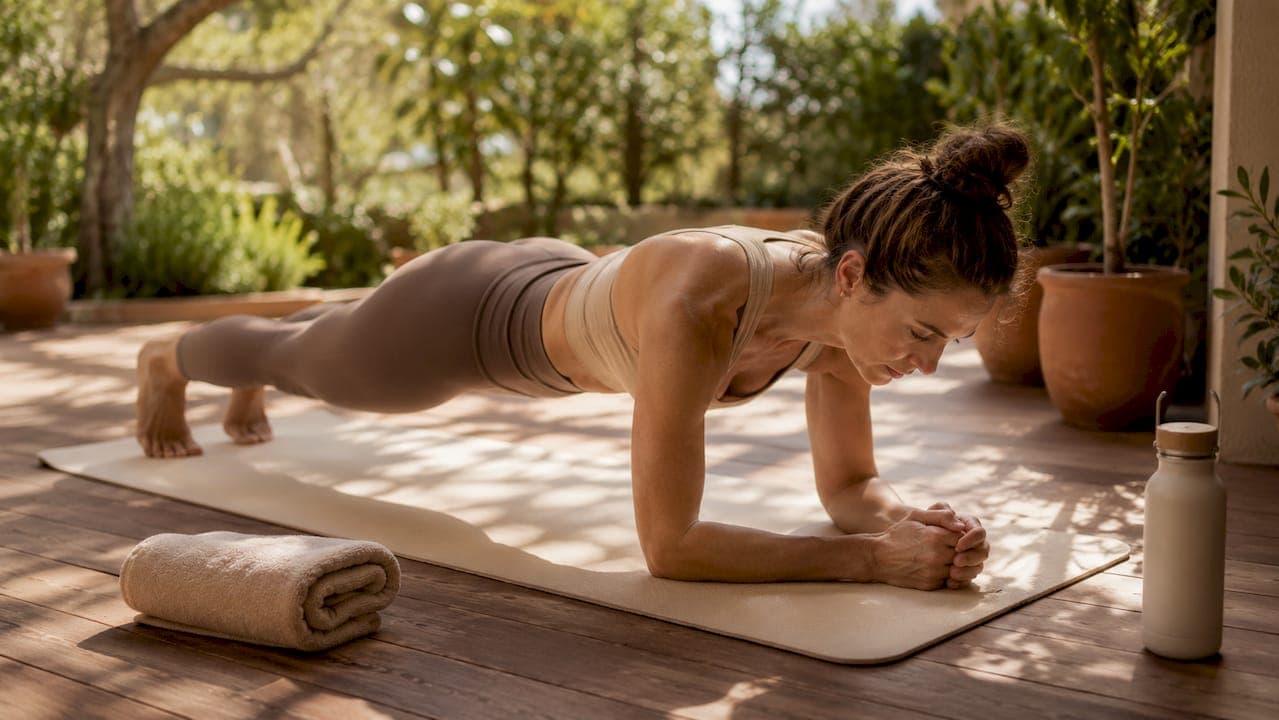
Core stability training is the targeted activation and strengthening of your trunk muscles to stabilise your spine and pelvis during everyday and athletic movements. The industry term for this practice is lumbopelvic stabilisation, though core stability training is the phrase most coaches and clinicians use in practice. If you are over 30 and want to lift heavier, move without pain, or simply stay injury-free, this is the foundation everything else is built on. Recent 2026 research confirms what good coaches have known for years: a well-trained core does far more than give you a flat stomach. It protects your spine, transfers force between your upper and lower body, and keeps you training consistently for years.
What is core stability training and which muscles does it involve?
Core stability training works through a coordinated system of deep and superficial trunk muscles. Most people picture the rectus abdominis, the "six-pack" muscle, when they think of core work. That muscle is largely a surface mover. The real stabilisers sit deeper.
The four key deep muscles are:
- Diaphragm (the ceiling of your core)
- Pelvic floor (the floor)
- Transverse abdominis (the front and sides, wrapping like a corset)
- Multifidus (the back, running along the spine)
When these four muscles co-contract, they create intra-abdominal pressure that acts like a built-in back brace. This pressure reduces lumbar spine compressive load by up to 40% during heavy lifting. That is a significant mechanical advantage, and it explains why core stability boosts lifts far more than extra sets of crunches ever will.
The timing of this activation matters as much as the strength itself. The transverse abdominis fires approximately 30 milliseconds before any limb movement begins. Your body braces before you even consciously initiate a lift or a step. When that timing is delayed or absent, spinal injury risk rises sharply.

Pro Tip: Practise diaphragmatic breathing before any core exercise. Inhale to expand your ribcage 360 degrees, then exhale and gently draw your lower abdomen inward. This is how you activate the deep system before loading it.
Superficial muscles like the rectus abdominis and obliques still matter. They produce movement and add stiffness under load. The problem is that most gym programmes train only these surface muscles, leaving the deep stabilising system undertrained and the spine underprotected.
How does core stability training reduce injury risk?
The injury prevention case for core stability training is now well supported by clinical evidence. A 2026 randomised controlled trial with 51 women found that core stability training produced significant reductions in chronic non-specific low back pain, with a mean reduction in the Oswestry Disability Index of 13.36 points compared to controls. That is a clinically meaningful improvement in both pain and daily function.
The biomechanical reason is straightforward. A stable trunk reduces shear and compressive forces on the lumbar discs during loaded movement. Without that stability, the spine absorbs forces it was not designed to handle repeatedly.
"Many people fail to achieve lasting back pain relief because they focus on superficial abs. Training a 360-degree pressure system that stabilises the spine during movement is the key."
The type of training you choose also matters. A systematic review found that Pilates and Sling Exercise Therapy deliver stronger pain relief than conventional core stability exercises for chronic low back pain, with standardised mean differences around 0.95 versus 0.36 for conventional training. Pilates works because it integrates breath, deep muscle activation, and controlled movement simultaneously. Sling Exercise Therapy adds an unstable surface that demands real-time coordination from the entire trunk system.
Traditional isolated exercises like crunches fall short for a specific reason. Repeated spinal flexion under load can increase lumbar disc stress rather than reduce it. Crunches primarily target the rectus abdominis and do not meaningfully engage the deep stabilising muscles. For adults over 30, whose intervertebral discs have already lost some hydration and resilience, this distinction is not minor.
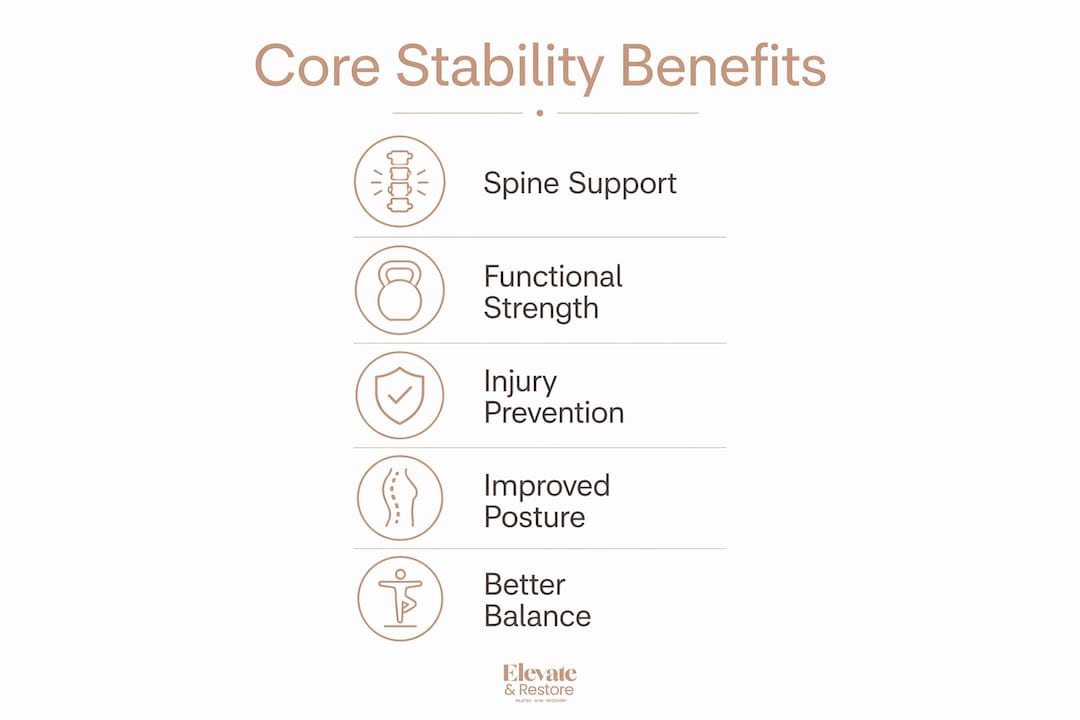
Functional core training for injury prevention after 30 focuses on resisting unwanted movement rather than producing it. Anti-rotation, anti-extension, and anti-lateral-flexion exercises train the trunk to hold position under load, which is exactly what your spine needs during a deadlift, a carry, or a change of direction.
What are the best core exercises for stability after 30?
Effective core stability training follows a clear progression. You build from activation to strength, then to dynamic control under load.
Stage 1: Activation
- Dead bug — Lie on your back, arms and legs in the air. Lower opposite arm and leg while keeping your lower back pressed to the floor. This trains transverse abdominis timing without spinal loading.
- Diaphragmatic breathing with pelvic floor engagement — Inhale to expand, exhale and gently lift the pelvic floor. This is the foundation of intra-abdominal pressure control.
- Bird dog — On all fours, extend opposite arm and leg. Hold for three seconds. This activates the multifidus and challenges lumbopelvic control simultaneously.
Stage 2: Strength and stiffness
- Plank variations — Front plank, side plank, and RKC plank (squeeze everything hard). These build trunk stiffness under sustained load.
- Pallof press — A cable or band anti-rotation exercise. The trunk resists rotation while the arms press forward. This directly trains the obliques and transverse abdominis in a functional pattern.
- Suitcase carry — Walk with a heavy weight in one hand. Your core works hard to prevent lateral lean. This is one of the most functional core exercises for real-world strength transfer.
Stage 3: Dynamic control
- Landmine rotation — A rotational drill that trains the obliques and hip-trunk connection under load.
- Loaded carries with variation — Farmer's carry, waiter's carry, and offset carries each challenge the core differently.
- Romanian deadlift — A hip-hinge pattern that demands lumbopelvic control throughout the full range of motion.
Pro Tip: Never chase fatigue in core training. If your lower back takes over during a plank or bird dog, stop and reset. Compensated reps train the wrong pattern and reinforce the problem you are trying to fix.
Breath control runs through every stage. Exhale on exertion and brace before you load. This is how you add Pilates principles to your lifting without changing your entire programme.
How does modern sports science view core stability training?
The traditional model of core stability treated the trunk as a static subsystem. The idea was simple: activate specific deep muscles, hold them, and the spine is protected. That model drove a generation of "draw in your navel" cues and isolated transverse abdominis exercises.
Sports science has moved on. The current view treats the trunk as a force-transmission structure that requires variable stiffness and lumbopelvic control arising from coordinated whole-body movement. Stability is not a fixed state. It is a dynamic quality that changes with speed, load, direction, and fatigue.
"Core stability is not about isolated muscle strength. It is about developing dynamic coordination and variability of trunk stiffness responsive to activity demands."
The practical implication is significant. Training only static holds like planks and dead bugs builds a foundation, but it does not prepare the trunk for the demands of sport, heavy lifting, or the unpredictable movements of daily life. The trunk needs to be trained across a range of tasks, speeds, and loads.
| Approach | Focus | Best for |
|---|---|---|
| Traditional core stability | Static deep muscle activation | Rehabilitation, beginners |
| Modern functional core training | Dynamic coordination, variable stiffness | Performance, injury prevention |
| Pilates | Breath, deep activation, controlled movement | Pain management, pelvic floor, posture |
| Loaded carries and anti-rotation | Force transmission, real-world strength | Strength athletes, general fitness |
The most effective programmes combine both approaches. You need the activation foundation from traditional methods and the dynamic challenge from functional training. Neither alone is sufficient for adults over 30 who want lasting results.
Key takeaways
Core stability training protects the spine, improves functional strength, and reduces injury risk by developing coordinated deep muscle activation and dynamic trunk control.
| Point | Details |
|---|---|
| Deep muscles are the priority | Diaphragm, pelvic floor, transverse abdominis, and multifidus create the pressure system that protects your spine. |
| Timing matters as much as strength | The transverse abdominis fires 30 ms before limb movement; delayed activation raises injury risk. |
| Pilates outperforms crunches | Research shows Pilates and Sling Exercise Therapy reduce chronic back pain more effectively than conventional core exercises. |
| Progress through three stages | Move from activation to strength to dynamic control before adding heavy load or speed. |
| Static and dynamic training both count | Combine plank-style holds with loaded carries, anti-rotation, and rotational drills for full trunk development. |
The thing most people over 30 get wrong about core training
Most people I work with at Elevateandrestore arrive thinking their core is weak because they cannot hold a plank for two minutes. That is almost never the real problem. The real problem is that their deep system has switched off. Years of sitting, poor breathing habits, and training programmes built around crunches and sit-ups have left the transverse abdominis and multifidus largely dormant. The surface muscles compensate, and the spine pays the price.
What I have seen consistently is that once people learn to breathe properly and reconnect with their deep core, their lifts improve, their back pain reduces, and their posture changes without them consciously trying to "stand up straight." The foundation was always there. It just needed to be woken up.
My honest recommendation for anyone over 30 is to spend four to six weeks on activation work before chasing load or intensity. It feels slow. It is not glamorous. But it is the difference between a core that works for you and one that fails you at the worst possible moment. Pair that with recovery methods that support strength training and you will adapt faster than you expect.
The other thing worth saying plainly: core training is not a separate session you bolt onto the end of a workout. It is a quality of movement that should run through everything you do. Every squat, every carry, every hinge is a core exercise when you execute it with proper intra-abdominal pressure and lumbopelvic control.
— Elevate
Train your core the right way at Elevateandrestore
At Elevateandrestore, our Reformer Pilates classes are built around exactly the principles covered in this article. Small groups of six people mean your coach can watch your breath, your bracing, and your movement quality in real time. That level of attention is what separates genuine deep core development from going through the motions.
Our functional training gym in West Footscray combines loaded carries, anti-rotation work, and progressive trunk training with access to our recovery hub, including sauna, cold plunge, hot tub, and compression boots. If you are over 30 and serious about building a core that actually works, this is where to start.
FAQ
What is the difference between core strength and core stability?
Core strength refers to how much force your trunk muscles can produce. Core stability is the ability to control spinal position and resist unwanted movement during dynamic tasks. You need both, but stability is the foundation.
How often should I train core stability?
Three to four sessions per week is sufficient for most adults over 30. Core stability work integrates naturally into your main training sessions rather than requiring separate workouts.
Can core stability training fix lower back pain?
A 2026 randomised controlled trial found core stability training significantly reduces chronic non-specific low back pain. Results improve further when Pilates or Sling Exercise Therapy is included alongside conventional exercises.
Why do crunches not build real core stability?
Crunches target the rectus abdominis and do not engage the deep stabilising muscles. Repeated spinal flexion under load can also increase lumbar disc stress, making crunches a poor choice for spinal protection.
Does core stability training improve lifting performance?
Deep core engagement reduces lumbar spine compressive load by up to 40% during heavy lifting. A stable trunk also improves force transfer between the lower and upper body, which directly increases how much you can safely lift.