

Endocrine system fitness is the state where your hormonal pathways function at their best to regulate metabolism, energy, mood, and recovery, shaped largely by consistent, balanced physical activity. The term is not standard clinical vocabulary. Clinicians use "hormonal regulation through exercise" or "exercise endocrinology," but endocrine system fitness captures the same idea in plain language. Your endocrine system is a network of glands, including the pituitary, thyroid, adrenal glands, and ovaries, that release hormones as chemical messengers into the bloodstream. Hormones regulate metabolism, repair, growth, and stress response, and exercise is one of the most potent tools available to influence how well that system works. For women over 30, when oestrogen, progesterone, and thyroid hormones begin to shift, understanding this relationship is not optional. It is foundational.
What is endocrine system fitness and why does it matter?
Endocrine system fitness describes how well your hormonal system responds to, and recovers from, physical stress. A well-functioning endocrine system bounces back quickly after exercise, maintains stable energy between sessions, and keeps cortisol from dominating your hormonal profile. When the system is out of balance, the signs are familiar: persistent fatigue, poor sleep, stubborn weight, and mood swings that do not match your circumstances.
The clinical benchmark most relevant here is 150 minutes of moderate aerobic exercise per week, which improves metabolic signalling foundational to endocrine health. That figure is not arbitrary. It reflects the minimum consistent stimulus needed to keep insulin sensitivity, thyroid function, and cortisol rhythms working in your favour. For women over 30, hitting that threshold regularly produces measurably different hormonal outcomes than sporadic intense sessions.
The glands most affected by exercise include the adrenal glands, which produce cortisol and adrenaline; the pancreas, which manages insulin; the pituitary, which governs growth hormone; and the thyroid, which sets your metabolic rate. Each of these responds to movement within minutes and adapts over weeks. That adaptability is exactly what endocrine system fitness trains.

How does exercise influence hormone function?
Exercise triggers two distinct types of hormonal response: acute and chronic. The acute response happens during and immediately after a session. Cortisol rises to mobilise energy. Growth hormone spikes to support tissue repair. Testosterone increases transiently to signal anabolic activity. The chronic response is what builds over months of consistent training, where baseline hormone levels shift, receptor sensitivity improves, and the system becomes more efficient at regulating itself.
One of the most significant discoveries in exercise science over the past decade is that muscle functions as an endocrine organ. When muscle fibres contract, they release proteins called myokines. IL-6 levels can increase up to 100 times during intense exercise, acting as a messenger that regulates metabolism in the liver, fat tissue, and immune system. That means every time you train, your muscles are sending hormonal signals to organs far beyond the muscle itself.
The type of exercise matters significantly for which hormones respond and how:
- Aerobic training (walking, cycling, swimming): improves insulin sensitivity, lowers resting cortisol over time, and supports thyroid function through consistent metabolic demand.
- Resistance training: triggers the strongest acute rise in testosterone and growth hormone, supporting muscle mass and bone density, both of which decline after 30.
- High-intensity interval training (HIIT): produces the largest short-term hormonal spike but also the highest cortisol load, requiring adequate recovery to avoid suppression.
- Mobility and low-impact movement: activates the parasympathetic nervous system, lowering cortisol and supporting hormonal reset between harder sessions.
Resistance and high-intensity exercises trigger transient rises in anabolic hormones but can cause suppression lasting up to 72 hours if recovery is insufficient. That suppression window is where many women over 30 unknowingly undermine their hormonal health by training again too soon.
Pro Tip: If you feel flat, irritable, or unusually fatigued 24–48 hours after a hard session, your cortisol is likely still elevated. Swap the planned workout for a walk or mobility session instead.
Why balanced fitness routines support hormonal health in women over 30
A single training modality is not enough to support endocrine system fitness across all the hormones that matter for women over 30. Structured routines combining aerobic, resistance, and mobility training produce better endocrine outcomes than any single approach. The reason is that each modality targets a different part of the hormonal system, and the combination creates a more complete stimulus.
The table below shows how each exercise type influences key hormones relevant to women over 30.
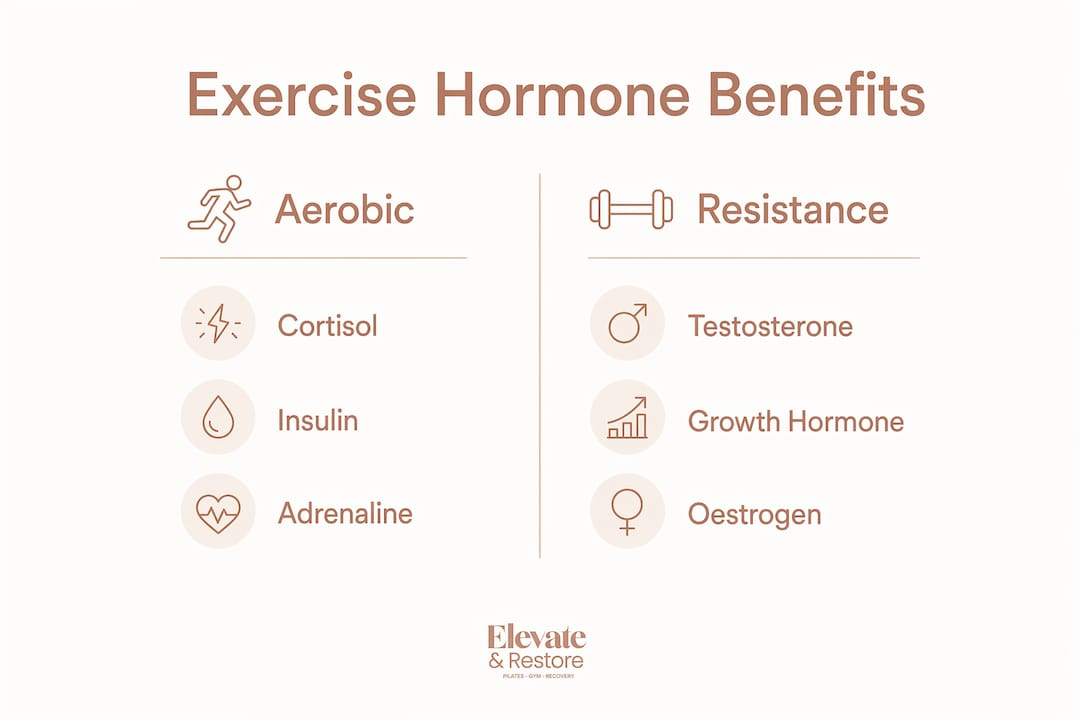
| Exercise type | Primary hormones influenced | Key endocrine benefit |
|---|---|---|
| Moderate aerobic (e.g., brisk walking, cycling) | Insulin, cortisol, thyroid | Improves insulin sensitivity, lowers resting cortisol |
| Resistance training | Testosterone, growth hormone, oestrogen | Supports muscle mass, bone density, and metabolic rate |
| HIIT | Cortisol, adrenaline, growth hormone | Boosts fat metabolism but requires careful recovery |
| Mobility and Pilates | Cortisol, parasympathetic hormones | Reduces stress load, supports hormonal reset |
Clinical guidelines recommend 2–4 days of resistance training per week alongside the 150-minute aerobic benchmark. For women navigating perimenopause or post-menopause, resistance training for women over 30 becomes especially important because declining oestrogen accelerates muscle and bone loss. Strength work directly counters that decline by stimulating testosterone and growth hormone release.
The risk of overtraining is real and underappreciated. Chronic high-volume training without adequate recovery leads to cortisol dominance, which suppresses oestrogen, progesterone, and testosterone. The result looks like burnout: poor sleep, low libido, irregular cycles, and weight gain despite high exercise volume. More training is not always the answer. The right mix is.
Pro Tip: Aim for no more than two high-intensity sessions per week. Fill the remaining days with moderate aerobic work, resistance training at a controlled pace, and at least one full recovery or mobility session.
Why recovery is the missing piece of endocrine health
Recovery is not passive. It is the phase where hormonal adaptation actually occurs. During rest, growth hormone peaks, cortisol drops, and the anabolic hormones produced during training do their repair work. Without adequate recovery, that process is interrupted, and the hormonal gains from training are never fully realised.
The sympathetic nervous system drives the stress response during exercise. The parasympathetic nervous system drives recovery. Sleep, rest days, and low-stress movement are critical for hormonal reset and preventing chronic imbalance. Most growth hormone is released during deep sleep, which means poor sleep quality directly reduces the anabolic benefit of every training session.
Four practical recovery principles for endocrine health:
- Prioritise sleep duration and quality. Aim for 7–9 hours. Growth hormone release is tied to slow-wave sleep, which is disrupted by late-night training or screen exposure before bed.
- Schedule rest days deliberately. At least one full rest day per week allows cortisol to return to baseline and anabolic hormones to complete their repair cycle.
- Use low-stress movement on recovery days. Walking, gentle Pilates, or stretching activates the parasympathetic system without adding hormonal load. Low-impact exercise on recovery days is not wasted effort. It is active hormonal management.
- Monitor perceived exertion as a daily guide. Perceived exertion reflects endocrine system stress more accurately than a fixed training plan. If a session that normally feels moderate feels hard, your hormonal system is telling you something.
Pro Tip: Tools like sauna and cold plunge support parasympathetic recovery by reducing inflammation and resetting cortisol rhythms. Elevateandrestore's recovery lounge includes sauna, cold plunge, hot tub, and compression boots, all designed to support this process.
Practical habits that build endocrine fitness over time
Endocrine system fitness is built through daily habits, not occasional effort. Regular moderate movement yields better long-term hormonal outcomes than sporadic high-intensity efforts. Consistency is the mechanism. Hormonal adaptation requires repeated, predictable stimulus over weeks and months.
A practical weekly framework for women over 30 looks like this:
- Monday, Wednesday, Friday: 30–45 minutes of resistance training or functional fitness at moderate intensity.
- Tuesday, Thursday: 30 minutes of moderate aerobic activity such as brisk walking, cycling, or swimming.
- Saturday: One mobility or Pilates session focused on breath, range of motion, and parasympathetic activation.
- Sunday: Full rest or a gentle walk under 30 minutes.
Beyond the workout itself, three lifestyle factors directly influence hormonal health. Hydration affects cortisol regulation. Dehydration raises cortisol, which suppresses other hormones. Protein intake supports the raw materials for hormone synthesis. Avoiding extreme caloric restriction prevents the hormonal shutdown that occurs when the body perceives famine. Aligning training times with your natural energy peaks, a concept explored in circadian rhythm fitness, further supports endocrine efficiency.
Track consistency rather than intensity. A training log that shows five moderate sessions per week for three months is a stronger hormonal signal than three brutal sessions followed by two weeks off. Your endocrine system responds to patterns, not peaks.
Key takeaways
Endocrine system fitness requires consistent, balanced movement across aerobic, resistance, and recovery modalities to maintain hormonal regulation, metabolic health, and wellbeing in women over 30.
| Point | Details |
|---|---|
| Define your baseline | Aim for 150 minutes of moderate aerobic activity weekly as the minimum hormonal stimulus. |
| Mix your modalities | Combine resistance, aerobic, and mobility training to support the full range of hormones relevant to women over 30. |
| Recover deliberately | Schedule rest days and prioritise sleep to allow growth hormone and cortisol to reset. |
| Use perceived exertion | Let daily energy and effort levels guide training intensity rather than fixed plans. |
| Prioritise consistency | Regular moderate movement produces better long-term hormonal outcomes than sporadic intense effort. |
What I have learned training women through hormonal change
The most common mistake I see is treating fitness as a volume problem. Women come in convinced they need to do more, train harder, and push through fatigue. What their hormonal system actually needs is the opposite. Consistent, moderate effort with real recovery built in produces far better results than the boom-and-bust cycle most people default to.
What surprises many women over 30 is how quickly their body responds when the load is right. Within four to six weeks of balanced training, sleep improves, energy stabilises, and mood becomes more predictable. Those changes are hormonal. They are not coincidental.
The other thing I have noticed is that strength training is still underused by this group. Many women gravitate toward cardio because it feels productive. But resistance work is where the most significant endocrine benefits sit for women navigating the hormonal shifts of their 30s, 40s, and 50s. Women need strength training after 30 not just for aesthetics but for hormonal function, bone density, and metabolic resilience.
At Elevateandrestore, the small-group model exists precisely because hormonal health is individual. Six people in a session means coaches can actually see how someone is moving, how their energy tracks across the week, and when to pull back versus push forward. That level of attention is what makes the difference between training that supports your endocrine system and training that quietly depletes it.
— Elevate
How Elevateandrestore supports your hormonal health
Endocrine system fitness is not a solo pursuit. It requires the right mix of movement, recovery, and guidance, and that is exactly what Elevateandrestore is built around.
At Elevateandrestore in West Footscray, small-group functional fitness and Pilates sessions are designed to deliver the balanced stimulus your hormonal system needs, without the overtraining risk of large, impersonal classes. The recovery lounge gives you access to sauna, cold plunge, hot tub, and compression boots, the tools that make hormonal reset between sessions possible. If you are ready to train in a way that works with your endocrine system rather than against it, Elevateandrestore is the place to start.
FAQ
What is endocrine system fitness in simple terms?
Endocrine system fitness is the ability of your hormonal system to respond well to exercise and recover efficiently between sessions. It is built through consistent, balanced physical activity that supports hormones like cortisol, insulin, oestrogen, and growth hormone.
How does exercise affect hormones in women over 30?
Exercise triggers acute hormonal responses including cortisol and growth hormone release, and over time builds chronic adaptations that improve insulin sensitivity and hormonal balance. Resistance and aerobic training together produce the most complete endocrine benefit for this group.
Can too much exercise disrupt hormonal health?
Yes. Overtraining leads to cortisol dominance, which suppresses anabolic hormones like testosterone and oestrogen. Cortisol-induced suppression can persist for up to 72 hours after a hard session, making recovery as important as the training itself.
How many days per week should I exercise for hormonal health?
Clinical guidelines support 150 minutes of moderate aerobic activity weekly, combined with 2–4 resistance training sessions. At least one full rest day and one low-impact recovery session per week are equally important for hormonal regulation.
Does sleep really affect hormones that much?
Sleep is when most growth hormone is released and when cortisol returns to baseline. Poor sleep directly reduces the hormonal benefit of every training session and increases the risk of chronic cortisol elevation.