

Fascial system fitness is the targeted training of your body's continuous connective tissue network to improve movement, strength, and recovery beyond what muscle exercise alone can achieve. Known in clinical settings as fascial training or myofascial conditioning, this approach treats fascia not as passive wrapping but as an active, responsive tissue that shapes how you move, feel, and recover. If you have ever foam rolled before a session at Elevateandrestore and wondered why it works, or why tight hips persist despite months of stretching, the answer almost always lives in the fascial system.
What is the fascial system and why does it matter for your fitness?
The fascial system is a continuous 3D connective tissue network that wraps, interpenetrates, and connects every muscle, organ, nerve, and bone in your body. Researchers at StatPearls describe it as a mechano-metabolic structure, meaning it responds to mechanical load by changing its chemistry and architecture. This is not a passive scaffold. It is a living tissue that adapts to how you train, sit, and move.
Understanding the fascial system means recognising that no muscle works in isolation. When you perform a deadlift or a Pilates roll-down, force travels through fascial lines that cross multiple joints and body regions simultaneously. Restrict one section of that network and you reduce force transfer, alter joint mechanics, and increase injury risk across the entire chain.

Fascia also contains more sensory nerve endings than muscle, which gives it a direct role in proprioception, the body's ability to sense its own position in space. When fascia becomes restricted or dehydrated, proprioceptive accuracy drops. This means your nervous system receives less reliable feedback about joint position, and injury risk rises independently of muscle strength.
Key properties that make fascia trainable:
- Viscoelasticity: Fascia deforms slowly under sustained load and returns to shape, making long holds more effective than quick stretches.
- Mechanosensitivity: Mechanical loading from exercise triggers integrin-FAK-RhoA/ROCK signalling pathways that drive connective tissue adaptation and regeneration.
- Continuity: Fascia forms unbroken lines from foot to skull, so tension in one region affects distant areas.
- Hydration dependence: Fascial tissue requires adequate fluid to maintain glide between layers. Dehydration stiffens the matrix and reduces mobility.
How does fascial fitness differ from conventional muscle-focused training?
Conventional strength and cardio training targets muscle fibre recruitment, hypertrophy, and cardiovascular output. Fascial fitness targets the connective tissue matrix surrounding and threading through those muscles. The distinction matters because fascia responds to different stimuli, at different speeds, with different recovery needs.
The most practical difference is duration. Effective fascial training requires sustained pressure of approximately 90 seconds per area to induce a viscoelastic tissue response. The 10-second foam roll most people do before a session does not reach the tissue threshold needed for change. This is one of the most common and costly errors in self-care practice.
| Training variable | Muscle-focused training | Fascial fitness |
|---|---|---|
| Primary target | Muscle fibres and motor units | Connective tissue matrix and fascial lines |
| Effective stimulus | High load, progressive overload | Sustained pressure, elastic rebound, 3D movement |
| Minimum hold duration | Seconds to minutes per set | ~90 seconds per area for tissue response |
| Recovery speed | 48-72 hours for muscle repair | Slower; fascia remodels over days to weeks |
| Key benefit | Strength and hypertrophy | Mobility, proprioception, force transfer, recovery |
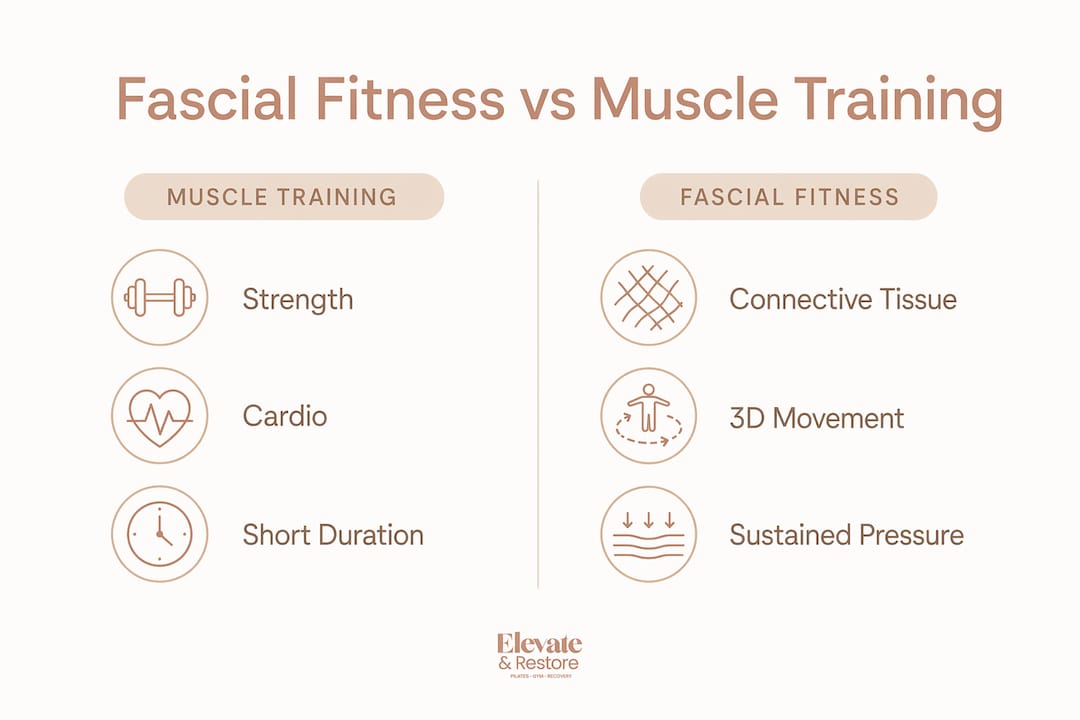
Fascial fitness also uses three-dimensional movement patterns that conventional gym training often ignores. Lateral lunges, rotational reaches, and bounding exercises load fascia along diagonal and spiral lines that straight-plane lifting does not reach. This is why athletes who train exclusively in the sagittal plane often develop asymmetries and unexplained tightness.
Pro Tip: When foam rolling, breathe slowly and hold each area for a full 90 seconds. If you feel discomfort ease within that window, you have found a genuinely restricted zone. If it does not ease, move on and return later rather than forcing the tissue.
What are evidence-based techniques for training your fascial system?
Fascial training methods fall into four practical categories, each targeting different mechanical properties of the tissue.
-
Foam rolling and myofascial release. Apply sustained, moderate pressure to a target area using a foam roller or massage ball for at least 90 seconds. Foam rolling benefits fascia only when held long enough to activate the viscoelastic response. Focus on the thoracic spine, hip flexors, calves, and plantar fascia. Breathe through the discomfort rather than tensing around it.
-
Elastic, spring-like movement. Skipping, bounding, and light plyometric drills load the fascial system through its elastic rebound properties. These movements store and release energy through the Achilles tendon, plantar fascia, and thoracolumbar fascia. Short, rhythmic repetitions at low intensity are more effective for fascial loading than heavy, slow plyometrics.
-
Slow, sustained stretching. Stretches held for 90 seconds or longer allow the viscoelastic properties of fascia to respond. Yin yoga and restorative Pilates use this principle directly. Fast, ballistic stretching primarily loads the muscle spindle reflex and does not reach the deeper fascial matrix.
-
Fascial flossing. A compression band is wrapped around a limb and the joint is moved through its full range while compressed. Research on collegiate distance runners found that lower-leg fascial flossing improves myofascial glide, flexibility, and perceived tightness while preserving jump performance after fatigue. Ultrasound imaging confirmed the glide improvements, making this one of the few fascial techniques with direct tissue-level evidence.
"Fascial fitness is best understood as loading, positioning, and recovery strategies that focus on fascia's unique mechanical properties rather than fast stretching or high-load muscle work." — Fascial Training Guide, 2026
Hydration and sleep are non-negotiable supports for fascial health. The ground substance within fascia is largely water-based. Without adequate hydration, the matrix thickens, layers lose their ability to glide, and the tissue becomes less responsive to training. Aim for consistent daily fluid intake, not just pre-session hydration.
How to integrate fascial system fitness into your existing exercise routine?
The most effective approach treats fascial training as a layer added to your existing programme rather than a replacement for it. You do not need to overhaul your sessions. You need to add specific inputs at the right moments.
Warm-up phase. Use 5-8 minutes of foam rolling and slow 3D movement before strength or cardio sessions. Focus on areas that feel restricted rather than rolling everything. Target the thoracic spine, hip flexors, and calves as a baseline, then add areas specific to the day's training.
Within the session. Include at least one elastic, spring-like movement in every session. Skipping rope for two minutes, lateral bounds, or a short bounding drill before your main lifts loads the fascial system in ways that improve force transfer and reduce injury risk. Functional training that prevents injury consistently incorporates these multi-plane fascial loading patterns.
Cool-down phase. Dedicate 10 minutes post-session to sustained stretching and light fascial flossing on worked areas. This is when the tissue is warm and most receptive to viscoelastic change. Holding each position for 90 seconds or more at this point delivers measurable results over weeks of consistent practice.
Dedicated fascial sessions. Once per week, a 30-45 minute session focused entirely on foam rolling, slow stretching, and bounding drills accelerates tissue adaptation. Mindful movement classes built around Pilates and restorative movement align closely with this approach.
- Use a high-density foam roller for large areas like the thoracic spine and IT band.
- Use a lacrosse ball or massage ball for smaller, more precise areas like the plantar fascia and glutes.
- Use resistance bands for fascial flossing on the calves, knees, and elbows.
- Avoid rolling directly over joints, bony prominences, or acutely inflamed tissue.
Pro Tip: Track your range of motion in two or three key movements, such as a forward fold or overhead reach, at the start of each week. Fascial adaptation is slow and subtle. Objective measurements prevent you from abandoning a practice that is working simply because you cannot feel the change yet.
What are the benefits and limitations of fascial system fitness?
The evidence for fascial training is growing, though it is not yet as deep as the evidence base for resistance training or cardiovascular exercise. The benefits that are well-supported include the following.
| Benefit | Evidence basis |
|---|---|
| Improved fascial glide and flexibility | Ultrasound-confirmed in collegiate runner flossing study |
| Enhanced proprioception and movement accuracy | Fascia's high sensory nerve density; restricted fascia impairs joint position sense |
| Reduced injury risk | Improved force transfer and proprioception reduce mechanical overload |
| Pain modulation | Myofascial release therapy targets stiff fascial areas to alleviate pain and improve mobility |
| Connective tissue regeneration | Mechanical loading activates mechanotransduction pathways that drive fascial repair |
The limitations are equally worth knowing. Myofascial release evidence is heterogeneous due to significant variation in technique, pressure, and duration across studies. This makes it difficult to compare results or establish universal protocols. The Mayo Clinic notes that while massage and stretching may loosen muscles and joints, the precise mechanism of myofascial release remains debated.
Fascial training also requires patience. Connective tissue remodels far more slowly than muscle. Expecting dramatic results in two weeks leads to abandonment of a practice that would have delivered real change at the eight-week mark. Consistency over months, not intensity over days, is what drives fascial adaptation. For complex presentations or chronic pain, working with a qualified practitioner who understands fascial anatomy is the most reliable path forward.
Key takeaways
Fascial system fitness works because it targets the connective tissue network that determines how force travels, how joints move, and how accurately your body senses its own position in space.
| Point | Details |
|---|---|
| Fascia is an active tissue | The fascial system is a continuous 3D network that adapts to mechanical load, not passive wrapping. |
| Duration is the key variable | Foam rolling and stretching require ~90 seconds per area to trigger a genuine viscoelastic tissue response. |
| Fascial flossing has direct evidence | Ultrasound studies confirm improved myofascial glide, flexibility, and performance in athletes using flossing techniques. |
| Proprioception depends on fascia | Restricted fascia reduces sensory nerve accuracy, increasing injury risk independently of muscle strength. |
| Consistency beats intensity | Fascial tissue remodels slowly. Eight weeks of regular practice outperforms two weeks of aggressive rolling. |
Why fascial fitness changed how I coach movement
Most people arrive at Elevateandrestore having trained hard for years but carrying persistent tightness, recurring niggles, or a frustrating ceiling on their mobility. The first thing I notice is that their muscle strength is often fine. What is not fine is the tissue quality surrounding those muscles.
The shift that changes everything for these clients is not adding more load. It is adding the right kind of input at the right duration. When someone spends a genuine 90 seconds on a restricted hip flexor before their Pilates session, the change in movement quality within that same session is visible. Not because the muscle got stronger, but because the fascial matrix released enough to let the joint move through its actual range.
The misconception I see most often is treating foam rolling as a warm-up ritual rather than a training stimulus. Rolling for 10 seconds per side while watching the clock is not fascial training. It is theatre. The tissue needs time, breath, and sustained load to respond.
My honest advice is to start with two areas, your thoracic spine and your calves, and commit to 90-second holds every session for six weeks. Measure your forward fold at the start and end. The change will be objective and it will be enough to convince you that this layer of training is worth the time.
Fascial fitness does not replace strength work or cardio. It makes both of them work better. At Elevateandrestore, every session is designed with this in mind, whether you are in the reformer room or the recovery lounge.
— Elevate
Train smarter with Elevateandrestore
At Elevateandrestore, fascial health is built into every aspect of how we train and recover. Our reformer Pilates classes use slow, sustained movement patterns that load the fascial system through its full range, exactly the kind of input that drives connective tissue adaptation. Small groups of six mean your movement quality gets real attention, not just a programme handed to you at the door.
Our recovery lounge takes fascial recovery seriously. The sauna, cold plunge, hot tub, and compression boots each support tissue hydration, circulation, and fascial glide in ways that passive rest simply cannot match. If you are ready to train the tissue that connects everything, we are ready to help you do it properly.
FAQ
What is fascial system fitness in simple terms?
Fascial system fitness is the practice of deliberately training your body's connective tissue network using specific techniques like foam rolling, sustained stretching, and elastic movement drills. It targets the fascia surrounding and threading through muscles to improve mobility, force transfer, and recovery.
What is myofascial release and how does it work?
Myofascial release applies light, sustained pressure to stiff areas of the fascial network to reduce tension and improve mobility. The Mayo Clinic notes it is used clinically for pain relief from myofascial trigger points, though technique variation means results differ between practitioners.
How long should I foam roll for fascial benefits?
Foam rolling requires approximately 90 seconds of sustained pressure per area to trigger a viscoelastic tissue response. Shorter durations, such as 10 seconds, do not reach the threshold needed for genuine fascial change.
Can fascial training reduce injury risk?
Yes. Fascia contains more sensory nerve endings than muscle, and restricted fascia impairs proprioception independently of muscle strength. Improving fascial glide and tissue quality through regular training reduces mechanical overload and the injury risk that comes with poor joint position sense.
How often should I include fascial training in my routine?
Include 5-10 minutes of foam rolling and slow stretching in every session warm-up and cool-down, and add one dedicated 30-45 minute fascial session per week. Consistent practice over six to eight weeks produces measurable improvements in range of motion and tissue quality.