
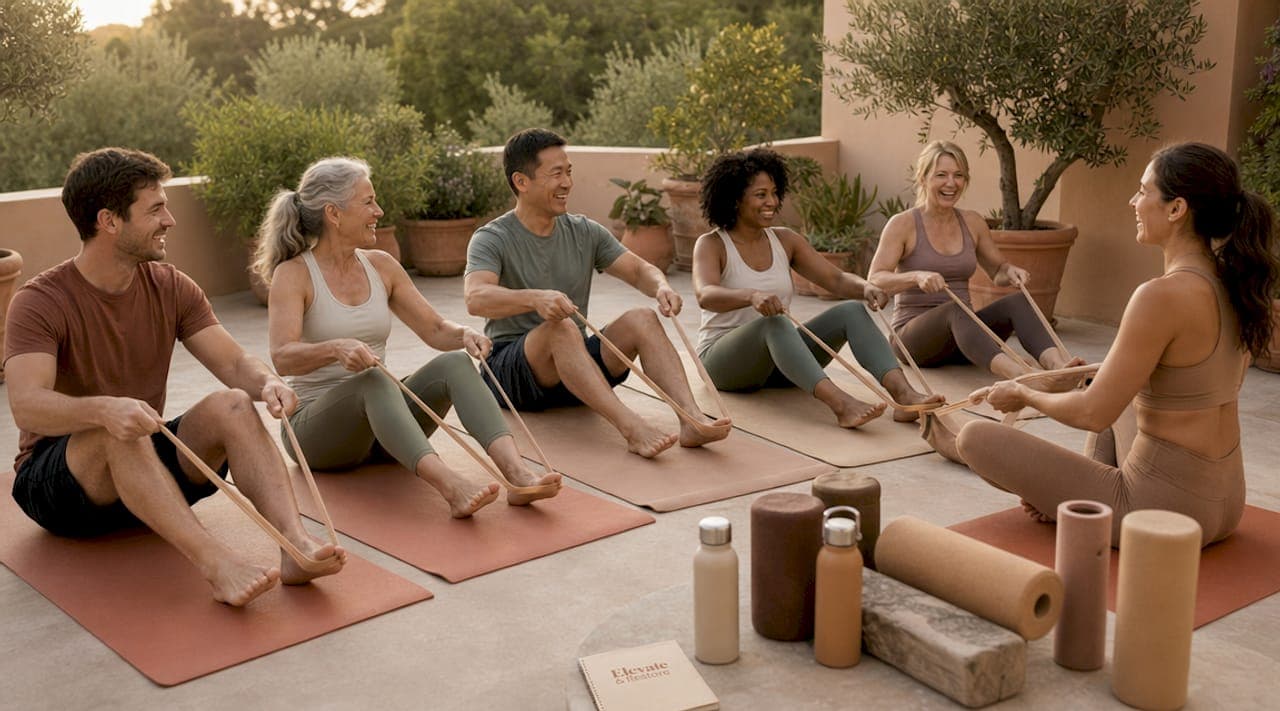
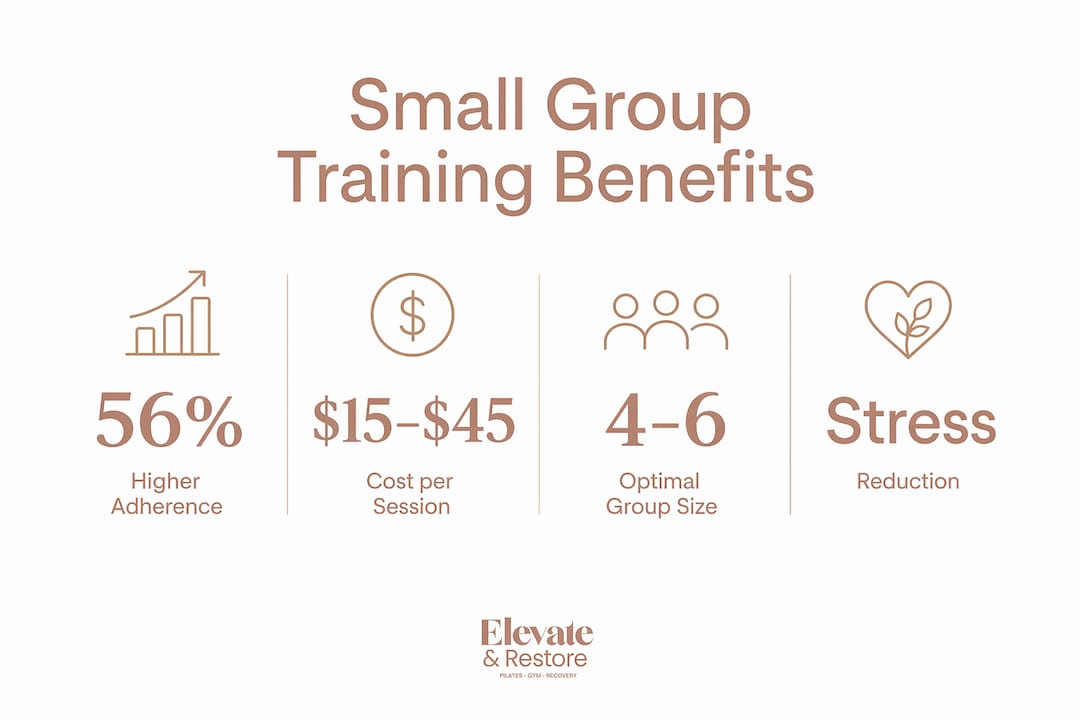
A small group fitness class is a structured, coach-led training session with 2 to 10 participants, designed to deliver personalised attention within a motivating group setting. Unlike solo gym sessions or large fitness classes, this format sits at the intersection of private coaching and community energy. The optimal coaching range is 4 to 6 people, which allows a trainer to correct form, scale exercises, and track individual progress without losing the group dynamic. At Elevateandrestore, every session is capped at six participants for exactly this reason.
What is a small group fitness class?
Small group training (SGT) is the recognised industry term for what many people call a small group fitness class. The format pairs the personalised feedback of one-on-one coaching with the social energy of a group environment, at a fraction of the cost of private sessions. Programmes like CrossFit, F45, and boutique Pilates studios have popularised this model, but the most effective versions go beyond branded workouts. They rely on certified trainers who understand progressive programming, not just trainers who count reps and play music.
The key distinction from a large group class is the trainer-to-participant ratio. In a spin class or boot camp with 20 to 30 people, a trainer physically cannot assess your movement patterns or adjust your load. In a group of four to six, they can. That difference in attention is what separates a class that produces results from one that produces fatigue.
What are the benefits of small group training?
The benefits of small group fitness are well supported by research, and they go beyond simply having a trainer nearby.
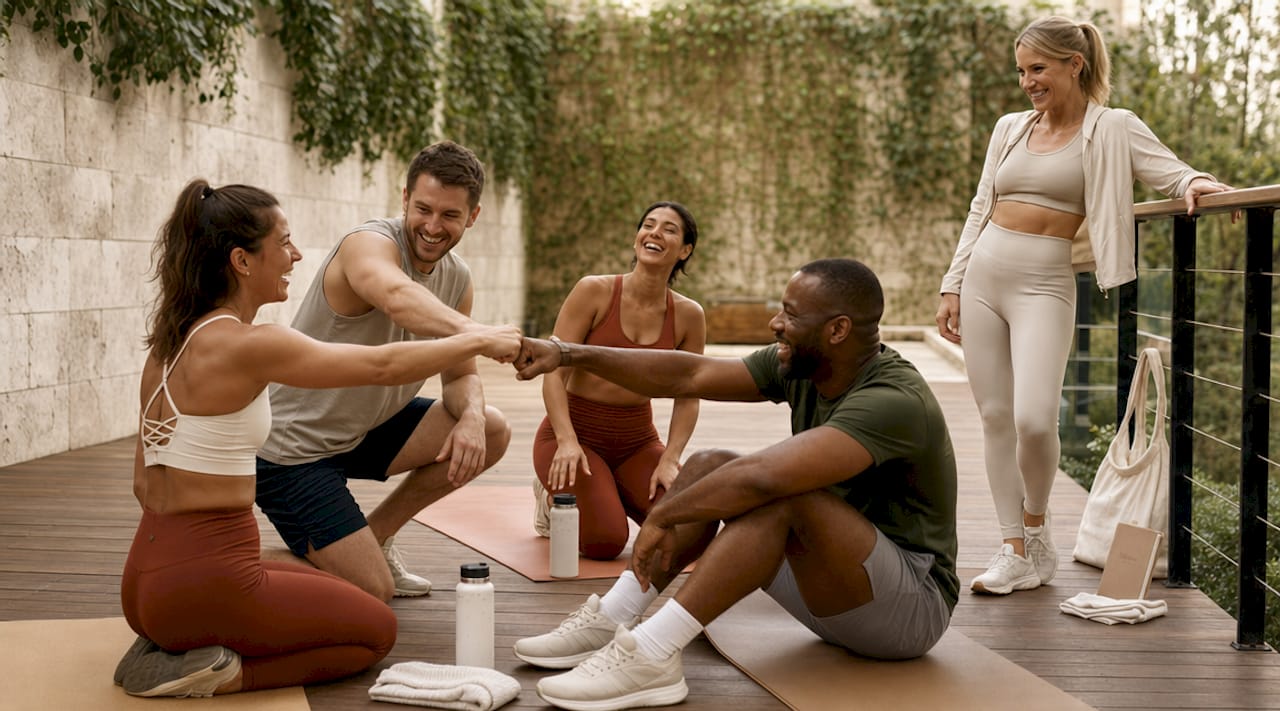
Cost-effectiveness is the most obvious advantage. One-on-one training costs $60 to $120 per hour, while small group sessions typically run $15 to $45 per session. That price difference makes expert coaching accessible to people who could never justify a private training budget.
Adherence and consistency are where the research gets compelling. Group exercise participants are 56% less likely to cancel their gym membership compared to those training alone. This is not just about willpower. When you have a regular time slot, a familiar trainer, and the same six faces expecting you to show up, skipping becomes socially awkward in the best possible way.
Stress reduction and mental wellbeing are measurable outcomes, not just side effects. Training in group settings lowers self-reported stress by 26% and improves quality of life compared to solo training. For people managing busy schedules, anxiety, or low motivation, this is a significant reason to choose a group format over solo gym sessions.
Injury prevention is an underrated benefit of the small group model. A certified trainer watching six people can spot a collapsing knee, a rounded lower back, or an overloaded shoulder in real time. In a large class, those movement faults go unnoticed for weeks and become chronic problems.
Pro Tip: If accountability is your biggest challenge, book your sessions at the start of each week and treat them like medical appointments. The social obligation of a small group makes cancellation feel genuinely costly, which is exactly the friction you need.
The benefits of structured group fitness compound over time. Clients who attend consistently with the same group build fitness literacy alongside physical capacity. They learn to read their own bodies, understand progressive overload, and make smarter decisions outside the studio.
How does small group training compare to other formats?
Understanding the differences between training formats helps you choose the right fit for your goals and personality.
Small group training balances personalised attention with group motivation at a moderate price point. It is a hybrid model that neither large group classes nor private sessions can replicate. Here is how the three formats compare directly:
| Format | Participants | Trainer attention | Typical cost | Best for |
|---|---|---|---|---|
| One-on-one training | 1 | Full, continuous | $60 to $120 per session | Rehabilitation, elite performance |
| Small group training | 2 to 10 (ideal: 4 to 6) | High, shared | $15 to $45 per session | Consistent progress, community |
| Large group class | 10 to 40+ | Minimal | $10 to $30 per class | General fitness, motivation |
The atmosphere in each format differs significantly. One-on-one sessions are focused and quiet. Large group classes are high-energy and anonymous. Small group sessions sit in between: familiar, supportive, and purposeful. Most people find the small group atmosphere easier to sustain long-term because it combines social warmth with genuine coaching.
For people who are new to structured training, the small group format also reduces the intimidation factor. You are not performing in front of a crowd, and you are not alone with a trainer scrutinising every movement. The group of familiar peers creates a psychologically safe space to learn, fail, and improve.
What happens during a typical small group fitness session?
A well-designed small group session follows a clear structure that balances preparation, training stimulus, and recovery. Typical sessions include a dynamic warm-up, circuit or station training, and trainer-driven modifications scaled to each participant's fitness level.
A standard 45 to 60 minute session at a quality studio looks like this:
- Dynamic warm-up (8 to 10 minutes). Mobility drills, activation exercises, and movement prep specific to the day's training focus. Not a generic jog on the treadmill.
- Skill or technique block (5 to 10 minutes). The trainer introduces or refines the primary movement pattern for the session, such as a hinge, press, or squat variation.
- Main workout (25 to 30 minutes). Circuit or station-based training combining strength, functional movements, and conditioning. Exercises are scaled individually so every participant works at an appropriate intensity.
- Cool-down and mobility (5 to 10 minutes). Targeted stretching and breathing work to support recovery and reduce next-day soreness.
The trainer's role throughout is to coach, not just supervise. The effectiveness of small group training depends on the trainer's ability to deliver periodised, progressive programming tailored to the group, not random workouts assembled the morning of the session. This is the difference between a studio that produces results and one that just produces sweat.
Variety in session design prevents adaptation plateaus. Quality programmes rotate between HIIT, strength-focused sessions, mobility work, and team finishers across the week. At Elevateandrestore, this is built into the weekly schedule so participants develop across multiple physical qualities rather than grinding the same stimulus repeatedly.
Pro Tip: Before joining any small group programme, ask the trainer how sessions are programmed across the week and month. If the answer is vague, the programming is probably random. Progressive, periodised programming is the single biggest predictor of long-term results.
How does community drive results in small group fitness?
The social dimension of small group training is not a soft benefit. It is a physiological mechanism. The Köhler Effect describes the tendency for individuals to work harder in a group than alone, particularly when they perceive themselves as the least capable member. In practical terms, training alongside people who are slightly fitter than you consistently raises your output without requiring extra motivation.
Group fitness participants also report higher feelings of belonging and better overall wellbeing compared to solo exercisers. These psychosocial benefits matter for long-term fitness adherence because motivation is finite. Community is not.
The community dynamic in a small group is qualitatively different from a large class. In a group of six, you know everyone's name within two sessions. You notice when someone is absent. You celebrate when someone hits a new personal best. These micro-interactions before and after sessions, the check-ins, the shared frustration of a hard workout, the post-session conversations, create genuine social bonds that make showing up feel like a choice you want to make rather than one you have to make.
Consistent attendance with the same group members substantially improves adherence beyond the sporadic participation common in open gym settings. The research is clear: familiarity breeds commitment.
"The group becomes your reason to show up on the days when your own motivation runs out."
How to choose the right small group fitness class
Not all small group classes are created equal. Choosing the right one requires looking past the marketing and assessing a few concrete factors.
Trainer qualifications and coaching style matter more than the studio's aesthetic. Look for trainers with recognised certifications such as Certificate III or IV in Fitness, and ask whether they have experience in the specific training modality you are pursuing, whether that is functional strength training, Pilates, or conditioning work.
Class size is non-negotiable. Any session marketed as small group with more than ten participants is a large group class with a different label. The coaching quality drops sharply above six to eight people.
Programme focus and progression should align with your goals. A class built around random daily workouts will not produce the same results as one built on a structured training block. Ask to see the programme structure before committing.
Environment and scheduling affect consistency more than people expect. A studio that fits your commute, offers sessions at times that suit your life, and has a culture you enjoy is worth more than a technically superior programme you never attend. The most common frequency for group fitness sessions is 2 to 3 times per week, which balances recovery with meaningful progress.
Trial sessions are standard practice at reputable studios. Use them. A single session tells you more about coaching quality, group culture, and programming logic than any website description.
Key takeaways
Small group fitness classes deliver better long-term results than solo training because they combine personalised coaching, progressive programming, and genuine community accountability in a single, cost-effective format.
| Point | Details |
|---|---|
| Optimal group size | Sessions with 4 to 6 participants allow trainers to coach form and scale exercises individually. |
| Cost advantage | Small group sessions cost $15 to $45, compared to $60 to $120 for one-on-one training. |
| Adherence boost | Group exercise participants are 56% less likely to cancel their gym membership than solo trainers. |
| Community effect | The Köhler Effect and social bonds formed in small groups raise output and sustain long-term commitment. |
| Programming quality | Progressive, periodised programming separates results-driven studios from random workout providers. |
Why small group training changed how I think about fitness coaching
Most fitness professionals will tell you that consistency is the key to results. That is true, but it is incomplete. Consistency without quality coaching produces consistent mediocrity. What I have observed working with clients in small group settings is that the combination of accountability and skilled instruction creates a feedback loop that neither solo training nor large classes can replicate.
The misconception I hear most often is that small group classes are a compromise. People assume they are getting less than private training because they are sharing the trainer's attention. In reality, the group dynamic adds something private sessions cannot: the lived experience of training alongside people who are working through the same challenges. That shared struggle is not a distraction. It is a catalyst.
I have also seen people dramatically underestimate how much the social layer of a small group affects their physical output. Clients who would stop a set early when training alone will push through an extra two reps when their group is watching. That marginal effort, repeated across hundreds of sessions, compounds into real physical change.
The studios worth your time are the ones where the trainer knows your name, your movement history, and your goals. Where the programme changes week to week with intention. Where the six people in the room feel like a team rather than strangers sharing a time slot. That environment is not accidental. It is built deliberately, and it is worth seeking out.
— Elevate
Train smarter with Elevateandrestore in Melbourne's inner west
Elevateandrestore is a functional training and Pilates studio in Melbourne's inner west, built around the small group model. Every session is capped at six participants, which means your trainer knows your movement patterns, your goals, and when to push you harder. The studio also includes a full recovery hub with sauna, cold plunge, hot tub, and compression boots, so your training and recovery happen in the same place.
If you are ready to experience what boutique small group training actually feels like, Elevateandrestore offers trial sessions with no long-term commitment required. Come in, meet the group, and see whether the environment fits. You can also explore the Reformer Pilates programme if structured, low-impact training is your starting point.
FAQ
What is the ideal size for a small group fitness class?
The ideal size is 4 to 6 participants. This range allows a certified trainer to provide personalised form corrections and exercise scaling while maintaining the motivational energy of a group setting.
How often should I attend small group fitness sessions?
The most effective frequency is 2 to 3 sessions per week. This schedule allows adequate recovery between sessions while providing enough training stimulus for consistent progress.
Are small group fitness classes suitable for beginners?
Yes. The small group format is particularly well-suited to beginners because the trainer can scale every exercise to your current fitness level, and the intimate group size reduces the intimidation of a large class environment.
How much do small group fitness sessions cost in Australia?
Small group training sessions typically cost $15 to $45 per session, compared to $60 to $120 per hour for one-on-one personal training. The exact price varies by studio, location, and session length.
What is the difference between small group training and a regular group fitness class?
Small group training involves 2 to 10 participants with a trainer who actively coaches each person individually. A regular group fitness class typically has 10 to 40 or more participants, where the trainer leads the group but cannot provide individual attention or form correction.