

Postural imbalance correction is the process of identifying and addressing uneven muscle tension, joint misalignment, and movement dysfunction to restore balanced posture and body function. In clinical practice, the term "postural re-education" is often used interchangeably, and both refer to the same structured approach used in physiotherapy and musculoskeletal rehabilitation. The goal is not to achieve a rigid, picture-perfect stance. It is to restore the muscle coordination and movement capacity that lets your body move freely and without pain. Whether you are dealing with a stiff neck from desk work, rounded shoulders, or persistent lower back ache, understanding what is postural imbalance correction is the first step toward doing something about it.
What causes postural imbalance and how does it affect the body?
Postural imbalance develops when certain muscles become overworked and tight while opposing muscles weaken and switch off. The most common driver is prolonged static posture, such as sitting at a desk for hours, looking down at a phone, or standing in one position without moving. Over time, these habits create predictable patterns of dysfunction.
The most frequently seen patterns include:
- Forward head posture: the head drifts in front of the shoulders, loading the neck and upper back
- Rounded shoulders: tight chest muscles pull the shoulders forward, weakening the mid-back stabilisers
- Anterior pelvic tilt: tight hip flexors pull the pelvis forward, compressing the lower back
- Thoracic hyper-kyphosis: excessive rounding of the upper spine, often paired with rounded shoulders
- Lateral spinal shifts: uneven loading through one hip or leg, common in people who habitually stand on one side
These patterns cause more than cosmetic changes. Poor alignment reduces movement efficiency, accelerates muscle fatigue, and places sustained load on joints and discs. Posture also influences nervous system function, with poor alignment linked to reduced vagal tone, contributing to fatigue and tension.
One of the most important shifts in modern clinical thinking is this: no universal "perfect" posture exists. Pain and discomfort are linked more to sustained loading and reduced capacity than to any specific degree of tilt or curve. That means the goal of correction is not to freeze your body in one ideal position. It is to build the capacity to move comfortably across many positions.

What does a professional postural assessment involve?
A professional assessment is the foundation of any effective correction plan. Without it, exercises are guesswork. A comprehensive postural assessment covers static and dynamic alignment, strength testing, mobility checks, and an ergonomic review.
A structured assessment typically follows these steps:
- Static alignment observation: the practitioner evaluates your posture from the front, side, and back to identify visible imbalances in the head, shoulders, spine, pelvis, and feet.
- Dynamic movement screening: watching how you squat, hinge, and walk reveals compensation patterns that static observation misses.
- Muscle strength testing: key stabilisers including the deep neck flexors, mid-back muscles, glutes, and core are tested for weakness or inhibition.
- Mobility assessment: tight areas such as the chest, hip flexors, and thoracic spine are identified through range-of-motion testing.
- Breathing pattern evaluation: shallow, chest-dominant breathing is a common finding that directly affects muscle activation and tension patterns.
- Ergonomic and lifestyle review: workstation setup, sleep position, and daily habits are discussed to identify contributing factors.
From this assessment, a customised correction plan is built around reactivating inhibited muscles such as the deep neck flexors, mid-back, and glutes, while lengthening tight areas including the chest and hip flexors. The plan typically combines targeted strengthening, mobility work, breathing retraining, and ergonomic adjustments. Manual therapy may also be used to reduce tension in overloaded tissues before corrective exercise begins.
Which exercises and techniques effectively correct postural imbalances?
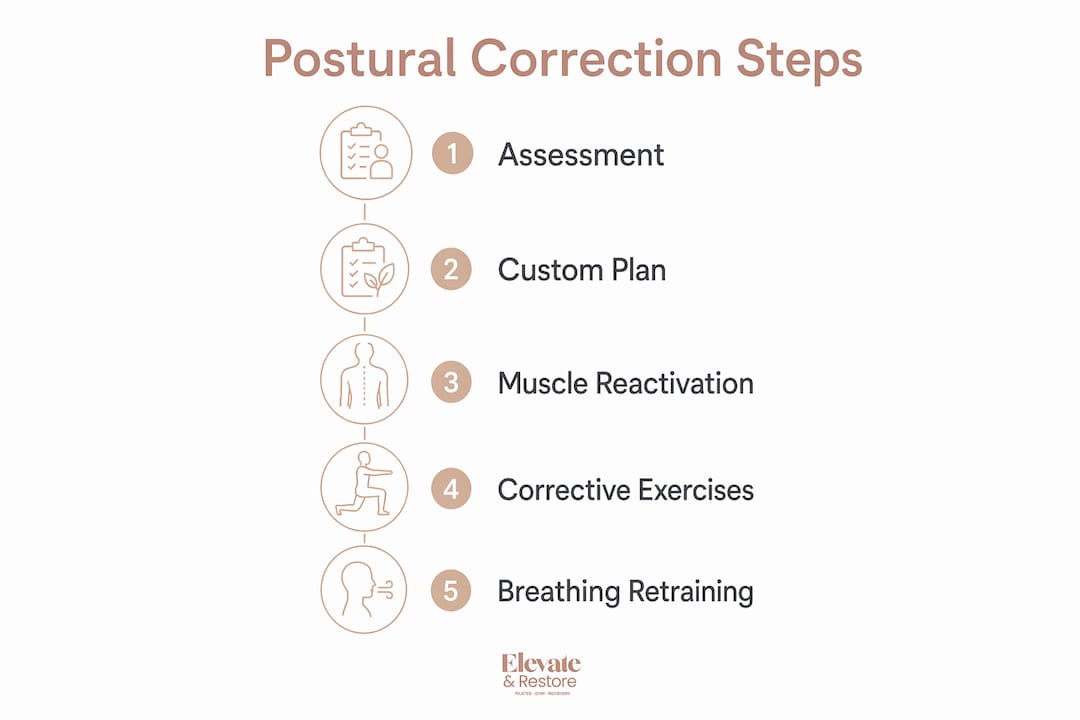
Evidence supports corrective exercise as an effective method for improving postural alignment. A systematic review of 28 randomised controlled trials found significant improvements in forward head posture, rounded shoulders, and thoracic hyper-kyphosis angles following corrective exercise programmes. That finding confirms that targeted movement can produce measurable structural change.
Foundational corrective exercises
Corrective programmes consistently target the same muscle groups: deep neck flexors, mid-back stabilisers, glutes, and core. The most effective exercises include:
- Chin tucks: retract the chin gently to activate the deep neck flexors and reduce forward head posture. Hold for 5 seconds, repeat 10 times.
- Scapular squeezes: draw the shoulder blades together and down to activate the mid-back. Hold for 5 seconds, repeat 10–15 times.
- Glute bridges: lie on your back with knees bent, press through the heels, and lift the hips. This activates the glutes and reduces anterior pelvic tilt.
- Cat-cow stretches: move the spine through flexion and extension to restore thoracic mobility and reduce stiffness.
- Chest and hip flexor stretches: open the front of the body to counteract the tightening caused by prolonged sitting.
The role of breathing retraining
Diaphragmatic breathing retraining is foundational before strength training begins. Shallow, chest-dominant breathing triggers neck and shoulder tension and inhibits the deep stabilising muscles that support the spine. Retraining the breath to engage the diaphragm reduces this tension and enables proper muscle activation during exercise. Spend two to three minutes on diaphragmatic breathing before any corrective session.
Pro Tip: Practise diaphragmatic breathing by placing one hand on your chest and one on your belly. On the inhale, your belly should rise first. If your chest rises first, you are breathing shallowly and your neck muscles are compensating.
What to avoid
Posture braces used continuously can cause muscle atrophy by replacing rather than strengthening internal support. Successful correction depends on neuromuscular re-education, not passive support. Similarly, rigidly holding a "good posture" position all day is counterproductive. The body needs movement variability to prevent fatigue and strain from any fixed position.
How can you maintain balanced posture every day?
Long-term postural change requires rebuilding automatic coordination of deep stabilising muscles. That is a process of retraining, not willpower. Sustainable improvement comes from integrating small habits into daily life rather than relying on occasional exercise sessions alone.
Practical daily strategies include:
- Micro-breaks every 30–45 minutes: gentle movement breaks involving walking, shoulder rolls, and neck rotations reset posture and circulation, preventing the muscle fatigue caused by sustained static positions.
- Workstation setup: position your screen at eye level, keep your feet flat on the floor, and support your lower back. A poorly set-up workstation undoes corrective exercise progress quickly.
- Phone habits: hold your phone at eye level rather than looking down. Sustained neck flexion from phone use is one of the fastest ways to rebuild forward head posture.
- Sleep position: sleeping on your back or side with appropriate pillow support reduces overnight strain on the neck and lower back.
- Awareness training: notice when you have been in one position for too long. Discomfort is a signal to move, not to push through.
Pro Tip: Set a timer on your phone or computer to remind you to move every 30 minutes. The reminder removes the need to rely on memory or motivation, which both fade during focused work.
Integrating corrective exercises into an existing fitness routine is the most reliable way to maintain progress. Pilates, in particular, builds the core stability and deep stabiliser strength that postural correction depends on. Addressing strength training imbalances alongside posture work produces faster and more durable results.
Key takeaways
Postural imbalance correction works by restoring muscle function, movement variability, and breathing mechanics, not by forcing the body into a fixed ideal position.
| Point | Details |
|---|---|
| Correction targets muscle function | Reactivating weak stabilisers and lengthening tight muscles produces lasting alignment change. |
| Assessment comes first | A professional assessment identifies specific imbalances before any exercise plan is built. |
| Breathing retraining matters | Diaphragmatic breathing reduces tension and enables proper activation of stabilising muscles. |
| Movement variability beats rigid posture | Shifting positions frequently prevents fatigue and strain better than holding one "correct" posture. |
| Daily habits sustain progress | Micro-breaks, ergonomic setup, and integrated corrective exercise maintain improvements over time. |
What I have learned from working with postural imbalances
The most common mistake I see is people treating postural correction as a willpower problem. They try to "sit up straight" all day and feel like failures when they slump an hour later. That is not a discipline issue. It is a muscle function issue. The deep stabilisers that hold you upright without effort are simply not strong enough yet.
The second myth worth addressing is the idea of a perfect posture. There is no single correct position. The body is designed to move, and the best posture is always your next one. Rigid posture efforts create new tension patterns rather than resolving old ones. What actually works is building the capacity to move freely across many positions, which is exactly what structured corrective exercise and Pilates develop.
The third pitfall is skipping the assessment. People buy posture braces, follow generic exercise videos, and wonder why nothing changes. Without knowing which muscles are weak and which are tight in your specific body, you are working blind. A proper assessment changes everything because it tells you exactly where to direct your effort.
The approach that produces real results combines a thorough assessment, targeted strengthening, breathing work, ergonomic adjustments, and consistent movement habits. None of these elements alone is sufficient. Together, they rebuild the automatic coordination that good posture actually requires.
— Elevate
How Elevateandrestore supports postural correction
Postural re-education is most effective when it is guided, progressive, and specific to your body. Elevateandrestore offers small-group reformer Pilates classes in West Footscray with a maximum of six people per session, giving every person the attention needed to correct movement patterns safely and effectively. Pilates directly targets the deep stabilisers, breathing mechanics, and movement variability that postural correction depends on.
After training, the recovery lounge at Elevateandrestore supports muscle recovery through sauna, cold plunge, hot tub, and compression boots. Reducing post-session tension helps the body consolidate the neuromuscular changes that corrective exercise creates. If you are ready to address your posture with a structured, evidence-based approach, Elevateandrestore is the place to start.
FAQ
What is postural imbalance correction?
Postural imbalance correction is the process of identifying and addressing uneven muscle tension, joint misalignment, and movement dysfunction to restore balanced posture and function. It combines assessment, targeted exercise, breathing retraining, and ergonomic adjustments.
How long does it take to correct postural imbalance?
Postural correction is gradual and depends on the severity of the imbalance and consistency of the programme. Measurable improvements in alignment angles are achievable with regular corrective exercise, though rebuilding automatic muscle coordination takes months of consistent practice.
Do posture braces fix postural imbalance?
Posture braces do not fix postural imbalance and can worsen it when used continuously. Wearing a brace replaces internal muscle support rather than strengthening it, leading to muscle weakening over time.
What are the signs of postural imbalance?
Common signs include forward head posture, rounded shoulders, one shoulder sitting higher than the other, persistent neck or lower back pain, and uneven hip height. Fatigue during activities that should feel easy is also a reliable indicator.
Can Pilates correct postural imbalances?
Pilates directly targets the deep stabilising muscles, breathing mechanics, and movement patterns that postural correction requires. It is one of the most evidence-aligned exercise methods for improving alignment and reducing the muscle imbalances that drive poor posture.