
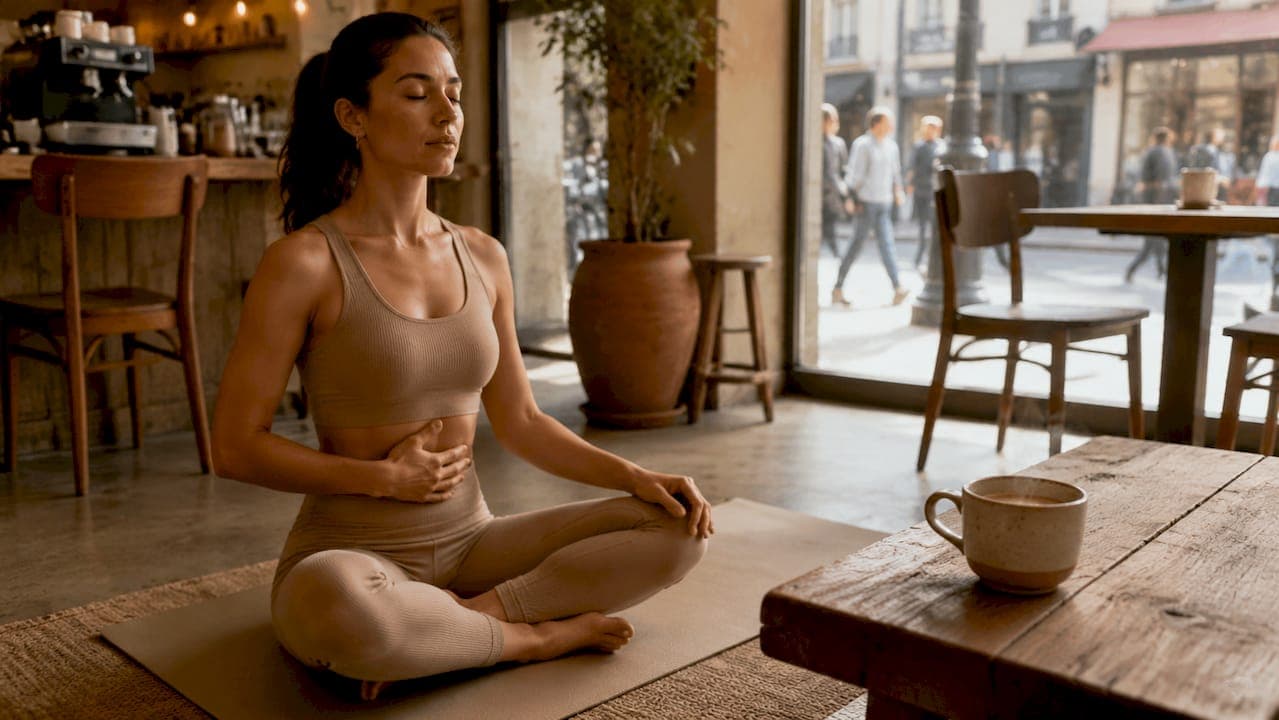
Pilates improves the nervous system by activating the parasympathetic nervous system and reprogramming how the brain regulates muscle tension, breath, and stress responses. This is not a vague wellness claim. Clinical research, including a 2026 randomised controlled trial measuring heart rate variability (HRV), confirms that consistent Pilates practice produces measurable changes in autonomic function. The mechanisms are specific: diaphragmatic breathing stimulates the vagus nerve, mindful movement reduces threat perception in the central nervous system, and the slow, controlled tempo of Pilates keeps the body out of fight-or-flight during exercise. Understanding why Pilates improves nervous system health gives you a clear reason to treat it as neurological training, not just a workout.
How does Pilates breathing influence the autonomic nervous system?
Breath is the fastest lever you have over your nervous system, and Pilates uses it with precision. The specific technique of a slow, controlled exhale through pursed lips directly stimulates the vagus nerve, which is the primary pathway the body uses to activate parasympathetic (rest-and-digest) states. Most exercise drives the body deeper into sympathetic arousal. Pilates breathing does the opposite.
The vagus nerve activation from Pilates-style exhalation signals the autonomic nervous system to lower heart rate, reduce cortisol output, and shift the body away from the chronic low-grade fight-or-flight state that most people carry through their day. This is why practitioners often describe feeling calmer after a session, not just physically tired. The effect is physiological, not psychological.
Pilates breathing works through three distinct mechanisms:
- Diaphragmatic engagement: The diaphragm sits directly adjacent to the vagus nerve. Deep belly breathing physically stimulates vagal fibres, producing an immediate parasympathetic response.
- Extended exhalation ratio: Pilates cues a longer exhale than inhale. This ratio is the same principle used in clinical breathwork protocols for anxiety and panic disorders.
- Rhythmic coordination with movement: Breath is timed to effort, which prevents the breath-holding pattern that spikes sympathetic arousal during physical exertion.
Experts now describe Pilates breath control as one of the most accessible tools for nervous system regulation available to the general population. The science supports this. You do not need a meditation cushion or a float tank. You need a Pilates mat and someone who can cue your breath correctly.
Pro Tip: If you find your mind racing during a session, return your attention to the exhale. A slow, full breath out through slightly pursed lips is the fastest way to bring your nervous system back to a regulated state mid-class.
How does Pilates retrain muscle tension through the nervous system?
Most people assume tight muscles are a structural problem, something to stretch or foam roll away. The reality is that muscle tension is regulated centrally, by the central nervous system, not by the muscle tissue itself. Chronic stiffness in the neck, hips, or lower back is often the nervous system holding protective tension in response to perceived threat, whether that threat is physical load, emotional stress, or poor movement patterns it has learned to distrust.
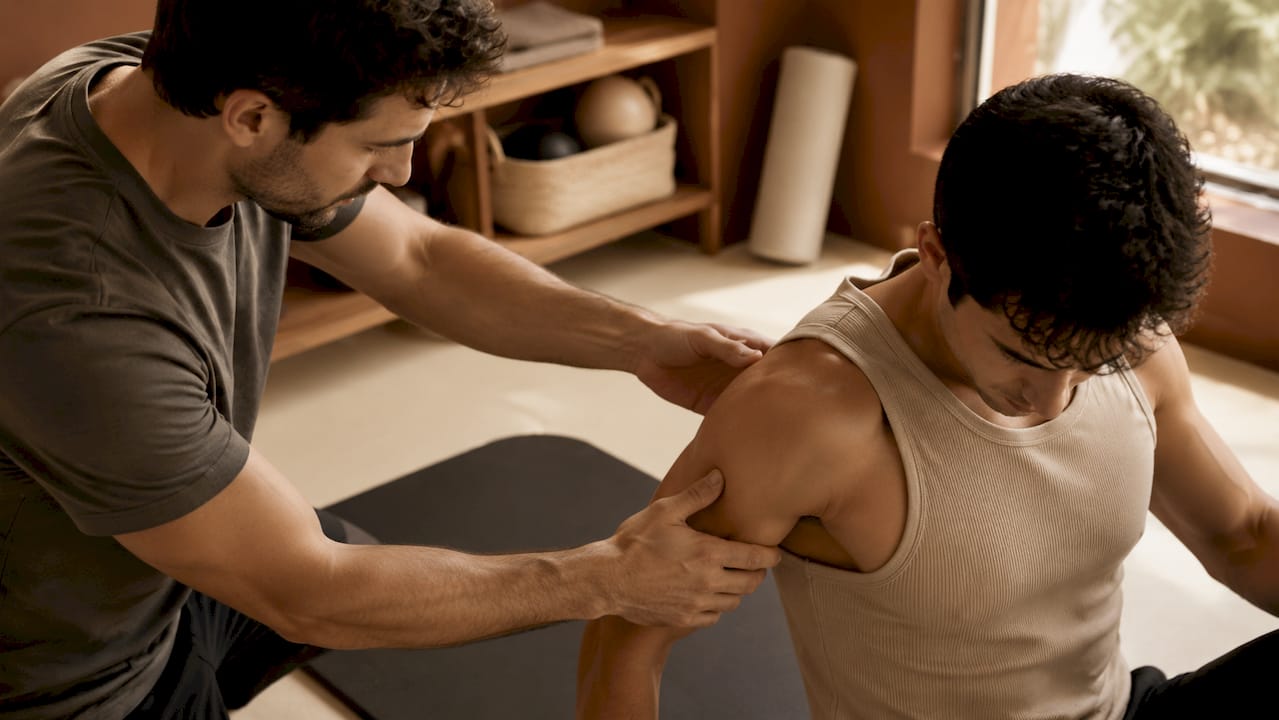
Pilates addresses this at the source. The precise, slow movements provide the nervous system with high-quality sensory feedback. Over time, the brain learns that movement in these patterns is safe. It stops issuing the protective tension signal. The result is not just temporary relief but a genuine reprogramming of muscle tone regulation at the central level.
Here is how that process unfolds across a consistent Pilates practice:
- Session one to four: The nervous system is introduced to unfamiliar movement demands. Proprioceptive input is high. The brain is actively mapping new movement patterns.
- Weeks two to four: Protective co-contraction begins to reduce as the nervous system recognises the movements as non-threatening. Clients often report their first genuine reduction in chronic tension.
- Weeks five to twelve: Central nervous system reorganisation consolidates. Postural muscle tone regulation improves, stabilising responses become more efficient, and overactivity in chronically tight muscle groups decreases.
- Beyond twelve weeks: Autonomic resilience builds. The nervous system carries the learned regulation into daily life, not just during sessions.
"Lasting changes in muscle tension after Pilates are due to central nervous system reorganisation rather than transient mechanical stretching." — Spring Hill Medical Group
This distinction matters enormously. Stretching a tight muscle gives temporary relief because it works on the tissue. Pilates gives lasting relief because it changes the instruction the brain is sending. That is why people who have tried everything for chronic tension often find Pilates produces results that nothing else has.
What does research say about Pilates, HRV, and anxiety?
The clinical evidence for the benefits of Pilates for nervous system function is now substantial enough to move beyond anecdote. HRV, which measures the variation in time between heartbeats, is the gold-standard marker of autonomic nervous system health. Higher HRV indicates stronger parasympathetic activity and better stress resilience.
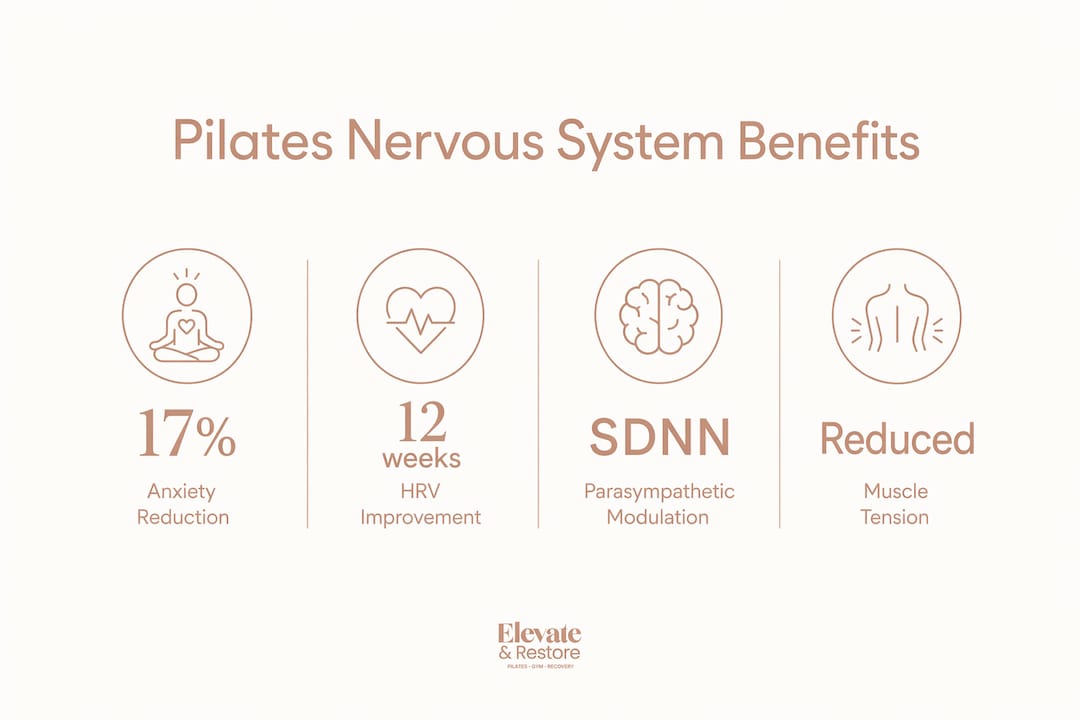
A 12-week Pilates programme produced measurable improvements in HRV parameters, specifically SDNN (the standard deviation of normal-to-normal intervals), compared to control groups. This means the nervous system became more flexible and responsive, not just calmer at rest. That distinction is critical. You are not just reducing stress in the moment. You are building a more resilient autonomic nervous system that recovers faster from all stressors.
The anxiety data is equally compelling. A single 50-minute Pilates session reduces state anxiety by 17% in a studio environment and by 33.1% outdoors. State anxiety, measured using the validated STAI-S scale, reflects how anxious a person feels right now, not as a trait. A 17% reduction from one session is a clinically meaningful shift. The outdoor figure of 33.1% suggests that combining Pilates with natural environments amplifies the parasympathetic response, a practical consideration for programme design.
| Research finding | Outcome | Timeframe |
|---|---|---|
| HRV improvement (SDNN) | Increased parasympathetic modulation | 12 weeks |
| Anxiety reduction (studio) | 17% decrease in STAI-S score | Single session |
| Anxiety reduction (outdoor) | 33.1% decrease in STAI-S score | Single session |
| Depression and anxiety symptoms | Significant reduction via meta-analysis | 12 weeks |
Meta-analyses confirm that Pilates reduces depression and anxiety symptoms across multiple populations and study designs. This is not one study with a small sample. It is a pattern of evidence across systematic reviews. For anyone managing chronic stress, anxiety, or low mood, this is a meaningful finding. Pilates and mental health are directly connected through measurable neurological pathways, not through vague notions of feeling good after exercise.
How does Pilates compare with yoga and meditation for nervous system benefits?
Yoga, meditation, and Pilates all produce parasympathetic activation, and they share the core tools of breath control and present-moment awareness. The differences lie in mechanism and application, and those differences matter depending on what your nervous system actually needs.
Yoga and meditation are primarily attentional practices. They train the nervous system by directing focus inward and reducing cognitive reactivity. Pilates is a moving meditation that adds a layer yoga and seated meditation cannot replicate: it retrains the nervous system's relationship with physical load and movement. For people whose anxiety or tension is expressed somatically, through tight muscles, poor posture, or physical hypervigilance, Pilates addresses the problem at the level where it lives.
The comparison is worth examining directly. For a detailed breakdown of how Pilates and yoga differ in their approach to nervous system and physical health, the Pilates vs yoga comparison at Elevateandrestore covers the practical distinctions clearly.
Key differences in nervous system application:
- Yoga: Strong parasympathetic activation through breath and stillness; less emphasis on movement quality under load.
- Meditation: Trains attentional regulation and reduces default mode network overactivity; no physical load component.
- Pilates: Combines breath, load, and precision movement to retrain both autonomic and somatic nervous system responses simultaneously.
Pilates also maintains parasympathetic activity during exercise in a way that high-intensity training cannot. The slow tempo and breath coordination keep vagal tone active even as physical demand increases. This is a unique neurological training stimulus. You are teaching the nervous system to stay regulated under pressure, which transfers directly to how you handle stress outside the studio. For a deeper look at how mindful movement reduces anxiety, the science behind this is well documented.
Key takeaways
Pilates improves the nervous system through parasympathetic activation, central nervous system retraining, and measurable improvements in HRV and anxiety markers backed by clinical research.
| Point | Details |
|---|---|
| Breathing drives parasympathetic activation | Pursed-lip exhalation stimulates the vagus nerve, shifting the body from fight-or-flight to rest-and-digest. |
| Muscle tension is a nervous system issue | Chronic stiffness is centrally regulated; Pilates reprograms the brain's tension signals, not just the tissue. |
| HRV improves with consistent practice | A 12-week programme increases SDNN, indicating stronger autonomic resilience and faster stress recovery. |
| Single sessions reduce anxiety measurably | One 50-minute session reduces state anxiety by 17% indoors and 33.1% outdoors on the validated STAI-S scale. |
| Pilates outperforms yoga for somatic tension | The combination of load, breath, and precision movement retrains both autonomic and somatic nervous system responses. |
What I have seen that most people miss about Pilates and the nervous system
Most people come to Pilates for a stronger core or better posture. That is fine. But the clients at Elevateandrestore who get the most out of it are the ones who start to understand that they are training their nervous system, not just their body.
The misconception I see most often is that nervous system benefits from Pilates are a side effect, something pleasant that happens alongside the physical work. They are not. The breath cues, the slow tempo, the precision of movement, these are the mechanism. The physical strength gains are the side effect. When you understand that, you stop rushing through the exhale and start treating it as the most important part of the rep.
The other thing worth saying plainly: Pilates in a small group setting produces better nervous system outcomes than solo practice, particularly for people dealing with anxiety. There is a co-regulation effect when you practise alongside others in a calm, focused environment. The nervous system reads the room. Six people breathing together, moving with intention, creates a collective regulated state that is genuinely harder to access alone. This is part of why the small group format at Elevateandrestore is not just a business model. It is a better neurological environment.
If you are using Pilates specifically for stress or anxiety, pair it with recovery tools. The sauna and cold plunge at Elevateandrestore are not add-ons. Thermal contrast directly stimulates vagal tone and extends the parasympathetic window that Pilates opens. The combination is more effective than either in isolation.
— Elevate
Experience the nervous system benefits at Elevateandrestore
Elevateandrestore is a functional training and Pilates studio in West Footscray built around small groups of six, which means every session is coached with the precision your nervous system training actually requires. The instructors cue breath and movement together, which is the difference between a workout and genuine autonomic conditioning.
After your session, the recovery hub is there: sauna, cold plunge, hot tub, and compression boots. Each of these tools extends the parasympathetic activation that Pilates initiates, giving your nervous system more time to consolidate the adaptation. If you are ready to treat your nervous system as something worth training, explore the Reformer Pilates programme at Elevateandrestore and book your first session. You can also explore the full recovery lounge to see how post-Pilates recovery amplifies every benefit covered in this article.
FAQ
How quickly does Pilates improve the nervous system?
A single 50-minute session produces measurable anxiety reduction. Sustained improvements in HRV and autonomic resilience develop over a 12-week programme with consistent practice.
Why does Pilates help anxiety more than regular exercise?
Pilates maintains parasympathetic activity during physical exertion through breath coordination and slow tempo, whereas high-intensity exercise drives sympathetic arousal. This makes Pilates neurologically distinct from most forms of exercise.
What is HRV and why does it matter for stress?
HRV (heart rate variability) measures how flexibly your autonomic nervous system responds to demands. Higher HRV indicates stronger parasympathetic function and better capacity to recover from stress. Pilates increases HRV over 12 weeks.
Does outdoor Pilates produce better nervous system benefits?
Research shows a 33.1% anxiety reduction from a single outdoor session versus 17% indoors. Natural environments amplify the parasympathetic response, making outdoor practice worth pursuing when accessible.
Is Pilates or yoga better for nervous system regulation?
Both activate the parasympathetic nervous system, but Pilates adds the dimension of retraining the nervous system's response to physical load. For people with somatic anxiety or chronic muscle tension, Pilates addresses the problem more directly.