

Functional fitness is defined as training that builds your capacity to perform everyday movements, and it is the most direct method for preventing chronic disease as you age. Unlike isolated gym exercises, functional fitness targets the movement patterns your body uses constantly: squatting, hinging, reaching, carrying, and balancing. The National Institute on Aging, the CDC, and the WHO all recognise regular multicomponent physical activity as a frontline defence against cardiovascular disease, type 2 diabetes, osteoporosis, and obesity. Understanding why functional fitness prevents disease means understanding how your body actually breaks down without it, and what you can do right now to stop that process.
Why functional fitness prevents disease in your body
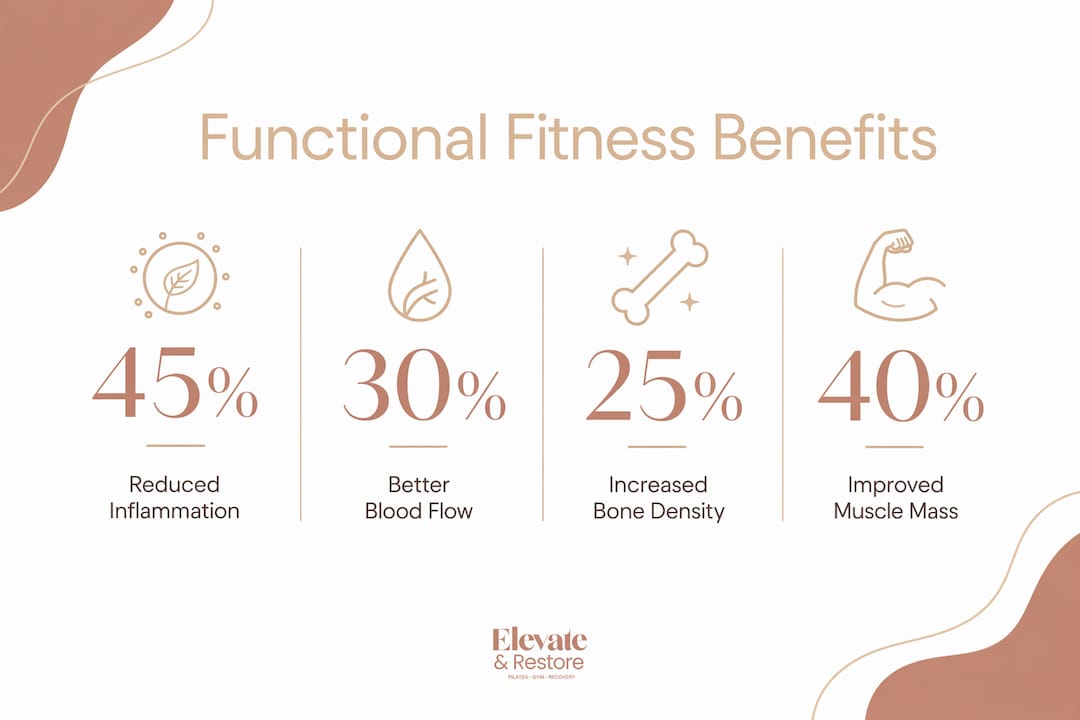
Functional fitness combats cardiovascular disease, type 2 diabetes, obesity, and osteoporosis by directly targeting the physiological systems that regulate each condition. It improves blood glucose uptake in muscle tissue, which lowers insulin resistance. It raises HDL cholesterol and lowers triglycerides, reducing arterial plaque risk. These are not side effects of exercise. They are the primary mechanisms at work.
Bone density is another direct target. Weight-bearing functional movements like squats, lunges, and loaded carries apply mechanical stress to bone, which signals the body to maintain and build density. This is the primary defence against osteoporosis, a condition that affects roughly one in three women and one in five men over 50 in Australia.
Muscle mass is the metabolic engine of disease prevention. Sarcopenia begins around age 25, and without deliberate resistance-based training, adults lose 3–8% of muscle mass per decade. Less muscle means a slower metabolism, higher body fat, and greater insulin resistance. Functional training directly offsets this decline by loading the muscles in the patterns they were built to perform.

The immune system also benefits. Moderate-intensity functional exercise reduces chronic low-grade inflammation, which is a root driver of conditions including type 2 diabetes, heart disease, and certain cancers. Physical inactivity is a major global mortality risk, and functional fitness addresses it by making movement feel achievable and relevant to daily life.
| Disease risk | How functional fitness helps |
|---|---|
| Cardiovascular disease | Improves blood pressure and lipid profiles through regular loaded movement |
| Type 2 diabetes | Increases muscle glucose uptake and reduces insulin resistance |
| Osteoporosis | Applies mechanical load to bones, stimulating density maintenance |
| Obesity | Builds muscle mass, raising resting metabolic rate |
| Sarcopenia | Directly counters age-related muscle loss through progressive resistance |
Does functional fitness improve mental health too?
The mental health benefits of functional fitness are as well-documented as the physical ones. 71% of studies show that functional fitness interventions reduce anxiety and depression in adults aged 60 and over. That figure represents a systematic review of multiple trials, and the effect holds across different exercise formats and settings. For adults over 30, the implication is clear: starting earlier produces better outcomes.
The mechanism runs through the nervous system. Functional movement requires your brain to coordinate multiple muscle groups simultaneously. This neurological demand stimulates the release of brain-derived neurotrophic factor (BDNF), a protein that supports neuron growth and is strongly linked to reduced depression risk. The science behind mindful movement confirms this connection between deliberate physical activity and measurable anxiety reduction.
Mobility itself plays a role in mental wellbeing that most people underestimate. When you can move freely without pain, your confidence in your own body increases. That confidence translates into greater social participation, more independence, and a reduced sense of vulnerability. These are not abstract benefits. They show up in daily decisions about whether to take the stairs, carry your own groceries, or play with your kids.
Kinesiophobia, the fear of movement caused by chronic pain, is a significant barrier for many adults over 30. Progressive functional fitness retrains the nervous system to reduce pain avoidance behaviour, creating a positive feedback loop where reduced pain leads to more movement, which leads to further improvement.
Pro Tip: If pain or fear of injury is stopping you from starting, begin with bodyweight movements only. A single set of slow, controlled squats per day is enough to begin the neurological retraining process.
How does functional fitness differ from traditional exercise?
Traditional gym training often isolates single muscle groups. A bench press trains the pectorals. A bicep curl trains the biceps. These exercises build size and strength in specific muscles, but they do not teach those muscles to work together under real-world conditions. Functional fitness uses multi-joint, multi-planar movements that replicate the demands of daily life, and that distinction matters enormously for disease prevention and injury avoidance.
Consider the difference between a leg press machine and a bodyweight squat. The leg press supports your spine and controls the movement path. A squat requires your core, hips, ankles, and spine to stabilise simultaneously. The squat trains the pattern you use every time you sit down or pick something up. The leg press does not.
| Training type | Focus | Real-world transfer | Injury prevention |
|---|---|---|---|
| Isolated training | Single muscle group | Low | Limited |
| Functional fitness | Multi-joint movement patterns | High | Strong |
Functional training improves stabilisation during movement, which protects joints and reduces the risk of both acute injuries and chronic overuse conditions. Better proprioception, the body's sense of its own position in space, is a direct outcome. This is why functional fitness reduces fall risk in older adults far more effectively than isolated strength training alone.
Form matters more than load. Correcting compensatory movement patterns, the ones your body developed to avoid pain or compensate for weakness, is the foundation of effective functional training. Rushing to add weight before movement quality is established is the most common mistake adults over 30 make when starting out.
Pro Tip: Before adding any load, film yourself performing a bodyweight squat or lunge from the side. Most people are surprised by what they see. Fixing form first protects your joints and accelerates progress.
How to start functional fitness for disease prevention
Starting functional fitness after 30 does not require a gym membership or complex equipment. The goal is to build competency in the fundamental movement patterns: squat, hinge, push, pull, carry, and rotate. These six patterns cover the full range of what your body does in daily life.
-
Start with bodyweight fundamentals. Squats, reverse lunges, hip hinges, and overhead reaches are the foundation. Perform two to three sets of eight to twelve repetitions, three times per week. Focus entirely on control and range of motion before adding resistance.
-
Walk every day. Combining functional fitness with walking enhances balance, strength, and cardiovascular health simultaneously. A 30-minute daily walk at moderate pace is one of the most evidence-backed disease prevention tools available.
-
Address fear of movement directly. If pain is present, work with a physiotherapist or a qualified functional trainer before progressing. Guided programmes are particularly effective at overcoming kinesiophobia and building confidence safely.
-
Track progress in functional terms. Note whether daily tasks feel easier: getting up from the floor, carrying shopping, climbing stairs. These markers are more meaningful than weight lifted or kilojoules burned.
-
Add recovery as a non-negotiable. Muscle adaptation happens during rest, not during training. Sleep, hydration, and active recovery methods like walking or light stretching between sessions are as important as the sessions themselves. For adults over 30, recovery methods for strength training deserve the same attention as the workouts.
Most beginners experience a 2–4 week neurological learning phase before strength gains become visible. During this phase, the nervous system is learning to recruit muscle fibres more efficiently. This is why neurological adaptation precedes visible strength gains, and why patience in the first month is critical.
Pro Tip: Pair your functional training sessions with a nutrition strategy that supports immune function. A diet rich in whole foods, adequate protein, and anti-inflammatory fats amplifies every benefit functional fitness delivers. Nutrition and immune support are directly linked.
Key takeaways
Functional fitness is the most direct exercise strategy for preventing chronic disease after 30 because it targets the movement patterns, metabolic systems, and neurological pathways that deteriorate fastest with age and inactivity.
| Point | Details |
|---|---|
| Disease prevention mechanism | Functional fitness improves blood glucose, bone density, and lipid profiles directly. |
| Muscle loss starts early | Sarcopenia begins at 25, making resistance-based functional training urgent from your 30s. |
| Mental health impact | 71% of studies confirm functional fitness reduces anxiety and depression in older adults. |
| Form before load | Correcting movement patterns before adding resistance prevents injury and accelerates gains. |
| Neurological phase | Expect a 2–4 week adaptation period before visible strength changes appear. |
What I have learned from watching people move
Most adults over 30 who walk through our doors at Elevateandrestore have spent years doing exercise that looked productive but was not transferring to their actual lives. They could bench press their bodyweight but struggled to get off the floor without using their hands. That gap between gym performance and real-world function is exactly where disease risk hides.
The thing I have noticed most consistently is that people underestimate the neurological side of this. They expect to feel stronger within a week and get discouraged when they do not. What is actually happening in those first few weeks is far more interesting. The brain is rewiring its communication with the muscles. Coordination improves before strength does. That is not a failure of the programme. It is the programme working.
The other pattern I see is impatience with form. People want to add weight before they have earned the right to. A heavy squat with poor mechanics does not prevent disease. It creates a new injury to manage. Slowing down and mastering the movement first is not a beginner's approach. It is the only approach that produces lasting results.
Functional fitness is not about aesthetics or performance records. It is about maintaining the capacity to live independently, move freely, and stay out of the healthcare system for as long as possible. That is a goal worth taking seriously, and it is one that becomes more urgent with every year past 30.
— Elevate
Train with Elevateandrestore in Melbourne's inner west
Elevateandrestore is a functional training and Pilates studio in West Footscray built specifically for adults who want to move better and stay healthy long-term. Every session runs in small groups of six, which means your form gets attention and your programme gets adjusted to your body, not a generic template.
The studio combines reformer Pilates classes with functional strength training and a full recovery hub including sauna, cold plunge, hot tub, and compression boots. Recovery is built into the model because Elevateandrestore treats it as part of the training, not an optional extra. If you are over 30 and want a programme that actually prevents disease rather than just burning kilojoules, explore the gym at Elevateandrestore and book a session.
FAQ
What is functional fitness?
Functional fitness is training that focuses on multi-joint, multi-planar movements that replicate the demands of daily life. It builds strength, coordination, and balance in the patterns your body uses constantly, from squatting and hinging to carrying and reaching.
Can exercise actually prevent chronic disease?
Yes. Functional fitness directly improves blood glucose regulation, bone density, lipid profiles, and immune function, all of which are primary risk factors for cardiovascular disease, type 2 diabetes, and osteoporosis. The CDC and WHO both recognise multicomponent physical activity as a frontline disease prevention strategy.
How is functional fitness different from regular gym training?
Regular gym training often isolates single muscle groups with limited real-world transfer. Functional fitness trains movement patterns that involve multiple joints and muscle groups simultaneously, which improves coordination, reduces injury risk, and produces benefits that carry over directly into daily life.
When should I start functional fitness?
The earlier the better. Muscle mass loss begins around age 25, and the metabolic and neurological benefits of functional training accumulate over time. Starting in your 30s gives you a significant advantage in preventing the chronic conditions that typically emerge in your 50s and 60s.
How long before I see results from functional training?
Most people experience a 2–4 week neurological adaptation phase before visible strength changes appear. Functional improvements, such as daily tasks feeling easier and pain reducing, often appear within the first two to three weeks of consistent training.