

Consistency in fitness is defined as maintaining regular exercise habits over months and years, and research confirms it produces better long-term health outcomes than intense, sporadic workouts. For women over 30, this distinction matters enormously. Hormonal shifts, recovery demands, and busier lives mean that the all-or-nothing approach so common in fitness culture actively works against you. Consistency is the strongest predictor of training outcomes, outperforming program design and equipment. The science is clear: showing up regularly, even imperfectly, beats burning out on a perfect programme every single time.
Why consistency beats intensity in fitness for women over 30
Consistency in a fitness context means exercising on a regular schedule, at a manageable effort level, over an extended period. It is not about how hard you push in any single session. It is about how reliably you show up across weeks, months, and years.
Intensity, by contrast, refers to the effort level within a session. High-intensity training has real benefits, but only when it sits inside a consistent routine. Without that foundation, intensity becomes the enemy of progress. It creates soreness, fatigue, and the kind of forced rest days that quietly erode your momentum.

For women over 30, the case for consistency over intensity is especially strong. Recovery takes longer after 30. Cortisol responses to extreme exertion are more pronounced. Life demands, whether work, family, or health, make it harder to bounce back from sessions that leave you wrecked for three days. A sustainable rhythm protects you from all of that.
The minimum viable workout concept is worth understanding here. A 10–15 minute session on a low-energy day maintains the neural pathways and habit loops that keep your routine alive. It is not a compromise. It is an insurance policy against the all-or-nothing thinking that derails most women's fitness plans.
- Consistency means regular, moderate effort repeated over time
- Intensity means the difficulty level of a single session
- Habit loops are the behavioural patterns that make exercise automatic
- Minimum viable workout is the shortest session that keeps your habit intact
- Friction reduction means removing barriers so showing up feels easy
Pro Tip: Schedule your workouts like appointments. Put them in your calendar with a specific time and location. The decision is already made, so you just follow through.
What does the research say about consistency versus intensity?
The evidence strongly favours consistency as the primary driver of long-term fitness results. Physiological adaptations, including muscle growth, cardiovascular efficiency, and metabolic improvements, typically require 12–24 months of sustained effort. That timeframe only becomes possible through consistent training, not through sporadic bursts of intensity.
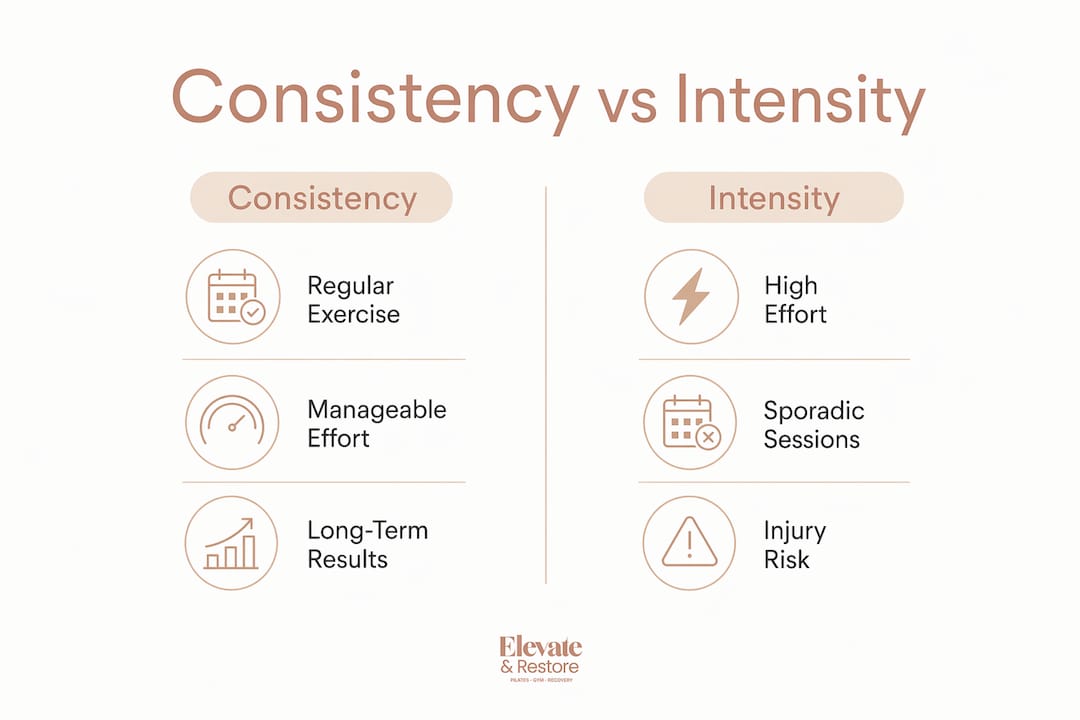
Dropout rates tell the same story from the other direction. About 50% of people quit high-intensity exercise programmes within the first six months. High initial intensity is a primary predictor of dropout. Moderate frequency, by contrast, correlates with significantly higher adherence over time. That pattern holds across age groups, but it is especially relevant for women over 30 who are building fitness around real-life demands.
The health benefits of consistent, low-level activity are also striking. Slow running once a week reduces all-cause mortality risk by 27%. That result comes from frequency, not from pushing harder. It shows that the body responds to repeated stimulus, not to occasional heroic effort.
"A mediocre program performed consistently will outperform a perfect program done inconsistently every time. Consistency absorbs minor mistakes and interruptions without derailing progress."
Total weekly volume predicts results better than session intensity. A year of daily 30-minute moderate workouts produces superior physiological retention compared to sporadic high-intensity bursts. The cumulative effect of showing up repeatedly is what drives lasting change.
| Approach | Adherence at 6 months | Long-term outcome |
|---|---|---|
| High-intensity, sporadic | Low (approx. 50% dropout) | Frequent resets, limited adaptation |
| Moderate, consistent | High | Sustained physiological gains |
| Minimum viable workout habit | Very high | Habit preservation, reduced detraining |
How does consistency prevent injury and build resilience?
High-intensity workouts often cause soreness and forced rest days that reduce total weekly training volume. This is the hidden cost of going too hard too often. You train intensely on Monday, spend Tuesday and Wednesday recovering, and end up with fewer total sessions than someone who trained moderately every day. The maths does not favour intensity.
Consistent, moderate training allows gradual tissue adaptation. Tendons, ligaments, and muscles strengthen progressively when they receive regular, manageable stimulus. Sudden spikes in intensity do the opposite. They stress tissues faster than they can adapt, which is how overuse injuries happen. For women over 30, where connective tissue recovery is slower, this matters even more.
Functional training approaches that prioritise movement quality over load are particularly effective here. They build the kind of resilience that holds up across years, not just weeks.
The psychological dimension is just as real. Consistent training builds confidence through repeated small wins. Every session you complete reinforces the identity of someone who exercises regularly. That identity becomes self-sustaining over time. Intensity-focused training, by contrast, often creates a cycle of motivation spikes followed by burnout and guilt.
- Soreness from intense sessions forces rest days, cutting total weekly volume
- Gradual tissue adaptation from moderate training reduces overuse injury risk
- Repeated manageable sessions build confidence and a stable fitness identity
- The all-or-nothing mindset is broken by accepting that any session counts
Pro Tip: If you are sore or tired, do a shorter, easier version of your planned session rather than skipping it entirely. Ten minutes of movement beats zero minutes every time.
How can women over 30 build consistent fitness habits that last?
Building lasting consistency requires a different approach to goal-setting than most fitness culture promotes. The goal is not to train harder. The goal is to train more reliably. These are not the same thing, and confusing them is where most women go wrong.
-
Set frequency goals, not intensity goals. Aim for four sessions per week rather than "push harder each time." Frequency is what you control. Intensity can vary with how you feel on a given day.
-
Use the minimum viable workout as your floor, not your ceiling. On days when motivation is low or time is short, a 10–15 minute session keeps your habit alive. It is not a failure. It is the habit doing exactly what it is supposed to do.
-
Track attendance, not performance. Measuring success by attendance streaks rather than session quality supports long-term adherence. A simple tick in a diary for each session completed is enough. The streak becomes its own motivation.
-
Build in flexibility without guilt. Missing one session does not break your routine. Missing two in a row starts a new pattern. The rule is simple: never miss twice. One missed session is life. Two missed sessions is the beginning of a habit you do not want.
-
Choose movement you actually enjoy. Pilates, strength training, and mindful movement practices are all well-suited to women over 30 because they build strength and body awareness without excessive joint stress. Enjoyment is the most underrated predictor of consistency.
-
Integrate recovery as part of the programme. Recovery is not the absence of training. It is what makes training sustainable. Sauna, cold plunge, and compression therapy all support the kind of physical readiness that keeps you showing up.
Women over 30 also benefit from strength training as a consistent practice because it directly counters age-related muscle loss. The key is progressive, manageable loading over time, not maximum effort in any single session.
Key takeaways
Consistency in fitness outperforms intensity because repeated, manageable effort drives physiological adaptation, habit formation, and long-term adherence in ways that sporadic high-intensity training cannot match.
| Point | Details |
|---|---|
| Consistency predicts outcomes | Sustained effort over 12–24 months drives muscle and cardiovascular adaptation more reliably than intensity. |
| Dropout risk is real | About 50% of people quit high-intensity programmes within six months; moderate frequency keeps you in the game. |
| Minimum viable workout matters | A 10–15 minute session on hard days preserves habit loops and prevents detraining. |
| Track attendance, not performance | Counting sessions completed builds the identity and momentum that sustain fitness for years. |
| Recovery supports consistency | Integrating recovery practices reduces injury risk and keeps training sustainable over the long term. |
What I have learned from watching women train consistently
The women who get the best results at Elevateandrestore are almost never the ones who train the hardest in any given session. They are the ones who show up on Tuesday when they are tired, on Thursday when work was brutal, and on Saturday when they would rather be anywhere else. That reliability is what separates lasting results from another fitness cycle that ends in January.
Perfectionism is the biggest obstacle I see. Women over 30 often carry a belief that if they cannot do the full session perfectly, it is not worth doing at all. That belief is the programme's worst enemy. A 20-minute Pilates session done consistently for six months will change your body and your relationship with movement far more than six weeks of intense daily training followed by burnout.
The mindset shift that changes everything is this: your goal is not to have a great workout today. Your goal is to still be training in five years. Every decision you make about intensity, duration, and frequency should be filtered through that lens. Moderate, consistent effort is not settling for less. It is the most direct path to the results you actually want.
— Elevate
Consistent fitness support at Elevateandrestore
Elevateandrestore is built around the principle that sustainable fitness comes from regular, supported movement, not from pushing to your limit every session.
The Reformer Pilates programme at Elevateandrestore runs in small groups of six, which means every session is coached, not just supervised. That structure makes it easier to show up consistently because the environment holds you accountable without overwhelming you. The Recovery Lounge, with sauna, cold plunge, hot tub, and compression boots, is designed to keep your body ready for the next session. Recovery is part of the programme, not an afterthought. If you are ready to build a fitness habit that actually lasts, Elevateandrestore is the place to do it.
FAQ
Why does consistency matter more than intensity in fitness?
Consistency drives the physiological adaptations that produce lasting results. Research shows these adaptations require 12–24 months of sustained effort, which is only achievable through regular training, not sporadic intensity.
How often should women over 30 exercise for best results?
Frequency matters more than duration or intensity. Aiming for four moderate sessions per week builds the habit and cumulative volume that produce long-term fitness gains.
What is a minimum viable workout?
A minimum viable workout is a short session of 10–15 minutes that maintains your habit loop on low-energy or busy days. It prevents detraining and keeps your routine intact without requiring full effort.
Does low-intensity exercise actually produce health benefits?
Running slowly just once a week reduces all-cause mortality risk by 27%. Health benefits come from frequency and regularity, not from how hard you push in any single session.
How do I stop the all-or-nothing mindset from ruining my routine?
Adopt the rule of never missing twice. One missed session is normal. Two in a row starts a new pattern. A short, easy session always counts more than skipping entirely.