
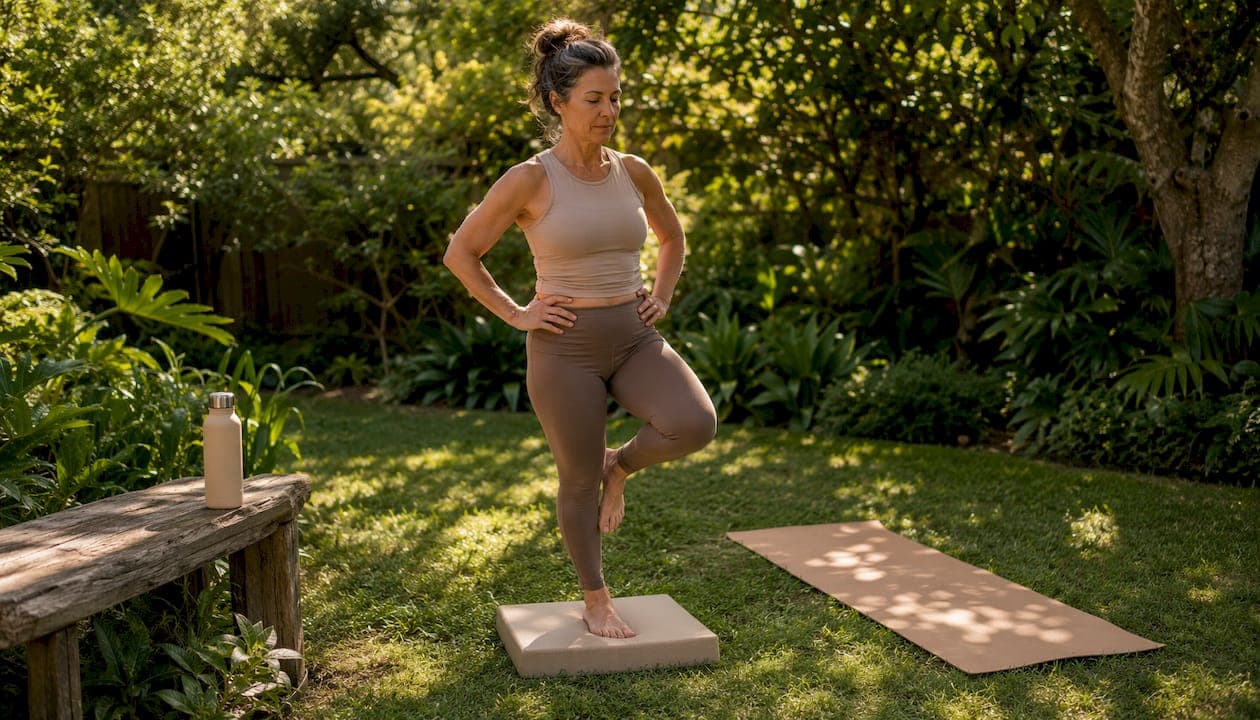
Proprioception training is the deliberate practice of challenging your body's internal sense of position, movement and force to improve balance, joint stability and coordination. It works by stressing the feedback loop between your muscles, joints and nervous system, then letting that system adapt. According to the Cleveland Clinic, proprioception is largely subconscious — your brain is constantly reading signals from receptors in your muscles and joints without you thinking about it. Training that system makes those signals faster and more accurate.
Two benefits stand out in the clinical literature. First, better balance, which matters whether you're stepping off a kerb or landing from a jump. Second, meaningfully lower re-injury risk: a Frontiers in Rehabilitation Sciences review found that proprioceptive training improves transfer to untrained motor tasks, meaning gains carry over into everyday life, not just the drills you practised. Most people see real change training 2–3 sessions per week, and many drills slot neatly into a warm-up. At Elevateandrestore in West Footscray, proprioception work is woven into small-group functional training and Pilates sessions, giving you coached progressions rather than guesswork.
Table of Contents
- How proprioception actually works in your body
- Why proprioception training matters for your health and performance
- Who benefits most, and signs your proprioception needs work
- Quick self-tests to gauge your baseline proprioception
- Proprioception exercises: from beginner to advanced
- How often to train and how to build a weekly plan
- Safety, contraindications and when to stop
- What a professional proprioception session looks like at Elevateandrestore
- Key takeaways
- The mistake most people make with balance training
- Train your balance with Elevateandrestore in West Footscray
- Trusted sources and further reading
How proprioception actually works in your body
Your nervous system runs a constant position-tracking service using three types of receptors:
- Muscle spindles detect changes in muscle length and the speed of that change.
- Golgi tendon organs sense tension and force through tendons.
- Joint receptors (Ruffini endings, Pacinian corpuscles) register pressure, stretch and joint angle.
Signals from all three feed into the spinal cord and brain simultaneously. The brain integrates them with input from the vestibular system (inner ear, responsible for head position and linear acceleration) and the tactile system (skin pressure and texture). Proprioception is distinct from both: it tells you where your limb is and how fast it's moving, independent of what you can see or feel on your skin.
| Sense | Primary receptor | What it detects |
|---|---|---|
| Proprioception | Muscle spindles, joint receptors | Limb position, movement, force |
| Vestibular | Semicircular canals, otolith organs | Head orientation, acceleration |
| Tactile | Skin mechanoreceptors | Pressure, texture, vibration |
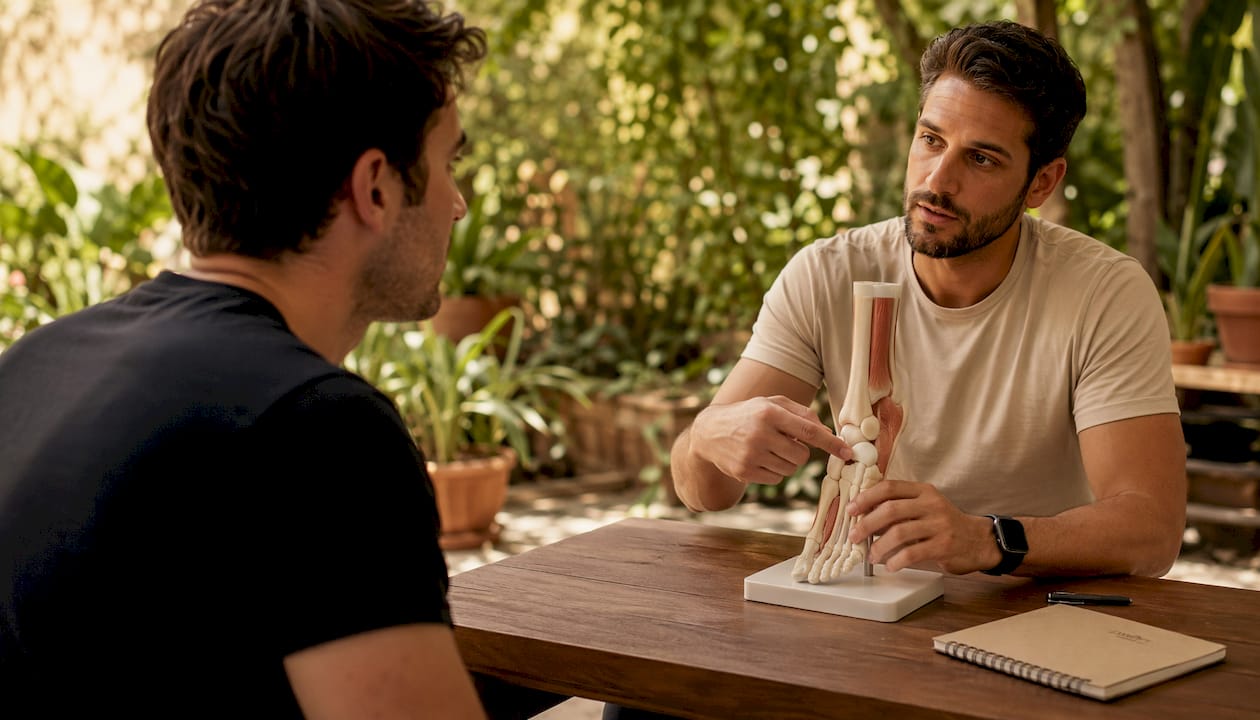
Closing your eyes during a balance drill removes visual compensation and forces the brain to rely almost entirely on muscle and joint receptors. That's why eyes-closed training accelerates proprioceptive learning when done safely — it's not a party trick, it's a deliberate load on the system.
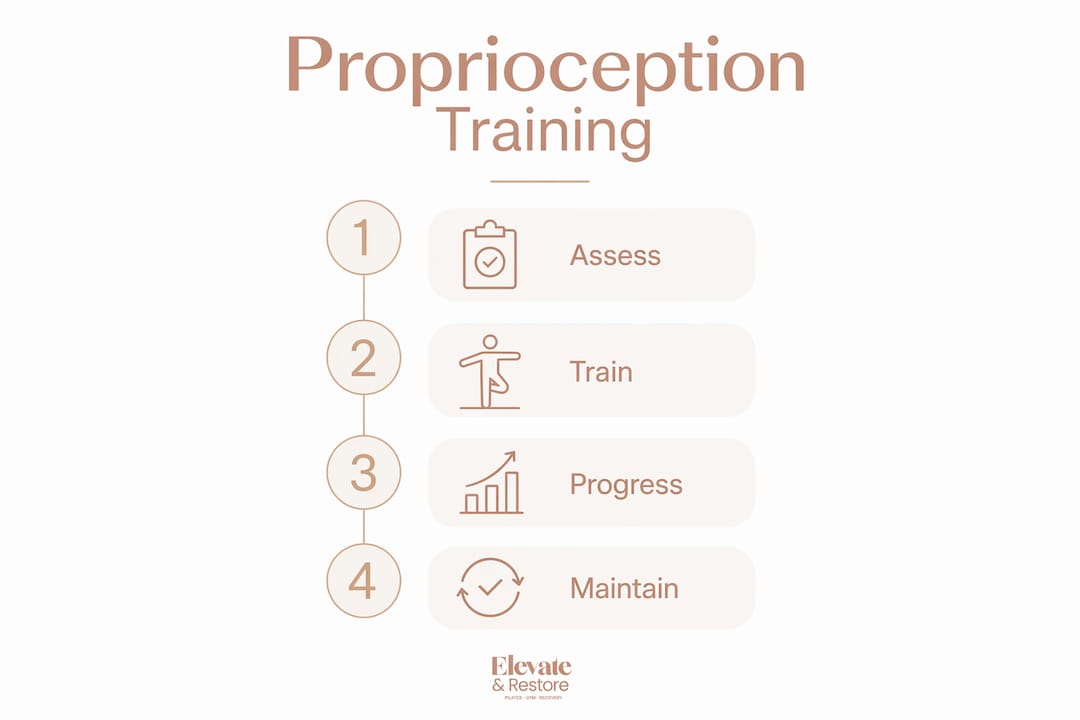
Why proprioception training matters for your health and performance
Proprioception declines with age. The Cleveland Clinic notes this directly as a contributor to fall risk in older adults, which makes proprioceptive drills preventative maintenance rather than purely a rehabilitation tool.
For athletes, the evidence is pointed. Research published in sports and rehabilitation medicine shows proprioceptive training enhances dynamic neuromuscular control, reducing the incidence of ankle sprains and supporting ACL rehabilitation outcomes. Physio-pedia links proprioceptive and balance exercises specifically to lower re-injury rates in ankle sprain and ACL populations — two of the most common sports injuries in Australia.
The gains aren't confined to sport. Post-surgical patients regain functional movement faster when proprioceptive work is included in their rehab. Older adults who train balance and coordination regularly show measurably better gait stability. Even people who simply feel clumsy or unsteady on uneven ground tend to respond well within a few weeks of consistent training.
One systematic review noted average improvements around 52% over baseline measures across included studies — a substantial effect for a training method that requires no equipment beyond a clear patch of floor.
Who benefits most, and signs your proprioception needs work
Most people would benefit from some proprioceptive training. A few groups have the most to gain:
- Older adults (proprioception declines progressively after 40, accelerating fall risk)
- Anyone who has sprained an ankle or knee in the past 12 months
- Post-operative patients (ACL reconstruction, hip or knee replacement)
- Athletes in court, field or contact sports
- People who describe themselves as "clumsy" or who frequently stumble on uneven ground
- Those with strength imbalances between left and right sides
Common signs of reduced proprioceptive function include difficulty holding a single-leg balance for more than a few seconds, frequent ankle rolls on slightly uneven surfaces, and a tendency to look at your feet when walking on unfamiliar terrain.
When to see a clinician first: If your balance problems came on suddenly, are accompanied by dizziness, double vision, or numbness and tingling in your limbs, stop and get a medical assessment before starting any balance training. These can be signs of neurological or vestibular conditions that need diagnosis, not exercise progressions.
For most people with a history of ankle sprain or general unsteadiness, starting with the self-tests below is safe. If you're post-surgery or managing a chronic condition, check with your physiotherapist before progressing to unstable surfaces.
Quick self-tests to gauge your baseline proprioception
These tests give you a starting reference point. Do them near a wall or sturdy chair.
Single-leg balance test
- Stand on one foot, hands on hips, eyes open.
- Time how long you can hold without touching down or grabbing support. Aim for 30 seconds.
- Repeat with eyes closed. Most adults manage 10–20 seconds; under 5 seconds warrants attention.
- Test both sides and note any difference.
Tandem walk
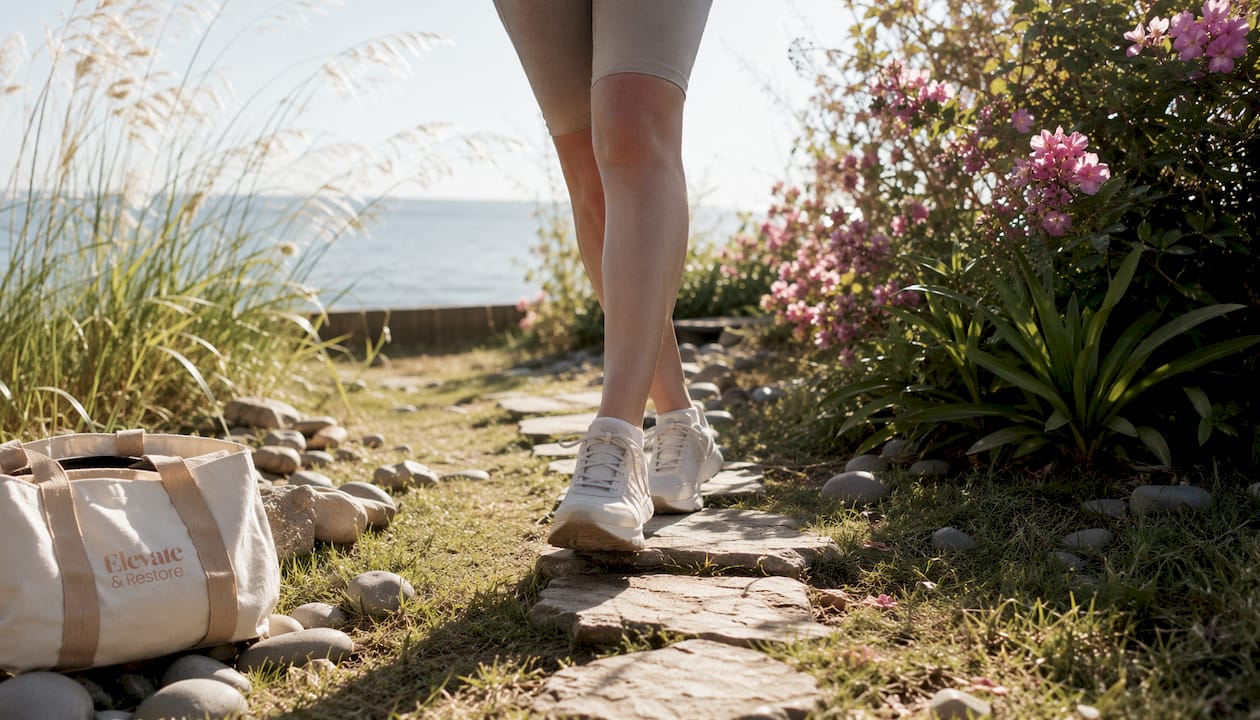
- Place one foot directly in front of the other, heel to toe, for 10 steps in a straight line.
- Arms can be out for balance. Count how many steps you complete without stepping off the line.
- Fewer than 8 clean steps suggests coordination worth working on.
Heel-to-toe walk
Similar to the tandem walk but performed over a longer distance (5–6 metres). Watch for consistent drift to one side, which can indicate asymmetric proprioceptive function.
Safety reminders:
- Always test near a wall or with a chair within arm's reach.
- Stop immediately if you feel dizzy or experience any sharp pain.
- Don't test on a slippery surface.
Single-leg balance and tandem walking are practical baseline measures you can repeat every 3–4 weeks to track genuine improvement.
Proprioception exercises: from beginner to advanced
Beginner exercises
- Double-leg balance hold: Stand with feet hip-width, eyes open, for 30–60 seconds. Focus on feeling equal weight through both feet.
- Weight shifting: Slowly shift your weight from foot to foot, pausing at each end range for 3 seconds. 10 repetitions each side.
- Ankle alphabet: Seated or standing on one leg, trace the alphabet with your foot in the air. Covers full ankle range in a controlled way.
- Slow heel raises (eyes open): Rise onto your toes over 3 seconds, lower over 3 seconds. 3 sets of 10.
Intermediate progressions
- Single-leg balance: Progress from eyes open (30 seconds) to eyes closed (10–20 seconds). Single-leg stance and balance board work are established clinical tools for this stage.
- Foam pad or folded mat: Perform single-leg holds on a slightly unstable surface. The instability recruits more joint receptors.
- Reaching tasks: Stand on one leg and reach forward, sideways and behind with the opposite hand. Challenges dynamic stability.
- Tai Chi and yoga both improve lower-limb proprioception and serve as practical low-impact adjuncts to formal drills.
Advanced drills
- Single-leg hop and stick: Hop forward on one leg and land, holding the landing position for 3 seconds without wobble. 5 repetitions each side.
- Agility ladder with reduced vision: Walk or step through an agility ladder pattern while focusing your gaze on a fixed point above the ladder rather than your feet.
- Balance disc single-leg squat: Perform a slow, controlled quarter-squat on one leg on a balance disc. 3 sets of 6–8 reps.
Progression table
| Level | Example exercise | Hold/reps | Surface | Eyes |
|---|---|---|---|---|
| Beginner | Double-leg balance | 30–60 sec | Firm floor | Open |
| Beginner | Slow heel raises | 3 × 10 | Firm floor | Open |
| Intermediate | Single-leg balance | 30 sec | Firm floor | Open → Closed |
| Intermediate | Foam pad balance | 20–30 sec | Foam pad | Open |
| Advanced | Single-leg hop and stick | 5 reps | Firm floor | Open |
| Advanced | Balance disc squat | 3 × 6–8 | Balance disc | Open |
Pro Tip: Move slowly and deliberately through every rep. The coaching cue "slow is smooth and smooth is fast" applies directly here — controlled, slow movements teach the nervous system correctly. If you're wobbling uncontrollably, regress to the previous level rather than grinding through bad form.
For sport-specific progressions, injury prevention for tactical athletes covers how to layer proprioceptive drills into performance training.
How often to train and how to build a weekly plan
Evidence supports 2–3 proprioception sessions per week for meaningful improvement. The good news: most drills take 5–10 minutes and slot directly into a warm-up before strength or cardio work. Sample beginner week
- Monday: 5-minute warm-up — double-leg balance (2 × 30 sec), weight shifting (10 reps), slow heel raises (2 × 10).
- Wednesday: Same circuit, add ankle alphabet on each side.
- Friday: Progress one element — attempt single-leg balance eyes open (2 × 20 sec each side).
Sample intermediate week
- Monday: Single-leg balance eyes open and closed (3 × 30 sec), foam pad holds (2 × 20 sec), reaching tasks (3 directions × 5 reps).
- Thursday: Dynamic drills — hop and stick (4 reps each side), agility ladder (3 passes), balance disc quarter-squat (2 × 8).
- Saturday: Tai Chi class or yoga session as active recovery and proprioceptive adjunct.
Sets, reps and hold times
| Stage | Hold time | Sets | Sessions/week | Progression trigger |
|---|---|---|---|---|
| Beginner | 20–30 sec | 2–3 | 2 | Hold 30 sec with control for 2 sessions |
| Intermediate | 30 sec | 3 | 2–3 | Eyes-closed hold stable for 20 sec |
| Advanced | Task-based reps | 3 | 3 | Clean landing on hop-and-stick × 5 |
Measure improvement by retesting your single-leg balance time every 3–4 weeks. A 5-second gain in eyes-closed hold time is a meaningful signal of progress. Pairing proprioception work with functional training accelerates overall movement quality.
Safety, contraindications and when to stop
Most healthy adults can begin beginner proprioception drills without medical clearance. A few situations call for caution or clinical sign-off first:
- Unstable fractures or acute joint inflammation: avoid any weight-bearing balance work until cleared by a doctor or physiotherapist.
- Uncontrolled dizziness or vertigo: proprioception training will not fix a vestibular disorder and may worsen symptoms. See a GP or vestibular physiotherapist first.
- Severe peripheral neuropathy: reduced sensation in the feet changes the risk profile significantly; supervised training is strongly preferred.
- Recent surgery (within 6 weeks): follow your surgeon's or physio's specific return-to-activity timeline.
Red flags — stop and seek urgent review:
- Sudden severe pain during a drill
- New numbness, tingling or weakness in a limb
- Repeated unexpected falls (more than two in a week)
- Loss of bladder or bowel control alongside balance changes
General information note: The guidance in this article is educational and does not replace professional medical advice. If you have a neurological condition, recent injury, or are post-operative, confirm your training plan with a physiotherapist or your treating clinician before starting.
When a referral is warranted, a physiotherapist will typically perform a formal balance and proprioception assessment (often using tools like the Star Excursion Balance Test or force plate measures), then build a supervised programme. Occupational therapists are the right referral for fall prevention in older adults managing daily-living tasks.
What a professional proprioception session looks like at Elevateandrestore
Home practice is valuable, but a studio session compresses the learning curve considerably. At Elevateandrestore, proprioception work is embedded in small-group functional training and Reformer Pilates sessions, with a maximum of six people per class so trainers can actually watch your movement.
A typical session runs roughly as follows:
- Assessment: the trainer observes your single-leg balance, gait pattern and any asymmetries before the session begins.
- Warm-up drills: 5–8 minutes of targeted proprioceptive activation (ankle circles, slow heel raises, eyes-closed holds) before loading.
- Main block: supervised balance and dynamic drills progressed to your current level, integrated with Pilates or functional strength work.
- Cool-down and recovery: sessions can be followed by use of the recovery hub (sauna, cold plunge, hot tub, compression boots), which supports tissue recovery and readiness for the next session.
What to expect when you book:
- Sessions run in groups of up to six, so you get genuine trainer attention.
- Equipment includes Reformers, foam pads, balance discs and resistance bands.
- Progressions are adjusted session by session based on what the trainer observes, not a fixed schedule.
- Safety checks happen before any eyes-closed or unstable-surface work.
The studio difference: Supervised training removes the most common error in home practice — advancing difficulty before stability is genuinely established. A trainer watching your landing mechanics or your single-leg wobble catches problems that a mirror cannot.
The transfer to everyday tasks tends to happen faster under supervision because progressions are calibrated precisely. Clients working on post-ankle-sprain rehab or general ageing-related balance concerns typically notice functional change within 4–6 weeks of consistent sessions.
Key takeaways
Proprioception training produces the most reliable gains when it is practised consistently at 2–3 sessions per week, progressed deliberately from stable to unstable surfaces, and integrated with strength or Pilates work rather than treated as a standalone add-on.
| Point | Details |
|---|---|
| Start with a baseline test | Time your single-leg balance (eyes open and closed) before your first session to track real progress. |
| Train 2–3 times per week | Evidence supports this frequency for meaningful improvement; short drills fit into any warm-up. |
| Progress slowly and deliberately | Only move to unstable surfaces or eyes-closed holds once you can hold the current level with full control. |
| Know your red flags | Sudden pain, new neurological symptoms, or repeated falls require clinical assessment before continuing. |
| Elevateandrestore offers coached sessions | Small-group sessions (max 6) at Elevateandrestore integrate proprioception work with Pilates and functional training for faster, supervised progression. |
The mistake most people make with balance training
The single most common error is treating proprioception training like cardio: more effort, more wobble, more progress. It works the opposite way. The nervous system learns position sense through clean, controlled repetitions, not through grinding out reps while falling sideways.
Clients who rush to unstable surfaces before they've mastered stable single-leg holds tend to plateau quickly. The wobble they're fighting is uncontrolled, which means the nervous system is getting noisy, inconsistent feedback. Regress, slow down, and the gains come faster.
A few coaching cues worth keeping in mind: keep your gaze fixed on a single point at eye level during balance holds; let your ankle do the micro-adjustments rather than locking your knee; and if you're using a foam pad, step onto it slowly rather than jumping on. Eyes closed should only come once you can hold the eyes-open version with genuine stillness, not approximate stillness.
Short, frequent sessions beat long, infrequent ones every time. Five minutes of deliberate balance work three times a week outperforms a 30-minute session once a fortnight, both for skill acquisition and for retention.
Train your balance with Elevateandrestore in West Footscray
If the self-tests above revealed gaps, or you simply want faster progress than home practice delivers, Elevateandrestore offers a direct path forward. Small-group Reformer Pilates and functional training sessions are built around exactly this kind of work: assessed, progressed, and supervised so you're not guessing at your next step.
The studio keeps classes to six people, which means your trainer can see your ankle wobble, your landing mechanics, and whether you're ready to progress to a foam pad or need another week on the firm floor. After your session, the recovery lounge (sauna, cold plunge, hot tub and compression boots) is there to support tissue recovery and keep you training consistently. Book a session at Elevateandrestore and get a clear, coached starting point for your proprioception training.
Trusted sources and further reading
- Cleveland Clinic — Proprioception
- Frontiers in Rehabilitation Sciences — Proprioceptive training review
- PMC — Systematic review of proprioception training learning dynamics
- Physio-pedia — Proprioception
- Springer — Proprioceptive training and injury prevention
- Verywell Health — Proprioception overview and coaching guidance
- The Guardian — Practical proprioception tests and training ideas
- ASICS — Guide to proprioception exercises