

Regular exercise reduces the overall burden of perimenopausal symptoms by around 15.7%, measured across eleven common symptoms on the Blatt-Kupperman Index. That figure comes from a systematic review of randomised controlled trials, and it covers everything from paresthesia and irritability to fatigue, insomnia, and hot flushes. The perimenopause fitness impact is not subtle: physical activity works on the endocrine system, cardiovascular function, and mood regulation simultaneously, making it one of the most effective non-hormonal tools available to women in this transition.
Key symptom improvements linked to regular physical activity during perimenopause:
- Paresthesia and irritability reduced by up to 2 points on the Blatt-Kupperman scale, the greatest gains of any symptom category
- Fatigue, headache, insomnia, and hot flushes each dropped from an average severity score of 2 to 1
- Musculoskeletal pain (myalgia and arthralgia) improved across aerobic and resistance-based programmes
- Mood and anxiety benefited through endorphin release and cortisol regulation
- Sleep quality improved, particularly with consistent moderate-intensity training
- Weight and metabolic markers responded positively to combined resistance and aerobic work
Pilates and resistance training, the two modalities at the core of ElevateandRestore's approach, address several of these simultaneously. Pilates builds postural strength and body awareness; resistance training preserves muscle mass and bone density as oestrogen declines. Neither requires pushing to exhaustion, which matters a great deal during perimenopause.
What actually changes in your body during perimenopause?
Perimenopause is driven by declining ovarian function, and the drop in oestrogen touches almost every system in the body. Bone density falls, muscle mass erodes faster, metabolism slows, and cardiovascular risk climbs. Understanding these changes is what makes the impact of hormones on fitness so concrete rather than abstract.
The endocrine system sits at the centre of all of it. Oestrogen regulates insulin sensitivity, fat distribution, and inflammatory responses. When levels fluctuate erratically before declining, the body's ability to recover from exercise, manage stress, and maintain lean tissue becomes less predictable. That unpredictability is why a training approach that worked well at 35 may feel harder or less effective at 45, even with the same effort.
Common physiological and symptom changes during perimenopause:
- Hormonal fluctuations: irregular oestrogen and progesterone cycles, often years before the final period
- Accelerated muscle loss (sarcopenia): oestrogen supports muscle protein synthesis; its decline speeds tissue loss
- Reduced bone density: mechanical loading becomes critical to offset fracture risk
- Metabolic slowing: resting metabolic rate drops, making weight management harder without dietary adjustment
- Vasomotor symptoms: hot flushes and night sweats affect sleep and daily function
- Joint pain and stiffness: reduced oestrogen lowers collagen production, affecting cartilage and connective tissue
- Cardiovascular risk: lipid profiles shift unfavourably, raising LDL and lowering HDL
- Mood disruption: oestrogen influences serotonin pathways, contributing to anxiety and low mood
The cardiometabolic risk acceleration during perimenopause is particularly worth noting. Women who were at low cardiovascular risk in their thirties can see their risk profile shift meaningfully within a few years of perimenopause onset. Exercise directly counters this by improving lipid profiles, blood pressure, and insulin sensitivity.
How exercise eases perimenopause symptoms and supports wellbeing
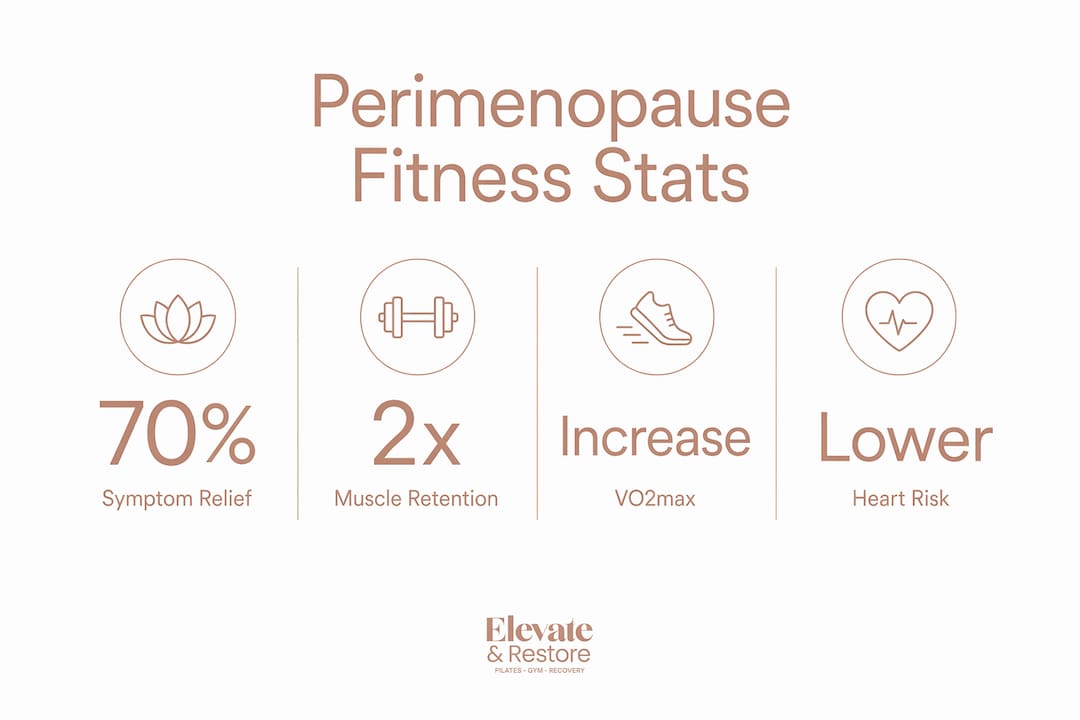
The mechanisms behind exercise's benefits are well established. Aerobic activity raises VO2max, which a meta-analysis found improved by 3.51 mL/kg/min with exercise versus control in perimenopausal women, a gain associated with meaningfully reduced cardiovascular disease risk. Resistance training preserves lean muscle and bone, while mind-body modalities like Pilates regulate cortisol and support parasympathetic recovery.
Exercise also works as a credible alternative or complement to hormone replacement therapy (HRT) for mild to moderate symptoms. Unlike HRT, it carries no increased risk of stroke or breast cancer. The trade-off is that exercise requires consistency and some skill in programming, particularly around intensity.
Specific benefits supported by clinical evidence:
- Reduced symptom severity: total symptom scores fell by 15.7% with regular physical activity across randomised controlled trials
- Improved cardiorespiratory fitness: VO2max gains translate directly to reduced cardiovascular mortality risk
- Better sleep: moderate-intensity training reduces insomnia severity, particularly when exercise is not performed too close to bedtime
- Mood stabilisation: endorphin release and reduced cortisol lower anxiety and depression scores
- Reduced musculoskeletal pain: both aerobic and resistance work decrease myalgia and arthralgia
- Weight management: combined exercise and dietary changes produce greater symptom improvements than either alone, including reductions in hot flushes and musculoskeletal pain
One finding worth sitting with: combined resistance training and dietary intervention reduced perimenopausal symptom scores more than exercise alone. The gap is not enormous, but it is consistent enough across studies to make nutrition a genuine part of the conversation, not an afterthought.
Pro Tip: Mind-body exercises like Pilates and yoga help manage elevated cortisol levels common in perimenopause. Even two sessions per week can improve sleep quality and reduce anxiety without adding physiological stress.
What types of exercise work best during perimenopause?
The evidence points clearly toward a mixed approach: resistance training as the foundation, aerobic work for cardiovascular and metabolic health, and flexibility or mind-body practice for stress and joint function. No single modality covers everything perimenopause throws at the body.

Resistance training twice weekly is the minimum to combat sarcopenia and the metabolic slowing caused by oestrogen decline. Bones respond to mechanical loading; without it, density loss accelerates. Starting with resistance bands or bodyweight movements is both effective and safe, with load progression guided by how joints and connective tissue are responding rather than by a fixed weekly increment.
High-intensity interval training (HIIT) offers cardiovascular and metabolic benefits equal to or greater than moderate-intensity continuous training, in less time. For women managing work, family, and fluctuating energy, that efficiency matters. The caveat is that HIIT raises cortisol, so it works best when recovery is genuinely adequate, not just scheduled.
Exercise types and guidelines for perimenopause:
- Resistance training: at least twice weekly, targeting major muscle groups; begin with bands or bodyweight and progress gradually
- Aerobic activity: brisk walking, cycling, swimming, or low-impact cardio for 150 minutes weekly at moderate-to-vigorous intensity, per clinical consensus guidelines
- HIIT: one to two sessions weekly when recovery is solid; not appropriate during high-symptom or high-stress periods
- Pilates: builds core strength, postural alignment, and body awareness; low joint stress and highly adaptable
- Flexibility and mobility work: yoga, stretching, or foam rolling to address joint stiffness and support parasympathetic recovery
- Mind-body practice: meditation, breathwork, or tai chi to manage cortisol and improve sleep architecture
Safety considerations are real at this life stage. Joint laxity increases as oestrogen falls, raising injury risk if load progression is too aggressive. Women with cardiovascular symptoms, significant bone density loss, or severe vasomotor symptoms should get medical clearance before starting a new programme, particularly one involving high-intensity work.
Practical ways to stay active when symptoms keep shifting
The hardest part of exercising in perimenopause is not knowing which version of yourself will show up on any given day. Energy, sleep quality, and mood can swing dramatically across a single week. The answer is not to push through regardless; it is to build a programme flexible enough to meet you where you are.
Auto-regulation is the key principle here. Exercise physiologist Dr. Rachelle Reed emphasises aligning training intensity with daily recovery capacity rather than following a fixed plan regardless of how the body is responding. On a high-symptom day, a walk or a gentle Pilates session is a better choice than a heavy lifting session, not because you are giving up, but because cortisol is already elevated and adding more load worsens the hormonal picture.
Nutrition plays a supporting role that is easy to underestimate. Adequate protein intake preserves muscle during resistance training. Calcium and vitamin D support bone density. Reducing alcohol and refined carbohydrates helps stabilise blood sugar, which in turn reduces hot flush frequency and improves sleep. The synergy between diet and exercise is well documented; treating them as separate concerns misses the compounding effect.
Practical strategies for maintaining an active lifestyle:
- Start where you are: a 20-minute walk three times a week beats an ambitious programme abandoned after a fortnight
- Track your patterns: note energy, sleep, and mood alongside workouts to identify which exercise types help and which drain you
- Build in recovery: rest days are training days for the nervous system; treat them as non-negotiable
- Prioritise sleep: poor sleep raises cortisol and reduces exercise tolerance; address sleep hygiene before adding training volume
- Eat enough protein: muscle protein synthesis requires adequate dietary protein, especially when oestrogen is no longer supporting it
- Find your people: community fitness increases motivation and mental wellbeing in perimenopausal women, making studio environments valuable beyond the physical workout itself
- Watch for overtraining signals: persistent fatigue, worsening sleep, increased irritability, or declining performance are signs to reduce load, not increase it
Pro Tip: If you wake feeling unrefreshed or your resting heart rate is elevated, treat that as data. Drop intensity for the day and focus on movement that feels restorative rather than demanding.
Hormonal optimisation through nutrition and lifestyle is increasingly well supported. Approaches like fasting and hormonal management are gaining traction as complementary strategies alongside structured exercise, particularly for women managing weight and metabolic symptoms.
How Elevateandrestore integrates training and recovery for perimenopausal women
Elevateandrestore's model is built around what the evidence actually supports: small group sessions capped at six people, combining functional resistance training and Pilates with a dedicated recovery hub. The small group format is not just a preference; it means every session can be adapted to where each person is on a given day, which is exactly what perimenopause demands.
The Pilates programme targets the postural and musculoskeletal changes that oestrogen decline accelerates. Reformer Pilates in particular loads the body through controlled ranges of motion, building strength without the joint stress of heavier compound lifts. For women new to resistance work, or returning after a break, it is a genuinely effective entry point that also addresses the core and pelvic floor changes common in perimenopause.
Recovery is treated as training, not a luxury. The recovery lounge includes sauna, cold plunge, hot tub, and compression boots, each with a distinct physiological rationale. Sauna exposure supports cardiovascular adaptation and may reduce vasomotor symptom frequency. Cold plunge reduces inflammation and supports parasympathetic nervous system recovery. Compression boots accelerate lymphatic clearance after resistance sessions. Together, they address the recovery deficit that perimenopausal women often experience when training load exceeds their current hormonal capacity.
Synergies between fitness and allied health professionals, including gynaecologists and psychologists, are increasingly recognised as critical to sustainable exercise habits during this life stage. Elevateandrestore's educational content and structured programming reflect that broader picture, connecting physical training with the hormonal and psychological context that shapes how women respond to exercise during perimenopause.
Women navigating perimenopause get the most from training when the environment accounts for fluctuating capacity, not just fixed programming. Elevateandrestore's resistance training approach for women over 30 is built around exactly that principle: progressive, adaptable, and grounded in what the body actually needs at this stage.
Key takeaways
Regular physical activity is the most evidence-backed non-hormonal intervention for managing perimenopausal symptoms, with the strongest results coming from a combination of resistance training, aerobic exercise, and structured recovery.
| Point | Details |
|---|---|
| Symptom reduction is measurable | Regular exercise reduces total perimenopausal symptom scores by 15.7%, with paresthesia and irritability showing the greatest gains. |
| Combined approach works best | Resistance training paired with dietary changes reduced symptom scores by over 20% in clinical studies, providing greater improvement than exercise alone. |
| 150 minutes weekly is the target | Clinical guidelines recommend at least 150 minutes of moderate-to-vigorous activity per week for cardiometabolic health. |
| Recovery is part of the programme | Auto-regulating intensity based on daily recovery capacity prevents cortisol spikes that worsen symptoms. |
| VO2max gains protect the heart | A meta-analysis found exercise improved VO2max by 3.51 mL/kg/min versus control, directly reducing cardiovascular disease risk. |