

Estrogen is defined as the primary female sex hormone governing recovery, metabolism, and injury risk in women's fitness. Its role is far more nuanced than simply driving muscle growth. A 2026 study from the University of Texas Medical Branch found no difference in muscle protein synthesis between low and high estrogen phases of the menstrual cycle. That finding reframes the entire conversation. The role of estrogen in fitness is most significant in how it shapes your recovery, your body composition, and your long-term resilience as your hormones shift through your 30s and beyond.
How does estrogen influence muscle growth and exercise performance?
The most common misconception is that estrogen directly controls how much muscle you build. The 2026 University of Texas Medical Branch study tested 17 healthy women and found myofibrillar protein synthesis rates did not differ significantly despite large variations in estradiol across the menstrual cycle. That means your muscle-building capacity stays consistent throughout the month, regardless of where you are in your cycle.
What does change is how hard your workouts feel. Research published in 2026 found that women reported higher perceived difficulty during the luteal phase, when progesterone peaks. Yet heart rate, oxygen uptake, and CO2 production remained unchanged. Your body is working at exactly the same capacity. Your brain is just receiving a different signal.
This distinction matters enormously for training consistency. If you skip sessions during the luteal phase because workouts feel brutal, you are responding to perception, not physiology. Understanding this keeps you in the gym when your hormones are trying to talk you out of it.
| Cycle phase | Dominant hormone | Muscle protein synthesis | Perceived effort |
|---|---|---|---|
| Follicular | Oestrogen | No significant difference | Lower |
| Luteal | Progesterone | No significant difference | Higher |
Pro Tip: Track how hard your sessions feel across your cycle for two to three months. You will likely find the pattern is predictable, which makes it manageable rather than mysterious.
What role does estrogen play in recovery, metabolism, and injury risk?
Estrogen does its most important work away from the barbell. Estrogen supports muscle repair and reduces exercise-induced inflammation, which means lower estrogen levels can slow your recovery between sessions. For women over 30, this is where the hormone's decline starts to show up in training tolerance before it shows up on the scales.

Fat distribution is another area estrogen controls directly. Fat storage patterns shift as estrogen declines during the menopausal transition, moving from hips and thighs toward the abdomen. This is not purely cosmetic. Abdominal fat carries a higher metabolic and cardiovascular risk profile. Recognising this shift as hormonal rather than personal failure changes how you approach nutrition and training.
Injury risk is more complicated. Menstrual symptoms predict recovery issues more reliably than hormone levels alone, according to guidance from Quality in Sport and IDEA Health & Fitness. That means two women with identical estrogen readings can have completely different injury and recovery experiences. Individual variation is the rule, not the exception.
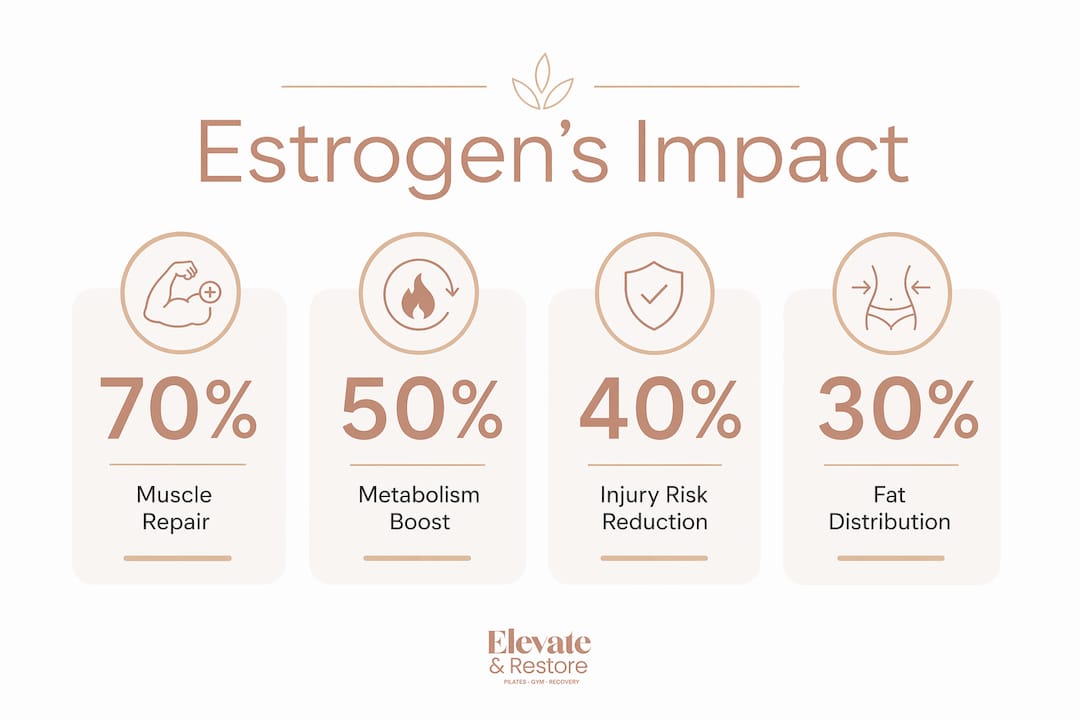
Early research by Tiidus (2003) suggests estrogen may lessen skeletal muscle damage from exercise and support faster repair. The evidence is preliminary but points in a clear direction: protecting your estrogen-supported recovery window matters more as you age.
Key effects of declining estrogen on the body:
- Slower muscle repair between training sessions
- Increased abdominal fat storage and shifting body composition
- Greater susceptibility to exercise-induced inflammation
- Reduced bone density protection over time
- Heightened variability in injury risk and recovery speed
Pro Tip: Prioritise sleep, protein intake, and active recovery methods like sauna or compression therapy in the days after hard sessions. These tools directly support the recovery functions that estrogen previously handled more efficiently. Elevateandrestore's sauna and recovery hub is built specifically for this.
How can women adapt their fitness routines to changing estrogen levels after 30?
Resistance training is the single most effective intervention for women navigating estrogen decline. Sarcopenia research confirms that consistent resistance training protects muscle protein turnover during the menopausal transition, directly countering the muscle loss that accelerates as estrogen drops. This is not optional maintenance. It is the primary tool for protecting your metabolic rate and physical function into your 40s and 50s.
Pilates deserves a specific mention here. It builds the deep stabilising muscles that protect joints, which become more vulnerable as estrogen-related connective tissue support decreases. Injury resilience through Pilates is particularly relevant for women in their 30s and 40s who want to train hard without accumulating overuse injuries. Reformer Pilates adds load and range of motion in a controlled environment, making it ideal for this stage of life.
Rigid cycle-based training schedules rarely work in practice. Individualised symptom monitoring is more effective than scheduling workouts strictly by cycle phase. Track energy, soreness, sleep quality, and mood. Let those signals guide your training intensity rather than a calendar date.
Community fitness also plays a measurable role in consistency. Training in a small group creates accountability that sustains you through the weeks when motivation dips alongside your hormones. Community fitness for women over 30 consistently outperforms solo training for long-term adherence.
| Exercise type | Primary benefit | Hormonal relevance |
|---|---|---|
| Resistance training | Muscle mass preservation | Counters sarcopenia from estrogen decline |
| Reformer Pilates | Joint stability and injury resilience | Protects connective tissue as estrogen drops |
| Low-impact cardio | Cardiovascular health and fat metabolism | Supports body composition during hormonal shifts |
| Functional training | Movement quality and injury prevention | Maintains capacity as hormonal recovery slows |
| Active recovery (sauna, cold plunge) | Inflammation reduction and repair | Replaces some recovery functions of estrogen |
What misconceptions do women have about estrogen and fitness?
The biggest myth is that estrogen directly determines how much muscle you can build. Estrogen receptor alpha signalling is a poor predictor of muscle hypertrophy outcomes. Training volume is far more important than estrogen status when it comes to building muscle. Women who believe their hormones are limiting their gains are often simply under-training.
The second myth is that feeling exhausted during the luteal phase means your body is failing. Perceived workout difficulty peaks when progesterone is high, but actual power output does not drop. Knowing this reframes a frustrating experience as a predictable, manageable pattern.
The third myth is that menopause causes weight gain primarily through hormonal changes. Physical inactivity and muscle loss drive menopausal weight gain more directly than hormonal shifts alone. Sarcopenia, the gradual loss of muscle mass, slows your metabolism. Hormones set the conditions. Inactivity pulls the trigger.
Common myths versus what the evidence actually shows:
- Myth: Estrogen controls muscle-building capacity. Fact: Training volume is the primary driver of hypertrophy.
- Myth: Hard workouts during the luteal phase mean you are overtrained. Fact: Perceived effort rises but physiological capacity stays the same.
- Myth: Menopause causes weight gain through hormones alone. Fact: Muscle loss and inactivity are the main metabolic drivers.
- Myth: Cycle-syncing your training is necessary for results. Fact: Symptom-led adjustments work better than rigid phase-based scheduling.
- Myth: Low estrogen means you cannot recover properly. Fact: Recovery slows but targeted strategies, including resistance training and active recovery, compensate effectively.
Key takeaways
Estrogen shapes women's fitness most powerfully through recovery, body composition, and injury risk, not through acute muscle growth or exercise capacity.
| Point | Details |
|---|---|
| Muscle synthesis stays consistent | Estrogen phase does not change muscle protein synthesis rates across the menstrual cycle. |
| Perceived effort is not lost capacity | Harder-feeling workouts during the luteal phase reflect hormone-driven perception, not reduced physical output. |
| Recovery is where estrogen matters most | Declining estrogen slows muscle repair and increases inflammation, making recovery strategies non-negotiable after 30. |
| Resistance training is the core intervention | Consistent strength work protects muscle mass and metabolic rate as estrogen declines through menopause. |
| Symptom tracking beats cycle scheduling | Individual responses to hormonal shifts vary widely; tracking symptoms outperforms rigid phase-based training plans. |
What I have learned training women through hormonal change
Working with women over 30 at Elevateandrestore, the pattern I see most often is this: women arrive frustrated, convinced their hormones are working against them. They are not wrong that something has shifted. They are wrong about what to do with that information.
The science now confirms what good coaches have observed for years. Your muscle-building capacity does not disappear when estrogen drops. Your recovery window narrows, your body composition shifts, and your perception of effort changes. Those are real and significant. But they are manageable with the right training structure.
What I have found works is a combination of consistent resistance training, Pilates for joint health, and deliberate recovery. Not because it is trendy, but because the evidence points directly there. Women who strength train after 30 consistently report better energy, better body composition, and better resilience through hormonal transitions than those who rely on cardio alone.
The uncomfortable truth is that most women wait too long to build the muscle base that protects them through menopause. The best time to start was five years ago. The second best time is now.
— Elevate
Training support designed for women navigating hormonal change
Elevateandrestore runs small-group sessions capped at six people, which means your training gets real attention, not a generic programme. The studio combines functional training and reformer Pilates with a full recovery hub including sauna, cold plunge, hot tub, and compression boots.
For women over 30 managing shifting estrogen levels, that combination is deliberate. Reformer Pilates sessions build the joint stability and controlled strength that protect you as hormonal support decreases. The recovery facilities directly address the inflammation and repair challenges that come with declining estrogen. If you are ready to train in a way that actually fits where your body is right now, Elevateandrestore is worth a look.
FAQ
Does estrogen affect how much muscle women can build?
Estrogen receptor alpha signalling is a poor predictor of muscle hypertrophy. Training volume matters far more than estrogen status for building muscle in women.
Why do workouts feel harder during the luteal phase?
Progesterone rises during the luteal phase and increases perceived effort, but heart rate, oxygen uptake, and physical output remain unchanged. The difficulty is real but it is perceptual, not physiological.
Does menopause cause weight gain through hormones alone?
Physical inactivity and muscle loss are the primary drivers of menopausal weight gain. Hormonal changes shift fat distribution, but sarcopenia and reduced activity drive the metabolic slowdown.
Should women train differently at different points in their cycle?
Rigid cycle-based scheduling is less effective than tracking individual symptoms. Adjust training intensity based on energy, soreness, and sleep quality rather than calendar phase alone.
What is the best exercise for women with declining estrogen?
Resistance training is the most evidence-backed intervention for protecting muscle mass and metabolic rate as estrogen declines. Pilates and active recovery methods support joint health and inflammation management alongside it.