
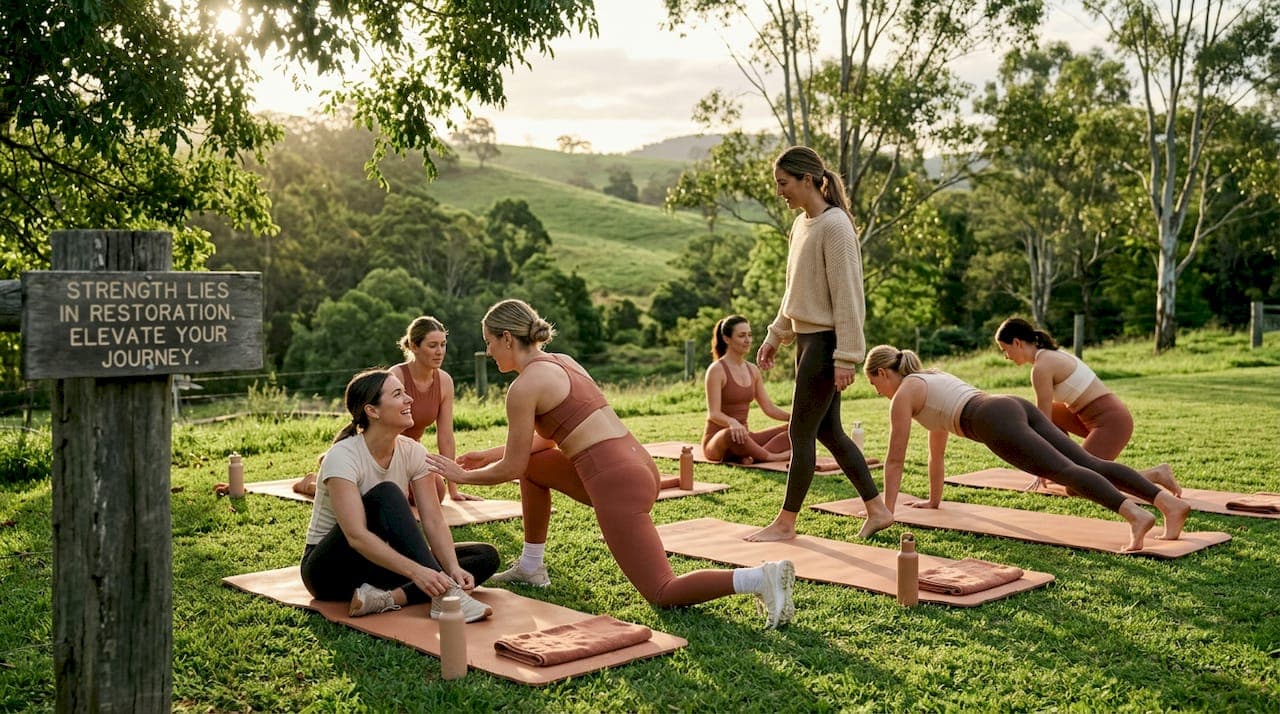
Most people assume that discipline is a solo sport. You set the alarm, you show up, you do the work. But if that were true, gym membership cancellations wouldn't spike every February. The real reason why group fitness increases accountability has nothing to do with willpower and everything to do with psychology. When you exercise alongside others in a structured environment, something shifts. You stop relying solely on motivation, which is unreliable at best, and start drawing on something far more durable: the social bonds and mutual expectations that form when people train together consistently.
Table of Contents
- Key takeaways
- Why group fitness increases accountability through social connection
- Trust, reciprocity, and the identity shift that keeps you going
- How group size and format shape your accountability
- Peer relationships and the confidence to keep showing up
- How to choose a group fitness environment that actually holds you accountable
- My honest take on group fitness for women over 30
- Train with people who notice when you're not there
- FAQ
Key takeaways
| Point | Details |
|---|---|
| Social bonds beat willpower | Group fitness creates mutual expectations that outlast personal motivation, making attendance more consistent. |
| Trust drives commitment | Reciprocity and trust within a group are the strongest predictors of whether you'll keep showing up. |
| Group size shapes experience | Larger groups improve social recognition and satisfaction, while small supervised groups sharpen feedback and self-efficacy. |
| Peer support builds confidence | Observing and being encouraged by peers raises your belief in your own ability to exercise regularly. |
| Structure matters more than presence | Exercising near others is not enough. Intentional group design with consistent schedules and coaching is what creates real accountability. |
Why group fitness increases accountability through social connection
The psychological term for what happens in a good group fitness class is relatedness, one of three core human needs identified in Self-Determination Theory. When that need is met, motivation shifts from external pressure to genuine internal drive. You're no longer going to class because you paid for it. You're going because your people are there.
This matters enormously for women over 30 who are juggling work, family, and the mental load that comes with both. Solo workouts are easy to cancel quietly. Group workouts carry social weight. Research confirms that group exercise benefits extend beyond physical outcomes to include psychosocial gains that make people want to keep participating.
Here's what that looks like in practice:
- You recognise the same faces each week, and they recognise you. Absence becomes noticeable.
- A coach or instructor knows your name and your goals, which creates a sense of being seen.
- You feel part of something larger than your own fitness targets, which reduces the isolation that often derails solo training.
- The energy of others working hard alongside you raises your own effort without conscious thought.
Pro Tip: Look for group fitness settings where the instructor uses your name and acknowledges your progress. That personal recognition is not just nice to have. It's one of the primary mechanisms that keeps you coming back.
Supervised small-group programmes show significantly lower dropout rates than solo training, with researchers attributing this directly to relatedness, professional feedback, and shared goals. That's not a coincidence. It's the science of belonging at work.
Trust, reciprocity, and the identity shift that keeps you going
There's a meaningful difference between exercising in the same room as strangers and training as part of a genuine group. The first is co-location. The second is community. And only the second creates the kind of accountability that sticks.
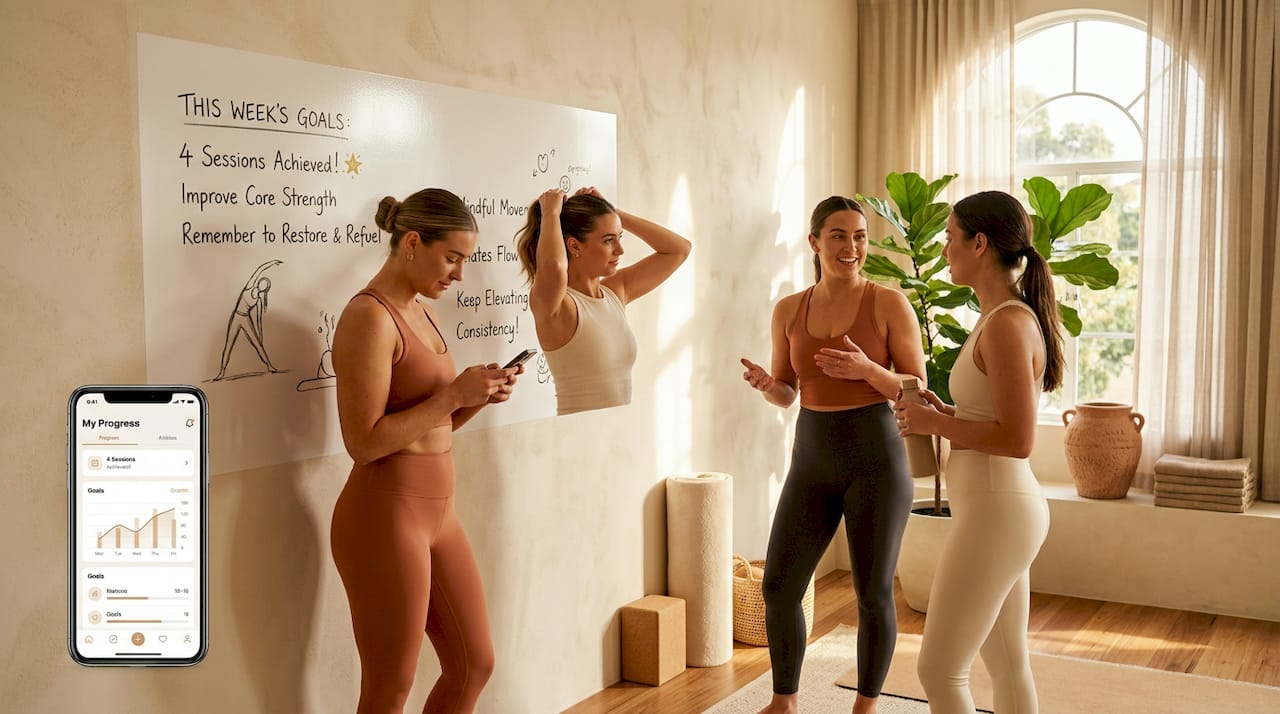
The concept of social capital explains why. In group fitness contexts, social capital refers to the trust, reciprocity, and shared norms that develop between members over time. When you trust the people around you and feel a sense of mutual obligation, you start to feel responsible not just to yourself but to the group. Missing a session isn't just a personal setback. It feels like letting your crew down.
Research into group conditioning programmes found that reciprocity and trust were the strongest predictors of whether participants intended to keep exercising. Not the quality of the workout. Not the equipment. The social bonds.
"Accountability that sticks is rooted in social capital characterised by trust and shared social norms, rather than pressure or shame."
This is a critical distinction. The accountability that works long-term is not the kind that makes you feel guilty for missing a session. It's the kind that makes you genuinely want to be there because you value the people and the experience. That shift from obligation to belonging is where group fitness becomes transformative.
A shared group identity reinforces this further. When you start to think of yourself as someone who trains at a particular studio with particular people, that identity becomes part of how you see yourself. Behaviour follows identity. You don't skip because skipping would feel inconsistent with who you are.
How group size and format shape your accountability
Not all group fitness formats create the same accountability. The structure, size, and even the delivery format of a group can significantly affect how committed members feel and how often they show up.
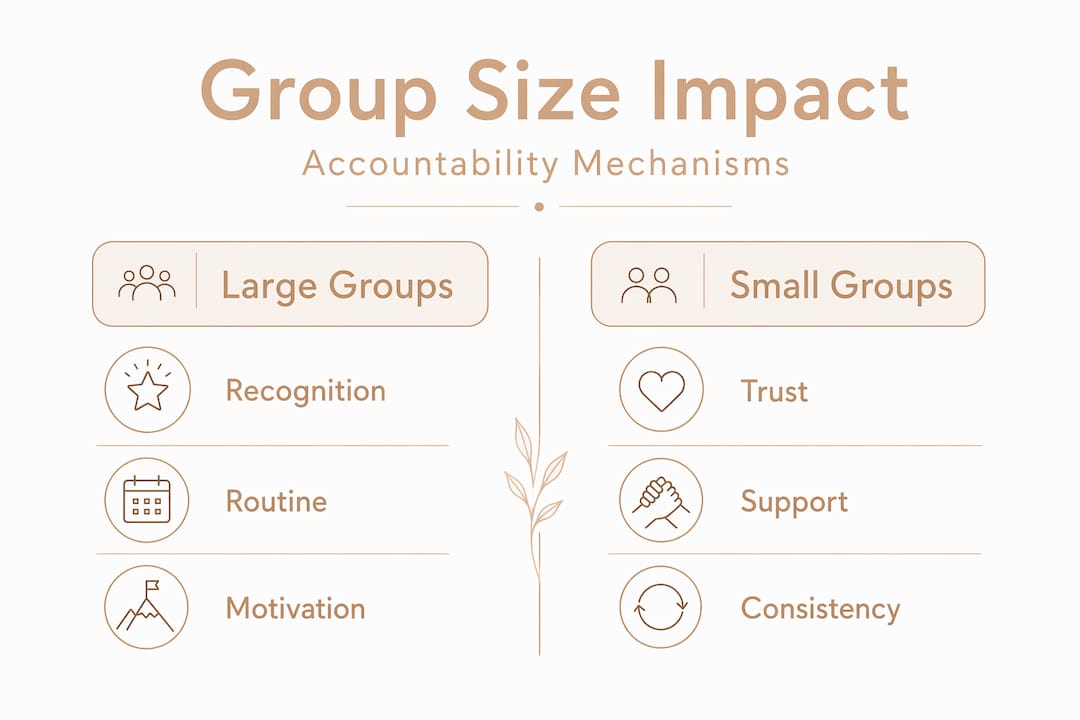
| Format | Accountability strength | Key mechanism |
|---|---|---|
| Large group (12+ people) | High social recognition | Members become known regulars, improving attendance frequency |
| Small supervised group (4-8 people) | High feedback and observation | Coach and peers notice effort and absence directly |
| Virtual group with peer interaction | Moderate to high | Replicates social support and mutual expectation remotely |
| Solo exercise | Low | Relies entirely on personal motivation with no external reinforcement |
Participants in groups of 12 or more reported the highest satisfaction scores at 8.8 out of 10, and 64% attended three or more times per week. Part of what drives this is social recognition. In a larger class, you become a familiar face. Instructors and fellow members notice when you're absent, which creates a gentle but real social expectation to attend.
Smaller groups offer a different kind of accountability. With six people in a room, there's nowhere to hide and no reason to. Your effort is visible, your progress is tracked, and your absence is felt immediately. That level of observation, when it comes from a place of support rather than judgement, is extraordinarily motivating.
Virtual formats are worth mentioning too, particularly for women managing unpredictable schedules. Remote group exercise with peer support significantly increased physical activity in postpartum women, showing that the social mechanisms of group accountability can travel beyond the studio walls.
Pro Tip: If you're choosing between group formats, prioritise consistency over size. A small group you attend three times a week will build stronger accountability than a large class you visit occasionally.
Peer relationships and the confidence to keep showing up
One of the quieter benefits of group fitness is what it does to your belief in yourself. Self-efficacy, your confidence in your own ability to exercise consistently, is one of the strongest predictors of long-term physical activity. And it turns out that other people are one of the fastest ways to build it.
Watching someone at a similar fitness level complete a challenging exercise tells your brain: I can do that too. Receiving encouragement from a coach or classmate after a hard set reinforces the belief that you're capable. Over time, these small moments compound into a fundamentally different relationship with exercise.
Research using a chain-mediated model found that peer relationships improve exercise intentions through two linked pathways: social support and self-efficacy. The connection runs from peer interaction to feeling supported, to believing you can do it, to actually intending to keep going. That's not a small effect. It's the mechanism behind why people who train in groups are more likely to still be training a year later.
For women over 30, this is particularly relevant. Many arrive at group fitness after years of stop-start solo attempts, carrying the belief that they're just not consistent people. What they often discover is that consistency was never the problem. The environment was. Place the same person in a group with genuine peer support and skilled coaching, and the behaviour changes because the belief changes first.
Group-based interventions show a statistically significant improvement in functional outcomes compared to solo exercise, with the effect strongest when groups are intentionally structured rather than simply co-located. The design of the group matters as much as the group itself.
How to choose a group fitness environment that actually holds you accountable
Knowing the theory is one thing. Finding or building the right environment is another. Here's what to look for when you're evaluating whether a group fitness setting will genuinely support your accountability.
- Consistent scheduling. A group that meets at the same time each week becomes a predictable social appointment. Predictability transforms attendance from a decision into a habit.
- Familiar faces. The accountability effect builds over time. Look for studios with low member turnover and a culture that encourages regulars to get to know each other.
- Visible attendance. Whether it's a booking system, a sign-in sheet, or simply a coach who notices when you're not there, some form of attendance visibility creates gentle social expectation.
- Coaching and feedback. A skilled coach does more than lead the session. They build your competence by giving specific feedback, which satisfies the third core need in Self-Determination Theory alongside relatedness and autonomy.
- A culture of support, not shame. Accountability rooted in trust outperforms accountability rooted in guilt. If missing a session makes you feel judged rather than missed, that environment will eventually push you away.
Pro Tip: Before committing to a group fitness programme, attend two or three sessions and pay attention to how members interact with each other, not just with the instructor. The culture between members is where real accountability lives.
For women with busy schedules, hybrid options that combine in-person sessions with an online community group can replicate many of the same social mechanisms. The key is that the group must feel real and reciprocal, not performative.
My honest take on group fitness for women over 30
I've worked with a lot of women who come through the door convinced they have a discipline problem. They've tried solo gym memberships, home workout apps, early morning runs. None of it stuck. And they've internalised that as a personal failing.
What I've seen again and again is that it was never about discipline. It was about the absence of a community that made showing up feel worthwhile. When you're tired, stressed, and pulled in fifteen directions, the only thing that reliably gets you out the door is knowing that real people are expecting you and that you'll feel genuinely better for having been there.
The women who stay consistent at Elevateandrestore are not the ones with the most willpower. They're the ones who've built real relationships within the group. They text each other. They notice when someone's been absent. They celebrate each other's progress. That's not a side effect of the training. That's the training.
What I'd push back on is the idea that any group setting delivers this automatically. Showing up to a class of 30 strangers where nobody knows your name is not the same as training in a small, intentional group where your presence matters. The group's social cohesion is what creates accountability. Size, structure, and culture all shape whether that cohesion develops.
If you're over 30 and you've been trying to make fitness stick on your own, stop treating it as a solo project. Find a group that feels like yours. The accountability will follow.
— Elevate
Train with people who notice when you're not there
At Elevateandrestore, every session is capped at six people. That's not an accident. It's the format that makes genuine accountability possible, where your coach knows your name, your goals, and your progress, and so does everyone else in the room.

Whether you're drawn to functional training or reformer Pilates classes, the structure at Elevateandrestore is built around the same principle: small groups, expert coaching, and a community that keeps you coming back. After your session, the recovery hub, including sauna, cold plunge, hot tub, and compression boots, gives you another reason to look forward to every visit. Explore the boutique fitness options and find the group that fits your life.
FAQ
Why does group fitness improve accountability more than solo training?
Group fitness creates social expectations and mutual bonds that solo training cannot replicate. When real people notice your absence and celebrate your progress, showing up becomes about more than personal goals.
How does group size affect accountability in fitness classes?
Larger groups help members become recognisable regulars, which improves attendance frequency. Small supervised groups provide direct peer observation and coaching feedback, both of which strongly reinforce consistent participation.
Can online group fitness classes create the same accountability?
Yes, when designed with genuine peer interaction and mutual support. Research shows that remote group exercise with structured peer feedback significantly increases physical activity levels, particularly for women managing demanding schedules.
What makes accountability in group fitness sustainable long-term?
Sustainable accountability comes from trust and social capital within the group, not from guilt or external pressure. When members feel genuinely supported and capable, they stay because they want to, not because they feel obligated.
How quickly does group fitness accountability build?
The social bonds that drive accountability develop over weeks of consistent attendance. Programmes with structured social cohesion and recurring peers tend to accelerate this process significantly compared to drop-in formats.