

Thoracic mobility is defined as the active ability to rotate and extend the mid-back spine under load, and it is the single most overlooked factor in lifting performance for people over 30. The role of thoracic mobility in lifting goes far beyond flexibility. It determines whether your shoulders, hips, and lower back can hold safe positions during squats, overhead presses, and Olympic lifts. When the thoracic spine stiffens, the body compensates elsewhere, and that is where injuries begin. Research confirms that 80% of total back rotation occurs through the thoracic spine. Lose that range, and every lift above your head or behind your neck becomes a risk.
What is the role of thoracic mobility in lifting mechanics?
Thoracic mobility directly controls the quality of your movement in three of the most demanding lifts: the overhead press, the back squat, and the snatch. Each of these requires the thoracic spine to extend and rotate so the shoulder blades can move freely and the bar can track in a straight line. When the mid-back is stiff, the body borrows range from wherever it can find it.
The most common compensations are lumbar hyperextension and rib flaring. Thoracic restrictions cause these patterns during overhead lifts, placing excessive strain on the shoulders and lower back. That strain is not random. It follows a predictable path from a stiff thoracic spine to an overloaded lumbar spine to chronic pain.

Mid-back stiffness also limits scapular glide. Restricted scapular movement significantly raises the risk of rotator cuff strain in lifters. This is why shoulder pain in older lifters so often traces back to the thoracic spine rather than the shoulder joint itself.
For lifters over 30, this matters more than it did at 25. Spinal stiffness accumulates with age, desk work, and training volume. The compensatory patterns that a younger body could absorb without consequence become the source of chronic discomfort in older lifters. Addressing strength training imbalances caused by thoracic stiffness is one of the most direct paths to pain-free lifting after 30.
Pro Tip: If your lower back aches after overhead pressing, test your thoracic extension first. Sit on a foam roller placed across your mid-back, support your head, and extend over it. If you feel nothing in your mid-back, your thoracic spine is the problem.
- Overhead press: requires thoracic extension to keep the bar over the centre of mass
- Back squat: needs thoracic extension to maintain an upright torso and prevent forward lean
- Snatch and clean: demand thoracic rotation and extension simultaneously under high load
- Bench press: thoracic extension creates the arch that protects the shoulder joint
What are the proven benefits of improving thoracic mobility?
The benefits of improving thoracic mobility are measurable, not theoretical. A six-week thoracic spine exercise programme significantly improved thoracic rotation and segmental mobility in professional athletes beyond what routine training alone achieved. That result matters because it confirms targeted work produces gains that general training does not.
The functional payoff shows up immediately in some lifters. Restoring thoracic mobility often produces a near-immediate increase in overhead reach and a reduction in neck and shoulder pain. The mechanism is straightforward: when the thoracic spine moves freely, the shoulder has a stable, mobile foundation to work from.
There is also a respiratory dimension that most lifters miss. A stiff rib cage linked to the thoracic spine restricts lung expansion and reduces endurance during high-intensity training. For anyone doing conditioning work alongside lifting, thoracic stiffness quietly limits how hard you can push.
"Mobility is distinct from flexibility. It involves active control under load rather than passive range. For lifters, this distinction is critical. Achieving proper positions in a squat or overhead press requires the thoracic spine to move with control, not just to stretch passively on a mat."
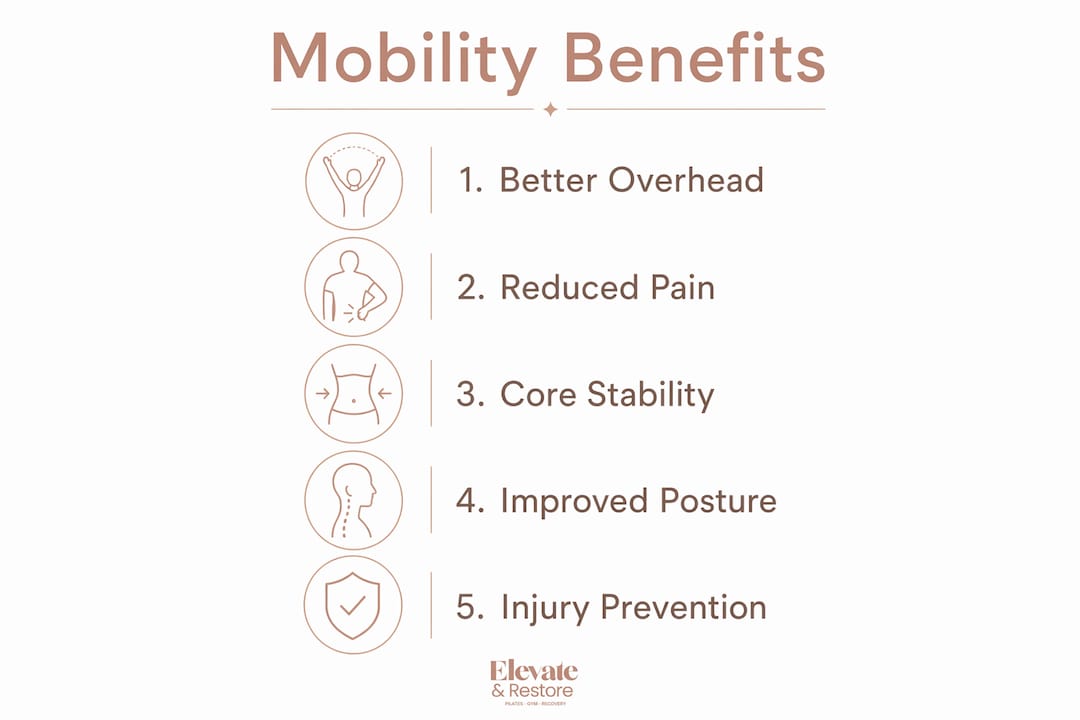
The table below summarises the key functional benefits of improved thoracic mobility for lifters over 30.
| Benefit | Mechanism | Practical outcome |
|---|---|---|
| Better overhead position | Thoracic extension frees the shoulder | Safer, stronger overhead press and snatch |
| Reduced lower back strain | Less lumbar compensation | Fewer injuries during squats and deadlifts |
| Improved scapular control | Mid-back mobility supports scapular glide | Lower rotator cuff injury risk |
| Greater respiratory efficiency | Rib cage mobility allows full lung expansion | Better endurance in high-intensity sessions |
| Improved posture under load | Thoracic extension counters desk-related rounding | Cleaner bar path and reduced spinal loading |
How to improve thoracic mobility: exercises and routines for lifters
The most effective approach to improving thoracic spine mobility combines targeted drills with proper testing before you begin. Testing thoracic spine extension with arms overhead confirms true mobility limits versus compensations or technique flaws. Many lifters target the thoracic spine when the real restriction is ankle dorsiflexion or a technique gap. Test first, then train.
Once you have confirmed a genuine thoracic restriction, the following sequence works well for lifters over 30.
- Foam roller thoracic extension. Place the roller across your mid-back at T6–T8. Support your head, extend over the roller for 5 seconds, and move the roller up one segment. Perform 8–10 extensions across the full thoracic spine.
- Quadruped thoracic rotation. Start on hands and knees. Place one hand behind your head and rotate your elbow toward the ceiling. Perform 10 controlled reps per side. Keep your lower back still throughout.
- Overhead Zercher squat. This loaded drill teaches neuromuscular control under load. Loaded mobility drills produce stronger carryover to lifting than passive stretching alone because they train active range under real conditions.
- Thoracic extension over a chair. Sit in a firm chair, clasp your hands behind your head, and extend your upper back over the top of the chair back. Hold for 3–5 seconds per rep. Perform 3 sets of 8.
- Seated thoracic rotation with a dowel. Sit on a bench with a dowel across your shoulders. Rotate fully to each side, keeping your hips square. Perform 3 sets of 10 per side.
Targeted mobility programmes for intermediate lifters recommend 10–15 minutes, three times per week, focusing on specific joint limitations rather than general flexibility routines. A consistent seven-minute daily routine performed with pain-free, controlled motion also produces results. The key word is consistent.
Pro Tip: Never chase thoracic range of motion through pain. If an extension drill causes sharp discomfort in the mid-back, reduce the range and slow the movement. Controlled, pain-free motion builds lasting mobility. Forced range builds compensation.
The comparison below shows why loaded drills outperform passive stretching for lifters.
| Method | Type of adaptation | Carryover to lifting | Best use case |
|---|---|---|---|
| Passive stretching | Flexibility gain | Short-lived | Warm-up or cool-down |
| Loaded mobility drills | Neuromuscular control | Strong and lasting | Pre-lift activation and skill work |
| Foam roller extension | Joint mobility | Moderate | Daily maintenance |
| Rotational drills with load | Active range under load | Strong | Directly before squats or overhead work |
How does thoracic mobility fit into a full training programme after 30?
Thoracic mobility does not exist in isolation. It connects directly to core stability, pelvic function, and shoulder health. When the thoracic spine moves well, the diaphragm can descend fully, intra-abdominal pressure increases correctly, and the core can brace effectively during heavy lifts. That chain of events is what makes thoracic mobility a foundation, not an accessory.
Adding Pilates to your lifting programme is one of the most practical ways to build thoracic mobility alongside core control. Pilates emphasises segmental spinal movement, breathing mechanics, and postural awareness. These are precisely the qualities that transfer to safer, stronger lifting after 30.
Breathwork is another underused tool. Lateral rib expansion breathing, where you direct breath into the sides of your rib cage rather than the chest, trains the thoracic spine to move with each breath cycle. Practised consistently, it improves rib cage mobility and reinforces thoracic extension under load.
The broader benefits of integrating thoracic mobility into a full training programme include:
- Safer overhead and rotational lifts due to reduced compensatory movement
- Better core bracing through improved diaphragm position and function
- Reduced neck and shoulder pain from improved scapular mechanics
- Improved posture and spinal awareness during daily movement, not just training
- Greater training longevity by reducing cumulative strain on the lumbar spine and shoulders
Recovery methods for strength training also support thoracic mobility work. Heat, in particular, increases tissue extensibility and makes mobility drills more effective when performed after a sauna session. For lifters over 30, combining mobility work with structured recovery is not optional. It is what keeps you training consistently year after year.
Key takeaways
Thoracic mobility is the active foundation of safe, effective lifting, and restricted mid-back movement causes compensations that accumulate into injury for lifters over 30.
| Point | Details |
|---|---|
| Thoracic spine drives rotation | 80% of total back rotation occurs through the thoracic spine, making it central to all major lifts. |
| Restrictions cause compensations | Limited thoracic mobility leads to lumbar hyperextension and rib flaring, increasing injury risk. |
| Test before you train | Confirm true thoracic restrictions with overhead extension testing before prescribing drills. |
| Loaded drills beat passive stretching | Overhead and rotational drills under load build neuromuscular control that transfers directly to lifting. |
| Consistency is the variable | Three sessions per week of 10–15 minutes produces measurable mobility gains in six weeks. |
What I have seen working with lifters over 30 at Elevateandrestore
The most common mistake I see is lifters spending months on passive stretching and foam rolling without ever testing whether the thoracic spine is actually the problem. They roll their mid-back for five minutes before every session and wonder why nothing changes. Passive work has its place, but it does not build the active control you need to hold a thoracic extension position under a loaded bar.
The second mistake is chasing range of motion without integrating it into lifting patterns. A lifter might gain 15 degrees of thoracic rotation on the floor and then lose all of it the moment they pick up a barbell. The body does not automatically transfer passive range into active, loaded movement. That transfer requires deliberate practice with loaded drills.
What I have found works consistently is a short, specific pre-session routine of two or three loaded drills, followed by immediate application in the first working sets. When a lifter does thoracic rotation drills and then walks straight into an overhead press, the nervous system connects the two. That connection is what produces lasting change.
The lifters who make the most progress are not the ones who spend the most time on mobility work. They are the ones who test accurately, train specifically, and stay consistent over months rather than weeks. Thoracic mobility is not a problem you solve once. It is a quality you maintain, and that maintenance pays off in every lift you do for the rest of your training life.
— Elevate
Thoracic mobility training at Elevateandrestore
At Elevateandrestore in West Footscray, thoracic mobility is built into every programme we design for lifters over 30. Our small-group sessions of six people mean your movement quality gets real attention, not a generic warm-up.

Our Reformer Pilates classes target segmental spinal movement, breathing mechanics, and postural control, exactly the qualities that transfer to safer, stronger lifting. After your session, the recovery lounge gives you access to sauna, cold plunge, hot tub, and compression boots to support the tissue work you have just done. If you are ready to address your thoracic mobility with a programme built around your actual restrictions, book an assessment with us at Elevateandrestore.
FAQ
What is thoracic mobility and why does it matter for lifting?
Thoracic mobility is the active ability to rotate and extend the mid-back spine under load. It matters for lifting because the thoracic spine contributes to 80% of total back rotation, making it central to safe overhead, squat, and rotational movements.
How often should I do thoracic mobility exercises?
Targeted thoracic mobility programmes recommend 10–15 minutes, three times per week, focusing on specific joint limitations. A consistent daily routine of seven minutes also produces results when performed with controlled, pain-free motion.
Can a stiff thoracic spine cause shoulder pain?
Yes. Mid-back stiffness restricts scapular glide, which significantly increases the risk of rotator cuff strain. Restoring thoracic mobility often reduces neck and shoulder pain by giving the shoulder joint a stable, mobile foundation.
What is the difference between thoracic mobility and flexibility?
Mobility involves active control of a joint through its range under load. Flexibility is passive range without load. For lifters, mobility is the relevant quality because it determines whether you can hold a safe position during a squat or overhead press.
Do loaded drills work better than stretching for thoracic mobility?
Loaded mobility drills, such as overhead Zercher squats and rotational work with load, produce stronger carryover to lifting than passive stretching. Passive stretching offers short-lived flexibility gains, while loaded drills build the neuromuscular control needed to access range during actual lifts.