
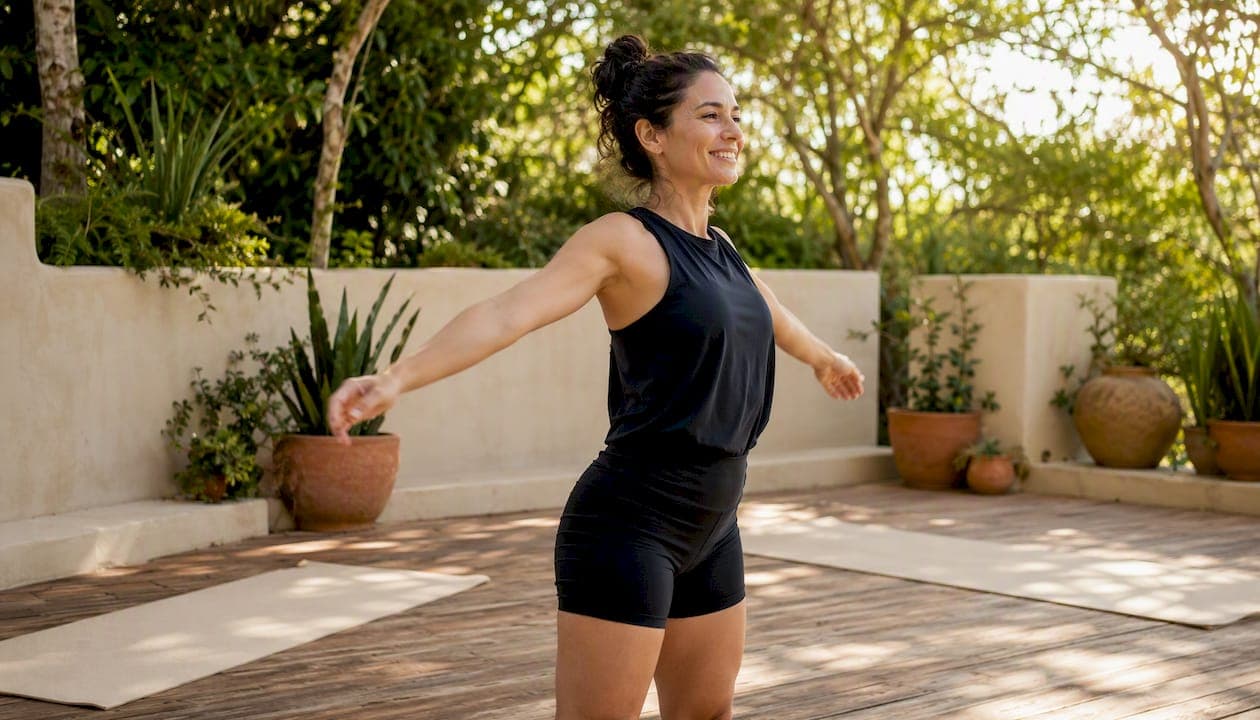
Assess before you load. That's the single most useful thing you can do right now for your overhead lifts. Run two quick tests, identify whether your limit sits in your thoracic spine, lats, scapula, or shoulder joint, then follow a 10-minute mobility routine before you touch a barbell. Most lifters skip straight to loading and wonder why their press stalls or their lower back takes over.
Here's how to start today:
- Wall overhead reach test: Stand with your back flat against a wall, feet 5cm out. Raise both arms overhead. If your lower back peels off the wall or your arms can't reach vertical, you likely have thoracic stiffness or lat tightness.
- Shoulder flexion active range of motion (AROM) check: Standing freely, raise one arm overhead as high as possible without arching your back. Less than 170 degrees of flexion, or a noticeable side-to-side difference, signals a restriction worth addressing.
Start with one drill right now: the foam roller thoracic extension. Place the roller perpendicular to your spine at mid-back, support your head, and extend over it for 5 breaths. Move it up two segments and repeat. That's 90 seconds of work that can unlock range you already have but can't access cold.
Pro Tip: Warm tissue moves better. A 5-minute general warm-up (light cardio, arm circles) before your mobility drills lets you access latent range rather than forcing a cold joint into positions it will resist.
Key takeaways
Consistent overhead mobility work, structured around the mobilise → activate → cement sequence and performed before every lifting session, produces the fastest and most durable improvements in overhead range and stability.
| Point | Details |
|---|---|
| Assess before you drill | Run the wall slide, AROM, and lat length tests to identify your specific restriction before choosing drills. |
| Follow the mobilise → activate → cement sequence | Passive stretching must be followed by activation and light loading or gains won't transfer to the bar. |
| Ten minutes daily beats one long session | A short, repeatable warm-up routine done consistently produces more carryover than infrequent long sessions. |
| Progress load gradually and in stages | Move from wall slides to landmine to dumbbell to barbell, adding load only when scapular and ribcage control is confirmed. |
| Elevateandrestore | Offers movement assessments, small-group Pilates, and functional training in West Footscray for guided overhead mobility progress. |
Table of Contents
- Why shoulder mobility matters for overhead lifts
- How to self-assess what's limiting your overhead position
- Common causes of restricted overhead range and what they look like
- Targeted drills grouped by the tissue they address
- How to progress mobility gains into loaded overhead strength
- The Elevateandrestore 10-minute overhead mobility routine
- When to stop and when to see a physiotherapist or GP
- How Elevateandrestore approaches overhead mobility in the studio
- Guided overhead mobility sessions at Elevateandrestore
- Sources
Why shoulder mobility matters for overhead lifts
Overhead mobility determines whether you can safely and effectively press, snatch, or overhead squat. That's not an exaggeration. When your shoulder can't reach a true vertical position, every overhead lift becomes a compensation game.
The movement system involved is more complex than most lifters realise. The Prehab Guys describe overhead mobility as a multi-segment task requiring coordinated motion across the glenohumeral joint, scapulothoracic joint, thoracic spine, and lumbopelvic region. Treating it as a pure shoulder-joint problem is why so many mobility programmes fail to transfer to the bar.
Here's what breaks down when each region is restricted:
- Glenohumeral joint: Limited flexion or external rotation forces the humerus into impingement territory, particularly in the subacromial space.
- Scapulothoracic rhythm: If the scapula can't upwardly rotate and posteriorly tilt, the acromion crowds the rotator cuff tendons during elevation.
- Thoracic extension: A stiff mid-back forces the lumbar spine to hyperextend to compensate, shifting load away from the shoulder and onto structures not built for it.
- Lumbopelvic control: An anterior pelvic tilt or rib flare during pressing mimics a mobility deficit even when joint range is adequate.
The performance implications are direct. Reduced overhead range shortens the effective pressing path, reduces the mechanical advantage of the rotator cuff, and caps the weight you can safely handle. For Olympic lifters, a restricted overhead position in the snatch or jerk means the bar travels forward, the catch is unstable, and missed lifts follow. For anyone pressing a barbell, the same restriction quietly loads the anterior shoulder and cervical spine with every rep.
How to self-assess what's limiting your overhead position
Five tests cover the main culprits: the wall slide, shoulder flexion AROM, thoracic extension on a foam roller, lat length test, and scapular assistance test. Run through them in order and you'll have a clear map of where to focus.
1. Wall slide
Stand with your back, head, and arms against a wall. Slide both arms overhead while keeping contact at your lower back, upper back, and wrists. Pass: arms reach vertical with all contact points maintained. Fail: lower back lifts off, elbows bend, or wrists lose contact. This points to thoracic stiffness, lat tightness, or both.

2. Shoulder flexion AROM
Stand freely, brace lightly, and raise one arm overhead as high as possible without arching. Repeat both sides. Pass: 170–180 degrees of flexion, symmetrical. Fail: less than 170 degrees or more than 10 degrees of side-to-side difference. Asymmetry often indicates a unilateral capsular or rotator cuff restriction.
3. Thoracic extension on a foam roller
Sit in front of a foam roller, place it at T6–T8 (mid-thoracic), support your head, and extend over it. Move up two segments toward T4 and repeat. Pass: you feel a comfortable stretch and extension through the mid-back. Fail: the movement feels blocked, painful, or you can only extend at the lumbar spine. This isolates thoracic stiffness directly.
4. Lat length test
Lie on your back, knees bent, lower back flat. Raise both arms overhead to the floor. Pass: arms reach the floor without the lower back arching. Fail: arms stop short of the floor or the lower back lifts. Tight lats pull the humerus into internal rotation and limit overhead reach, and they're a frequent cause of the lumbar arching you see during overhead lifts.
5. Scapular assistance test
Have a training partner (or use a mirror) watch you raise one arm overhead. The partner gently assists scapular upward rotation and posterior tilt as you lift. Pass: your overhead range increases noticeably with assistance. Fail (in a useful sense): no change, which points the restriction toward the glenohumeral joint or thoracic spine rather than scapular control.
Filming yourself from the side and behind adds a layer of objectivity that's hard to achieve in real time. A 10-second clip of your wall slide or overhead squat will show compensations you won't feel. If you're seeing significant asymmetry, sharp pain, or you can't identify the pattern, a physiotherapist or experienced coach can run a more detailed screen in a single session.
Common causes of restricted overhead range and what they look like
Most overhead restrictions trace back to thoracic extension stiffness or soft-tissue tightness around the shoulder and scapula. The glenohumeral joint itself is rarely the primary culprit, though it's usually the first place lifters look.
- Thoracic stiffness: Shows up as a blocked foam roller test and lumbar compensation during the wall slide. The mid-back simply won't extend, so the lower back takes over. Thoracic extension is a common limiting factor for overhead positions, and foam roller work often produces rapid improvements in overhead reach.
- Lat tightness: Fails the lat length test and produces the characteristic lower back arch during overhead pressing. The lats attach to the humerus and pull it into internal rotation and extension, physically blocking full flexion. Persistent lumbar arching during overhead lifts is a reliable indicator of lat restriction.
- Pec minor tightness: Tilts the scapula anteriorly, which reduces posterior tilt and upward rotation during elevation. You'll see the shoulder blade "winging" or the shoulder rolling forward at the top of a press.
- Posterior capsule tightness: Limits internal rotation and horizontal adduction, often showing up as a side-to-side difference in the AROM test. Common in lifters who bench press heavily without balancing posterior shoulder work.
- Poor scapular control: The scapular assistance test reveals this directly. The scapula fails to upwardly rotate smoothly, causing the shoulder to hike or the neck to tense during elevation. Weak lower trapezius and serratus anterior are usually involved.
- Lumbopelvic control deficits: This one mimics a mobility problem without being one. If your core can't hold a neutral pelvis and ribcage position under load, the lumbar spine extends to compensate, making it look like your shoulder range is the issue. Addressing core stability and lumbopelvic control often unlocks overhead range that was never actually restricted.
Pro Tip: Before assuming you need more shoulder stretching, check your rib position. Stand against a wall and consciously pull your lower ribs down. If your overhead reach improves immediately, lumbopelvic control is the primary issue, not tissue tightness.
Targeted drills grouped by the tissue they address
Choose drills that target the tissue your tests identified, then follow the mobilise → activate → cement sequence. Passive stretching alone won't stick. You need to follow it with activation work and then load the new range, even lightly, to teach your nervous system to own the position. This mobilise → activate → cement approach is the organising principle behind every effective overhead mobility programme.
Thoracic spine
| Drill | Sets × Reps / Hold | Goal | Progression |
|---|---|---|---|
| Foam roller thoracic extension | 3 × 5 breaths per segment | Open range quickly | Add rotation at end range |
| Quadruped thoracic rotation | 3 × 10 per side | Sustain end-range | Increase rotation depth |
| Thread-the-needle | 2 × 8 per side | Translate to loaded press | Add a light reach at end range |
Programming note: Perform thoracic drills first in your warm-up, before any shoulder work. Daily is appropriate for stiff lifters; 4–5 times per week for maintenance. For more on why thoracic extension is so critical for lifters over 30, the thoracic mobility guide for lifters covers the mechanics and programming in detail.
Latissimus dorsi
- Banded lat mobilisation: Anchor a band at shoulder height, step back, hinge at the hips, and let the band pull the arm into flexion and external rotation. Hold 30–45 seconds, 3 sets per side. This is one of the most effective drills for restoring overhead reach when lats are the limiting factor.
- Lat eccentric stretch (bench prayer stretch): Kneel in front of a bench, place forearms on the surface, and sit your hips back while keeping your arms extended. Hold 30–45 seconds. Focus on keeping the lower back neutral rather than letting it arch.
- Overhead lat stretch with side bend: Standing, reach one arm overhead and lean away. 3 × 30 seconds per side.
Pec minor and anterior shoulder
- Doorway pec stretch: Forearm on the door frame at 90 degrees, step through gently. 3 × 30 seconds. Avoid cranking the shoulder into pain.
- Bench opener (thoracic + pec): Sit beside a bench, place one arm along the surface, and rotate your chest toward the ceiling. 3 × 8 per side.
Posterior capsule
- Sleeper stretch: Lie on your side on the restricted shoulder, flex the elbow to 90 degrees, and gently press the wrist toward the floor into internal rotation. 3 × 30 seconds. Keep the shoulder blade from rolling forward.
- Cross-body stretch: Pull the arm across the chest at shoulder height, maintaining scapular position. 3 × 30 seconds per side.
Scapular control and rotator cuff
Active range-of-motion exercises that move the shoulder through its full range under muscular control are the bridge between passive stretching and loaded pressing. These include:
- Wall slides (activation): Back against the wall, arms in a "W" position, slide to overhead while maintaining contact. 3 × 10. Slow and controlled beats fast every time.
- Band pull-aparts: 3 × 15, focusing on scapular retraction and depression at end range.
- Prone Y-T-W: Lying face down, perform Y, T, and W arm positions with light weight or bodyweight. 3 × 8 each. Targets lower trapezius and serratus anterior directly.
For a deeper look at building the stabiliser strength that makes these drills stick, the lifter's guide to stabiliser muscles is worth reading alongside this section.
Pro Tip: During any overhead drill, watch your lower back. The moment it arches, you've exceeded your current range and are borrowing from the lumbar spine. Reduce the range, brace your core, and work at the edge of what you can control, not the edge of what you can force.
How to progress mobility gains into loaded overhead strength
Mobility without stability is just flexibility. The goal is to combine mobility with stability and gradual loading so your nervous system learns to hold the new range under real conditions. Progress by teaching the movement at the new range first, then adding load gradually while keeping scapular and ribcage control intact.
Step-by-step progression
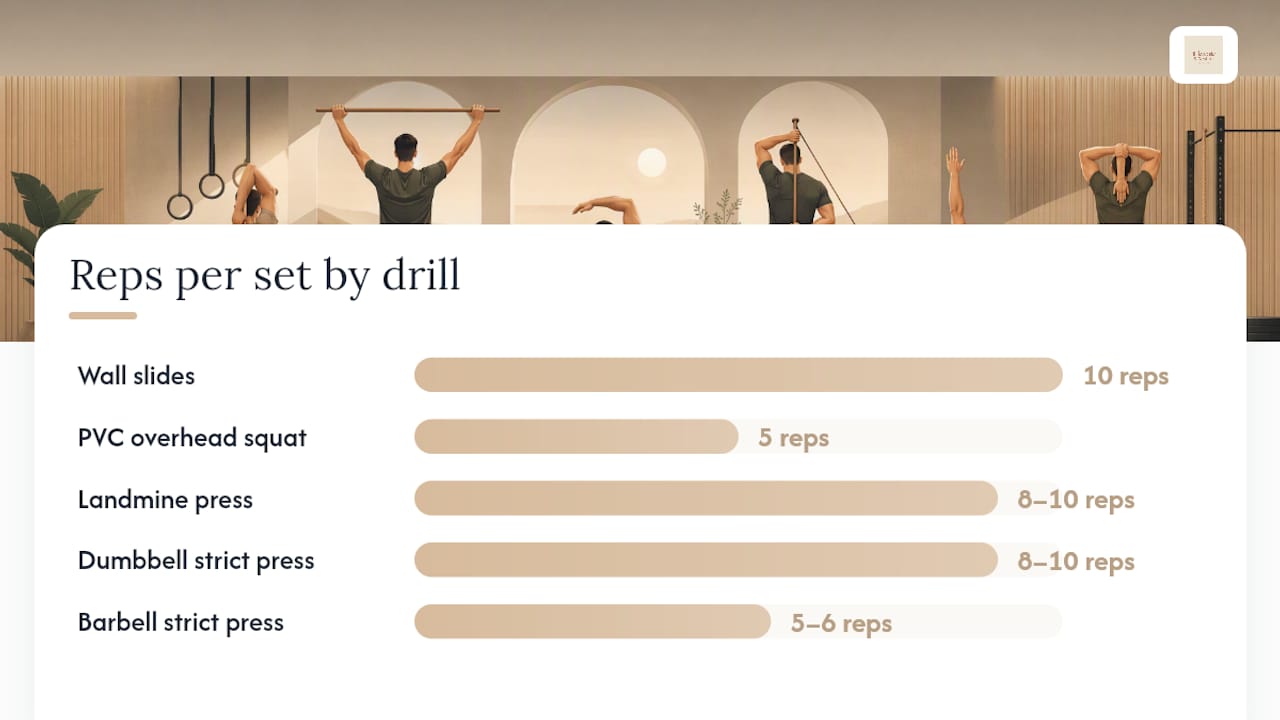
- Wall slides and active overhead reach (unloaded motor practice): 3 × 10 daily. Establish the pattern before adding any resistance. Focus on scapular upward rotation and a neutral ribcage.
- PVC or broomstick overhead squat and press: Use a light stick to practice the overhead position with feedback. 3 × 5, pausing 2 seconds at the top. This builds proprioception and reveals remaining compensations without load risk.
- Landmine press: The angled bar path reduces the demand on shoulder external rotation and thoracic extension, making it a safer early loading option for lifters with significant restriction or previous shoulder issues. 3 × 8–10 at a light load, focusing on scapular control throughout.
- Dumbbell strict press (neutral or semi-pronated grip): Allows each shoulder to find its own path. Start light, 3 × 8–10, and only progress load when the ribcage stays down for every rep.
- Barbell strict press: Introduce the barbell once you can demonstrate consistent scapular control and thoracic position through the full range with dumbbells. 3–4 × 5–6, building load over weeks, not sessions.
- Olympic overhead skill work: Coach Greg Everett argues that mobility and stability are inseparable and recommends including overhead squats, snatch push presses, and presses in the snatch to build proprioception and strength alongside range. These movements cement the overhead position under real athletic demand.
Programming guidance:
- Stability phase (weeks 1–4): 3–4 sessions per week, 3 × 10–12 at 50–60% of estimated max, prioritising position over load.
- Strength phase (weeks 5–8): 3 sessions per week, 4 × 5–6 at 70–80%, adding load only when the previous session's positions were clean.
- Combine overhead pressing with horizontal pulling (rows, face pulls) at a 1:1 ratio to prevent anterior shoulder dominance.
Contraindications: Behind-the-neck pressing and extreme-range barbell work are often inappropriate for lifters with significant restriction or prior shoulder pathology. Landmine and neutral-grip variations are the safer starting point. For a broader look at how imbalances affect loading choices, the common strength training imbalances guide covers this well.
The Elevateandrestore 10-minute overhead mobility routine
Ten minutes, done consistently before every overhead session, produces more carryover than a 45-minute mobility session once a fortnight. Frequency and consistency matter more than long single sessions. Here's the full sequence:
Complete routine: thoracic extension → lat mobilisation → wall slides → band pull-aparts → overhead reach hold. Total time: 10 minutes.
| Sequence | Exercise | Duration / Sets | Primary Target | Progression Cue |
|---|---|---|---|---|
| 1 | Foam roller thoracic extension | 3 segments × 5 breaths | Thoracic spine | Add rotation at end range |
| 2 | Banded lat mobilisation | 3 × 30 sec per side | Latissimus dorsi | Increase hip hinge depth |
| 3 | Wall slides (activation) | 3 × 10 reps | Scapular control | Slow the return phase |
| 4 | Band pull-aparts | 2 × 15 reps | Posterior shoulder | Pause 1 sec at end range |
| 5 | Overhead reach hold (PVC or arms) | 3 × 10 sec hold | Full overhead pattern | Add a light load (1 kg) |
Equipment needed: foam roller, resistance band, and a PVC pipe or broomstick. These simple tools form an effective first-line intervention for most overhead restrictions before any resisted training is needed.
At Elevateandrestore in West Footscray, this routine is scaled for older lifters and clients with previous shoulder issues by reducing the range on the foam roller work, substituting the banded lat mobilisation with a supported bench prayer stretch, and using a lighter band for pull-aparts. Clients with a history of rotator cuff issues perform the overhead reach hold at 135 degrees rather than full vertical until their scapular control is confirmed.
Pro Tip: Run this routine at the start of your warm-up, not after your main session. Mobility work done post-training when you're fatigued is harder to control and less likely to transfer to your next session's movement quality.
When to stop and when to see a physiotherapist or GP
Stop mobility work and seek assessment if you experience sharp pain, neurological symptoms, sudden weakness, or visible swelling. Discomfort from stretching is normal; pain that's sharp, refers down the arm, or doesn't settle within a few minutes is not.
Red flags that warrant a physio or GP visit:
- Sharp or catching pain during any shoulder movement, particularly at a specific arc of elevation
- Pins and needles, numbness, or tingling into the arm, hand, or fingers
- Night pain that wakes you or prevents you from lying on the shoulder
- Sudden, significant loss of movement or strength (particularly external rotation or overhead reach)
- A history of shoulder dislocation, labral tear, or rotator cuff injury that hasn't been formally cleared
- Systemic signs: unexplained weight loss, fever, or pain that doesn't change with position
Seek a physiotherapist's assessment before continuing overhead loading if you have any of the above. A single movement screen with a physio will tell you more about your specific restriction than weeks of self-directed work. In Australia, you can access a physiotherapist directly without a GP referral at most private practices. If cost is a concern, a GP referral under a Chronic Disease Management (CDM) plan may allow Medicare-subsidised sessions for eligible patients. For a straightforward overhead mobility assessment, a private physio appointment is typically the fastest route.
How Elevateandrestore approaches overhead mobility in the studio
The approach at Elevateandrestore follows a clear sequence: assess, mobilise, activate, load. Every client working on overhead lifts starts with a movement screen that maps restrictions across the thoracic spine, scapula, and shoulder joint before any drill prescription happens. Treating the shoulder in isolation, without checking thoracic mechanics and lumbopelvic control, consistently produces slower results.
The small-group format, capped at six people per session, means trainers can watch each person's overhead pattern in real time and adjust cues or range on the spot. For clients with previous shoulder issues or those over 30 who've accumulated years of desk posture, the programme typically starts with thoracic and lat work for two to three weeks before any loaded overhead pressing is introduced. The recovery hub, including infrared sauna and compression therapy, supports tissue recovery between sessions, which matters when you're asking stiff structures to change.
The primary client group is adults over 30 whose outcome priorities are function and pain-free lifting, not maximal load. That shapes everything from drill selection to how quickly progressions are introduced.
Guided overhead mobility sessions at Elevateandrestore
If you'd rather have your overhead position assessed and corrected by someone who can actually see what's happening, rather than working through it alone, Elevateandrestore offers exactly that in West Footscray, Melbourne.
Small-group reformer Pilates classes (maximum six people) build the scapular control, thoracic mobility, and lumbopelvic stability that translate directly to overhead lifting. Functional training sessions layer in the loaded progressions, from landmine work through to barbell pressing, with a trainer watching your position throughout. After your session, the recovery lounge with infrared sauna, cold plunge, hot tub, and compression boots supports the tissue recovery that makes consistent mobility work sustainable.
This is particularly well suited to adults over 30 who want guided, progressive work rather than a generic programme. Book a session or enquire about a movement assessment at Elevateandrestore.
Sources
These are the most useful resources behind the plan in this article, prioritised for lifters and coaches who want to go deeper.
- Real World Overhead Mobility for Weightlifting by Greg Everett - Mobility, Prep, Recovery & Injury - Catalyst Athletics
- 5 Simple Movements to Improve Overhead Shoulder Mobility Fast | Comeback Performance PT
- How to Assess and Improve Shoulder Overhead Mobility - PRehab
- Shoulder active range of motion (ROM) exercises — Verywell Health
- The Ultimate Guide to Shoulder Mobility Exercises for Overhead Lifts – BackSavvy™
This article is general information, not a substitute for advice from a qualified doctor. Consult a qualified healthcare professional about your own circumstances before acting on anything here.