
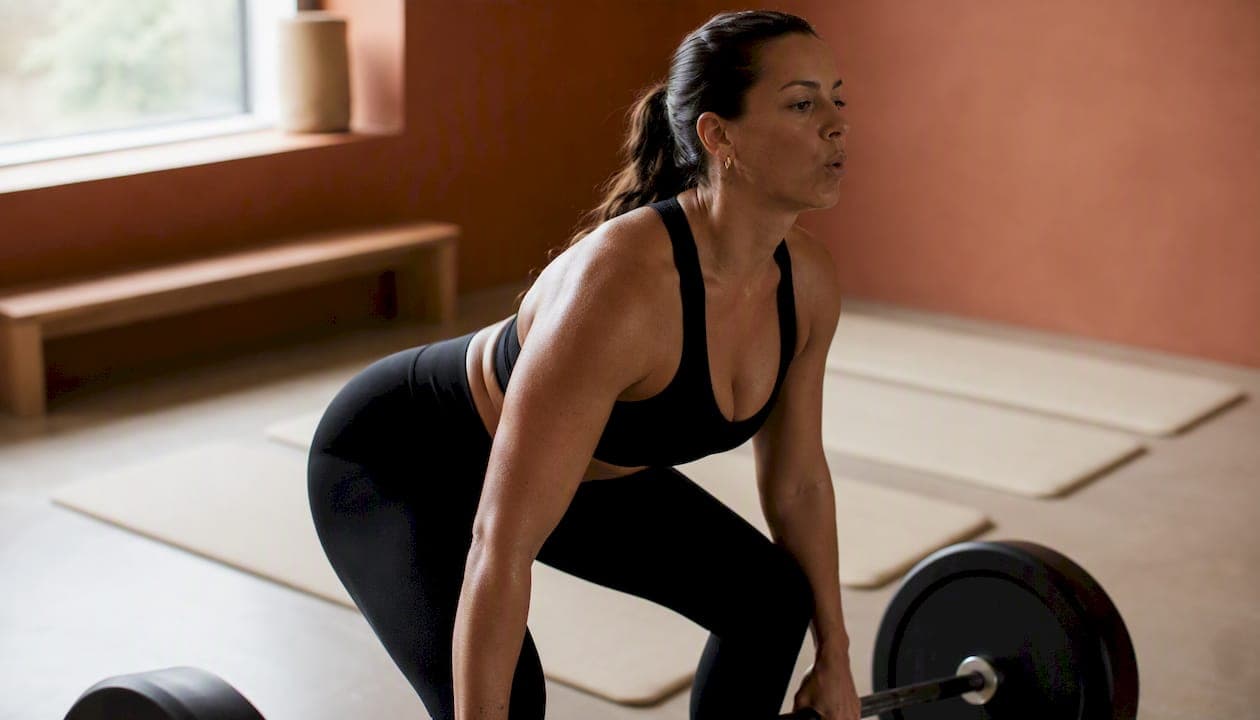
Breathe in before you lift, brace your whole trunk like you're about to take a punch, then exhale as you complete the rep. That's the core rule for most strength training. For near-maximal singles at high intensities, you hold that breath through the full rep using a controlled Valsalva manoeuvre. If you have high blood pressure, a cardiovascular condition, or a history of fainting during exertion, check with your GP or exercise physiologist before using breath-holding techniques. The mechanism is straightforward: a full diaphragmatic breath increases intra-abdominal pressure (IAP), which stiffens your trunk and helps protect your spine under load.
Table of Contents
- Why does breathing matter so much under heavy load?
- How do you know if you're belly breathing?
- When should you inhale and exhale during a lift?
- The Valsalva manoeuvre: when it helps and when to avoid it
- Progressions and drills to build belly breathing and bracing under load
- Breathing cues for the squat, deadlift, bench and overhead press
- Common breathing mistakes and how to fix them
- How Elevateandrestore teaches breathing and bracing in small-group sessions
- Key takeaways
- Breathing is the most undercoached skill in the weight room
- Coached breath-and-brace sessions at Elevateandrestore
- Useful sources
Why does breathing matter so much under heavy load?
Your torso is not a rigid column. It's a pressure cylinder. The diaphragm sits at the top, the pelvic floor at the base, and the deep abdominals wrap around the sides. When you inhale fully and brace, pressure builds inside that cylinder and the whole structure stiffens. That stiffness is what transfers force from your legs into the bar without leaking energy through a soft, unstable spine.
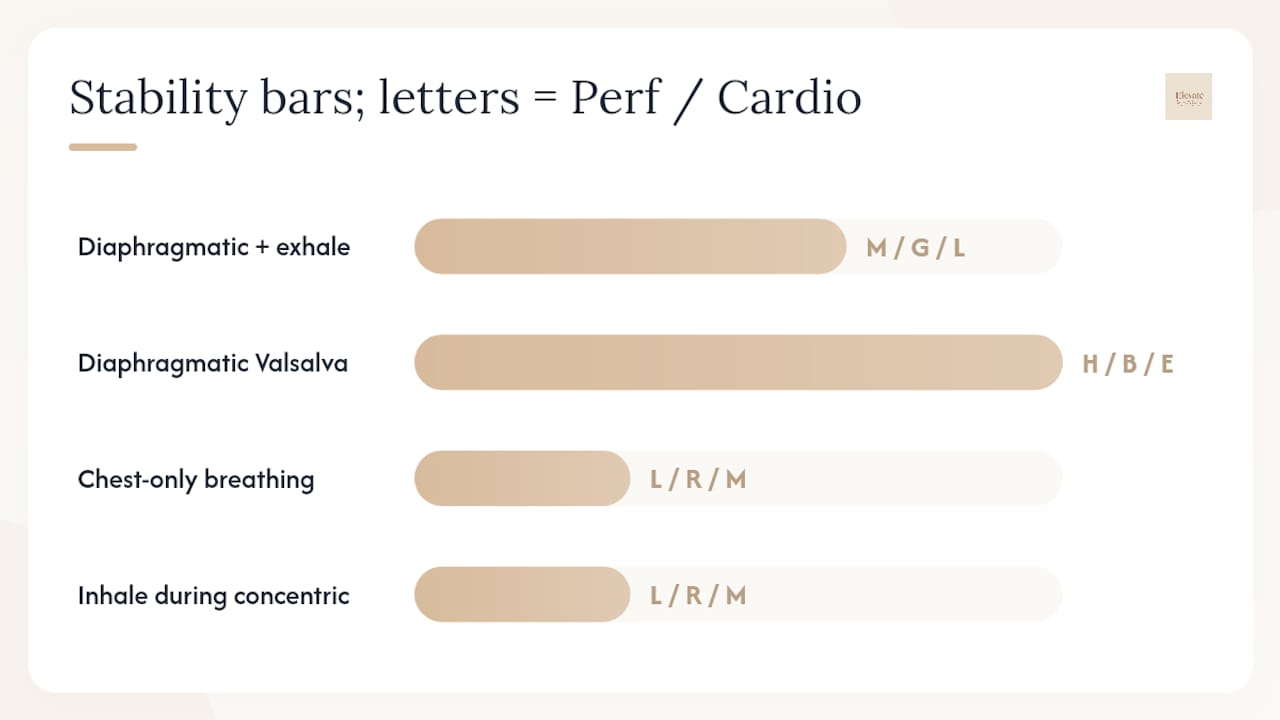
Research published in BMC Sports Science, Medicine and Rehabilitation confirms that breathing strategy directly influences both performance output and cardiovascular response during resistance exercise. Breath-holding increased trunk rigidity and tended to produce higher single-rep performance compared to other breathing methods, while inhaling during the concentric (effort) phase reduced performance. The trade-off is cardiovascular: breath-holding also altered heart-rate variability and raised haemodynamic load, which is why it's a tool for specific situations rather than a default habit.
Practically, poor breathing under load shows up in three ways: dizziness from prolonged breath-holding, neck and upper-back tension from chest-only breathing, and a loss of spinal stability mid-lift that increases injury risk. Getting the mechanics right fixes all three.
| Breathing approach | Spinal stability | Performance effect | Cardiovascular load |
|---|---|---|---|
| Diaphragmatic + exhale on exertion | Moderate | Good for moderate loads | Low |
| Diaphragmatic + Valsalva (breath-hold) | High | Best for near-max singles | Elevated |
| Chest-only breathing | Low | Reduced | Moderate |
| Inhaling during concentric phase | Low | Reduced | Moderate |
How do you know if you're belly breathing?
Diaphragmatic breathing, often called belly breathing, means your diaphragm does the primary work of drawing air in, rather than your chest and neck muscles. The result is a 360° expansion of your trunk: your belly moves forward, your sides push out, and your lower back widens slightly. That full-cylinder expansion is what creates usable IAP. A shallow chest lift, by contrast, recruits the scalenes and upper trapezius, raises tension in your neck, and produces almost no IAP at all.
Breathing for better strength experts emphasise that quality and timing of breath trump volume. A controlled, well-directed breath into your trunk is more useful than a maximal chest-focused gasp.
The two-hand test
The Cleveland Clinic's diaphragmatic breathing protocol gives you a simple way to check your pattern right now:
- Lie on your back with knees bent, or stand upright.
- Place one hand flat on your chest, the other on your belly just below your ribcage.
- Breathe in slowly through your nose for a count of four.
- The hand on your belly should rise first and more than the hand on your chest.
- Exhale slowly through pursed lips. Your belly falls; your chest stays relatively still.
- Repeat for five breaths and notice which hand moves more.
If your chest hand dominates, you're a chest breather. That's fixable with consistent drill practice over time with daily sessions.
Coaching cues for 360° expansion:
- Front: "Push your belly button away from your spine."
- Lateral: "Breathe into the sides of your ribcage, like you're trying to push your elbows apart."
- Posterior: "Send the breath into your lower back — feel it press against the bench or floor."
Pro Tip: Before your next working set, take one practice breath standing behind the bar. Place both hands on your lower ribs and feel for lateral expansion. If you can't feel it, you're not bracing the cylinder — you're just puffing your chest.
The American Lung Association's breathing exercises recommend pursed-lip breathing as a complementary drill to retrain habitual chest-breathing patterns. Inhale through your nose for two counts, then exhale through pursed lips for four. It slows the breath, forces diaphragm engagement, and is a useful warm-up drill before any strength session. For a deeper look at how Pilates-style cueing develops this pattern, the role of breathwork in Pilates guide covers 360° rib-cage expansion in detail.
When should you inhale and exhale during a lift?
The primary rule for moderate loads is simple: inhale on the eccentric (lowering) phase, exhale on the concentric (effort) phase. Mayo Clinic's weight training guidance states this directly: exhale during exertion, inhale during the easier phase, and avoid routinely holding your breath during submaximal work. The rhythm helps maintain blood pressure, reduces cardiovascular strain, and keeps the nervous system calm across a working set.
For a bicep curl, that means inhale as you lower the weight, exhale as you curl. For a squat, inhale at the top before you descend, then exhale as you drive back up. The pattern is consistent across most exercises at moderate intensity.
Where it changes is intensity. As you approach near-maximal loads, exhaling mid-rep would decompress the trunk at the worst possible moment. At 85–90% of your one-rep max, the Valsalva manoeuvre (covered in the next section) replaces the exhale-on-exertion rule. The breath is held through the entire rep, and you exhale only after the bar is back in a safe, locked-out position.
For high-rep metabolic sets (think sets of 15 or more), you'll need to breathe continuously. The practical approach is cyclic breathing: take a controlled breath at the top of each rep, exhale through the effort, and reset. Never hold your breath across multiple reps in a high-rep set. The cardiovascular cost accumulates fast, and dizziness follows.
Practical guidance by rep range:
- 1–3 reps at near-max load: Valsalva for each rep, full reset between reps.
- 4–8 reps at moderate-heavy load: Inhale at the top, exhale on exertion, reset at the top.
- 10+ reps at moderate load: Continuous cyclic breathing, one breath per rep minimum.
The Valsalva manoeuvre: when it helps and when to avoid it
The Valsalva manoeuvre is a controlled breath-hold against a closed or partially closed glottis (the opening in your throat). You take a full diaphragmatic breath, brace your trunk hard, and hold that pressure through the lift. IAP spikes, the trunk becomes rigid, and the spine is protected from shear and compressive forces at their peak.
The BMC Sports Science research found that breath-holding during resistance exercise increased trunk rigidity and often produced higher single-rep performance compared to other breathing strategies. The cardiovascular cost is real, though: blood pressure rises sharply during the hold, then drops when you exhale. Heart-rate variability is also affected. For healthy lifters performing single heavy reps, that trade-off is generally acceptable. For people with hypertension, cardiovascular disease, or a history of stroke, it is not.
PoinT GO Research's practical guide recommends Valsalva for lifts at approximately 80% of one-rep max and above, with one breath per rep and a full breathing reset between reps for multi-rep heavy sets.
One-rep Valsalva protocol
- Stand behind the bar in a locked-out or racked position.
- Take a full diaphragmatic breath (360° expansion, not a chest gasp).
- Brace your trunk hard — "like you're about to take a punch."
- Perform the rep. Hold the breath through the entire movement.
- Exhale only after you've returned to the safe, locked-out position.
- Take two to three normal breaths before the next rep.
| Situation | Valsalva appropriate? | Notes |
|---|---|---|
| Near-max single (≥80% 1RM) | Yes | One breath per rep, reset between reps |
| Moderate-load sets (4–8 reps) | Partial | Brace hard, exhale on exertion |
| High-rep sets (10+ reps) | No | Cyclic breathing only |
| High blood pressure | No | Consult GP or exercise physiologist first |
| Cardiovascular history | No | Medical clearance required |
| Pregnancy | No | Avoid breath-holding under load |
Pro Tip: The Valsalva is not about taking the biggest possible breath. It's about creating the most pressure. A 70% breath with a hard brace beats a 100% gasp with a soft trunk every time.
Progressions and drills to build belly breathing and bracing under load
Breathing drills should be practised when breathing is easy, not when you're already under a heavy bar. Start in low-stress conditions and build progressively toward loaded application. Trying to learn diaphragmatic breathing mid-set under 90% of your max is like learning to swim in a rip.
Four-step progression
- Supine diaphragmatic practice (unloaded) — Five minutes daily, using the two-hand test. Focus on 360° expansion and a slow, controlled exhale. Use the pursed-lip breathing drill from the American Lung Association to slow the breath and force diaphragm engagement.
What "good" looks like — drill pass criteria
- Belly expands before chest on inhale.
- Lateral ribcage expansion visible or palpable.
- No audible exhale or trunk collapse during the rep.
- Exhale happens only at lockout or safe position.
- No dizziness or lightheadedness after the set.
For a structured approach to breathing techniques for strength training, including Pilates-based cueing progressions, the Elevateandrestore guide covers the full drill sequence. The Pilates principles behind effective workouts also explains how 360° expansion and core engagement work together in movement-based training.
Dosing by intensity:
- Below 60% 1RM: practise diaphragmatic breathing with exhale on exertion.
- 60–79% 1RM: hard brace, exhale on exertion or hold for single reps.
- 80%+ 1RM: full Valsalva protocol, one breath per rep.
Breathing cues for the squat, deadlift, bench and overhead press
The principle is the same across all four lifts: take your breath at a mechanically strong position, not at the bottom of the movement. Forge AI Trainer's weightlifting breathing guide makes this explicit: inhaling at mechanically disadvantaged positions (bottom of the squat, mid-pull on a deadlift) is ineffective and potentially dangerous. Brace before you're in trouble, not after.
Squat Cue: "Big breath at the top, brace before you break." Take your breath and brace fully before you initiate the descent. Hold through the bottom. Exhale as you pass the sticking point on the way up, or at lockout for near-max loads. Never try to inhale at the bottom of the hole.
Deadlift Cue: "Breathe and brace before the bar leaves the floor." Set your brace while the bar is still on the ground. Exhale at lockout. For heavy singles, hold the breath through the entire pull. Reset fully before the next rep.
Bench press Cue: "Fill your back into the bench, then unrack." Take your breath before unracking, not after. The brace creates a stable base against the bench. Exhale as you press the bar to lockout. For near-max attempts, hold through the full press.
Overhead press Cue: "Brace like a squat, press through the top." The overhead press is the lift where lifters most often forget to brace because the load feels lighter. Brace hard before the press, exhale at the top. Losing trunk pressure mid-press shifts load onto the lumbar spine.
Common breathing mistakes and how to fix them
Most breathing errors under load fall into three categories: holding too long, breathing too shallow, or hyperventilating before the set.
Red flags to watch for:
- Holding your breath across multiple consecutive reps in a working set.
- Chest rising before belly on every inhale (chest-only breathing).
- Deliberate hyperventilation before a heavy lift to "get more oxygen."
- Exhaling before the sticking point on a near-max rep.
- Neck and upper-back tension that builds across a session.
Hyperventilation before a lift drops carbon dioxide levels in the blood, which can cause lightheadedness or fainting. It does not meaningfully increase oxygen delivery for a single rep. Skip it.
Immediate actions if something goes wrong mid-set
- Rack the bar or set the weight down safely.
- Sit or stand with feet shoulder-width apart. Do not lie down immediately.
- Breathe slowly through your nose for a count of four, out through pursed lips for a count of six.
- Wait until vision clears and heart rate settles before attempting another set.
- Reduce the load by at least 20% for the remainder of the session.
Longer-term safety checks:
- If lightheadedness occurs regularly, reduce load and review breathing mechanics before progressing.
- If you have diagnosed hypertension or any cardiovascular condition, get clinical clearance before using the Valsalva manoeuvre.
- If symptoms include chest pain, irregular heartbeat, or persistent headache after lifting, stop training and see a GP.
Johns Hopkins Medicine's breathing techniques describe the "blow-as-you-go" method (exhale during the hardest part of the effort) as a practical tool for managing exertion and breathlessness during activity. It's the clinical equivalent of the exhale-on-exertion rule and applies directly to recovery breathing between sets.
This article provides general fitness information, not medical advice. Confirm current guidelines with a qualified exercise physiologist or GP, particularly if you have a cardiovascular or respiratory condition.
How Elevateandrestore teaches breathing and bracing in small-group sessions
At Elevateandrestore, breathing is the first thing coached in every session, not an afterthought. The small-group format (maximum six people per class) means every person gets eyes on their brace, not just a verbal cue from across a crowded gym floor.
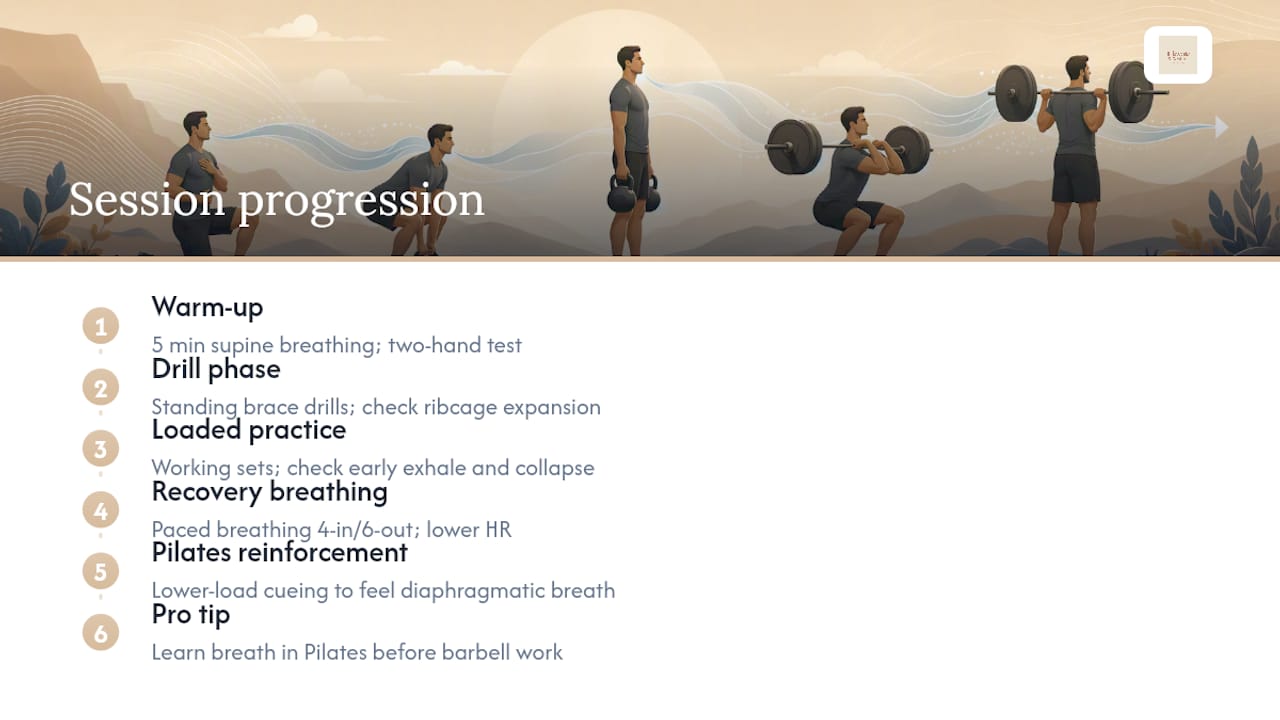
A typical session progression runs like this:
Warm-up: Five minutes of supine diaphragmatic breathing and the two-hand test. Clients identify whether they're chest or belly breathers before any load goes on.
Drill phase: Standing brace drills with an empty bar or light resistance. Instructors check for lateral ribcage expansion and posterior breath. Cues are tactile where needed.
Loaded practice: Working sets with coaching checks at each rep. The instructor watches for early exhale, chest-only breathing, and trunk collapse at the sticking point.
Recovery breathing: After heavy sets, clients use paced breathing (four counts in, six counts out) to bring heart rate down and shift the nervous system toward recovery. The recovery hub at the studio, including the infrared sauna and cold plunge, extends this parasympathetic shift after the session. Breathing techniques that improve recovery explains the physiological basis for this approach.
The Pilates reformer classes run alongside strength sessions and reinforce the same diaphragmatic cueing in a lower-load environment. That cross-training effect is one of the most underrated tools for lifters: Pilates teaches you to feel the breath, strength training teaches you to use it under pressure.
Pro Tip: If you're new to bracing, start your breathing practice in the Pilates class before applying it to barbell work. The lower load and slower tempo give you time to feel what 360° expansion actually means before the bar gets heavy.
Key takeaways
Breathing correctly under heavy loads comes down to one repeatable sequence: diaphragmatic breath, 360° brace, hold or exhale depending on load, reset between reps.
| Point | Details |
|---|---|
| Diaphragm first, always | Belly expands before chest on every inhale; chest-only breathing produces almost no useful trunk pressure. |
| Exhale on exertion for moderate loads | For sets below roughly 80% 1RM, inhale on the eccentric and exhale on the concentric to manage blood pressure and cardiovascular load. |
| Valsalva for near-max singles only | Use breath-holding at 80%+ 1RM with one breath per rep and a full reset between reps; avoid it entirely with high blood pressure or cardiovascular history. |
| Practise drills for four weeks first | Build from supine diaphragmatic practice to loaded Valsalva rehearsal before applying breath-holding to maximal lifts. |
| Elevateandrestore coaches the full sequence | Small-group sessions at Elevateandrestore progress from breathing drills to loaded bracing with instructor checks, supported by post-session recovery breathing in the recovery hub. |
Breathing is the most undercoached skill in the weight room
Most lifters spend years chasing technique cues for their squat or deadlift and almost no time on the thing that makes every cue work: the breath. A perfect hip hinge with a soft, unbraced trunk is still a vulnerable spine. A slightly imperfect hinge with a rock-solid brace is usually safer.
What the research actually shows is that the Valsalva manoeuvre is not a hack or a power-lifter trick. It's a physiological tool with a specific application window: near-maximal loads, single reps, healthy cardiovascular system. Outside that window, it's unnecessary and adds cardiovascular cost for no performance gain. The lifters who use it on every set of every exercise are misapplying it, and the lifters who avoid it entirely on heavy singles are leaving spinal protection on the table.
The Pilates influence in our coaching philosophy is not incidental. Pilates builds the proprioceptive awareness to feel whether you're actually bracing or just tensing your abs. Those are different things. Tensing the abs without a full diaphragmatic breath is like tightening a belt without filling the bag first. The pressure doesn't build the same way.
The four-week drill progression before applying Valsalva to max loads is not conservative for its own sake. It's the minimum time most adults need to override a habitual chest-breathing pattern that has been reinforced for decades. Rushing it means the brace is inconsistent under pressure, which is exactly when you need it most.
Coached breath-and-brace sessions at Elevateandrestore
Knowing the rule and feeling it under load are two different things. At Elevateandrestore in West Footscray, small-group reformer Pilates classes and functional training sessions are built around exactly this progression: diaphragmatic breathing drills, loaded bracing practice, and instructor feedback on every rep, with a maximum of six people per class so nothing gets missed.
Sessions include the full warm-up-to-working-set breathing progression described in this guide, plus access to the recovery hub (infrared sauna, cold plunge, hot tub, and compression therapy) to support parasympathetic recovery after heavy efforts. You get coached breathing practice in a low-ego environment, not a crowded gym floor where you're guessing whether your brace is right.
Book a session at elevateandrestore.com.au and tell the instructor you want to work on your breathing and bracing. They'll start you exactly where you need to be.
Useful sources
These are the primary sources used in this guide. Each one is worth reading directly if you want to go deeper on the physiology or clinical application.
-
BMC Sports Science, Medicine and Rehabilitation — Breathing strategies and bench press performance. The most directly relevant resistance-exercise research cited here. Read this if you want the data behind Valsalva performance effects and cardiovascular trade-offs.
-
Cleveland Clinic — Diaphragmatic breathing. The clearest clinical description of the two-hand test and step-by-step diaphragmatic practice. Useful for coaches explaining the drill to clients.
-
Mayo Clinic — Weight training in depth. Practical, conservative guidance on exhale-on-exertion for general weight training. Good reference for clients who are new to structured lifting.
-
PoinT GO Research — How to breathe during heavy lifts. Practical Valsalva sequencing and IAP rationale. Coaches will find the load-percentage thresholds and rep-by-rep protocol directly applicable.
-
American Lung Association — Breathing exercises. Pursed-lip and diaphragmatic breathing drills for retraining chest-breathing habits. Low-risk, clinically validated starting point before applying techniques under load.
-
Johns Hopkins Medicine — Breathing techniques. Covers pursed-lip and blow-as-you-go methods. Particularly useful for recovery breathing between heavy sets and post-session cool-down.
-
CNN Health — Breathing for better strength. Accessible summary of how breath quality and timing affect muscle engagement, stability, and power. Good for sharing with clients who want a readable overview.
-
Forge AI Trainer — How to breathe during weightlifting. Practical gym cues for where to take the breath across common barbell lifts. Coaches will find the mechanically-strong-position guidance directly usable on the floor.