

Regular sauna bathing is associated with measurable cardiovascular benefits, and the evidence behind that claim is stronger than most people realise. The landmark Laukkanen Kuopio cohort, published in JAMA Internal Medicine, tracked over 2,000 Finnish men and found that bathing. Frequent sauna use was linked to a substantially lower risk of sudden cardiac death compared with once-weekly use. A systematic review in Mayo Clinic Proceedings corroborated the biological plausibility, pointing to improved endothelial function, reduced arterial stiffness, and autonomic modulation as likely pathways. Harvard Health and UCLA Health both frame sauna as a safe adjunct to a healthy lifestyle, not a replacement for exercise.
In practical terms, a single session raises heart rate into a range that resembles low-to-moderate exercise, and habitual use several times per week is where the largest observational benefits appear. The critical caveat: virtually all long-term data are observational. The correlation is strong and consistent, but causation has not been fully established. Sauna works best alongside exercise and a sound diet, not instead of them.
Table of Contents
- What high-quality research actually shows
- How heat changes your cardiovascular system
- Short-term vs long-term cardiovascular effects
- How often, how long and at what temperature
- Safety, contraindications and who should check with a doctor first
- Where the evidence is weak and what we still do not know
- An evidence-based sauna routine for heart-health support
- How sauna compares to traditional cardiovascular exercise
- Hydration strategies before, during and after sauna
- Finnish sauna vs infrared: which type benefits the heart more?
- Key takeaways
- The sauna conversation we are not having honestly enough
- Supervised sauna sessions at Elevateandrestore's recovery hub
- Sources and further reading
What high-quality research actually shows
The Laukkanen cohort is the most-cited dataset in this space, and for good reason. Among men bathing 4–7 times per week, the risk of sudden cardiac death dropped by 63% compared with once-weekly bathers (hazard ratio 0.37). Fatal coronary heart disease and fatal cardiovascular disease followed a similar dose-response pattern. Session duration mattered too: sessions longer than 19 minutes were associated with lower risk than shorter ones.
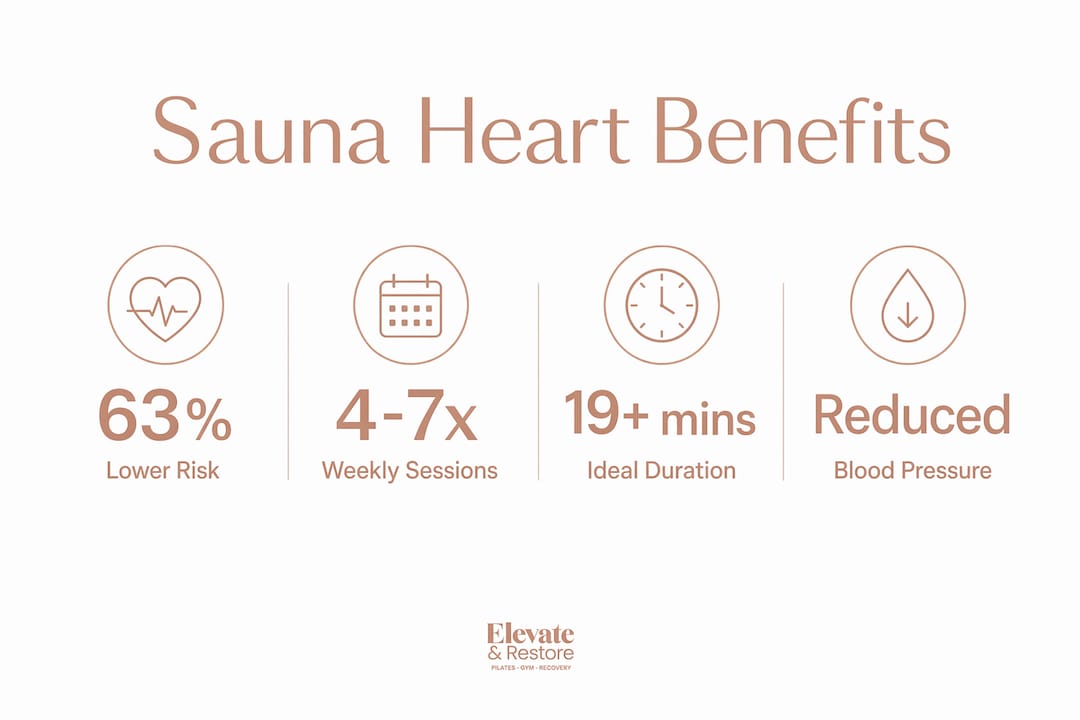
The Mayo Clinic Proceedings review synthesised mechanistic and observational data and concluded that sauna bathing may reduce vascular disease risk factors through improved endothelial function, reduced arterial stiffness, and autonomic modulation. Short-term randomised controlled trials (RCTs) tell a more modest story. A 2025 review in American Journal of Preventive Cardiology, summarised by Harvard Health, found limited improvements across most cardiovascular biomarkers, with a potential modest average reduction in systolic blood pressure of about 4 mmHg in combined passive heating studies. That is a real signal, but a modest one.
The honest confidence rating: observational evidence is strong and consistent across multiple cohorts; mechanistic data are biologically plausible; short-term RCT results are promising but not definitive for causation.
| Study type | Key finding | Confidence level |
|---|---|---|
| Laukkanen cohort (JAMA) | HR 0.37 for sudden cardiac death at 4–7 sessions/week | Strong (large prospective cohort) |
| Mayo Clinic Proceedings review | Improved endothelial function, reduced arterial stiffness | Moderate (mechanistic + observational) |
| Short-term RCTs (pooled) | ~4 mmHg systolic BP reduction | Modest (heterogeneous, short duration) |
How heat changes your cardiovascular system
The physiology is straightforward. Step into a sauna and your body responds to heat stress within minutes.

Acute responses include a rapid rise in heart rate, widening of skin blood vessels (vasodilation), and a transient redistribution of blood flow away from internal organs toward the skin. Heart rate can climb into the 100–150 bpm range depending on temperature and session length, which is why researchers describe the experience as resembling low-to-moderate intensity exercise.
Chronic adaptations with regular use are where the cardiovascular story gets interesting:
- Improved endothelial function: the inner lining of blood vessels becomes more responsive to nitric oxide, supporting healthy dilation.
- Reduced arterial stiffness: vessels become more compliant over time, reducing the workload on the heart.
- Autonomic modulation: regular heat exposure appears to shift the autonomic balance toward greater parasympathetic (rest-and-recover) tone during recovery periods.
- Reduced systemic inflammation: some studies report falls in inflammatory markers, though results vary by population.
The concept tying these together is thermal hormesis. Researchers at the University of Manitoba describe heat as a systemic stressor that triggers protective adaptations30275-1/fulltext) in vascular and autonomic function — essentially, controlled stress that makes the system more resilient. This is why thermotherapy practitioners call sauna a form of "passive training": consistency matters more than any single session's intensity.
Pro Tip: If high-intensity exercise is off the table due to injury or health limitations, regular sauna use may offer a partial cardiovascular stimulus. Pair it with gentle movement rather than treating it as a standalone fix. For readers managing injury, building resilience through Pilates alongside sauna sessions is a practical combination.
Short-term vs long-term cardiovascular effects
What changes in a single session:
- Heart rate rises to 100–150 bpm depending on temperature.
- Skin blood flow increases substantially; core organ perfusion reduces transiently.
- Blood pressure may dip transiently during the session, then normalise on cooling.
- Sweating causes plasma volume shifts, which is why hydration matters.
What the long-term observational data report:
The Laukkanen cohort showed dose-dependent reductions in fatal coronary heart disease, fatal cardiovascular disease, sudden cardiac death, and all-cause mortality. Frequent users also showed lower rates of stroke and hypertension incidence. These are associations in a prospective cohort, not proven causal effects.
Statistic to know: In the Laukkanen cohort, multiple sauna sessions per week were associated with a 63% lower risk of sudden cardiac death versus once-weekly bathing. This is observational evidence — not a clinical trial result.
Biomarker signals from trials:
| Biomarker | Direction of change | Evidence quality |
|---|---|---|
| Systolic blood pressure | Small reduction (~4 mmHg) | Modest, mixed RCTs |
| HDL cholesterol | Modest increase in some studies | Inconsistent |
| Inflammatory markers (CRP, IL-6) | Reductions in some controlled studies | Heterogeneous |
| Arterial stiffness | Reduced in several studies | Moderate |
How often, how long and at what temperature
The strongest cohort data used sessions of more than 19 minutes at Finnish sauna temperatures, roughly 60–90°C, and frequencies of 4–7 times per week. Benefits were also observed at 2–3 sessions per week, just with a smaller effect size. Expert guidance converges on at least 15–20 minutes per session to elicit meaningful heart rate increases and vasodilation; very short sessions of 5 minutes are generally insufficient for adaptation.
A sensible progressive protocol:
- Week 1–2: 5–10 minutes per session at a lower temperature (around 60–70°C). Focus on comfort and breathing.
- Week 3–4: Extend to 10–15 minutes. Aim for 2–3 sessions per week.
- Week 5 onwards: Build toward 15–20 minutes per session, 3–4+ times per week.
- Hydration: Drink 500 ml of water before entering. Rehydrate with at least 500 ml after.
- Cooldown: Exit gradually. Avoid jumping straight into cold water in the first few weeks; allow a few minutes of air cooling first.
- Post-exercise timing: A 15-minute sauna session after a workout has shown additive benefits for blood pressure regulation and cardiorespiratory fitness in some intervention studies.
Pro Tip: Pair your sauna session with active recovery strategies like light movement or breathwork during the cooldown phase. This supports autonomic recovery and reduces the lightheadedness some people feel on exiting.
Safety, contraindications and who should check with a doctor first
Sauna is safe for most healthy adults. It is not safe for everyone, and a few groups need medical clearance before starting.
Seek medical advice before using a sauna if you have:
- Unstable angina or a recent myocardial infarction (within the past 3–6 months)
- Severe or untreated aortic stenosis or other significant valve disease
- Uncontrolled hypotension or orthostatic instability
- Pregnancy with complications (uncomplicated pregnancy: discuss with your obstetrician)
- Acute illness, fever, or active infection
- Poorly controlled hypertension
Medication interactions to flag with your clinician:
Diuretics, vasodilators, beta blockers, and anticoagulants can all interact with the haemodynamic changes sauna produces. Timing of doses relative to sessions matters; do not adjust medications without clinical guidance.
Practical safety rules for every session:
- Never sauna alone if you are at elevated cardiovascular risk.
- Exit immediately if you feel dizzy, faint, or develop chest discomfort.
- Avoid alcohol before or during a session.
- Keep sessions shorter when unwell or sleep-deprived.
Where the evidence is weak and what we still do not know
The observational case for sauna and cardiovascular health is compelling, but several gaps deserve honest acknowledgement.
Confounding in cohort data: The Laukkanen cohort itself flags residual confounding as a limitation. Finland has one of the world's highest sauna densities, and frequent sauna users may differ from infrequent users in diet, physical activity, socioeconomic status, and social connection — all independent cardiovascular risk factors.
Short RCTs are heterogeneous: Trials vary widely in temperature, session duration, population, and outcome measures. This makes pooling difficult and explains why meta-analytic results for biomarkers like blood pressure and lipids are modest and inconsistent.
Unknowns that matter:
- The optimal dose-response curve for different populations (older adults, women, people with controlled hypertension)
- Whether infrared saunas produce equivalent cardiovascular adaptations to traditional Finnish saunas
- Long-term RCT outcomes in diverse, non-Finnish populations
Pro Tip: When reading sauna research, check whether the study population is Finnish. The cultural saturation of sauna use in Finland means findings may not translate directly to populations where sauna is a new habit rather than a lifelong practice.
An evidence-based sauna routine for heart-health support
This protocol suits a generally healthy adult starting or refining a sauna habit for cardiovascular support.
- Pre-session check: Well-hydrated, no alcohol in the past 4 hours, no acute illness, no new cardiac symptoms. If any concern, skip the session.
- Timing: Ideally 15 minutes after completing a workout session. This post-exercise window has shown additive cardiovascular benefits in intervention studies.
- Session length: 10–20 minutes depending on your current adaptation level. Start at the lower end.
- Temperature: 70–85°C for traditional sauna; lower for infrared (typically 45–60°C).
- During the session: Breathe steadily. If heart rate feels uncomfortably high or you feel dizzy, exit calmly.
- Cooldown: 5–10 minutes of air cooling or a tepid shower. Avoid abrupt cold immersion until you are comfortable with the heat response.
- Rehydration: At least 500 ml of water or an electrolyte drink post-session.
- Frequency target: Work toward 3–4 sessions per week for cardiovascular adaptation. Cohort benefits were strongest at 4–7 sessions per week.
For beginners, older adults, or those with controlled hypertension: halve the session length and add an extra week at each progression stage. Slower is safer and still effective.
Statistic to keep in mind: The Laukkanen cohort found that even 2–3 sessions per week were associated with lower cardiovascular mortality compared with once-weekly use — you do not need daily sessions to see a benefit.
How sauna compares to traditional cardiovascular exercise
Sauna and exercise are not interchangeable, but they share more physiological overlap than most people expect. During a session, heart rate climbs into ranges typical of a brisk walk or light jog, and cardiac output increases to manage the heat load. The cardiovascular system is genuinely working.
The key difference is metabolic demand. Exercise burns fuel, builds muscle, and drives aerobic adaptations through mechanical work. Sauna drives cardiovascular adaptations primarily through thermal stress and the vascular and autonomic responses it triggers. You get some of the circulatory training without the musculoskeletal load.

For people who cannot sustain vigorous exercise due to injury, joint pain, or deconditioning, this matters. Recovery methods for adults over 30 increasingly incorporate passive heat as a complement to lower-intensity movement precisely because it provides a cardiovascular stimulus without compounding physical wear. The combination of exercise plus sauna appears to outperform either alone in some studies for blood pressure regulation and cardiorespiratory fitness.
The bottom line: sauna is a useful cardiovascular tool, not a cardiovascular programme, and understanding some common tactical athlete training errors can help you integrate heat therapy safely and effectively during your recovery routine (Common Tactical Athlete Training Errors to Fix Now). Use it to supplement exercise, not replace it.
Hydration strategies before, during and after sauna
Dehydration is the most common avoidable risk in sauna use, and it directly undermines cardiovascular safety. Sweating during a session can produce fluid losses of 0.5–1 litre or more depending on temperature and duration. That volume shift affects plasma volume, blood viscosity, and blood pressure regulation.
Before: Drink 400–600 ml of water in the hour before your session. Avoid caffeine in large amounts immediately beforehand, as it can compound dehydration.
During: Most sessions are short enough that drinking inside the sauna is not necessary. For sessions over 20 minutes, a small amount of water is sensible.
After: Rehydrate with at least 500 ml of water or a low-sugar electrolyte drink within 30 minutes of finishing. If you have exercised beforehand, increase this to 750 ml or more. Weigh yourself before and after if you want a precise guide: every 1 kg of body weight lost equals approximately 1 litre of fluid deficit.
Avoid alcohol as a post-sauna drink. It compounds vasodilation and dehydration simultaneously, which is a meaningful cardiovascular risk, not just a wellness cliché.
Finnish sauna vs infrared: which type benefits the heart more?
Traditional Finnish saunas operate at 60–90°C with low-to-moderate humidity, producing intense dry heat. Most of the cohort evidence, including the Laukkanen study, was conducted in this context. The cardiovascular responses are well-documented: rapid heart rate increase, significant vasodilation, and substantial sweating.
Infrared saunas operate at lower temperatures, typically 45–60°C, using radiant heat that penetrates tissue directly rather than heating the air. The lower ambient temperature means some people tolerate longer sessions more comfortably. The evidence specific to infrared saunas is growing but smaller in volume than the Finnish sauna literature. Some trials show comparable acute cardiovascular responses; long-term cohort data equivalent to Laukkanen's work does not yet exist for infrared.
Practically, both types raise heart rate, promote vasodilation, and trigger sweating. The heat delivery mechanism differs; whether that translates to meaningfully different cardiovascular outcomes over years of use is an open research question. For most people, the best sauna is the one they will use consistently.
Key takeaways
Regular sauna bathing, particularly at frequencies of 4–7 sessions per week and session durations above 19 minutes, is associated with substantially lower cardiovascular mortality in large prospective cohorts, though causation remains unproven.
| Point | Details |
|---|---|
| Strongest evidence | Laukkanen cohort: 4–7 sessions/week linked to 63% lower risk of sudden cardiac death (HR 0.37). |
| Practical dose | Aim for 15–20 minutes per session, 3–4+ times per week; build gradually from 5–10 minutes. |
| Mechanisms | Vasodilation, improved endothelial function, reduced arterial stiffness, and thermal hormesis explain the cardiovascular signal. |
| Safety caveat | Unstable cardiac conditions, certain medications, and acute illness require medical clearance before use. |
| Elevateandrestore | The recovery hub at Elevateandrestore offers supervised infrared sauna sessions alongside cold plunge and compression therapy for structured, safe cardiovascular support. |
The sauna conversation we are not having honestly enough
Most wellness content presents sauna as either a miracle cardiovascular therapy or a luxury indulgence with no real science behind it. Neither framing is accurate, and both do readers a disservice.
The Laukkanen data are genuinely impressive. A hazard ratio of 0.37 for sudden cardiac death is not a marginal finding. But it comes from a population where sauna is woven into daily life, social culture, and a broader pattern of physical activity and community connection. Extracting the sauna variable and assuming the same benefit applies to someone who starts using one at 45 in a Melbourne studio requires a leap the data do not fully support.
What the evidence does support is this: regular heat exposure produces real, measurable physiological changes in the cardiovascular system. Those changes are consistent with better long-term outcomes. The dose matters, the consistency matters, and pairing it with exercise matters more than most guides acknowledge.
The people who get the most from sauna are not the ones who treat it as a passive shortcut. They are the ones who use it as one deliberate piece of a recovery and conditioning practice, showing up regularly, hydrating properly, and combining it with movement. That is not a complicated message, but it is an honest one.
Supervised sauna sessions at Elevateandrestore's recovery hub
If you want to experience the cardiovascular benefits of sauna without guessing at protocol, Elevateandrestore's recovery hub in Melbourne gives you a structured environment to do exactly that.
The recovery hub includes an infrared sauna, cold plunge, hot tub, and compression therapy, all available as standalone sessions or as part of a membership. Sessions are designed to complement the studio's small-group Pilates and functional training classes, so you can pair post-workout sauna use with the kind of progressive movement practice the evidence supports. Whether you are new to heat therapy or looking to build a consistent habit, the studio's approach is grounded in the same research this article covers. You can also explore how reformer Pilates fits alongside recovery work for a complete cardiovascular conditioning approach. Book a recovery session or enquire about a studio induction at elevateandrestore.com.au.
This article is general health information, not medical advice. Consult your GP or a qualified clinician before starting sauna use if you have a cardiovascular condition, are pregnant, or take relevant medications.
Sources and further reading
Key studies and authoritative sources referenced in this article:
- Laukkanen et al., JAMA Internal Medicine — Kuopio cohort on sauna frequency and cardiovascular mortality
- Mayo Clinic Proceedings systematic review30275-1/fulltext) — cardiovascular and other health benefits of sauna bathing
- PubMed: cardiovascular benefits of sauna bathing — indexed systematic review
- Harvard Health: sauna and heart health — clinical commentary including Dr Prashant Rao's perspective
- Harvard Health: sauna linked to longer life — accessible summary of the Laukkanen findings
- UCLA Health: sauna bathing for heart health — clinical overview
- NPR: sauna and cardiovascular health — science journalism summary
- WebMD: saunas and health — practical guidance and dosing
- Stanford Lifestyle Medicine: sauna and cardiovascular health — academic clinical perspective
- Australian Heart Foundation (heartfoundation.org.au) — local resource for cardiovascular health guidance and risk assessment