

An infrared sauna uses electromagnetic infrared waves to heat your body directly, rather than warming the surrounding air. The result is a gentler, more accessible heat experience that still triggers many of the same physiological responses as a traditional sauna. Here is what the evidence shows you can realistically expect:
- Cardiovascular support: improved circulation, lower blood pressure, and a heart rate response comparable to moderate walking
- Muscle recovery and pain relief: reduced pain scores and faster recovery in strength athletes, supported by systematic reviews
- Mental health: statistically significant reductions in depression symptoms when combined with CBT
- Better sleep and relaxation: improved circulation and nervous system downregulation that supports deeper rest
- Accessibility: the lower operating temperature makes infrared saunas suitable for people who find traditional sauna heat difficult to tolerate
How infrared saunas work compared with traditional saunas
The core difference is where the heat goes first. Traditional saunas heat the air around you to 70–110°C, and your body absorbs that heat secondarily. Infrared saunas operate at 40–60°C and direct electromagnetic waves straight into your tissue, warming you from the inside out before the room itself feels particularly hot.
That distinction changes the experience considerably. You sweat at a lower ambient temperature, which most people find easier to tolerate for longer periods. Infrared sessions typically run 30–45 minutes compared with the 15–20 minutes common in traditional Finnish saunas, and the drier, gentler environment suits daily or near-daily use.
The physiological responses overlap significantly: heart rate rises, blood vessels dilate, and core temperature climbs. The difference is in the intensity of the thermal stress. Traditional saunas push the body harder in a shorter window; infrared saunas apply a milder, more sustained stimulus that many clinical populations tolerate better.
What does the research say about infrared sauna health benefits?
The evidence base is growing, though it is not yet as deep as the decades of Finnish research behind traditional saunas. Here is what clinical studies have found so far:
Cardiovascular benefits
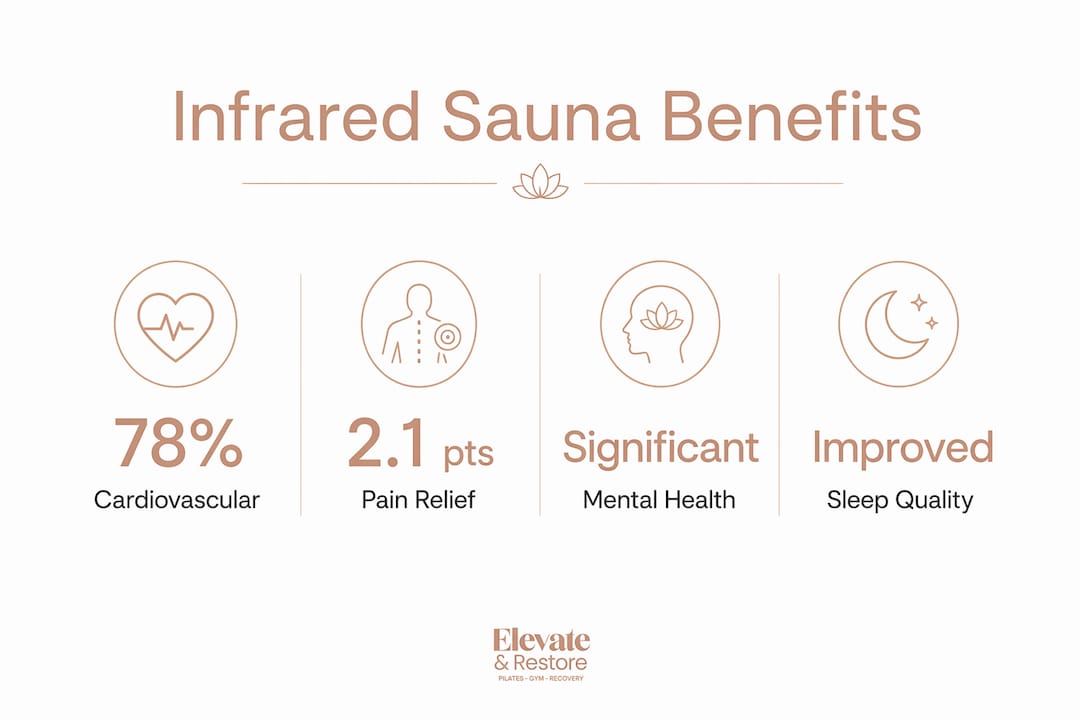
Infrared sauna use improves cardiac function and reduces a key cardiac stress marker in heart failure patients. Blood pressure, circulation, and endothelial function all show measurable improvement in trials. Traditional saunas carry stronger long-term cardiovascular mortality data, but infrared saunas produce meaningful results, particularly for cardiac patients who cannot tolerate extreme heat.

Muscle recovery and pain relief
Systematic reviews show infrared sauna use reduced pain scores by 2.1 points on the visual analogue scale and accelerated recovery in strength athletes, benefits that can be complemented by massaggi estivi. The mechanism involves heat shock protein activation and increased blood flow to damaged tissue.

Mental health
A recent clinical study found that infrared sauna sessions combined with CBT produced statistically significant reductions in depression symptoms. Sauna use alone is not a treatment for depression, but the combination shows genuine promise.
Sleep and relaxation
Regular sessions support better sleep quality through improved circulation and a parasympathetic nervous system response that helps the body wind down. Many people report this as one of the most consistent benefits.
Research limitations
Most infrared sauna trials involve small sample sizes and short durations. The field needs larger, longer studies before definitive clinical guidelines can be established. The benefits are real, but the precision of the evidence is still catching up.
| Benefit | Evidence level | Key finding |
|---|---|---|
| Cardiovascular function | Moderate (clinical trials) | — |
| Pain and muscle recovery | Moderate (systematic reviews) | Pain VAS reduced by 2.1 points |
| Depression symptoms | Emerging (recent RCT) | Significant reduction when combined with CBT |
| Sleep and relaxation | Moderate (observational) | Improved circulation and sleep quality reported |
| Detoxification | Weak (no strong evidence) | Sweat is mainly water and salt, not toxins |
How to use an infrared sauna safely
Getting the most from infrared therapy comes down to consistency and a few practical habits.
- Session length: aim for 30–45 minutes per session, especially once your body has adapted over the first few weeks
- Frequency: several sessions per week is well tolerated by most healthy adults; daily use is reasonable for those who respond well
- Temperature: start at the lower end of the 40–60°C range and increase gradually as your heat tolerance builds
- Hydration: drink water before, during, and after each session; you will lose fluid through sweating even at lower temperatures
- Beginners: your first few sessions should be shorter (15–20 minutes) at a lower temperature to gauge your response
- Post-session: allow your body to cool down naturally before showering; a cold plunge or cool shower can complement the recovery effect
- Timing: evening sessions suit sleep goals; post-workout sessions suit muscle recovery and soreness reduction
Pro Tip: Pair your infrared sauna session with a few minutes of slow breathing or light stretching afterwards. The parasympathetic state the heat creates is a good window for nervous system recovery, not just physical.
Precautions, risks, and when to talk to your doctor
Infrared saunas are safe for most healthy adults, but there are situations where medical advice is worth getting first.
- Pregnant women should avoid sauna use entirely; elevated core temperature carries documented risks in pregnancy
- People with cardiovascular conditions should consult a cardiologist before starting, even though infrared saunas are generally gentler than traditional ones
- Anyone on medications that affect heat regulation, blood pressure, or hydration should check with their GP
- Heat-sensitive individuals, including those with multiple sclerosis or autonomic nervous system conditions, may find infrared more tolerable than traditional saunas, but still need professional guidance
- Dehydration is the most common risk; it is easy to underestimate fluid loss in a lower-temperature environment
- Overheating: if you feel dizzy, nauseous, or your heart rate feels uncomfortable, exit immediately and cool down
- Alcohol: never use a sauna after drinking; alcohol impairs thermoregulation and significantly raises the risk of overheating
Monitor how you feel across your first several sessions. Most adverse responses are mild and avoidable with proper hydration and sensible session lengths.
What experts say about infrared saunas and detox claims
The detox claim is the one area where the marketing around infrared saunas consistently outruns the science. Sweating does not meaningfully eliminate toxins. As researchers and clinicians point out, sweat is primarily water and salt; the liver and lymphatic system handle actual detoxification. Sweating heavily in a sauna does not accelerate that process in any clinically significant way.
The heat shock protein story is more nuanced. Traditional saunas drive HSP70 increases of 150–300% due to the intensity of thermal stress, while infrared saunas produce increases in the 70–120% range. Both are meaningful for muscle repair and inflammation reduction; the difference is one of degree, not kind. Far-infrared light also penetrates skin tissue, potentially affecting immune cells and supporting deeper tissue recovery beyond surface warming, though this mechanism needs more research.
There is no universally better sauna type. Traditional saunas carry stronger long-term cardiovascular mortality data from decades of Finnish population studies. Infrared saunas suit people who need a gentler entry point, whether due to heat sensitivity, a clinical condition, or simply a preference for longer, lower-intensity sessions. The choice depends on your individual tolerance and health goals, and both modalities can sit comfortably within a broader wellness recovery routine.
Pro Tip: If you are new to infrared saunas, go in expecting something quieter and less dramatic than a traditional Finnish sauna. The heat is real and the physiological response is real, but the experience feels more like a warm, dry room than an intense steam session. That is by design.
Who should avoid infrared saunas?
Some people should not use infrared saunas at all, regardless of the lower temperature.
Pregnant women face the clearest contraindication; elevated core temperature is linked to foetal development risks and no safe threshold has been established for sauna use during pregnancy. People with implanted devices such as pacemakers or metal implants should check with their specialist, as electromagnetic infrared waves may interact with certain devices. Anyone recovering from a recent cardiac event, surgery, or acute illness should wait for medical clearance.
Children and older adults with reduced thermoregulatory capacity need extra caution. The body's ability to manage heat declines with age, and what feels manageable can become dangerous quickly if warning signs are ignored. People with skin conditions aggravated by heat, such as rosacea or certain inflammatory conditions, may find infrared sessions worsen their symptoms.
The lower temperature of infrared saunas does make them more accessible than traditional options for many of these groups, but "more accessible" is not the same as "safe for everyone." When in doubt, a conversation with your GP costs nothing and removes the guesswork.
Experience infrared sauna recovery at Elevateandrestore
Elevateandrestore's recovery lounge in Melbourne gives you access to infrared sauna sessions alongside cold plunge, hot tub, and compression boots, all within a small-group setting of six people at a time. That intimacy is deliberate. You get the space and quiet to actually recover, not a crowded day-spa experience.
The recovery hub sits alongside Elevateandrestore's functional training and Pilates programme, so you can pair a sauna session directly with your reformer Pilates class or strength session for a complete recovery loop. If you have been reading about infrared sauna benefits and want to experience them in a well-designed, professionally run space, book a session at Elevateandrestore's West Footscray studio.
Key takeaways
Infrared saunas deliver real, research-supported health benefits at lower temperatures than traditional saunas, making them accessible for a wider range of people, including those with heat sensitivity or certain cardiac conditions.
| Point | Details |
|---|---|
| Lower temperature, real results | Infrared saunas operate at 40–60°C versus 70–110°C for traditional saunas, yet still trigger cardiovascular and recovery responses. |
| Cardiovascular and pain evidence | Clinical trials show pain scores reduced by 2.1 points on the VAS scale. |
| Mental health potential | Infrared sauna sessions combined with CBT produced statistically significant reductions in depression symptoms in a recent study. |
| Detox claims are overstated | Sweat is mainly water and salt; the liver and lymphatic system handle detoxification, not the sauna. |
| Elevateandrestore recovery lounge | Offers infrared sauna access in a small-group Melbourne studio, paired with cold plunge, hot tub, and compression boots. |