Active recovery works because low-intensity movement after hard exercise accelerates the clearance of metabolic waste from your muscles, restoring physiological readiness faster than lying on the couch ever could. It is not rest. It is purposeful, gentle movement that keeps blood circulating, flushes out lactate and hydrogen ions, and gets you back to full capacity sooner.
Why active recovery improves performance: the short answer
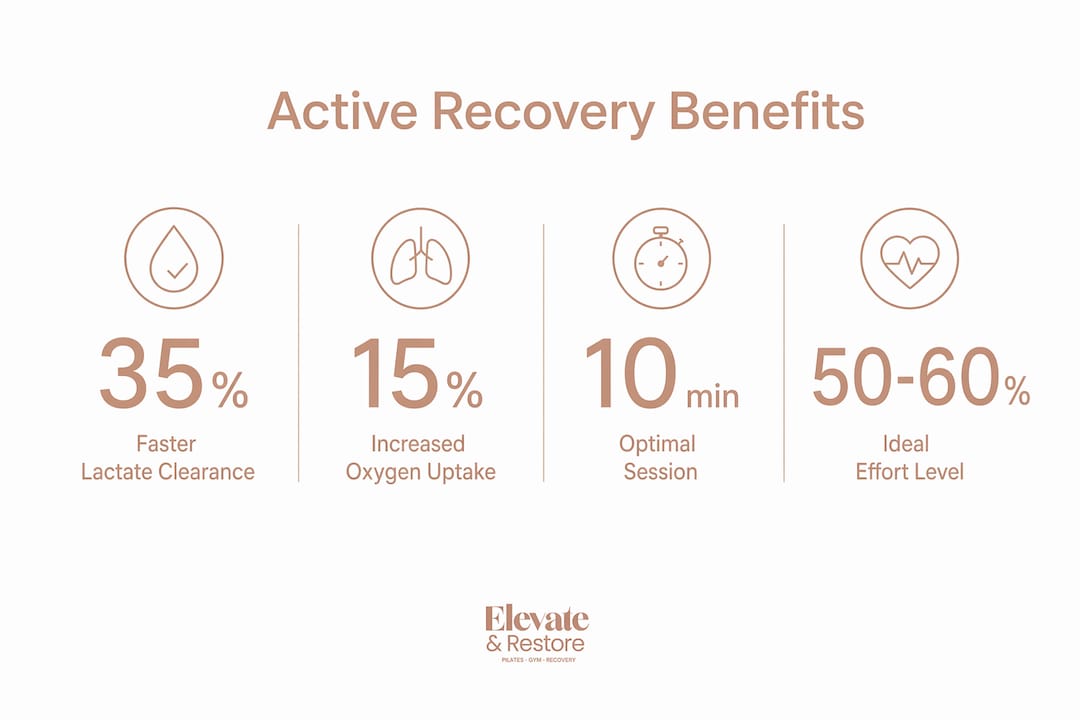
Active recovery sits between full effort and complete rest. You move at low intensity, typically around 50–60% of maximum effort, to keep circulation elevated without adding meaningful fatigue. The physiological payoff is real and well-documented.
Key benefits backed by research:
- Faster lactate clearance: moving muscles continue pumping metabolic waste into the bloodstream for breakdown, rather than letting it pool.
- Reduced muscle soreness: improved circulation limits the build-up of hydrogen ions that contribute to that heavy, aching feeling.
- Quicker readiness: pH balance in muscle tissue restores faster with active recovery than with passive rest.
- Psychological lift: athletes consistently report feeling looser and mentally sharper after active recovery, even when physiological markers look similar to passive rest.
How your body actually responds to active recovery
The mechanism is straightforward. When you exercise at high intensity, your muscles produce lactate and hydrogen ions faster than your aerobic system can clear them. Active recovery increases intramuscular blood flow, which accelerates the transport of those waste products out of muscle tissue and into the bloodstream, where they are broken down or excreted.

There is a second mechanism worth knowing. Research shows active recovery induces higher VO2 and oxygen consumption, which supports phosphocreatine resynthesis. That means your muscles replenish their immediate energy stores more efficiently, leaving you better prepared for the next bout of effort.
| Physiological marker | Effect of active recovery |
|---|---|
| Blood lactate | Cleared faster than with passive rest |
| Hydrogen ion concentration | Reduced, supporting pH restoration |
| Intramuscular blood flow | Increased, aiding waste removal |
| Phosphocreatine resynthesis | Accelerated via elevated VO2 |
| Muscle pH | Restored more quickly |
Unlike ice baths, active recovery does not suppress post-exercise inflammation. That is actually a point in its favour. Beneficial inflammatory processes that drive fitness adaptations remain intact, while metabolic waste still clears efficiently.
What the research actually says
A 2019 systematic review published in the Journal of Strength and Conditioning Research examined 26 studies involving 471 athletes. The finding that held up most consistently: active recovery lasting 6–10 minutes produced reliably positive effects on performance metrics including counter-movement jump height and swim times. Shorter or longer durations showed less consistent results.
In high-intensity interval training specifically, active recovery between bouts reduced blood lactate and increased peak power by about 7.8% compared with passive recovery. That is a meaningful gain for athletes whose sport demands repeated explosive efforts.
The same systematic review noted that blood lactate clearance rate alone is an unreliable marker of recovery quality, and that the optimal intensity for active recovery sessions remains inconclusive. The honest read: active recovery works, but it is not a precise science yet. Individual response varies, and the psychological benefits may be just as important as the physiological ones.
When and how to use active recovery most effectively
Active recovery delivers the most value when your next training session is close. Back-to-back training days, tournament play, or two-a-day sessions are exactly when low-intensity movement outperforms sitting still. If you have 72 hours before your next session, the urgency is lower.
Suitable activities include light cycling, walking, swimming, and gentle yoga. The common thread is that none of them should leave you tired. If you finish your active recovery session feeling like you worked out, you went too hard.
Pro Tip: Keep active recovery at 50–60% of your maximum effort and focus on smooth, continuous movement rather than any specific exercise. The goal is circulation, not conditioning.
For those recovering from strength training, a 10-minute walk or easy bike ride immediately post-session is often all it takes. Pair it with breathing techniques to further support parasympathetic recovery and waste clearance.
How Elevateandrestore integrates active recovery into training
At Elevateandrestore, active recovery is not an afterthought. It sits at the centre of how the studio structures functional training and Pilates sessions for small groups of six. The logic is simple: if you train hard, you need to recover well, and movement is the most accessible recovery tool you have.
Recovery is not passive. The athletes and clients who improve fastest are the ones who treat their recovery sessions with the same intention as their training. A 10-minute walk, a gentle Pilates flow, or time in the recovery lounge all count. Movement, not intensity, is the key.
Pilates, in particular, suits active recovery because it emphasises controlled movement, breath, and mobility without loading the body. A session focused on mobility and range of motion the day after heavy functional training keeps the body moving without adding stress. The recovery lounge at Elevateandrestore, which includes a sauna, cold plunge, hot tub, and compression boots, extends those benefits further. The sports psychology research supports this too: athletes who feel in control of their recovery report better motivation and training consistency over time.
Practical integration tips for small-group settings:
- Schedule a 10-minute active recovery block at the end of every high-intensity session.
- Use Pilates on the day following heavy functional training rather than taking a full rest day.
- Treat the recovery lounge as part of the training programme, not a reward for finishing.
- Personalise the approach: a client returning from injury needs different active recovery than a competitive athlete preparing for a tournament.
Limitations and risks worth knowing
Active recovery is not the right tool in every situation. If you are genuinely unwell, injured, or in the acute phase of overtraining, low-intensity movement can delay healing rather than support it. The body sometimes needs complete rest, and pushing through fatigue with "active recovery" as justification is a common mistake.
Intensity creep is the other risk. What starts as a gentle walk becomes a moderate jog, which defeats the purpose entirely. Research consistently shows the benefits appear at low intensity. Go harder and you are just adding another training stimulus, not recovering from the last one.
Active recovery also does not replace sleep, nutrition, or adequate rest days. It is one tool in a broader recovery strategy, not a substitute for the fundamentals. Used correctly, at the right intensity and at the right time, it is one of the most accessible performance tools available.
Active recovery improves performance by clearing metabolic waste faster, restoring muscle pH, and keeping athletes physically and mentally ready for their next session.
| Point | Details |
|---|---|
| Optimal session length | 6–10 minutes of active recovery consistently improves performance metrics across studies. |
| Target intensity | Work at 50–60% of maximum effort to increase circulation without adding fatigue. |
| Best timing | Most effective when sessions are close together, such as back-to-back training days. |
| Key mechanism | Increased blood flow clears lactate and hydrogen ions faster than passive rest. |
| Pilates as active recovery | Controlled Pilates movement supports mobility and recovery without loading the body. |
Ready to train and recover smarter? Elevateandrestore's small-group sessions combine functional training and Pilates with a dedicated recovery lounge in Melbourne featuring sauna, cold plunge, hot tub, and compression boots. If you want to see how reformer Pilates fits into a structured recovery programme, the studio is worth a visit.