
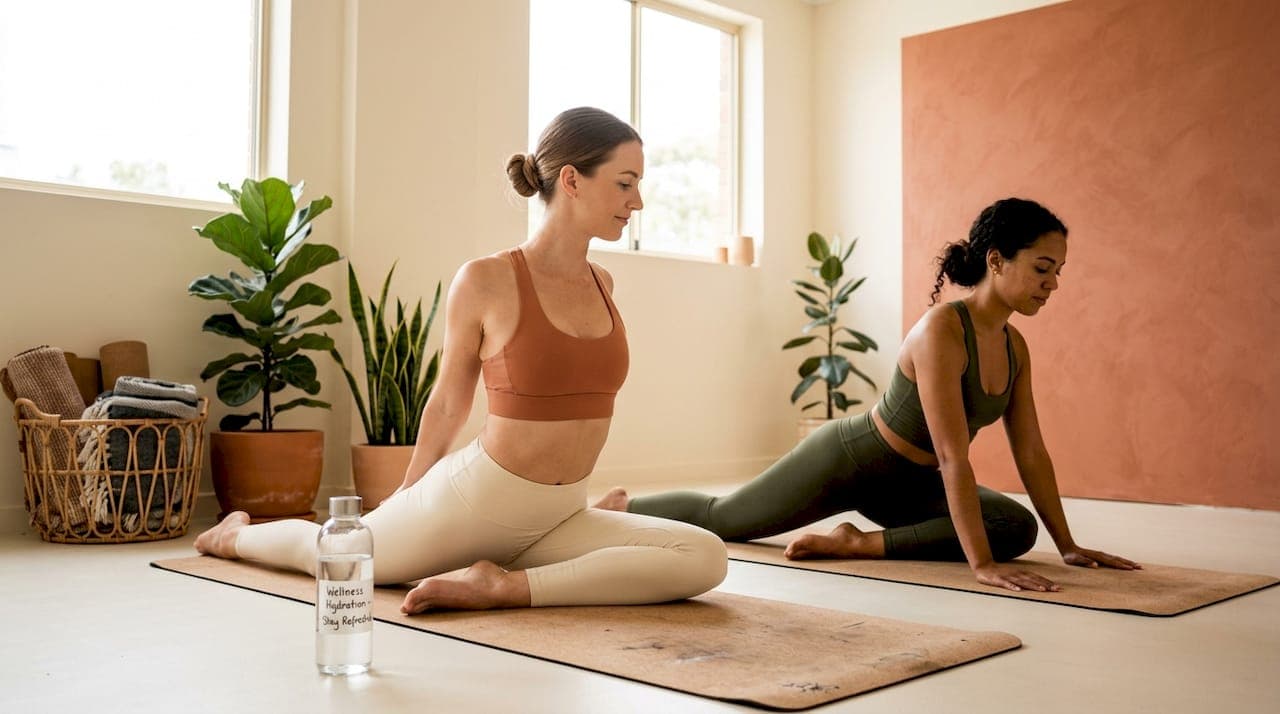
If you're over 30 and trying to decide between Pilates and yoga, you're not alone. The pilates vs yoga for women debate is one of the most common questions we hear, and the honest answer is that they're not interchangeable. They work differently, feel different, and deliver different results. One isn't better than the other in any absolute sense. But one might be significantly better for you, depending on what your body needs right now. Here's how to figure that out.
Table of Contents
- Key takeaways
- Pilates vs yoga for women: understanding the basics
- Physical benefits: strength, flexibility, and posture
- Mental and emotional benefits: stress, mood, and mindfulness
- Choosing what's right for you
- Avoiding common mistakes
- My honest take after years in this space
- Try it for yourself at Elevateandrestore
- FAQ
Key takeaways
| Point | Details |
|---|---|
| Different physical outcomes | Pilates builds core strength and muscle tone; yoga prioritises flexibility and joint mobility. |
| Mental health benefits differ | Yoga has stronger mindfulness and cortisol-lowering effects; Pilates reduces anxiety through focused movement. |
| Equipment shapes the experience | Reformer Pilates offers guided resistance; yoga needs only a mat and optional props. |
| Both practices complement each other | Combining Pilates and yoga delivers more complete physical and mental benefits than either alone. |
| Consistency beats intensity | Short, frequent sessions in either practice produce better long-term results than sporadic long workouts. |
Pilates vs yoga for women: understanding the basics
Before you can choose, you need to know what you're actually choosing between. Both are mind-body practices rooted in breath and movement, but that's roughly where the similarity ends.
Pilates was developed by Joseph Pilates in the early 20th century as a rehabilitation method. It centres on controlled, precise movements that target the deep stabilising muscles of the core, spine, and pelvis. You'll either work on a mat or on a reformer, which is a spring-loaded carriage machine that adds resistance and feedback to every exercise. Reformer equipment is particularly useful for beginners because it helps you feel correct alignment rather than just guess at it.
Yoga is a much older tradition with roots in Indian philosophy. In a fitness context, it spans from gentle restorative styles that calm the nervous system to athletic power yoga that genuinely challenges cardiovascular fitness. The common thread is breath, body awareness, and holding or flowing through postures.
Here's what you need to get started with each:
- Pilates (mat): A quality mat, comfortable fitted clothing, bare feet or grip socks
- Pilates (reformer): Access to a studio with machines, grip socks, fitted clothing
- Yoga: A non-slip mat, comfortable clothing, optional props like blocks and straps
- Both: No prior fitness experience required, though some styles suit beginners more than others
Pilates and yoga require minimal equipment compared to most gym-based training, which makes them accessible. That said, reformer Pilates does require studio access, and the quality of instruction matters enormously in both practices.
| Feature | Pilates | Yoga |
|---|---|---|
| Primary focus | Core strength, alignment, muscle control | Flexibility, breath, mindfulness |
| Equipment | Mat or reformer | Mat, optional props |
| Styles available | Mat, reformer, clinical | Hatha, vinyasa, yin, restorative, power |
| Suitable for beginners | Yes, especially with instruction | Yes, particularly gentle or hatha styles |
| Class size (at Elevateandrestore) | Maximum 6 people | Varies by studio |
Physical benefits: strength, flexibility, and posture
This is where the yoga vs pilates comparison gets genuinely interesting, because both practices improve your body in ways that overlap but are not identical.
Pilates for muscle tone and core strength
Pilates targets the deep stabiliser muscles that most gym workouts miss entirely. These are the muscles around your spine, pelvis, and deep abdomen that hold you upright, protect your lower back, and make every other movement more efficient. Women doing reformer Pilates three times a week for eight weeks gained measurable muscle mass and strength, which surprises people who assume Pilates is "just stretching." It is not.
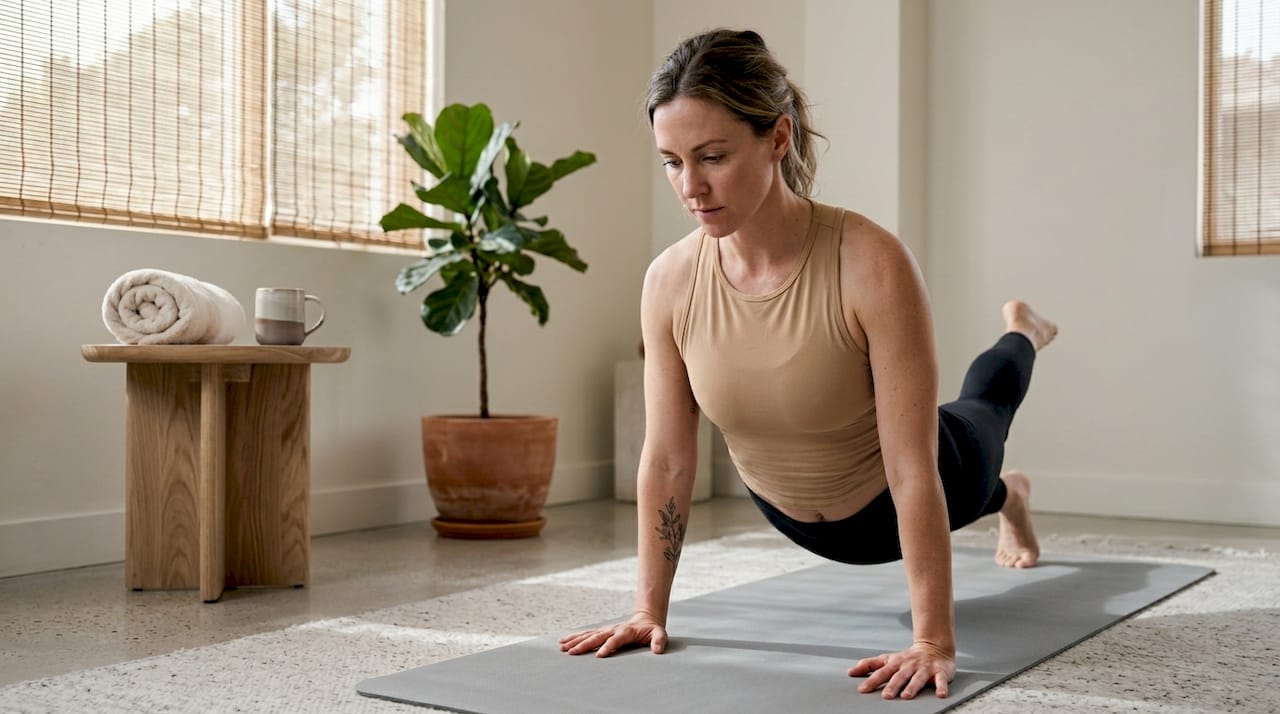
Posture is another standout benefit. Eight weeks of Pilates improved posture and daily functional movement in sedentary women, which matters enormously after 30 when desk work and lifestyle habits start to show up in your spine and shoulders.
Yoga for flexibility and joint mobility
Yoga's advantage is clear when it comes to flexibility. Twelve weeks of yoga improved hamstring flexibility by 35% and shoulder mobility by 24% in adults aged 40 to 65. That's a significant gain, and it translates directly to reduced injury risk, better movement quality, and less chronic tightness.
Yoga also builds genuine strength, particularly in the upper body, hips, and legs. Holding warrior poses or moving through a vinyasa sequence is harder than it looks. Yoga for strength is underrated.
Pro Tip: If you're new to Pilates, don't be surprised if you feel more challenged than expected. Pilates' precise alignment focus makes it far more demanding than it appears from the outside. Beginners often recruit the wrong muscles entirely without proper guidance, which is exactly why small-group instruction makes such a difference.
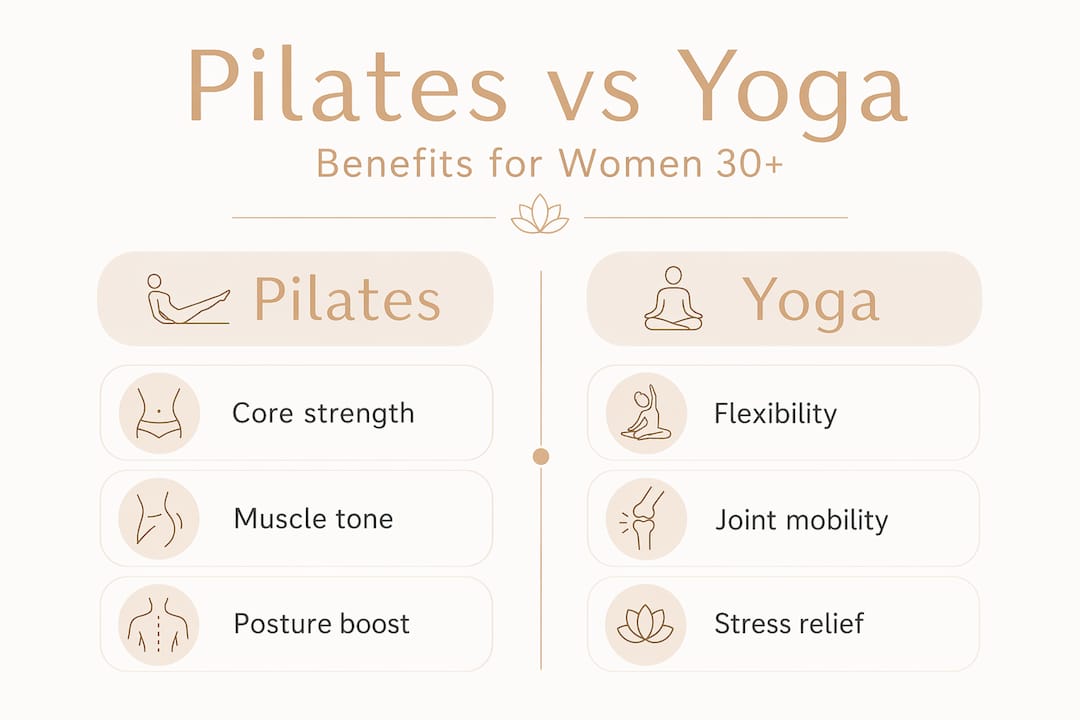
| Physical benefit | Pilates | Yoga |
|---|---|---|
| Core strength | Very high | Moderate |
| Muscle tone | High | Moderate to high |
| Flexibility | Moderate | Very high |
| Joint mobility | Moderate | High |
| Posture improvement | Very high | High |
| Injury rehabilitation | Very high | Moderate |
Mental and emotional benefits: stress, mood, and mindfulness
Here's something worth knowing: both practices improve mental health, but they do it through different mechanisms.
Yoga has the stronger evidence base for direct hormonal effects. Twelve weeks of yoga reduces cortisol (your primary stress hormone) while increasing serotonin and brain-derived neurotrophic factor (BDNF), a protein that supports brain health and mood regulation. This is why yoga classes for beginners often feel surprisingly emotional. You're not imagining it. The practice genuinely shifts your biochemistry.
Pilates works differently. Its mental benefit comes from the demand for concentration. When you're focused on engaging the right muscles in the right sequence, your mind has no bandwidth left for work stress or anxious thoughts. Once-weekly Pilates over three months measurably lowered anxiety, depression, and stress markers in women. That's a meaningful result from a modest commitment.
For women over 30, this distinction matters. Integrated mind-body practices like Pilates and yoga are particularly effective for hormone and stress regulation during perimenopause and beyond, when cortisol sensitivity increases and recovery becomes more important.
Here's how the mental benefits break down practically:
- Yoga is better for active stress relief, anxiety management, and building a consistent mindfulness practice
- Pilates is better for mental focus, body awareness, and the kind of calm that comes from mastering something precise
- Both reduce the physical symptoms of chronic stress, including tension, poor sleep, and low energy
- Combining both gives you the broadest mental health support, covering both the meditative and the functional sides of wellbeing
Choosing what's right for you
The most honest answer to "which is better, yoga or Pilates?" is: it depends on what you're trying to fix or build. Here's a practical way to think through it.
- If your main goal is a stronger core and better posture, start with Pilates. Reformer Pilates in particular gives you immediate feedback on alignment and builds the deep muscle strength that supports everything else you do.
- If you're chronically tight, stressed, or recovering from injury, yoga is likely the better starting point. A yin or restorative class will address flexibility and nervous system regulation simultaneously.
- If you want to lose body fat and build visible muscle tone, Pilates has the edge, particularly reformer-based work done consistently three times a week.
- If mental health and stress management are your priority, yoga's cortisol-lowering effects make it the stronger choice, though Pilates is far from ineffective.
- If you're a complete beginner, both are accessible. A small-group reformer Pilates class or a beginner hatha yoga class are both excellent entry points.
Short, frequent sessions consistently outperform sporadic long workouts for adherence and results in both practices. Two or three sessions a week beats one long session on the weekend every time.
Pro Tip: You don't have to choose permanently. Many women over 30 get the best results by doing Pilates two to three times a week for strength and structure, and adding one yoga session for flexibility and recovery. Both practices complement traditional strength and cardio training without competing with it.
Avoiding common mistakes
The most common mistake in both practices is moving too fast, too soon. Here's what to watch for:
- In Pilates: Gripping with your neck, shoulders, or hip flexors instead of engaging the deep core. This happens when you skip proper instruction and try to self-teach from videos. Without guidance, beginners almost always recruit the larger, more familiar muscles rather than the deep stabilisers the practice is designed to target.
- In yoga: Pushing into flexibility rather than breathing into it. Forcing a stretch activates a protective reflex in the muscle that makes it tighter, not looser. Props exist for a reason. Use them.
- In both: Treating soreness as progress and rest as failure. Recovery is where adaptation happens.
"The goal is not to be good at Pilates or yoga. The goal is to feel better in your body. Progress that you can't sustain is not progress."
Consistency matters far more than perfection. If you miss a week, you haven't lost your progress. Come back, start where you are, and keep going.
My honest take after years in this space
I've worked with hundreds of women over 30 at Elevateandrestore, and what I've seen consistently is this: the practice that wins is the one you'll actually show up for.
In my experience, women who come in expecting Pilates to be easy are usually humbled within the first session. That surprise often becomes the hook. There's something deeply satisfying about discovering that your body is capable of more precision and control than you thought. I've seen women in their 40s and 50s build core strength they never had in their 30s, simply because they found a practice that met them where they were.
Yoga, on the other hand, tends to attract women who are already aware of their stress load and looking for something that addresses both body and mind at once. What I've noticed is that the women who stick with yoga long-term are the ones who stop treating it as a flexibility class and start treating it as a recovery practice.
My honest recommendation? If you're over 30 and haven't tried reformer Pilates, try it before you decide it's not for you. The reformer changes the experience entirely compared to a mat class. And if you've been doing Pilates for a while and feel like something's missing, one yoga session a week might be exactly what your nervous system is asking for.
— Elevate
Try it for yourself at Elevateandrestore
If you've been sitting on the fence about where to start, Elevateandrestore makes the decision straightforward. Our reformer Pilates classes in West Footscray run in groups of no more than six people, which means you get real coaching attention, not just a spot in a crowded room. Every session is designed around proper alignment and progressive challenge, so you build genuine strength from day one.
Beyond Pilates, our boutique fitness classes give you a way to blend movement styles and find what works best for your body and goals. After class, the recovery hub, including sauna, cold plunge, hot tub, and compression boots, is there to support your body between sessions. It's the kind of environment where women over 30 actually thrive, because everything is built around results and recovery, not just showing up.
FAQ
What is the main difference between Pilates and yoga?
Pilates focuses on core strength, precise muscle control, and postural alignment, while yoga prioritises flexibility, breath, and mindfulness. Both improve body awareness, but through different methods and with different primary outcomes.
Which is better for weight loss: Pilates or yoga?
Pilates, particularly reformer-based classes done three times a week, has stronger evidence for building muscle mass and improving body composition. Yoga supports weight management indirectly through stress reduction and improved sleep quality.
Can I do both Pilates and yoga in the same week?
Yes, and many women over 30 find that combining both practices delivers the most complete results. A common approach is two to three Pilates sessions for strength and structure, plus one yoga session for flexibility and nervous system recovery.
Is Pilates or yoga better for back pain?
Pilates has stronger clinical evidence for back pain relief because it directly targets the deep stabiliser muscles that support the spine. Yoga can also help, particularly gentle or yin styles, but Pilates is generally the more targeted option for spinal health.
How quickly will I see results from Pilates or yoga?
Most women notice improved posture, reduced tension, and better body awareness within four to six weeks of consistent practice. Measurable strength and flexibility gains typically appear after eight to twelve weeks of two to three sessions per week.