

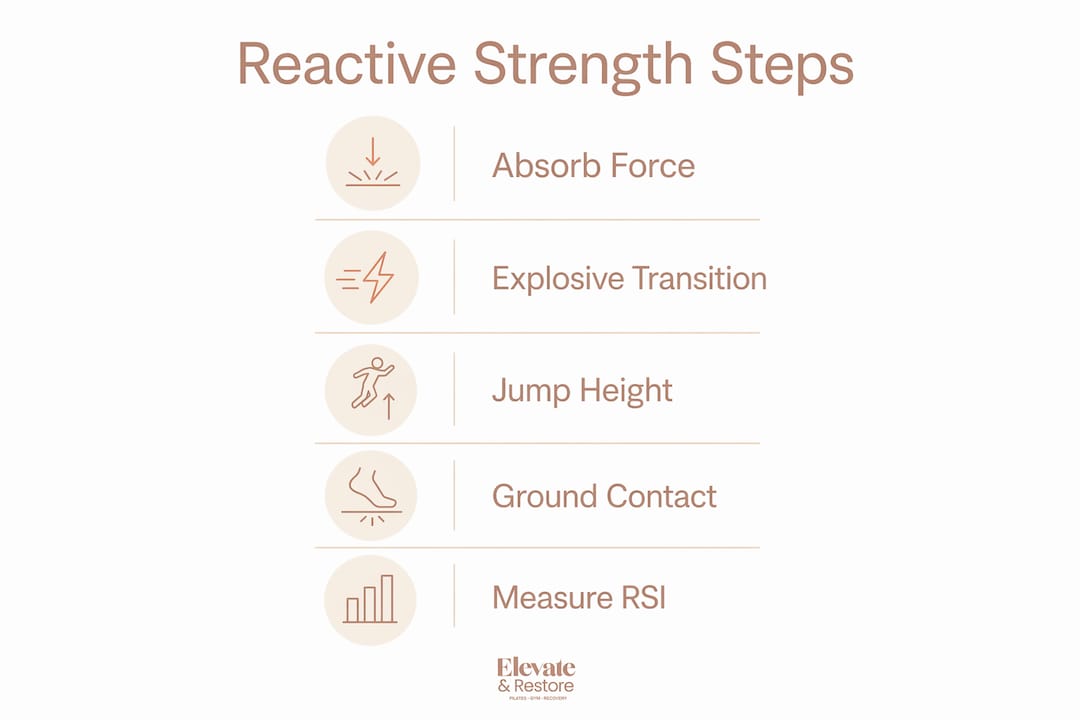
Reactive strength training is the practice of developing an athlete's ability to transition explosively from absorbing force to producing power within milliseconds, a quality measured precisely by the Reactive Strength Index (RSI). The RSI formula is straightforward: jump height in metres divided by ground contact time in seconds. At top sprint speeds, ground contact time sits between 80 and 100 milliseconds, meaning the body must absorb and redirect force almost instantaneously. For coaches and fitness enthusiasts serious about athletic performance, understanding reactive strength training is not optional. It is the foundation of speed, agility, and injury-resilient movement.
What is reactive strength training and how does it work?
Reactive strength training is a specialised method within plyometric and strength and conditioning practice. The industry standard term is reactive strength, and it refers specifically to the ability to absorb eccentric force and immediately reapply it concentrically, without any pause between the two phases. This is distinct from general explosiveness, which can involve a deliberate countermovement or pause before force production.
The key concept underpinning reactive strength is the stretch-shortening cycle (SSC). The SSC describes the sequence where a muscle first lengthens under load (eccentric phase), then transitions rapidly into a shortening contraction (concentric phase). In reactive strength, this transition must occur within a very short ground contact window. Reactive strength lives in this transition phase, requiring rhythmic energy absorption and immediate reapplication, which separates it from broader definitions of power or strength.
Three physiological mechanisms drive this process:
- Elastic energy storage and recoil. Tendons, particularly the Achilles and patellar tendons, store elastic energy during the eccentric phase and release it during the concentric phase. This elastic contribution reduces the metabolic cost of force production and increases output speed.
- Neuromuscular preactivation. The nervous system activates key muscles, especially the soleus and gastrocnemius, before ground contact occurs. This preactivation stiffens the muscle-tendon unit and prepares it to handle impact loads efficiently.
- Reflex potentiation. The stretch reflex, triggered by rapid muscle lengthening, contributes additional motor unit recruitment during the concentric phase, amplifying force output.
Elite sprinters and court sport athletes demonstrate ground contact times well below 150 milliseconds during reactive tasks. This benchmark matters because it separates reactive strength work from standard plyometrics, where longer contact times are acceptable and even desirable for maximal power development.
How is reactive strength measured and monitored?

The Reactive Strength Index is the primary metric coaches use to quantify reactive strength performance. The calculation is clean: RSI equals jump height in metres divided by ground contact time in seconds. A score of 1.5 to 2.0 is typical for recreational athletes, while elite sprinters and jumpers regularly exceed 3.0.
| Athlete level | Typical RSI range | What it indicates |
|---|---|---|
| Recreational | 1.0 to 1.5 | Basic reactive capacity, room for significant gains |
| Competitive amateur | 1.5 to 2.5 | Functional reactive strength for most team sports |
| Elite athlete | 2.5 to 3.5+ | High neuromuscular efficiency and tendon stiffness |
Technology for measuring RSI includes force plates, jump mats, and inertial measurement units (IMUs). Force plates provide the most accurate ground contact time data and are the gold standard in performance labs. Jump mats offer a practical and affordable alternative for field settings. IMUs, worn on the foot or shin, allow real-time monitoring during training sessions without interrupting flow.
Standardisation is non-negotiable for reliable data. Tracking RSI reliably requires consistent warm-up protocols, the same time of day, identical sensor placement, and stable environmental conditions. Professionals track 7 or 14-day moving averages to smooth out variability caused by transient factors like sleep quality or nutrition. A single data point tells you little. A trend tells you everything.
Fatigue monitoring is equally critical. Ground contact time drift of more than 15 milliseconds within a session is a definitive marker of reactive fatigue, signalling that continuing the session will produce diminishing returns and increase injury risk. This threshold gives coaches an objective stopping point rather than relying on subjective athlete feedback.
Pro Tip: Set a GCT drift alert on your jump mat or force plate software. When any athlete exceeds their baseline GCT by 15 ms, that athlete stops reactive work for the session. This single rule prevents the majority of overuse injuries in plyometric programmes.
What are the best reactive strength exercises and protocols?
Effective reactive strength exercises are organised by ground contact time targets. Short-contact drills with GCT below 150 milliseconds target reactive power and sprint mechanics directly, while depth jumps with GCT in the 180 to 220 millisecond range suit maximal power development. Both have a place in a well-designed programme.
Here is a practical progression from foundational to advanced reactive strength exercises:
- Ankle pogo jumps. Both feet, minimal knee bend, focus on ankle stiffness and rapid ground contact. Target GCT below 150 ms. This is the entry point for reactive strength work and teaches the athlete to use the Achilles tendon as a spring rather than relying on knee and hip extension.
- Hurdle hops. Low hurdles (30 to 50 cm), continuous rhythm, land and immediately rebound. Hurdle hops train the rhythmic quality of the SSC and are excellent for developing sprint-specific reactive patterns.
- Depth drop. Step off a box (30 to 40 cm), land softly and absorb. No jump on landing. This is a prerequisite drill that builds eccentric capacity and landing mechanics before any reactive loading is introduced.
- Depth jump. Step off a box, land, and immediately jump for maximum height with minimum contact time. This is the primary reactive strength exercise and should only be introduced once the athlete demonstrates silent, stable landings on the depth drop.
- Single-leg pogo and single-leg hurdle hops. Advanced progressions that increase demand on the ankle and knee stabilisers, directly transferring to running and change-of-direction mechanics.
Training parameters matter as much as exercise selection. Effective programming calls for 2 to 3 minutes of rest between sets, 5 to 10 seconds between individual reps, and a training frequency of 2 to 3 sessions per week with a minimum of 48 hours between sessions. Central nervous system fatigue accumulates faster with reactive work than with traditional resistance training, so recovery is not optional.
Progress is driven by RSI feedback, not by arbitrary box height increases. If an athlete's GCT is not improving or their jump height is plateauing, the answer is rarely a higher box. It is usually better technique, more recovery, or a return to foundational drills.
Pro Tip: Use verbal cues that focus on the braking phase rather than the jump. Telling an athlete to "punch the ground" or "stop fast" activates soleus preactivation before contact, which acutely improves RSI without any additional training load. This is one of the fastest performance wins available to coaches.
Reactive strength vs agile strength: what is the difference?
Reactive strength and agile strength are related but distinct physical qualities. Confusing them leads to poorly designed training programmes and athletes who are fast in straight lines but slow to react to unpredictable situations.
Reactive strength is defined by speed of force transition in predictable movement patterns. A sprint, a hurdle, a box jump. The movement is known in advance, and the body optimises the SSC for that specific pattern. Agile strength, by contrast, involves force production and absorption in unpredictable or rapidly changing movement contexts, such as a basketball player reacting to a defender's cut or a footballer changing direction in response to a teammate's pass.
"Reactive strength is about how fast you can turn force around. Agile strength is about how well you can redirect it when the plan changes." This distinction shapes every training decision for athletes in open-skill sports.
The training implications are significant. Reactive strength is developed through structured, repeatable drills with measurable GCT targets. Agile strength requires reactive decision-making combined with physical output, using tools like agility ladders with visual cues, reactive light systems such as Blazepods, or small-sided games with unpredictable demands.
For most athletes, both qualities need development. A rugby player who is reactive but not agile will be fast in a straight line but predictable. A netballer who is agile but lacks reactive strength will make the right decisions but lack the physical output to execute them at speed. Functional strength training that integrates both qualities produces the most transfer to sport performance.
Common pitfalls and best practices for coaches
The most frequent mistake in reactive strength programming is skipping the foundational phase. Proper landing competency reduces injury risk in depth jumps by up to 60%, yet many coaches progress athletes to depth jumps before they can demonstrate a silent, stable landing from a simple box step-down. The eccentric capacity to absorb force must precede the reactive demand to redirect it.
Key best practices for coaches and athletes:
- Assess landing mechanics first. An athlete who cannot land quietly from a 40 cm box with stable knees and hips is not ready for reactive strength work. This is a non-negotiable prerequisite, not a suggestion.
- Prioritise CNS recovery. Reactive strength training taxes the central nervous system more than muscular hypertrophy work. Scheduling reactive sessions on the same day as heavy lower-body resistance training compounds fatigue and reduces training quality for both.
- Standardise your testing. Inconsistent warm-ups, different times of day, or varying sensor placement will produce unreliable RSI data. Treat testing like a scientific protocol, not an afterthought.
- Avoid programme hopping. Measurable RSI improvements take 4 to 6 weeks to appear, with trained athletes gaining 5 to 10% and less-trained athletes gaining 10 to 20% over 8 to 12 weeks. Switching programmes before this window closes is the single biggest reason athletes fail to see results.
- Use verbal cues strategically. Braking-phase cues that increase soleus preactivation can acutely improve RSI even in athletes without prior plyometric experience. This is a low-cost, high-return coaching tool.
Injury prevention in reactive strength training also benefits from integrating functional movement screening before athletes begin high-impact protocols. Identifying asymmetries or mobility restrictions early allows coaches to address them before they become liabilities under reactive loading.
Key takeaways
Reactive strength training produces the greatest performance gains when RSI is monitored consistently, progression is grounded in measurable GCT targets, and foundational landing mechanics are established before high-impact loading begins.
| Point | Details |
|---|---|
| RSI is the core metric | Calculate RSI as jump height divided by ground contact time to track reactive strength progress objectively. |
| GCT drift signals fatigue | Stop reactive work when ground contact time increases by more than 15 ms within a session to prevent injury. |
| Progression must be earned | Athletes must demonstrate silent, stable landings before advancing to depth jumps or high-impact reactive drills. |
| Verbal cues work immediately | Braking-phase cues like "punch the ground" improve soleus preactivation and RSI acutely, even in beginners. |
| Recovery is non-negotiable | Allow 48 hours minimum between reactive sessions and limit frequency to 2 to 3 sessions per week. |
Why reactive strength deserves more respect in programming
Most athletes and coaches I work with understand plyometrics in a general sense. Box jumps, broad jumps, maybe some hurdle hops. What they miss is the precision layer underneath. Reactive strength is not just about jumping high or moving fast. It is about how efficiently your nervous system and tendons handle the transition between absorbing and producing force, and that quality is trainable, measurable, and directly linked to injury risk.
The athletes I see who skip the foundational phase and go straight to depth jumps are the same ones who end up with patellar tendinopathy or Achilles issues within a training block. It is not bad luck. It is a predictable outcome of loading a system that has not been prepared for the demand.
What I find genuinely underused is real-time GCT monitoring during sessions. Most coaches test RSI at the start of a block and again at the end. But the data that actually protects athletes and drives better session decisions comes from watching GCT in real time. When you can see fatigue accumulating in the numbers, you make better calls about when to stop. That is the difference between a programme that produces results and one that produces injuries.
Reactive strength also does not exist in isolation. Complex training that combines heavy resistance work with explosive reactive drills produces better strength outcomes and more functional muscle balance than reactive work alone. The athletes who develop the most complete physical profiles are those whose coaches understand how reactive strength fits within a broader programme, not those who treat it as a standalone method.
— Elevate
Train smarter with Elevateandrestore
Elevateandrestore is a functional training and Pilates studio in West Footscray built for athletes and active adults who want to train with purpose and recover properly. Small group sessions of six people mean every athlete gets coaching attention, not just a programme to follow. The facility includes a full recovery lounge with sauna, cold plunge, hot tub, and compression boots, giving your central nervous system the recovery conditions reactive strength training demands.

Whether you are building a reactive strength base from scratch or refining your RSI scores for competition, the coaching team at Elevateandrestore designs programmes around your measurable data, not generic templates. Book a session and find out what training with real feedback actually feels like.
FAQ
What is reactive strength training in simple terms?
Reactive strength training develops your ability to absorb force and immediately redirect it as explosive power, measured by the Reactive Strength Index. It targets the stretch-shortening cycle and is the physical quality most directly linked to sprint speed and agility performance.
How long does it take to improve reactive strength?
Measurable improvements appear within 4 to 6 weeks of structured training. Less-trained athletes typically gain 10 to 20% in RSI over 8 to 12 weeks, while trained athletes see gains of 5 to 10%.
What exercises build reactive strength most effectively?
Ankle pogo jumps, hurdle hops, and depth jumps are the primary reactive strength exercises. Short-contact drills with ground contact time below 150 milliseconds target reactive power directly, while depth jumps at 180 to 220 milliseconds develop maximal reactive output.
How often should you do reactive strength training?
Two to three sessions per week with a minimum of 48 hours between sessions is the recommended frequency. Reactive strength work taxes the central nervous system heavily, and insufficient recovery between sessions reduces quality and increases injury risk.
What is the difference between reactive strength and agile strength?
Reactive strength involves rapid force transition in predictable movement patterns, such as sprinting or hurdle hops. Agile strength involves force production and redirection in unpredictable contexts, such as changing direction in response to an opponent. Both qualities are necessary for complete athletic development.