
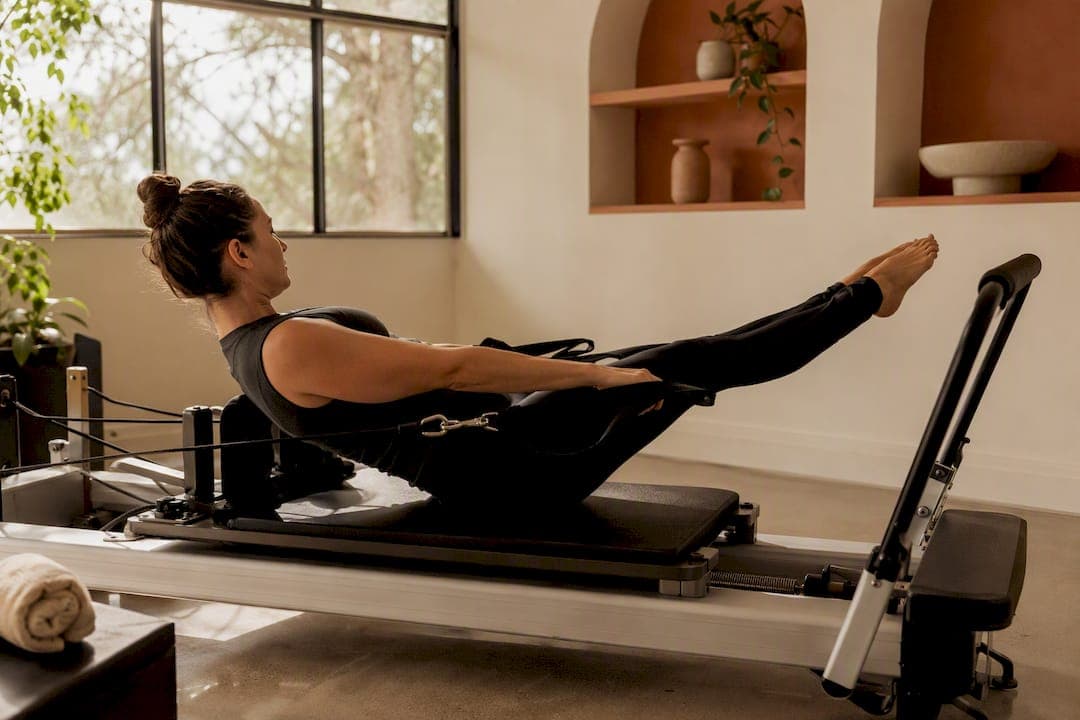
Yes. When a qualified instructor tailors the session to you, reformer Pilates can meaningfully reduce lower back pain and restore function. That's not marketing spin. A systematic review and meta-analysis found Pilates training produces clinically significant improvements in pain and disability for chronic low back pain compared with minimal intervention, with benefits holding up months later. A randomised controlled trial testing a six-week reformer programme backed this up, showing reduced pain intensity alongside better sleep and less fear of movement.
The caveat matters as much as the claim.
- Supervision and modification are what make it safe, not the exercises alone
- If you have neurological symptoms, recent trauma, or unexplained weight loss with your back pain, see a GP before booking a class
- Book an assessment with an instructor who screens for these red flags before programming your first session
Quick fact: A controlled trial used a reformer programme with sessions twice a week lasting about 45 to 50 minutes over six weeks, which led to improvements in pain scores and psychological markers such as fatigue.
Key Takeaways
Reformer Pilates reduces pain and disability for many people with chronic lower back pain when sessions are supervised, progressive, and matched to individual limitations.
| Point | Details |
|---|---|
| Evidence supports Pilates | A systematic review found that Pilates can lead to clinically significant improvements in pain and disability compared with minimal intervention, with benefits maintained in several trials for months after the intervention. |
| Trial protocol is consistent | Most studies use 45 to 50 minute sessions, twice weekly, over six weeks. |
| Mechanism goes beyond strength | Deep-core activation, postural control, and reduced fear of movement all contribute to outcomes. |
| Red flags override any programme | Neurological symptoms, trauma, or systemic signs mean seeing a GP before booking a class. |
| Elevateandrestore offers supervised, small-group sessions | Classes are capped at six people with an initial assessment and a recovery hub to support the full programme. |
This article is general information, not a substitute for advice from a qualified doctor. Consult a qualified healthcare professional about your own circumstances before acting on anything here.
Table of Contents
- How reformer Pilates works for back pain: core, posture and controlled loading
- What the research shows about pilates therapy for back issues
- When should you stop and see a doctor about back pain?
- 11 reformer exercises for lower back pain relief
- A 6-week starter programme for lower back pain
- How to choose a safe reformer class or instructor
- Our take on reformer Pilates and back pain
- Book a small-group reformer class built around your back
- Sources
How reformer Pilates works for back pain: core, posture and controlled loading
Reformer Pilates targets the muscles that actually stabilise your spine, not just the ones you can see in a mirror. The transversus abdominis, multifidus and pelvic floor work as a deep corset around your lumbar spine, and most back pain sufferers have let this system go quiet through disuse, guarding, or plain habit. Reformer work re-teaches this coordination in a way that's hard to fake, because the springs give you instant feedback the moment your form drifts.
That spring resistance is the real point of difference from mat-based training. Unlike bodyweight alone, springs let an instructor dial load up or down within a single exercise, so you get graded strengthening instead of an all-or-nothing effort. Research on apparatus-based Pilates suggests this setup may maintain core activation gains longer than mat work does, likely because the carriage forces controlled, repeatable movement patterns rather than momentum-driven ones.
Three things tend to improve together:
- Deep-core recruitment — transversus abdominis and multifidus learn to fire before you move, not after
- Postural alignment and spinal mobility — segmental control replaces the stiff, guarded movement many chronic pain sufferers default to
- Psychological load — validated tools like the Tampa Kinesiophobia Scale show reduced fear of movement and fatigue after structured reformer programmes, which matters because fear of movement is one of the strongest predictors of ongoing disability
That last point gets skipped in most gym-floor explanations, but it shouldn't. A nervous system convinced that movement equals damage will keep bracing and guarding no matter how strong your multifidus gets. Reformer sessions rebuild trust in movement gradually, which is arguably as important as the strength gains themselves.
What the research shows about pilates therapy for back issues
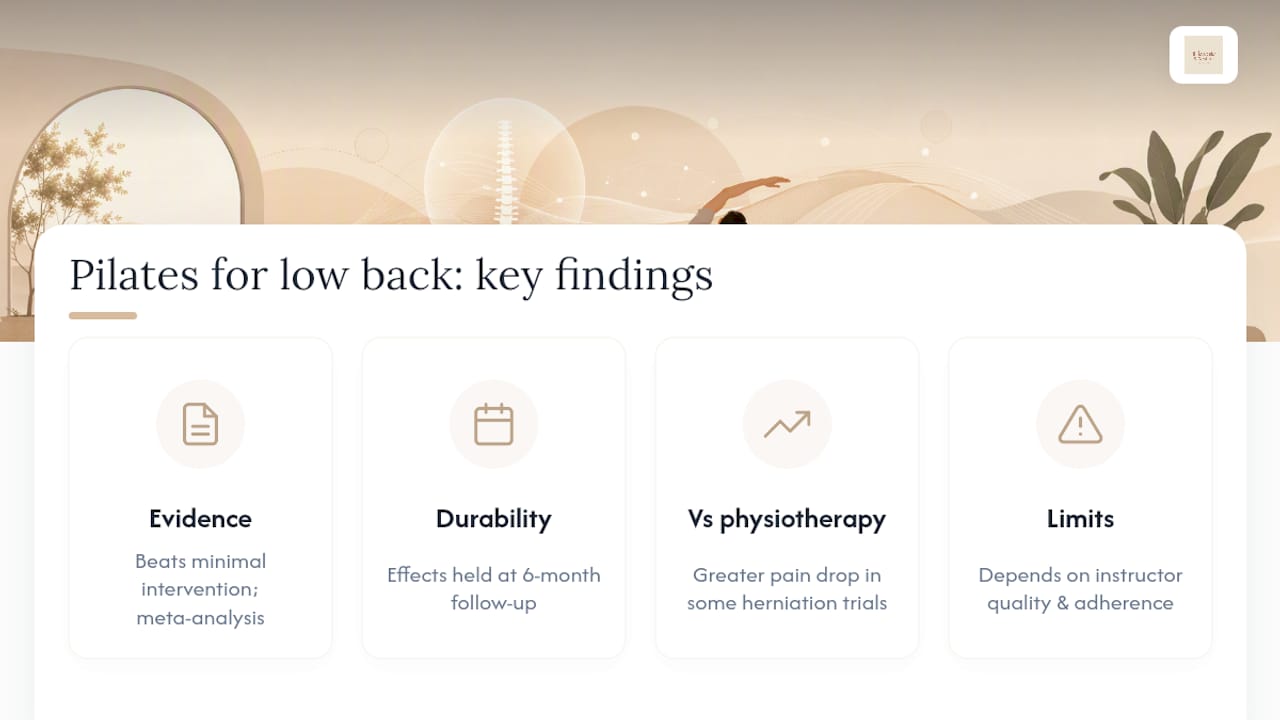
The strongest evidence comes from a meta-analysis pooling multiple trials, which found Pilates training outperforms minimal intervention for both pain and disability in people with chronic low back pain, using tools like the Roland–Morris Disability Index. Effects held at six-month follow-up in several of the pooled trials, which tells you this isn't a placebo bump that fades in a fortnight.
Trial protocols are strikingly consistent across studies, which makes them easy to translate into a real-world programme.
Standout finding: in trials comparing reformer Pilates against conventional physiotherapy for lumbar disc herniation, the reformer programme produced greater pain reduction on certain measures despite using fewer total sessions than the physiotherapy comparator.
That's worth sitting with. It doesn't mean reformer Pilates beats physiotherapy in every case or for every diagnosis, and no honest reading of the evidence claims that. What it does suggest is that structured, supervised reformer work is a genuinely competitive option for specific back conditions, not a soft alternative you settle for when "real" treatment isn't available.
The limits are real too. Pilates isn't consistently superior to other well-run structured exercise programmes, and several reviews note that outcomes depend heavily on instructor quality and how well participants stick to the programme. A brilliant protocol delivered by an under-qualified instructor, or attended sporadically, won't replicate trial results. The World Health Organization lists low back pain as a leading cause of disability globally and recommends exercise-based approaches as first-line management, which is the broader context reformer Pilates sits inside, not a rival to it.
When should you stop and see a doctor about back pain?
Most lower back pain responds well to movement, but some symptoms mean you skip the reformer and see a clinician first. Trust these signals over any exercise plan, no matter how well designed.
- Numbness, tingling, or weakness spreading down one or both legs
- Loss of bladder or bowel control
- Back pain following a fall, car accident, or direct trauma
- Unexplained fever, night sweats, or weight loss alongside back pain
- Pain that wakes you at night and doesn't ease with position changes
Certain reformer movements need modification for most back pain presentations, even without red flags. Deep spinal flexion under load and heavy resisted rotation both compress or shear the lumbar discs in ways that can aggravate an irritable spine, especially early in a programme. A good instructor will regress these before removing them altogether.
Pro Tip: If you're newly diagnosed, post-flare, or recovering from a disc injury, ask for a private or physiotherapist-led reformer session first. Small-group classes are excellent once you know your limits, but the first few sessions are where individualised feedback matters most.
Public health guidance, including NHS-endorsed Pilates resources for chronic back pain, consistently recommends checking with a GP first if your pain is acute, severe, or unexplained.
11 reformer exercises for lower back pain relief
These moves form the backbone of most evidence-aligned reformer programmes. Take this list to a qualified instructor rather than attempting to self-programme, since spring selection and setup matter more than most beginners expect.
-
Pelvic tilt and imprinting — Purpose: reconnects you with deep-core control before loading anything else. Cues: flatten your lower back into the carriage, exhale as you press. Modification: reduce range if your lower back feels reactive. Progression: add light footwork once the imprint feels automatic.
-
Bridge or hip hinge — Purpose: builds glute and hamstring strength to offload the lumbar spine. Cues: push through heels, keep ribs down. Modification: reduce spring load and range. Progression: single-leg bridge once double-leg feels stable.
-
Dead bug variations — Purpose: trains core stability under limb movement without spinal flexion. Cues: keep lower back neutral, move slowly. Modification: reduce arm and leg range simultaneously. Progression: add opposite-limb reach as control improves.
-
Knee stretch (round back and flat back) — Purpose: builds core endurance and shoulder stability. Cues: draw navel in, avoid collapsing through the lower back. Modification: reduce spring resistance and range of carriage travel. Progression: increase reps before increasing resistance.
-
Toe taps and table-top position — Purpose: isolates deep hip flexor and core control without spinal strain. Cues: move from the hip, not the lower back. Modification: keep feet closer to the carriage. Progression: extend one leg fully while maintaining position.
-
Cat–cow on the reformer or mat extension — Purpose: restores segmental spinal mobility. Cues: move slowly through each vertebra. Modification: reduce range if any position causes sharp pain. Progression: pair with breathwork for deeper spinal articulation.
-
Hamstring release with straps — Purpose: reduces posterior chain tightness that often accompanies lumbar pain. Cues: keep the opposite leg grounded, hips level. Modification: bend the working knee slightly. Progression: straighten the leg fully as flexibility improves.
-
Spine roll down — Purpose: teaches controlled flexion and extension through a full but gentle range. Cues: roll one vertebra at a time, breathe out on the way down. Modification: use hand support and shorten the range. Progression: remove hand support once control improves.
-
Mermaid stretch — Purpose: mobilises the spine laterally, a direction often neglected in back pain programmes. Cues: lengthen through the crown of the head, avoid collapsing the ribcage. Modification: reduce lateral reach. Progression: add a rotational component once lateral flexion feels comfortable.
-
Seated spine twist (gentle) — Purpose: restores rotational mobility without shear force. Cues: rotate from the ribcage, keep hips square. Modification: reduce rotation range significantly. Progression: increase range only as pain allows, never resistance.
-
Child's pose, assisted by the carriage — Purpose: a resting stretch that decompresses the lumbar spine. Cues: let the carriage support your reach, breathe into your back. Modification: use a bolster under the chest. Progression: hold longer as tolerance builds.
Spring selection follows a simple rule: lighter springs generally mean less support and more core demand, while heavier springs add stability but reduce the challenge to your stabilisers. Early in a programme, moderate springs that let you complete controlled reps without compensation beat heavy springs that force you into poor patterns.
Pro Tip: Pace your reps by quality, not count. Six clean repetitions with good spinal control beat fifteen where your lower back starts to arch or your breath gets held. Safe regressions, like supine footwork with light springs or supported pelvic imprints, should feel almost boring before you progress. That boredom is the point.
A 6-week starter programme for lower back pain
A six-week, twice-weekly reformer schedule is the most tested starting template, and it lines up with trial protocols showing genuine reductions in pain intensity and psychological load over the same period. Here's how a single session typically breaks down.
- Warm-up (10 minutes) — gentle footwork, pelvic tilts, and breathwork to prime the deep core before any loaded movement.
- Main set (30 minutes) — four to six exercises from the list above, chosen based on your current limitations and progressed only when form stays clean.
- Cool-down (5 to 10 minutes) — spine roll downs, mermaid stretch, and assisted child's pose to decompress and reset.
Track progress with more than a pain score. Watch how easily you stand from sitting, how long you can balance on one leg, and whether pain during specific tasks (bending to tie a shoe, twisting to reverse the car) drops week to week. Pain-at-rest scores can plateau while functional capacity keeps improving, so relying on pain alone undersells your progress. By week four, most people in trial cohorts report noticeably less fear around everyday movement, even before pain scores fully settle.
How to choose a safe reformer class or instructor
Not every reformer class is built for back pain. Look for instructors with a physiotherapy background or specific training in rehabilitation-focused Pilates, since programming for an injured spine differs meaningfully from general fitness cueing.
- Ask how many people are in each class. Small groups of six or fewer allow the instructor to actually watch your form, not just call out cues to the room.
- Ask what happens if an exercise aggravates you mid-class. A good studio has a modification ready, not a shrug.
- Ask whether new clients get any kind of initial assessment or screening before joining group sessions.
Pro Tip: If your pain is complex, recent, or you're recovering from a specific injury, ask about private one-on-one sessions before joining a group class. You can graduate to group work once your instructor is confident in your baseline control.
Studio perspective: how Elevateandrestore applies reformer Pilates safely
Elevateandrestore runs small-group reformer classes capped at six people, which means closer coaching and safer, more personalised progressions than a room of twenty allows.
- Groups of six maximum, so modifications get caught before they become habits
- A recovery hub with infrared sauna, cold plunge, hot tub and compression boots that supports the muscle recovery side of a back pain programme, not just the training side
Our take on reformer Pilates and back pain
The evidence supports a specific, unglamorous claim: reformer Pilates helps when it's supervised, progressive, and matched to the person doing it. That's the part conventional advice glosses over. Plenty of content treats "try Pilates" as a complete answer, as if the exercises themselves carry the therapeutic effect regardless of who's teaching them or how they're loaded.
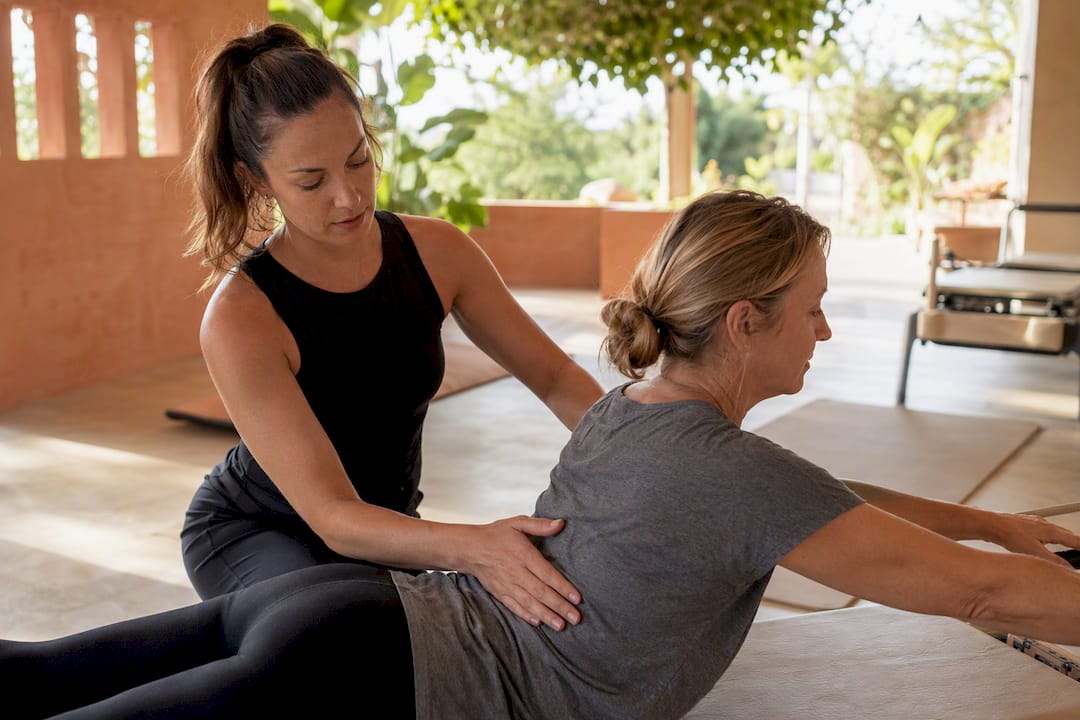
They don't. The research on instructor quality and adherence makes this explicit, and it matches what shows up in outcome data more broadly: a brilliant protocol taught poorly underperforms a modest protocol taught well. If you're choosing where to start, prioritise the instructor's ability to assess and modify over the studio's exercise menu or equipment brand.
The other overlooked piece is psychological. Reformer work rebuilds a person's confidence that movement is safe again, and that shift often precedes the pain reduction rather than following it. Chase that confidence deliberately, through controlled reps and honest feedback, and the pain scores tend to follow.
— Elevate
Book a small-group reformer class built around your back
Elevateandrestore runs small-group reformer Pilates classes capped at six people, so your instructor can actually watch how your spine moves and adjust before a habit sets in, not after. Every new client starts with an assessment rather than being dropped straight into a standard class, which matters when you're managing back pain rather than just chasing fitness.
Sessions pair with the studio's recovery hub, including infrared sauna, cold plunge, hot tub and compression boots, so the muscle recovery side of your programme gets the same attention as the strengthening side. If you're new to reformer equipment altogether, our guide on what reformer Pilates involves is a useful place to start before your first class. For readers building a broader rehabilitation plan, this prehabilitation guide for older lifters covers useful principles for integrating structured movement work alongside your Pilates sessions.
Book an initial assessment or first reformer class and find out where your baseline actually sits before you commit to a full programme.
Sources
- Effect of pilates training on pain and disability in patients with chronic low back pain: a systematic review and meta-analysis
- Effects of reformer pilates on pain, psychological factors, and sleep in chronic musculoskeletal pain: a randomized controlled trial
- Comparison of the Effectiveness of Reformer Pilates and Conventional Physiotherapy in Lumbar Disc Herniation