
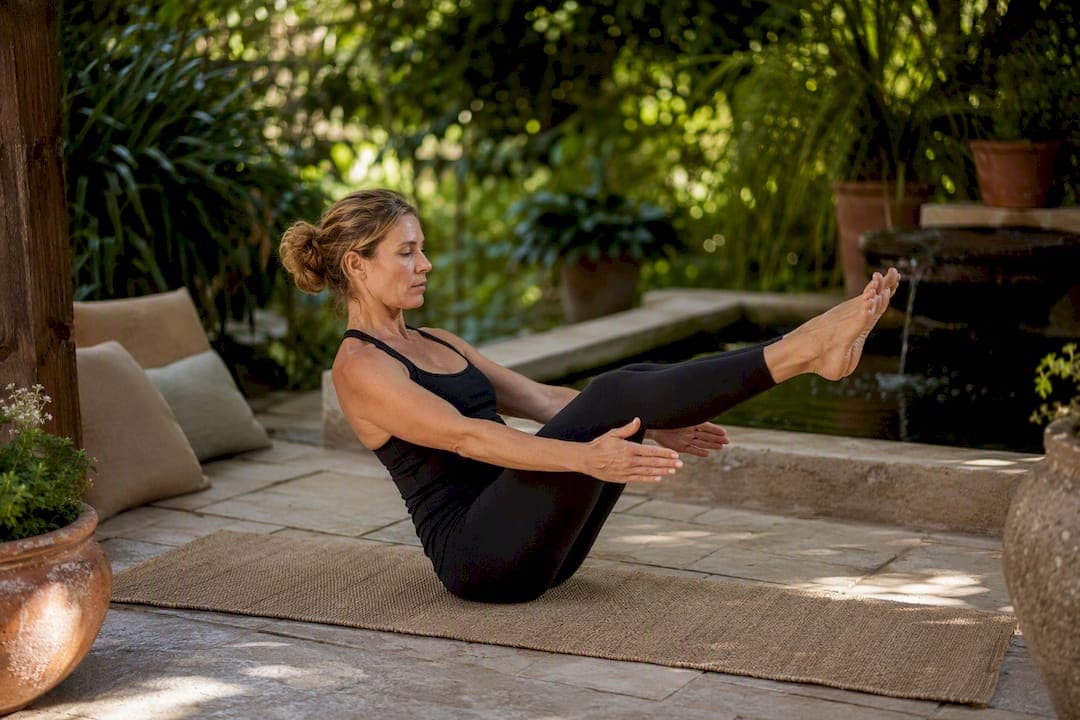
Pilates will not build new bone the way heavy resistance training or high-impact loading can, and no systematic review currently shows it does. What it reliably does is maintain existing bone mineral density, strengthen the muscles that stabilise your spine and hips, and improve the balance that keeps you upright in the first place. That combination lowers fracture risk even without a bone density scan showing improvement. Anyone with osteoporosis or osteopenia should get medical clearance and use spine-safe modifications, guidance the Royal Osteoporosis Society backs strongly.
TL;DR:
- Pilates alone is unlikely to increase bone density significantly without high-impact or resistance training but helps maintain existing bone mass and improves balance.
- Short trial durations, small sample sizes, and inconsistent protocols in studies limit current evidence on Pilates's ability to improve bone mineral density.
- Exercises that avoid spinal flexion, rotation with flexion, and deep extension are safer for osteoporosis, with modifications emphasizing neutral spine and hip hinges.
- Consistent sessions of two to three times weekly for 6 to 12 months, focusing on progression through resistance rather than range, are recommended for bone health.
- Small-group classes with close supervision and a focus on fall prevention optimize safety and effectiveness for individuals managing low bone density.
Table of Contents
- What the research says about Pilates and bone mineral density
- How does Pilates strengthen bones and protect them indirectly?
- Pilates exercises for osteoporosis: what to avoid and what to do instead
- Building a bone-safe Pilates routine: frequency, load and timeline
- Getting started safely with Pilates and low bone density
- How Elevateandrestore approaches bone-aware Pilates
- Where to check the evidence yourself
- Our take on Pilates and bone health
- Ready to build a bone-safe Pilates routine?
- Sources
What the research says about Pilates and bone mineral density
The most-cited evidence on this question comes from a 2021 systematic review and meta-analysis that pooled results across multiple trials of Pilates and yoga in adult women. The headline finding is unglamorous: Pilates and yoga combined did not produce a statistically significant improvement in bone mineral density compared with control groups. The pooled effect size sat at 0.07, with a confidence interval that crossed zero, meaning the true effect could plausibly be nothing at all.
Look closer, though, and the picture gets more interesting. When researchers isolated Pilates-only groups and compared bone density before and after the intervention, rather than against a separate control group, a small improvement was observed, and the effect appeared stronger in some postmenopausal subgroups where bone turnover is highest. This is the group most likely to be reading this article, and it's worth sitting with: the same body of evidence that says "Pilates doesn't beat a control group" also says "Pilates users saw a small improvement in their own numbers over time."
Why the mismatch? Three methodological issues explain most of it.
- Short trial durations. Bone remodels over a physiological cycle of around several months, and most included trials were shorter than the duration typically needed to reliably capture change through dual-energy X-ray absorptiometry (DXA) scanning.
- Small sample sizes. Many of the studies feeding into the meta-analysis had modest participant numbers, which widens confidence intervals and makes a true effect harder to detect statistically.
- Inconsistent protocols. Some trials measured mat Pilates, others reformer work, others combined Pilates and yoga sessions into a single intervention arm, which muddies any attempt to isolate what Pilates specifically contributes.
Researchers behind the review recommend trials running 12 months or longer to properly assess bone outcomes, a threshold almost none of the current literature meets. That's not a knock against Pilates. It's an honest statement that the science hasn't caught up with the question yet.
The practical takeaway sits between two extremes. Pilates is not a replacement for high-load resistance training or impact exercise when the specific goal is increasing bone mineral density. But it's also not irrelevant to bone health. The Royal Osteoporosis Society's own position is that Pilates can help maintain bone strength while building the muscle strength and balance that reduce your odds of the fall that causes a fracture in the first place. That's arguably the more useful outcome for most people over 50, because a fall you avoid matters more day to day than a T-score that moves by a fraction.
How does Pilates strengthen bones and protect them indirectly?
Bone responds to mechanical stress through a process called osteogenic loading. High-impact activity (running, jumping) and heavy resistance training (loaded squats, deadlifts) create the kind of force that signals bone cells to lay down new mineral. Pilates, by contrast, uses controlled, low-impact resistance, most often against spring tension or body weight. That's a fundamentally different stimulus, and it's the core reason Pilates alone won't drive the same bone-building response as barbell training.
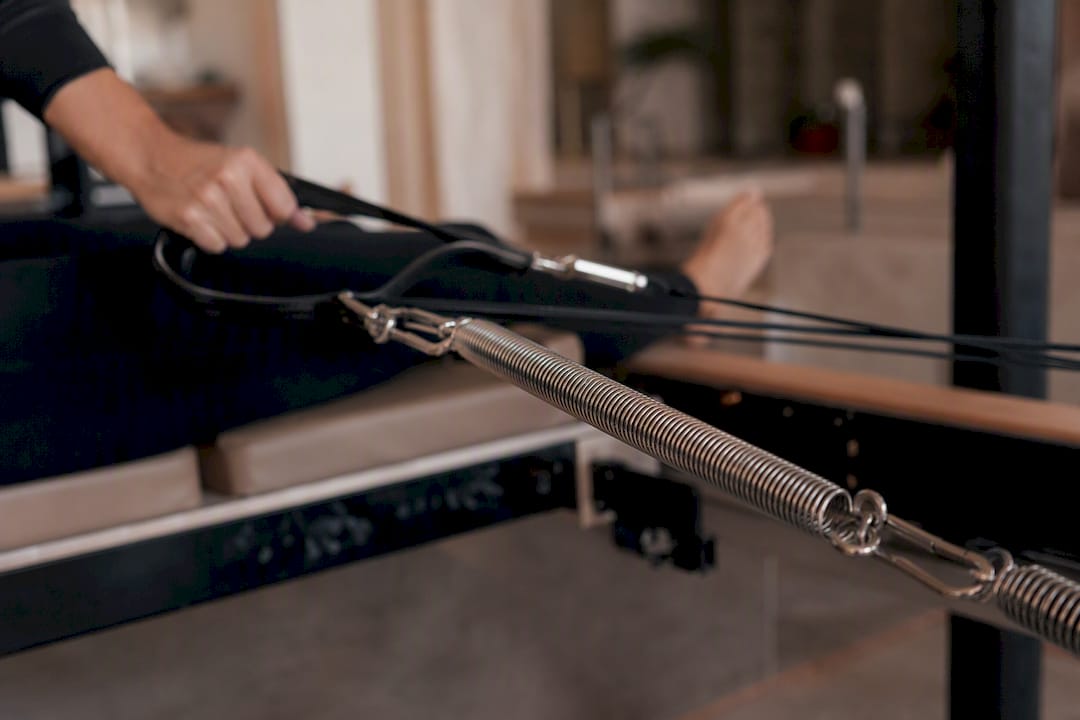
Where Pilates earns its place is in the neuromuscular side of the fracture-risk equation. Roughly 90% of osteoporotic fractures happen because someone fell, not because a bone spontaneously failed under normal load. Anything that improves balance, core stability, posture, and reaction time changes the odds of that fall happening at all. Consumer health guidance from Healthdirect makes this connection explicit: Pilates may not build bone the way high-load training does, but its balance and posture benefits translate directly into lower fracture incidence.
Three anatomical sites benefit most from this indirect pathway:
- Hip. Improved single-leg stability and hip-hinge mechanics reduce the sideways falls that most often cause hip fractures in older adults.
- Spine. Deep core activation and postural awareness reduce the forward-flexed posture that increases spinal compression fracture risk.
- Wrist. Better proprioception and reaction time mean a person is more likely to catch their balance rather than fall directly onto an outstretched hand.
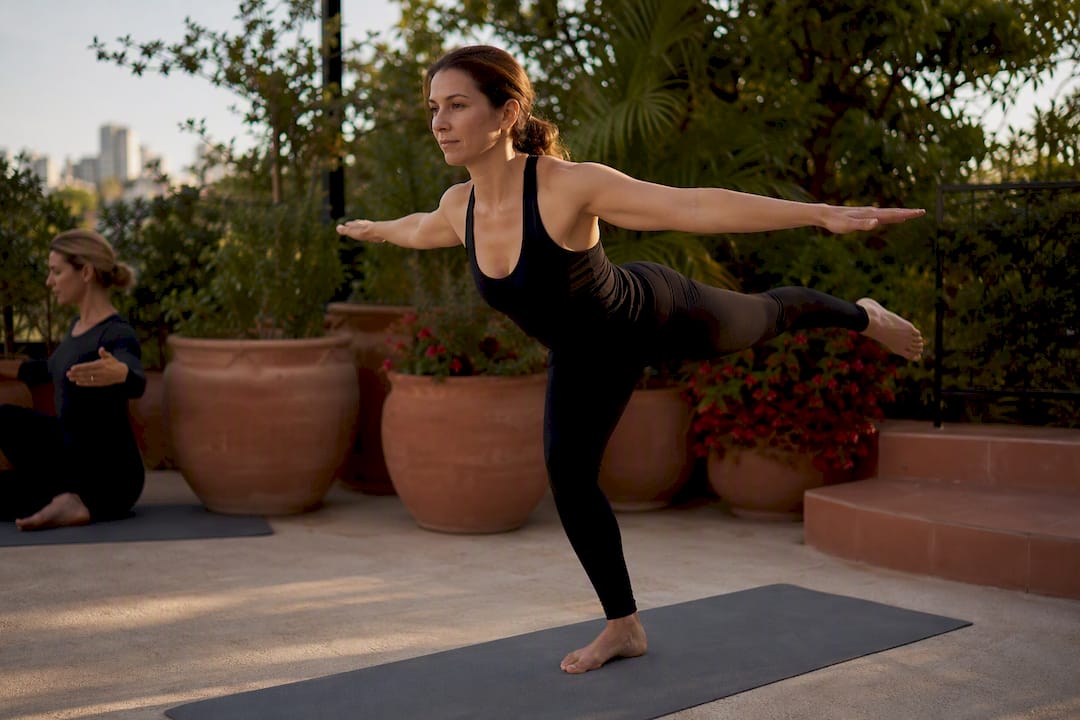
Exercises like standing footwork on the reformer, side-lying leg series, and bird-dog variations on the mat all train balance and hip stability without loading the spine in a risky position.
Pro Tip: Ask your instructor to add single-leg balance holds at the end of a session, even just 20 to 30 seconds per side. It's a tiny addition that directly targets the fall-prevention mechanism the evidence actually supports.
Pilates exercises for osteoporosis: what to avoid and what to do instead
Not every Pilates movement is appropriate once bone density drops. The Royal Osteoporosis Society specifically flags uncontrolled forward flexion, spinal rotation combined with flexion, and repeated end-range extension as movements that increase fracture risk in someone with fragile vertebrae. The mechanics are straightforward: flexing a spine with reduced bone density compresses the front of the vertebral body, and rotating while flexed adds a shearing force on top of that compression. Neither is dangerous for a young, dense spine. Both carry real risk for someone with osteoporosis.
Movements to approach with caution or avoid entirely:
- The Roll-Up and Roll-Down (full spinal flexion). Rolling the spine into a deep C-curve loads the anterior vertebrae exactly where compression fractures occur.
- Spine Twist and Saw (rotation combined with forward flexion). Combining twist with flexion multiplies shear force through the vertebral bodies.
- Double Leg Stretch and Teaser (deep flexion under load). These add resistance on top of a flexed spine, compounding the risk.
- Uncontrolled or repeated deep extension. Movements like extreme backbends, done repetitively without control, can also stress the spine, particularly for anyone with existing vertebral fractures.
The modification swaps that keep the benefit and remove the risk:
- Replace the Roll-Up with a standing roll-down to neutral, stopping well before end-range flexion and rolling back up through a supported spine.
- Swap Spine Twist for seated rotation with a tall, neutral spine, keeping the movement in the transverse plane only, never combined with flexion.
- Use supported bridging (pelvic lift with feet flat, spine in neutral) instead of exercises that push into full spinal extension.
- Perform reformer footwork with a strict neutral spine, avoiding the temptation to flatten the lower back into the carriage.
- For any forward-reaching movement, coach a hip hinge rather than spinal flexion, keeping the load through the hips and hamstrings instead of the lumbar spine.
Progression should always add load through the limbs or increase time under tension, never through greater spinal range of motion. If a client reports new or sharp back pain, tingling, or a sudden change in posture during a session, that's a stop-and-refer signal, not a "push through it" moment. Anyone with a recent vertebral fracture needs clinician sign-off before returning to any Pilates programme, reformer or mat.
Pro Tip: If you're unsure whether a cue is safe, ask the instructor to demonstrate the neutral-spine version first. A good bone-aware instructor will show you the modification before you ask for it.
Building a bone-safe Pilates routine: frequency, load and timeline
Consistency matters more than intensity here. Most bone-focused exercise guidance points to two to three sessions per week, each running 45 to 60 minutes, as the range that builds strength and balance without overloading recovery capacity. What it won't do is change a DXA scan result quickly. Bone remodels on a four-to-six month physiological cycle, and detecting a measurable shift in density typically requires a sustained programme of 6 to 12 months or longer. Anyone expecting a visible change after six weeks is chasing a timeline biology doesn't support.
Progressive overload is still the lever that makes a programme effective, even inside a low-impact format. It just needs to be applied without compromising spinal position.
- Increase reformer spring resistance gradually as footwork and leg work strengthen, rather than adding range of motion through the spine.
- Add light resistance bands to standing series to load the hips and shoulders directly.
- Introduce standing weighted squats or sit-to-stand transitions, which double as functional strength and fall-prevention training.
- Layer in gait and balance drills, such as tandem walking or single-leg reaches, once foundational stability is solid.
The reformer-versus-mat question comes down to control. A reformer allows an instructor to adjust spring tension in small, precise increments, which makes it easier to progress load without the participant needing to change their range of motion. Healthline's clinical overview notes this is exactly why reformer-based programmes are often recommended for people managing low bone density: the spring resistance provides controlled loading while a supervising instructor keeps the spine in a safe position throughout. Mat Pilates remains accessible and effective for building core strength, but it typically needs added resistance bands or a stronger emphasis on standing work to deliver a comparable strength stimulus.
Getting started safely with Pilates and low bone density
Before booking a class, get a clear picture of your own bone health and bring it with you. A few things to organise first will make the transition far smoother.
- Get medical clearance and bring your history. A recent DXA report, any fracture history, and a list of current medications (particularly bisphosphonates or endocrine therapy) give your doctor and instructor the full picture before you start.
- Expect a baseline functional assessment. A good instructor or physiotherapist may use simple tests such as a sit-to-stand assessment, a functional reach test, a hip-hinge check, or single-leg balance timing to establish where you're starting from.
- Screen the instructor, not just the studio. Ask directly whether they have experience working with clients who have osteoporosis, whether they routinely apply spinal-flexion modifications, and whether they're comfortable liaising with your GP or physiotherapist if something changes.
- Confirm class size and supervision level. Small-group settings allow an instructor to actually watch your form throughout a session, which matters far more for bone safety than it does in a general fitness class.
Getting these basics right before your first session does more for your safety than any single exercise choice you'll make once you're on the reformer.
How Elevateandrestore approaches bone-aware Pilates
Elevateandrestore runs small-group reformer Pilates classes capped at six people, a deliberate limit that lets instructors watch spinal position and correct form in real time rather than calling generic cues across a packed room. That level of attention is exactly what the evidence points to: bone-safe Pilates depends on someone catching an uncontrolled flexion or rotation before it becomes a habit.
The studio pairs this with functional training and HIIT sessions for the strength and balance work that sits alongside Pilates in a well-rounded bone health plan, plus a recovery hub with infrared sauna, cold plunge, hot tub, and compression boots. Recovery tools matter more than most people realise for older adults building a consistent routine, because the sessions that get missed due to soreness or fatigue are the sessions that don't contribute to the 6 to 12 month timeline bone remodelling actually needs.
- Small-group reformer classes (max 6) for close supervision and spine-safe modifications
- Functional training and HIIT for strength and balance beyond the studio floor
- Recovery hub access to support adherence over the months a bone-focused programme requires
Where to check the evidence yourself
The claims in this guide draw on a specific set of clinical and public health sources, listed here for anyone who wants to read further or bring the detail to a doctor's appointment.
- Effectiveness of Pilates and Yoga to improve bone density in adult women: A systematic review and meta-analysis, the primary evidence source on Pilates and bone mineral density outcomes
- Pilates and osteoporosis, Royal Osteoporosis Society, for contraindicated movements and safe modification principles
- Osteoporosis, Better Health Channel, for Australian clinical guidance on fracture-risk reduction
- Modifying Pilates for Clients With Osteoporosis, IDEA Health & Fitness Association, for the staged clearance-to-progression framework used throughout this guide
Our take on Pilates and bone health
The honest answer to "does Pilates increase bone density" is that it's the wrong question for most people asking it. The Royal Osteoporosis Society's own framing is closer to right: the real question is whether Pilates can safely form part of a multi-component programme that reduces fracture risk. On that measure, it earns its place.
Where conventional advice falls short is treating Pilates as either a bone-density miracle or a waste of time for osteoporosis. Both framings miss the point. Pilates won't replace loaded resistance training if bone-building is the sole goal, but dismissing it ignores that falls, not low density alone, cause most fractures.
Prioritise this: get clearance, find an instructor who treats spinal flexion and rotation with genuine caution, and judge progress by strength and balance, not by waiting on a scan result that might not move for a year.
— Elevate
Ready to build a bone-safe Pilates routine?
Reading about neutral-spine cues and spring progression is one thing. Having an instructor watch your hip hinge in real time, in a room of six people instead of twenty, is what actually keeps a bone-focused programme safe over the months it takes to work. That's the gap Elevateandrestore is built to close: small-group reformer Pilates where modifications aren't an afterthought, backed by functional training and a recovery hub for the days your body needs the sauna or compression boots more than another set of footwork.
If you're managing low bone density, book a small-group reformer Pilates class and mention your history when you arrive so instructors can tailor cues from your first session. Want to combine training with proper recovery between sessions? Check out the recovery lounge and add it to your weekly routine.
This article is general information, not a substitute for advice from a qualified doctor. Consult a qualified healthcare professional about your own circumstances before acting on anything here.
Sources
- Effectiveness of Pilates and Yoga to improve bone density in adult women: A systematic review and meta-analysis
- Pilates and osteoporosis | Royal Osteoporosis Society
- Osteoporosis — Better Health Channel (Victoria)