
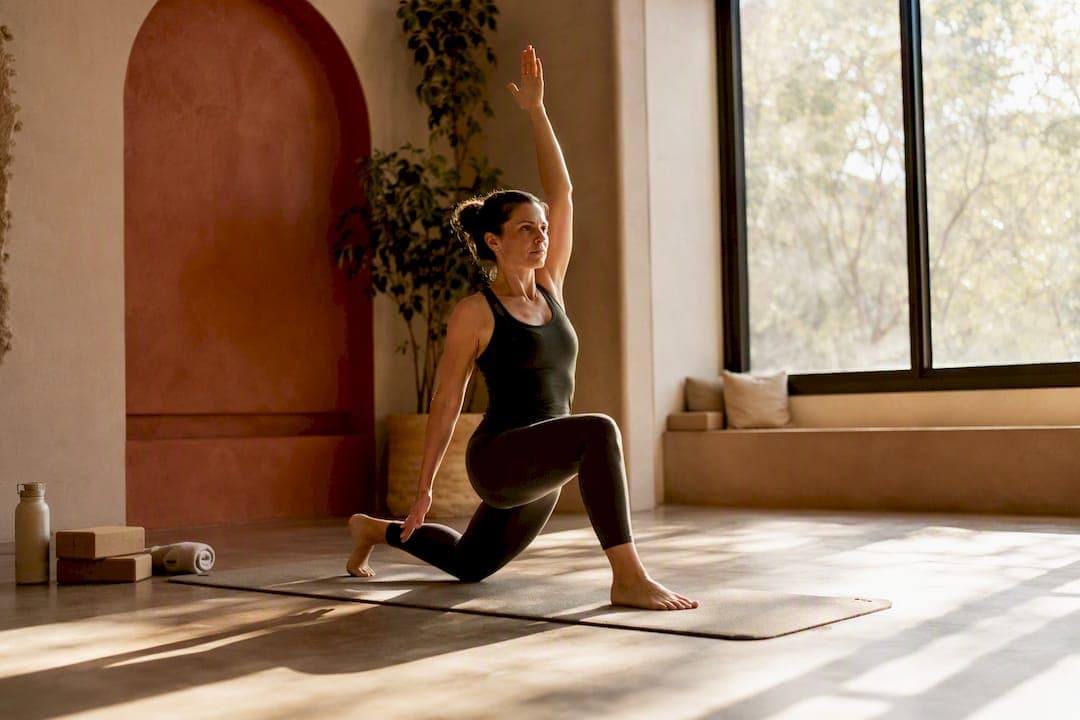
Yes, you can get genuine HIIT results without a single jump. Low-impact HIIT, often called HILIT, uses controlled tempo, fast transitions and time under tension to push your heart rate into the same zones as jump-based training. A simple starting template: 20 minutes total, 30 seconds of work followed by 30 seconds of rest, done two to three times a week. Elevate & Restore builds its small-group classes around exactly this model.
TL;DR:
- Low-impact HIIT uses faster limb movements and transitions instead of jumps to reach high heart rate zones, matching traditional HIIT intensity levels.
- Consistent rotation between low-impact and higher-impact exercises can extend joint health and reduce overuse injuries without sacrificing cardiovascular benefits.
- Short sessions of 10 to 20 minutes, with adjustable intervals and modifications, make effective low-impact HIIT suitable for busy schedules and joint sensitivity.
- Proper warm-up, gradual load progression, and professional coaching are crucial for reducing injury risk and optimizing results in joint-conscious training.
- Coaching feedback focusing on technique and transition speed drives more intensity than impact, making precise movement control the key to effective HILIT.
Table of Contents
- What low-impact HIIT (HILIT) actually is and how it produces intensity
- Why low-impact HIIT protects your joints without sacrificing results
- 12 low-impact HIIT moves to build your own routine
- Two ready-to-use low-impact HIIT routines
- Adapting HILIT for knee, hip or back sensitivity
- Weekly programming and recovery for sustainable progress
- How Elevate & Restore coaches HILIT in small groups
- The technique-first take on low-impact HIIT
- Train HILIT properly with small-group coaching and recovery support
- Sources
What low-impact HIIT (HILIT) actually is and how it produces intensity
HILIT swaps jumping jacks, tuck jumps and burpees for grounded versions of the same movements, but the interval structure stays identical to traditional HIIT. You still work hard, rest briefly, and repeat. What changes is how you generate intensity. Instead of relying on impact to spike your heart rate, HILIT uses faster arm drives, deeper squats held longer, and quicker transitions between exercises to create the same metabolic demand.
The mechanism is straightforward: your heart rate climbs when your muscles demand more oxygen quickly, and that happens whether the demand comes from landing a jump or from moving your limbs fast under load. Research on low-impact interval formats shows they can reach high heart rate zones through structured effort rather than impact, according to reporting from The New York Times.
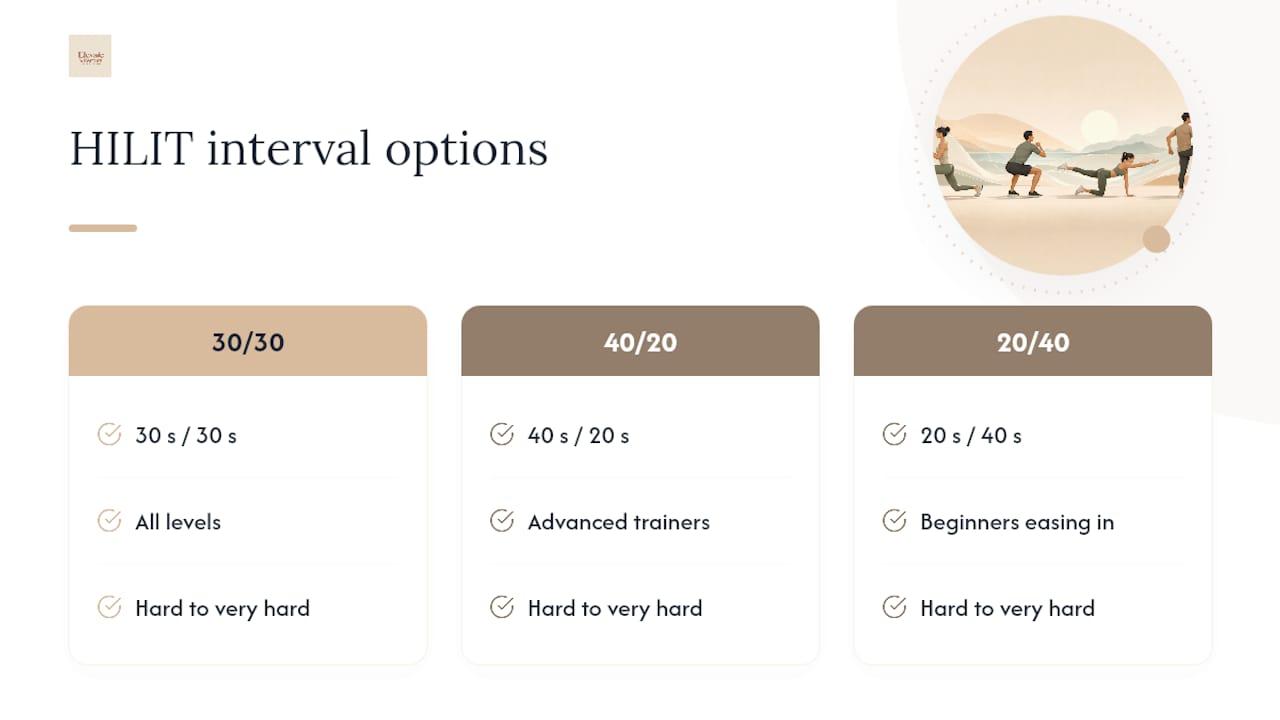
Common timing options include 30 seconds work with 30 seconds rest, 40/20 splits for more advanced trainers, or 20/40 for beginners easing into interval work. Whichever ratio you choose, perceived exertion should sit at "hard to very hard" by the final ten seconds of each work interval. If you're chatting comfortably through the whole set, you're not working hard enough.
Why low-impact HIIT protects your joints without sacrificing results
Low-impact does not mean low effort, and it definitely doesn't mean lower results. The real advantage shows up over months and years, not in a single session.
Rotating HILIT with higher-impact training reduces the cumulative pounding your knees, hips and lower back absorb week after week. Trainers and physiotherapists increasingly recommend this rotation specifically to extend training longevity, a point backed by Verywell Fit's reporting on sustainable interval programming. Fewer high-impact landings also means less inflammation to recover from, which keeps you consistent instead of sidelined.
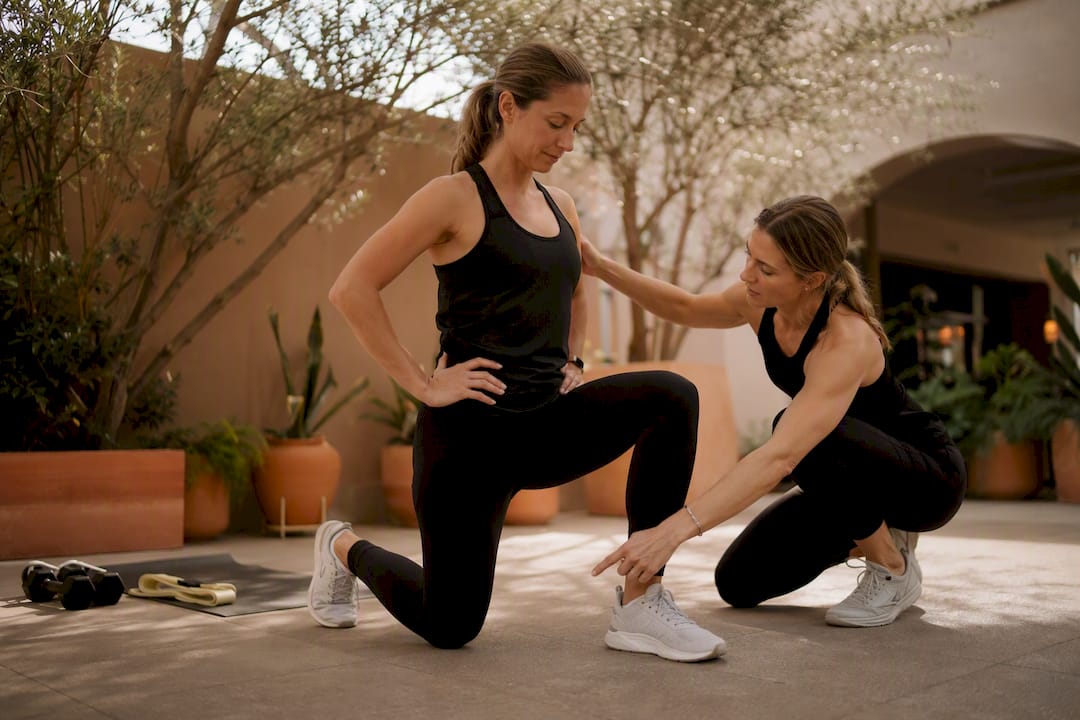
The cardiovascular and metabolic payoff doesn't disappoint either. Because HILIT still relies on the work-to-rest interval structure that makes HIIT effective in the first place, you get comparable calorie burn and post-exercise oxygen consumption without needing 45 minutes on a treadmill.
Key benefits worth noting:
- Joint-friendly loading reduces the risk of overuse injuries in knees, ankles and lower back.
- Sessions typically run 10 to 20 minutes, making them realistic to fit around work and family.
- You can train more frequently because recovery demands are lower than repeated high-impact sessions.
- Intensity is still driven by heart rate and time under tension, not by how hard you land.
Warming up properly and progressing load gradually protects joint lubrication and reduces injury risk, according to guidance from the American Academy of Orthopaedic Surgeons. That single habit, often skipped when people are short on time, matters more in HILIT than most people assume. If you're building strength alongside your cardio work, functional training after 30 pairs naturally with this kind of joint-conscious programming.
12 low-impact HIIT moves to build your own routine
These exercises form the backbone of a joint-friendly circuit. Mix and match based on which muscle groups you want to emphasise, and scale intensity using tempo and arm speed rather than impact.
Conditioning and cardio emphasis
1. March or high knees (no jump) Drive your knees up at speed while keeping one foot grounded at all times. Keep your chest tall and pump your arms hard. To scale up, increase knee height and arm speed rather than adding a hop.

2. Standing punch sequences Throw alternating jabs and crosses from a staggered stance, engaging your core with each punch. Keep your shoulders relaxed and rotate through your hips for power. Speed up the combination or add light hand weights to raise the challenge.
3. Lateral shuffles Step side to side in a low athletic stance, staying light on your feet without leaving the ground. Keep knees soft and tracked over toes. Widen your steps or lower your stance to increase difficulty.
4. Banded steps Loop a resistance band above your knees and step side to side or walk forward and backward. Keep tension on the band throughout and avoid letting your knees cave inward. Use a heavier band or add more steps per set to progress.
Lower-body emphasis
5. Squat to overhead press Squat down, then drive up while pressing light dumbbells overhead. Keep your core braced and avoid hyperextending your lower back at the top. Add load or slow the tempo on the way down to increase difficulty.
6. Step-back lunge Step one foot back into a controlled lunge, then return to standing without pushing off explosively. Keep your front knee tracking over your ankle. Add a pulse at the bottom or hold light weights to scale up.
7. Squat to calf raise Perform a standard squat, then rise onto your toes as you stand. This replaces the explosive squat jump while still challenging your quads and calves through a longer range of motion.
8. Glute bridges Lie on your back, feet flat, and drive your hips upward while squeezing your glutes at the top. Keep your ribs down to avoid arching your lower back. Add a resistance band above the knees or single-leg variations for progression.
Upper-body and core emphasis
9. Plank taps From a forearm or high plank, tap alternating shoulders while keeping your hips as still as possible. Keep your feet slightly wider than hip-width for stability. Slow the tempo down for a harder core challenge, since slower control demands more from your midline.
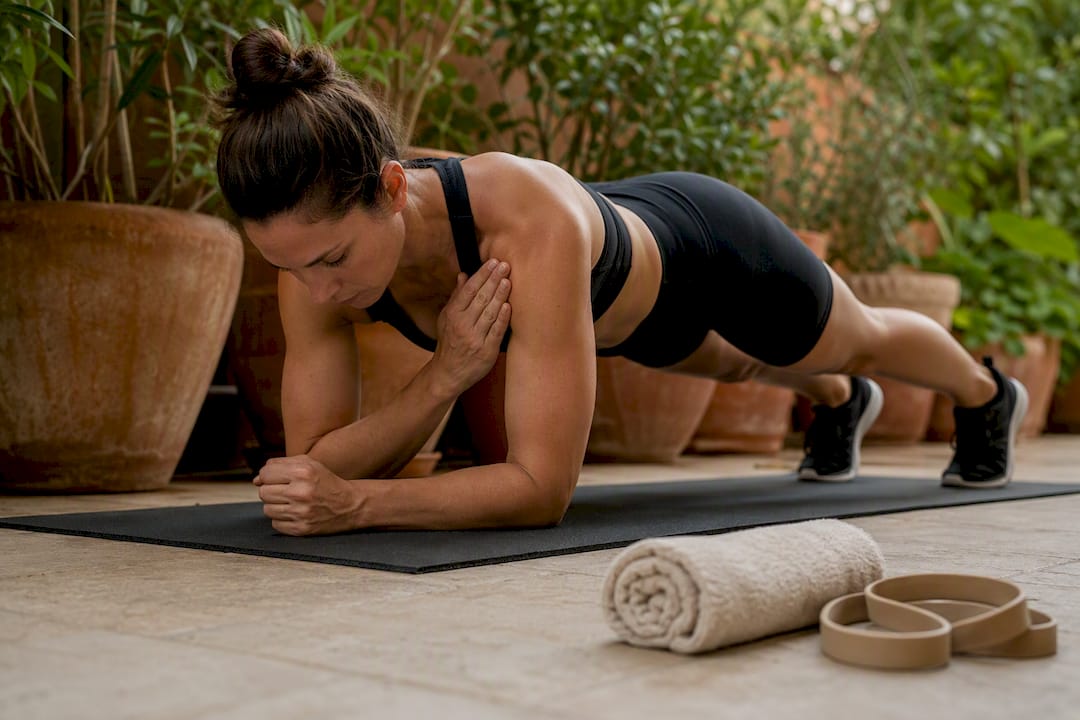
10. Mountain climbers (controlled tempo) Drive knees toward your chest one at a time from a plank position, without bouncing. Keep your hips level and avoid letting your lower back sag. Speed up the tempo to raise heart rate without adding impact.
11. Low-impact burpee alternative Step back into a plank instead of jumping, perform a push-up if you're able, then step forward and stand tall without a hop at the top. This keeps the full-body demand of a burpee while removing both jumps.
12. Renegade rows From a plank position with hands on light dumbbells, row one arm up while stabilising through your core. Keep hips square to the floor throughout. Increase weight or slow the row for added intensity.
Pro Tip: If an exercise feels easy after two rounds, don't add impact. Add tempo, add a light dumbbell, or shorten your rest period instead. That's how you scale HILIT correctly.
Two ready-to-use low-impact HIIT routines
Both routines below use exercises from the list above. Warm up for a few minutes with light marching, arm circles and hip openers before either session, and finish with two to three minutes of static stretching for your hips, hamstrings and shoulders.
The 10-12 minute express routine
- Warm-up: 2 minutes of marching and dynamic stretching.
- Round of six exercises, 30 seconds work, 30 seconds rest: high knees, squat to overhead press, plank taps, glute bridges, step-back lunges, standing punches.
- Repeat the round once more if you have the extra four minutes.
- Cooldown: 2 minutes of stretching through hips and shoulders.
This single-circuit, no-repeat format is popular precisely because it respects busy schedules while still delivering genuine intensity, a structure echoed in short-format routines from Nourish Move Love.
The 20-minute full session
- Warm-up: 4 to 6 minutes of marching, arm swings and bodyweight squats.
- Interval block: six exercises at 30 seconds work, 30 seconds rest, completed for two full rounds (roughly 12 minutes) — mix conditioning moves like lateral shuffles with strength moves like renegade rows.
- Cooldown and mobility: 3 to 4 minutes of static stretching, focusing on hip flexors and shoulders.
This warm-up, interval, cooldown structure mirrors the format widely recommended for 20-minute low-impact sessions, including templates published by SELF. Beginners should lean toward 20/40 work-to-rest ratios and lighter loads; more advanced trainers can push to 40/20 and add dumbbells to most moves.
Adapting HILIT for knee, hip or back sensitivity
Low-impact doesn't automatically mean joint-safe for everyone. If you have an existing knee, hip or lower back condition, a few screening questions matter before you start: does the joint swell after activity, does pain persist beyond 48 hours, or does a specific movement cause sharp rather than dull discomfort? Any of those warrant a chat with a physiotherapist or GP before you push intensity.
Specific substitutions help most people train around sensitivity rather than stopping altogether:
- Swap step-back lunges for stationary split squats if knee tracking is an issue.
- Replace squat to calf raise with a seated leg extension if hip flexion is limited.
- Use seated punch combinations instead of standing sequences if balance or lower back stability is a concern.
- Reduce range of motion on any squat or lunge pattern rather than skipping the movement entirely.
Pro Tip: In small-group settings, coaches often present the modified version of a move as the default, with the harder option offered as an add-on. This "option-first" cueing, a method noted in coverage from Nourish Move Love*, removes the stigma from scaling back and keeps everyone training at genuine intensity for their body.*
Weekly programming and recovery for sustainable progress
Two HILIT sessions paired with one strength session most weeks is a sensible starting split for most health-conscious adults, adjusted upward or downward depending on your goals and how your joints respond. If longevity and joint health are the priority, cap HILIT at two to three sessions and fill the rest of your week with strength and mobility work.
Recovery is where consistency is won or lost:
- Active recovery days, even ten minutes of walking or gentle mobility work, keep blood flowing without adding fatigue.
- Sleep quality affects how well your nervous system bounces back between sessions, arguably more than any single recovery tool.
- Modalities such as compression therapy, cold plunge and infrared sauna are used in studio settings to manage soreness and improve readiness for the next session.
Progress your training by increasing work intervals, shortening rest, adding rounds, or introducing light resistance, in that order. If you notice sleep disruption, elevated resting heart rate or persistent fatigue, that's your nervous system signalling overreach. For a deeper look at recovery science, active recovery's role in performance is worth reading before you ramp up frequency.
How Elevate & Restore coaches HILIT in small groups
Classes capped at six people let coaches apply option-first cueing in real time, adjusting each person's range of motion or load without breaking the group's rhythm. A typical class mirrors the 20-minute template above: warm-up, two rounds of six-exercise intervals, cooldown. Afterward, the recovery hub, including sauna, cold plunge and compression boots, helps members bounce back faster between sessions.
The technique-first take on low-impact HIIT
Most advice on this topic treats "low impact" as a consolation prize, something you settle for once your knees start complaining. That framing gets it backwards. Technique determines intensity far more than impact does, and most people training at moderate effort levels are leaving results on the table regardless of whether they jump.
The overrated variable is impact itself. Jumping feels intense because it's loud and jarring, not because it necessarily produces a higher heart rate than a fast, well-executed squat-to-press with tight transitions. What's underrated is transition speed between exercises. The gap between one movement ending and the next beginning is where most home workouts quietly lose their intensity, and it's the first thing worth fixing before adding load or jumping at all.
If you're picking one thing to prioritise, make it coaching feedback on tempo and form rather than chasing harder-looking exercises. In a small-group setting, that feedback loop happens in real time, which is precisely why option-first cueing works better than a video you follow alone. Learn to drive intensity through control first. Everything else, including whether you ever need to jump again, becomes optional.
— Elevate
Train HILIT properly with small-group coaching and recovery support
Following a routine from an article gets you started, but a coach watching your tempo, your transitions and your form gets you results without the guesswork of solo training. Elevate & Restore runs small-group functional training and HIIT classes capped at six people, so instructors can adjust load, range of motion or pace for anyone managing a knee, hip or back issue while everyone else keeps working hard.
Classes pair naturally with the studio's reformer Pilates sessions for anyone building strength and stability alongside their cardio work, and the recovery hub, including infrared sauna, cold plunge, hot tub and compression boots, supports the frequent training this article recommends. If you're new to interval training or returning after a joint issue, book a reformer Pilates class to build a stable base first, or head straight to the recovery lounge to see how compression and cold exposure fit into your weekly plan. Get in touch to find a class time that suits your schedule.
Sources
- A 20-Minute Intense Workout That’s Easy on Your Joints - The New York Times
- Low-Impact HIIT Workout (Verywell Fit)
- Exercise and bone health (American Academy of Orthopaedic Surgeons)
- 20-Minute low-impact HIIT workout (SELF)
- 10-minute low impact HIIT workout (Nourish Move Love)