

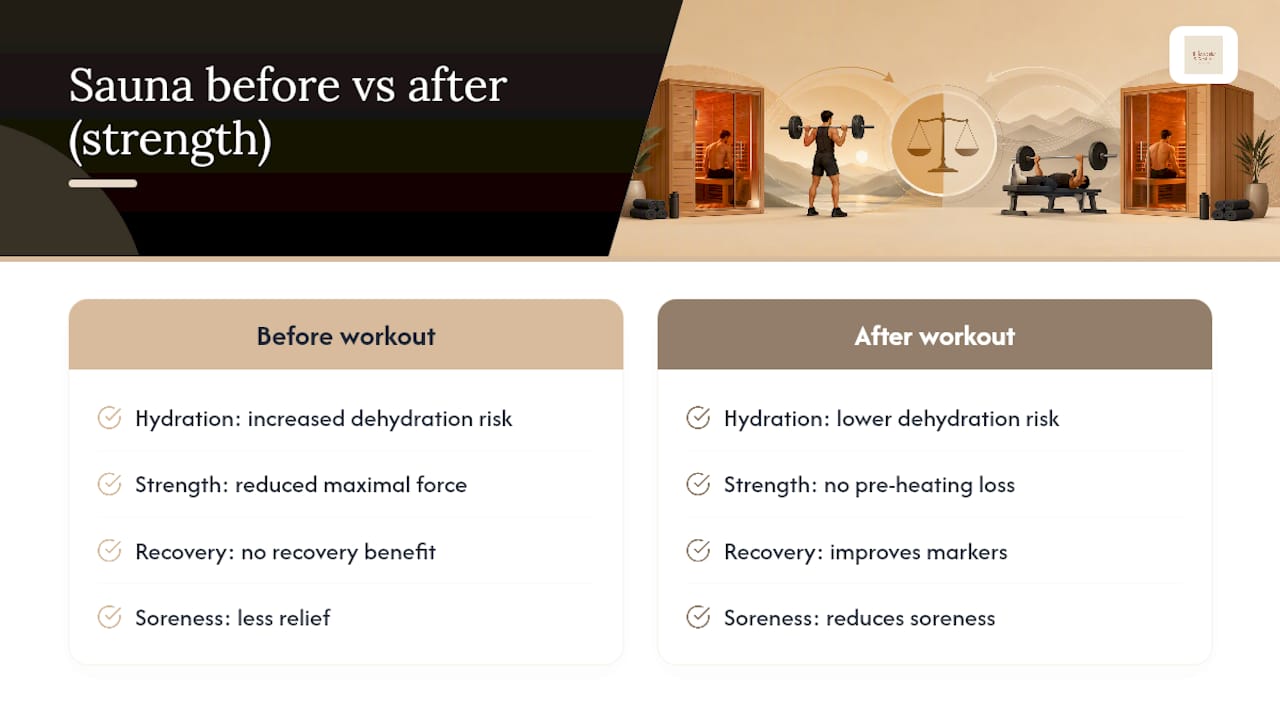
For most people training for strength, power or general fitness, the infrared sauna belongs after the workout, not before. Heating muscles that are already fatigued speeds up circulation to tissue that needs it, without touching your ability to lift heavy or sprint hard. Wait 10 to 15 minutes after you finish training, let your heart rate settle, then aim for 15 to 20 minutes in the sauna.
There are exceptions worth knowing:
- Mobility, yoga or light technical sessions can benefit from a short pre-heat.
- Early-morning stiff joints sometimes respond well to 5 to 10 minutes of gentle warmth first.
- Anyone chasing a personal best in a strength or power lift should skip pre-workout heat entirely.
Key Takeaways
Post-workout infrared sauna use, taken 10 to 15 minutes after training for 15 to 20 minutes, improves recovery markers without compromising strength or power output.
| Point | Details |
|---|---|
| Default to after training | Most goals, including strength, power and endurance, are best served by sauna after the workout, not before. |
| Wait before entering | Give your heart rate 10 to 15 minutes to settle after intense exercise before stepping into the sauna. |
| Match session length to goal | Use 15 to 20 minutes for soreness relief, or three 15-minute sessions weekly for cardiovascular gains. |
| Watch hydration closely | Combined training and sauna use increases fluid loss, so add electrolytes on heavy sweat days. |
| Try it at Elevateandrestore | The recovery hub pairs infrared sauna, cold plunge and compression therapy with small-group training for a guided routine. |
Table of Contents
- Sauna before exercise: when it helps and when it backfires
- Sauna after workout: the recovery case, backed by trials
- How to decide: before, after, or skip it altogether
- Safety, contraindications and cooldown basics
- What the evidence actually shows, and where it's thin
- Our studio protocol for infrared sauna after training
- Frequently asked questions
- Sources
Sauna before exercise: when it helps and when it backfires
A short stint in an infrared sauna before training does raise skin blood flow, loosens connective tissue and can settle pre-session nerves. That combination genuinely helps if your workout is about range of motion rather than raw output. Think mobility flows, yoga, easy aerobic work, or a sport-specific warm-up where relaxed joints matter more than peak force.
It's a different story for heavy strength or power work. Pre-heating raises core temperature and dehydrates you slightly before you've even started, both of which chip away at maximal force output. Some coaches and physiologists recommend pre-workout heat only for sessions built around flexibility or motor-skill rehearsal, rather than maximal lifts.
If you do use it beforehand:
- Keep it short: 5 to 10 minutes, no more.
- Stay at a comfortable, low-moderate perceived heat, not a full sweat-drenching session.
- Finish at least 10 minutes before your first working set so your body isn't still adjusting.
Risks stack up quickly if you push this further. Dehydration before a hard session lowers blood volume and makes cramping more likely. Dizziness on standing, a common early sign of heat strain, is also more likely to hit mid-workout if you've already spent 20 minutes sweating beforehand.
Pro Tip: If your main session that day is heavy squats, deadlifts or sprint intervals, skip the sauna until after. A hot lower body and a maximal lift are a poor combination.

Sauna after workout: the recovery case, backed by trials
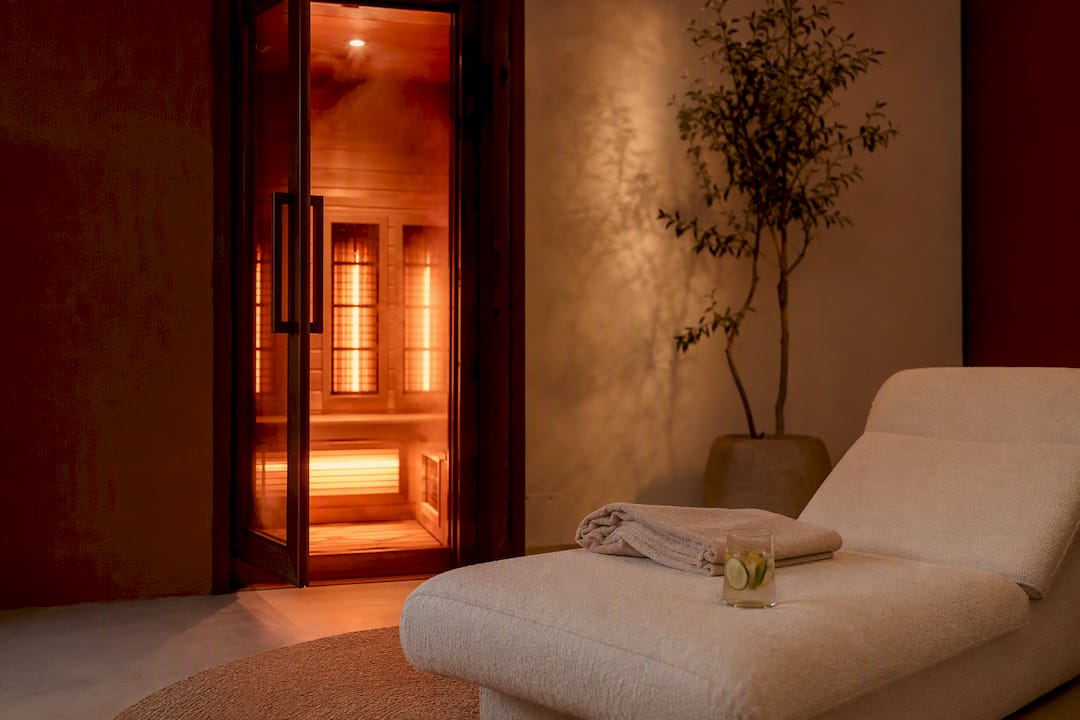
This is where infrared heat earns its keep. Post-exercise, your muscles are already warm and your circulation is elevated, so the sauna's heat reaches useful tissue faster than it would from a cold start. A randomised crossover trial found a single 20-minute infrared sauna session at roughly 43°C measured air temperature, taken straight after resistance training, blunted the usual next-day drop in jump performance and left participants reporting less muscle soreness than passive recovery alone.
Repeated use compounds the effect. An 8-week randomised trial had participants add 15-minute post-exercise sauna sessions three times a week to their normal training. Estimated cardiorespiratory fitness improved more than exercise alone, and systolic blood pressure dropped further too. A separate 6-week trial in female team-sport athletes using 10-minute post-training sessions three times weekly found small gains in jump power and sprint acceleration, though no extra muscle growth compared with the control group.
Statistic callout: Three times weekly, 15-minute post-workout sauna sessions added 2.7 mL/kg/min to estimated VO2max over eight weeks, on top of what exercise alone delivered.
Three practical protocols, depending on your goal:
- Fast soreness relief: 15 to 20 minutes at a comfortably hot setting straight after lifting, two to three times a week.
- Cardiovascular adaptation: 15 minutes, three sessions weekly, stacked consistently onto your normal training rather than used sporadically.
- Rest-day wellness: a slower, 20 to 30 minute session with no exercise attached, purely for circulation and mental reset.
None of these require record heat. The trials that produced these results used moderate, sustainable temperatures, not extreme ones.
How to decide: before, after, or skip it altogether
Your goal should decide your timing, not habit. Here's the quick logic:
- Strength or power work: after, always. Pre-heat undermines your best lifts.
- Endurance training: after, ideally as a regular three-times-weekly habit rather than a once-off.
- Mobility or yoga: before is fine, kept short and gentle.
- Pure relaxation, no training that day: anytime, longer session, no rush.
Practitioner guidance commonly recommends waiting at least 10 to 15 minutes after finishing vigorous exercise before stepping into the sauna, giving your heart rate and core temperature a chance to start normalising. Walking in immediately, still breathing hard from your last set, just stacks two stressors on your cardiovascular system at once.
A few common scenarios:
- Early-morning workout, stiff joints: a brief 5 minute warm-up pre-session is reasonable if it's mobility-focused.
- Double training day: sauna after the first session only if you have adequate time to rehydrate before the second.
- Training camp or heavy block: favour post-workout sauna on lighter days; skip it after your hardest sessions until you've recovered.
Safety, contraindications and cooldown basics
Infrared heat is safe for most healthy adults, but it's not risk-free, especially combined with exercise. Skip it, or check with a doctor first, if you have:
- Unstable cardiovascular conditions or a history of fainting.
- Early pregnancy.
- Certain blood pressure or heart medications.
- A recent concussion.
- Uncontrolled hypotension.
Hydration matters more here than in a standalone workout or standalone sauna session. Combining both in one day increases fluid loss, and CDC guidance on heat-related illness stresses hydration and monitoring as core precautions whenever you're adding significant heat exposure to your day. Water alone isn't always enough. Add electrolytes if you've trained hard and sweated heavily before your session.
Stop immediately and step out if you notice lightheadedness, nausea, confusion or a racing heartbeat that doesn't settle. These are recognised early signs of heat-related illness worth taking seriously, not pushing through.
Pro Tip: After your session, cool down gradually rather than jumping straight into a freezing shower. A few minutes at room temperature first helps your heart rate settle without the shock of an abrupt swing.
What the evidence actually shows, and where it's thin
The strongest data on infrared sauna and exercise comes from a handful of well-designed trials, not decades of research. Here's the honest picture.
- A single 20-minute session post-resistance training improved next-day jump performance and cut soreness compared with passive recovery, per the crossover trial mentioned earlier.
- Three sessions weekly for eight weeks improved fitness markers and blood pressure beyond exercise alone, per the multi-arm RCT.
- Repeated 10-minute sessions over six weeks in athletes improved some power measures without adding muscle mass, according to the Frontiers trial.
- Broader narrative reviews on heat therapy support a soreness-reduction effect, though study designs vary enough that sweeping claims aren't warranted.
What we can say confidently: post-workout infrared sauna reduces perceived soreness and supports fitness gains when used consistently. What needs more research: whether these benefits differ by age, sex or training background, since most trials use small, fairly homogeneous samples of trained or semi-trained adults, not the general population.
Our studio protocol for infrared sauna after training
Here's the routine we run at Elevateandrestore for clients moving from a Pilates or functional training session into the recovery hub:
- Finish your workout and rehydrate with water for 10 to 15 minutes before entering the sauna.
- Aim for 15 to 20 minutes in the infrared sauna, at a comfortably warm setting that raises perceived exertion without dizziness.
- Follow with a gradual cooldown, room temperature first, before any cold plunge or compression boots.
On heavy training days, we suggest three sessions weekly rather than daily use. On rest days, a longer 20 to 30 minute session works well for general wellness.
Pro Tip: Bring a light towel and loose clothing. Trying to "sweat more" by overdressing just adds discomfort without adding benefit.
A studio view on making sauna a habit, not a hero move
We'd rather see clients use the sauna consistently at moderate doses than chase the longest, hottest session possible. Extremes aren't the goal. Sauna complements good sleep, solid nutrition and a properly built training program. It doesn't replace any of them.
A simpler way to get sauna recovery right
Working out when to use heat, for how long, and at what temperature is easy to overthink on your own. Elevateandrestore's recovery hub gives you infrared sauna, cold plunge, hot tub and compression therapy in one boutique space, with staff who can guide your timing based on what you trained that day rather than a generic online protocol.

Small-group reformer Pilates and functional training sessions cap at six people, so your recovery plan gets the same attention as your workout. If you're ready to pair your training with a proper post-workout sauna routine, book a recovery session and try the protocol in this article for yourself.
Frequently asked questions
Is it better to use an infrared sauna before or after a workout? After, for most training goals. Post-workout sessions improve recovery and soreness without the strength and hydration trade-offs that come with pre-heating.
How long should I wait between exercise and the sauna? Around 10 to 15 minutes, enough time for your heart rate and core temperature to start settling before adding more heat.
Can I use the sauna before a strength workout? It's best avoided before heavy lifting or power work, since pre-heating can reduce maximal force output and increase dehydration risk during the session.
What temperature and duration work best for post-workout sauna use? Trials showing recovery benefits used 15 to 20 minute sessions at roughly 43°C measured air temperature, or comparable moderate heat if your device only shows perceived intensity.
Is infrared sauna safe to combine with cardio and strength training in the same week? Yes, for most healthy adults, provided you rehydrate properly and space sessions so you're not sauna bathing after every single workout without recovery days in between.
This article is general information, not a substitute for advice from a qualified doctor. Consult a qualified healthcare professional about your own circumstances before acting on anything here.
Sources
- A post-exercise infrared sauna session improves recovery of neuromuscular performance and muscle soreness after resistance exercise training - PMC
- Effects of repeated use of post-exercise infrared sauna on neuromuscular performance and muscle hypertrophy