
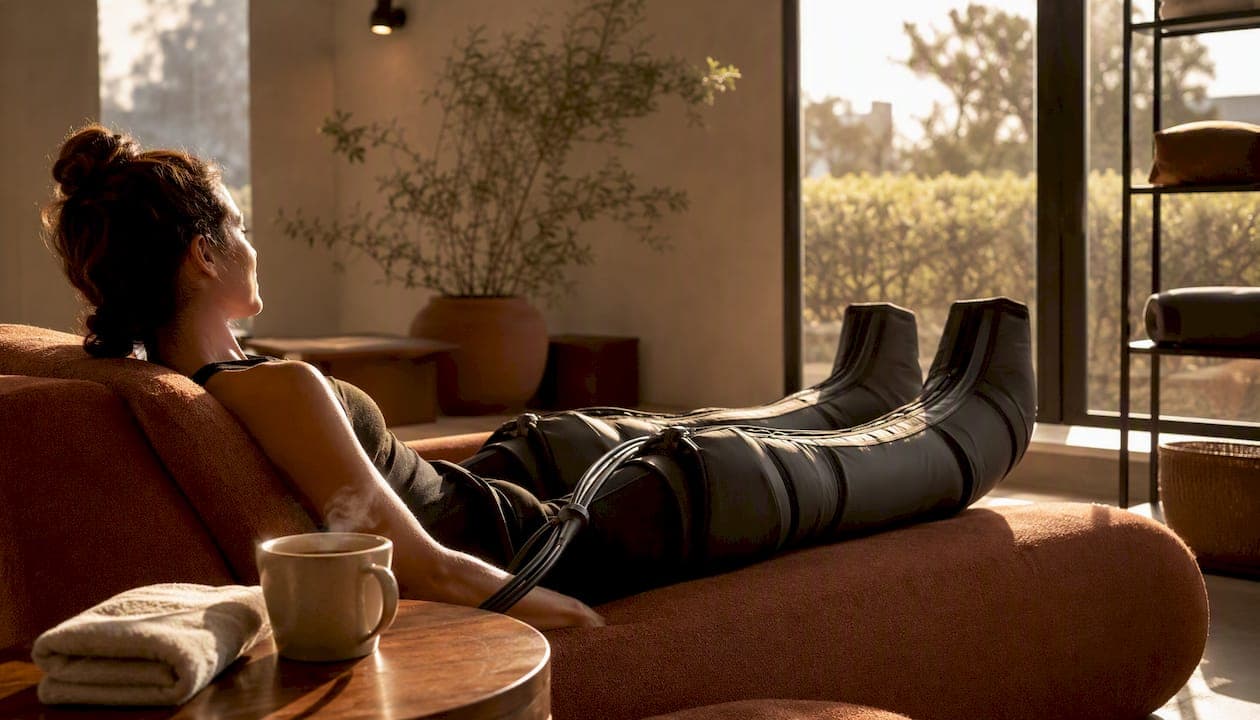
Compression boots reliably improve how you feel after hard training. The evidence is clear on that much. What they do not reliably do is produce measurable jumps in objective performance, so set your expectations accordingly before you book a session or buy a pair. The practical protocol backed by the most research: 20–30 minutes, sequential inflation mode, at roughly 60–90 mmHg (most studies cluster around 80 mmHg). Start your first session at the lower end of that pressure range and work up from there.
Before you use them, run through this quick safety screen:
- Active deep vein thrombosis (DVT): do not use compression boots.
- Known clotting disorder without medical clearance: do not use.
- Untreated peripheral arterial disease or active leg infection: do not use.
- Severe peripheral neuropathy: seek clinician advice first.
- Pregnant, post-surgery, or unsure about your vascular history: check with your GP or physiotherapist before your first session.
For most healthy adults, the next step is simple: try one 20–30 minute post-workout session at moderate pressure. If you want a guided first experience with proper screening, book a trial at a local recovery lounge like Elevate & Restore in Melbourne's inner west.
Pro Tip: Post-workout is the best window. Coaches consistently report that using boots immediately after training helps shift your nervous system toward rest and recovery, which is when the subjective benefit feels strongest.
Key takeaways
Compression boots reliably reduce perceived soreness and support subjective recovery, with the strongest evidence pointing to 20–30 minute sessions at 60–90 mmHg in sequential mode.
| Point | Details |
|---|---|
| Evidence-backed protocol | Use sequential mode for 20–30 minutes at 60–90 mmHg; most studies cluster around 80 mmHg. |
| Realistic expectations | Expect reduced soreness and better perceived recovery, not measurable performance gains. |
| Safety screen first | Do not use with active DVT, untreated PAD, active leg infection, or severe neuropathy. |
| Boots are an adjunct | Sleep and nutrition drive recovery; compression adds to those foundations, not replaces them. |
| Elevate & Restore | Offers guided compression sessions with pre-session screening at their Melbourne inner west recovery lounge. |
Table of Contents
- How do compression boots actually work?
- What does the research actually show?
- Who should check with a clinician first?
- How to run a safe, effective session
- Common mistakes that reduce results
- How to try compression boots in Australia
- Our perspective on compression boots in practice
- Try a compression session at Elevate & Restore
- Sources
How do compression boots actually work?
Compression boots, also called intermittent pneumatic compression (IPC) devices, consist of three parts: a pair of sleeve-style boots that encase your legs from foot to hip (or thigh), a series of internal air chambers within those sleeves, and a control unit that manages inflation pressure and timing.
The key mechanism is sequential inflation. The chambers fill from the foot upward, one zone at a time, in a distal-to-proximal wave. That direction matters. Blood and lymphatic fluid naturally return to the heart against gravity, and the sequential squeeze mimics the pumping action of walking or muscle contraction. Each inflation cycle pushes venous blood and lymph upward, reduces venous stasis (the pooling that causes that heavy-leg feeling after a long run), and encourages fresh, oxygenated blood to flow back into the tissue once the pressure releases.
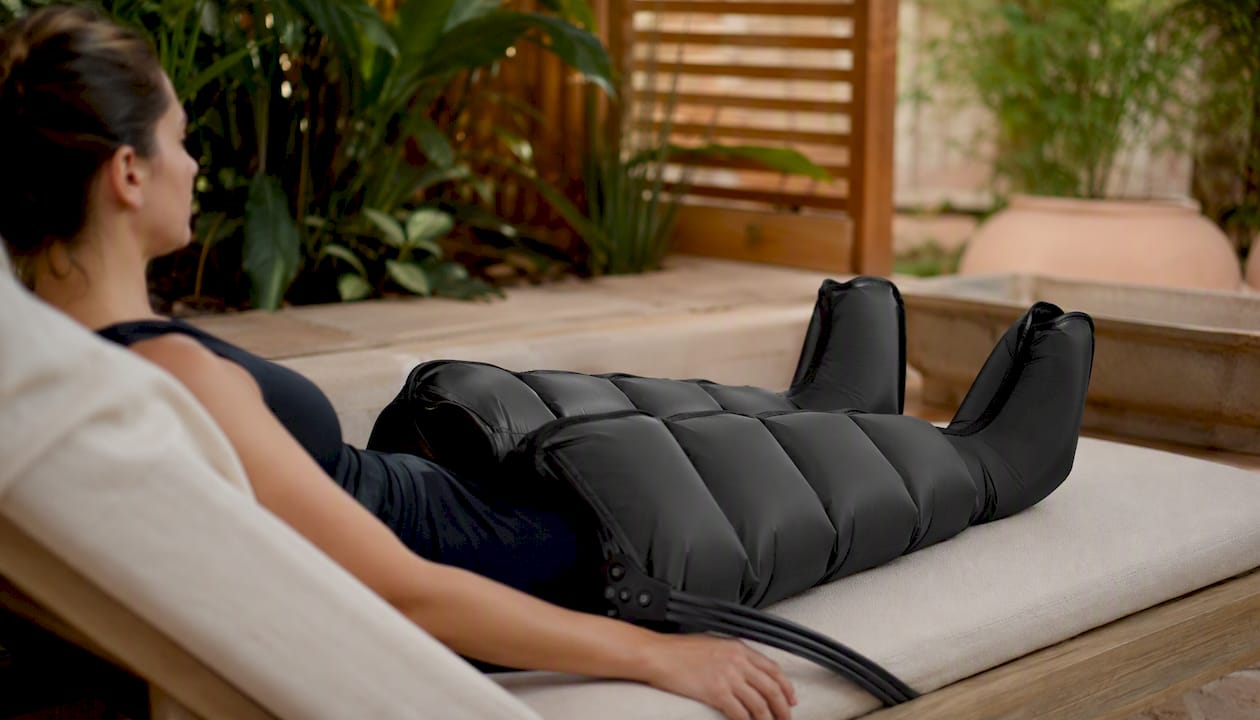
Some devices also offer a peristaltic mode, where chambers inflate and deflate in a rolling wave rather than holding pressure across multiple zones simultaneously. Sequential mode has the most research behind it for sports recovery, so that is the setting to default to.
How IPC differs from static compression:
- Static compression garments (socks, sleeves, tights) apply constant, graduated pressure. They help with venous return during activity but do not actively pump fluid.
- IPC boots cycle on and off, creating a dynamic pumping effect that static garments cannot replicate.
- Active recovery (walking, light cycling) achieves a similar circulatory effect through muscle contraction, but IPC allows you to achieve it passively while seated.
IPC has been used clinically since the 1970s for DVT prevention and lymphoedema management, which is why the underlying physiology is well-established even if the sports-recovery evidence is still maturing.
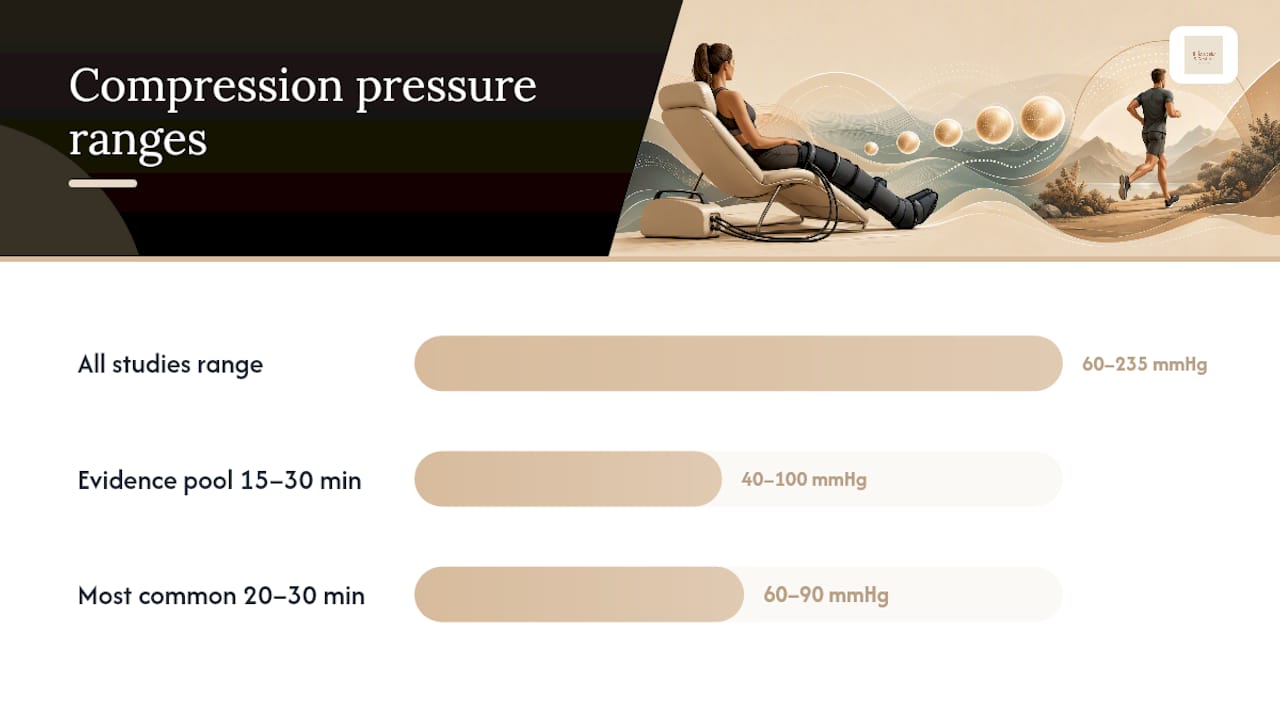
Pressure is measured in millimetres of mercury (mmHg), the same unit used for blood pressure. Most sports recovery devices operate between 40 and 200 mmHg, with the sweet spot for general recovery sitting in the 60–90 mmHg range.
What does the research actually show?
The honest summary: boots are a solid feel-better tool with modest, real effects on soreness and a weak signal on objective performance. A 2024 systematic review and meta-analysis of 17 studies involving 319 participants found trivial-to-small benefits for muscular function and trivial-to-moderate effects on pain and soreness. The most commonly used protocols across those studies were 20–30 minutes at approximately 80 mmHg.
One important caveat: most trials in this space are unblinded. You cannot give someone a fake compression boot without them noticing, so subjective measures like perceived soreness are vulnerable to placebo and ritual effects. That does not make the benefit imaginary, but it does mean you should not interpret "I feel better" as proof of accelerated physiological repair.
Evidence summaries classify DOMS reduction as moderate and subjective recovery improvement as the most consistent finding across athletic adult populations. Objective performance markers, such as peak power or sprint time, show much weaker and less consistent effects.
Protocol heterogeneity is a real problem in the literature. Pressures across studies range from roughly 60 mmHg to 235 mmHg, and durations span 15–60 minutes. That spread makes it hard to draw clean conclusions, but it also tells you something useful: the protocols that appear most often in the evidence, 20–30 minutes at 60–90 mmHg, are the ones to trust.
A small crossover study in trained cyclists found no effect on heart rate from IPC boots used between rides, and mixed results on blood lactate, with some elevations noted in the boot condition. That is a useful reminder that physiological responses vary between individuals and that the boots are not a guaranteed performance lever.
| Study type | Protocol used | Key finding |
|---|---|---|
| Systematic review and meta-analysis (17 studies, 319 participants) | 20–30 min, ~80 mmHg (most common) | Trivial-to-small effect on muscle function; trivial-to-moderate effect on soreness |
| Crossover RCT (cyclists, n=10) | IPC between cycling trials | No HR difference; mixed lactate responses |
| Evidence synthesis (RCT pool) | 15–30 min, 40–100 mmHg | DOMS reduction moderate; subjective recovery most consistent signal |
What this means practically:
- Use boots expecting to feel better, not to perform measurably better the next day.
- The 20–30 minute window at moderate pressure is the evidence-aligned dose.
- Expert commentary from Nike frames boots as a tool that moves metabolic waste and replaces it with oxygenated blood, but treats them as an adjunct to sleep and nutrition, not a replacement for either.
- Coaches at Runner's World note that post-workout timing is where the practical benefit is strongest, helping shift the nervous system toward rest.
Who should check with a clinician first?
Most healthy, active adults can use compression boots without any medical clearance. But there are clear situations where you need to pause and get professional advice before stepping into a pair.
Absolute contraindications (do not use without medical clearance):
- Active deep vein thrombosis (DVT) or suspected DVT
- Known clotting disorder without clinician sign-off
- Untreated peripheral arterial disease (PAD)
- Active infection, open wound, or skin breakdown on the leg
- Severe peripheral neuropathy (you cannot reliably feel pain or pressure)
Relative cautions (seek clearance, do not self-clear):
- Pregnancy
- Recent surgery or fracture involving the lower limb
- Recent vascular surgery
- Severe varicose veins with complications (ulceration, phlebitis)
Cleveland Clinic guidance on compression therapy reinforces that fitting and provider oversight matter, particularly for higher-pressure applications and anyone with vascular risk factors. If you have any history of circulatory problems, a conversation with your GP or physiotherapist before your first session is the right call.
During a session, stop and remove the boots if you notice:
- Numbness or pins and needles that do not resolve when you adjust pressure
- Pain that feels disproportionate to the pressure setting
- Sudden swelling, skin colour change, or a sensation of heat in one area
- Dizziness or faintness
Pro Tip: If you are using boots at a studio or physio clinic for the first time, tell the staff your full medical history before they set the pressure. A trained operator will screen you and adjust the protocol accordingly, which is one of the strongest reasons to try your first session in a supervised setting rather than at home.
How to run a safe, effective session
Before you start
Hydrate well in the hour before your session. Eat a light meal if needed, but avoid a heavy meal immediately beforehand. Check your skin for any cuts, rashes, or broken areas on your legs. Remove jewellery from ankles and calves. Choose the correct boot size: the sleeve should fit snugly without bunching, and your foot should sit fully inside the foot chamber.
Step-by-step session guide
- Sit in a reclined or semi-reclined position with your legs roughly horizontal. This position supports venous return and makes the session more comfortable.
- Pull the boots on from the foot up, aligning the foot chamber correctly. Zip or fasten each section firmly but without forcing.
- Connect the hoses to the control unit and select sequential mode (distal-to-proximal inflation).
- Set pressure to the lowest available setting for your first session. For subsequent sessions, work up toward 60–80 mmHg for general post-workout use.
- Set the timer. Use the protocol that matches your session type (see the table below).
- Sit still. You can read, listen to a podcast, or simply rest. Avoid standing or moving the legs significantly during inflation cycles.
- If any sensation feels sharp, numb, or wrong, reduce pressure immediately. Do not push through discomfort.
- When the session ends, sit for 60 seconds before standing to let your circulation adjust.
Protocol reference
| Use case | Duration | Pressure range |
|---|---|---|
| Post-hard training session | 20–30 min | 60–80 mmHg |
| Long endurance event recovery | 30–60 min (or two 30-min sessions) | 60–80 mmHg |
| Day-to-day decompression or heavy legs | 15–20 min | 40–60 mmHg |
After the session
Drink water. Do two to three minutes of gentle ankle circles or a slow walk before returning to normal activity. Note your perceived recovery score (a simple 1–10 rating works well) so you can track whether the protocol is working for you over time.
Pro Tip: Integrating a boot session into a weekly recovery plan works best when it follows your two hardest training days. Pairing compression with active recovery strategies on lighter days gives your body a more complete recovery stimulus across the week.
Common mistakes that reduce results
Getting the most from compression boots is less about finding the perfect device and more about avoiding a handful of consistent errors.
The most common mistakes:
- Starting at maximum pressure. High pressure on a first session often causes discomfort and makes people abandon the tool entirely. Start low, progress across sessions.
- Sessions that are too short. Fifteen minutes feels like enough but sits below the evidence-supported window. Aim for at least 20 minutes to hit the dose most studies used.
- Poor sleeve fit. A loose boot that bunches around the calf creates uneven pressure and reduces the pumping effect. Fit matters as much as pressure setting.
- Using boots instead of sleep. Boots are an adjunct. If you are sleeping five hours a night and skipping meals, no amount of compression will compensate. Sleep and recovery tools work together, not as substitutes.
- Skipping hydration. Compression moves fluid. If you are dehydrated going in, you will feel worse coming out.
- Treating boots as a daily non-negotiable. Two to four sessions per week on your hardest training days is a reasonable frequency. Daily use on top of a full training load adds little and can become a time sink.
Dos and don'ts at a glance:
- Do: start low, use sequential mode, keep legs horizontal, hydrate before and after.
- Do: clean boot liners after each use, check zips and seals regularly, replace worn cuffs.
- Don't: use on broken or infected skin, push through numbness or sharp pain, treat boots as a replacement for foundational recovery.
- Don't: set pressure above what feels comfortable in the first two sessions, regardless of what the device maximum allows.
A mobility restoration checklist can help you sequence compression sessions alongside mobility work, which is particularly useful if you are managing tightness alongside general fatigue.
How to try compression boots in Australia
Access to IPC boots in Australia has grown considerably. You no longer need to own a device to experience a proper session.
Ways to access boots:
- Recovery lounges and wellness studios (like Elevate & Restore in Melbourne's inner west) offer single sessions, trial packages, and membership bundles that include compression alongside sauna, cold plunge, and hot tub.
- Physiotherapy clinics that offer sports recovery services often have IPC devices and can provide clinician-supervised sessions, which is the best option if you have any vascular or injury history.
- Sporting event recovery tents at major running and triathlon events increasingly offer post-race compression sessions.
- Short-term rental services exist in some capital cities for athletes who want to trial a device at home before purchasing.
What to look for in a provider:
- Staff who can explain contraindications and screen you before your first session
- Clear hygiene procedures (clean liners, sanitised boots between clients)
- A range of pressure settings and device modes (sequential mode availability is non-negotiable)
- A visible client consent and screening process
- Clinician oversight or referral pathways for higher-risk clients
For single sessions at a recovery lounge, expect to pay in the range typical for boutique wellness services in Australian capital cities. Membership bundles that include compression alongside other recovery modalities generally offer better value per session than casual drop-ins.
Pairing compression with other recovery modalities, such as sauna for strength training recovery, is a common approach at full-service recovery hubs and tends to produce a stronger subjective recovery response than any single modality alone.
Our perspective on compression boots in practice
The conversation around compression boots tends to split into two camps: true believers who swear by them and sceptics who dismiss them as expensive massage theatre. Both miss the point.
The evidence does not support compression boots as a performance-enhancement tool. If you are chasing a measurable improvement in next-day power output or sprint time, the research is not on your side. But framing boots purely as a placebo undersells what they genuinely do: they reduce perceived soreness, they help people feel recovered enough to train consistently, and they create a deliberate recovery ritual that pulls athletes away from screens and into a parasympathetic state for 20–30 minutes. That last part is underrated.
Training adherence is where the real value sits. An athlete who feels better after hard sessions is more likely to show up the next day, and showing up consistently is what drives adaptation over months and years. Compression boots, used sensibly as part of a broader recovery plan that includes strength training for injury prevention, quality sleep, and adequate nutrition, earn their place.
What concerns us more than the placebo debate is the pressure arms race. Some users, particularly those who have purchased high-end home devices, default to maximum pressure because it feels more intense and therefore more effective. It is not. The evidence clusters around 60–90 mmHg. Cranking the device to 200 mmHg does not double the benefit; it increases the risk of discomfort, nerve irritation, and skin issues.
At Elevate & Restore, every compression session starts with a screening conversation and a conservative pressure setting. The goal is not to impress clients with intensity. It is to give them a session they want to repeat.
Try a compression session at Elevate & Restore
Elevate & Restore is Melbourne's inner west recovery hub for people who train seriously and want their recovery to match. A trial compression session here is not just 20 minutes in a pair of boots: you get a pre-session screening conversation, a guided protocol set to the right pressure for your training load and history, and post-session advice on how to integrate compression into your weekly plan.
The recovery lounge pairs compression therapy with infrared sauna, cold plunge, and hot tub access, so you can combine modalities in a single visit rather than piecing together a recovery routine across multiple locations. Sessions suit both casual visitors and members, with class packs and membership options available for those who train regularly.
Book your recovery session at Elevate & Restore and experience a guided first session with proper screening and protocol support.
Sources
- Compression therapy — Cleveland Clinic
- What Are Compression Boots—And How Do They Work?
- Compression boots benefits (Runner's World)
- Compression Boots: Recovery Evidence — Superpower
This article is general information, not a substitute for advice from a qualified doctor. Consult a qualified healthcare professional about your own circumstances before acting on anything here.