

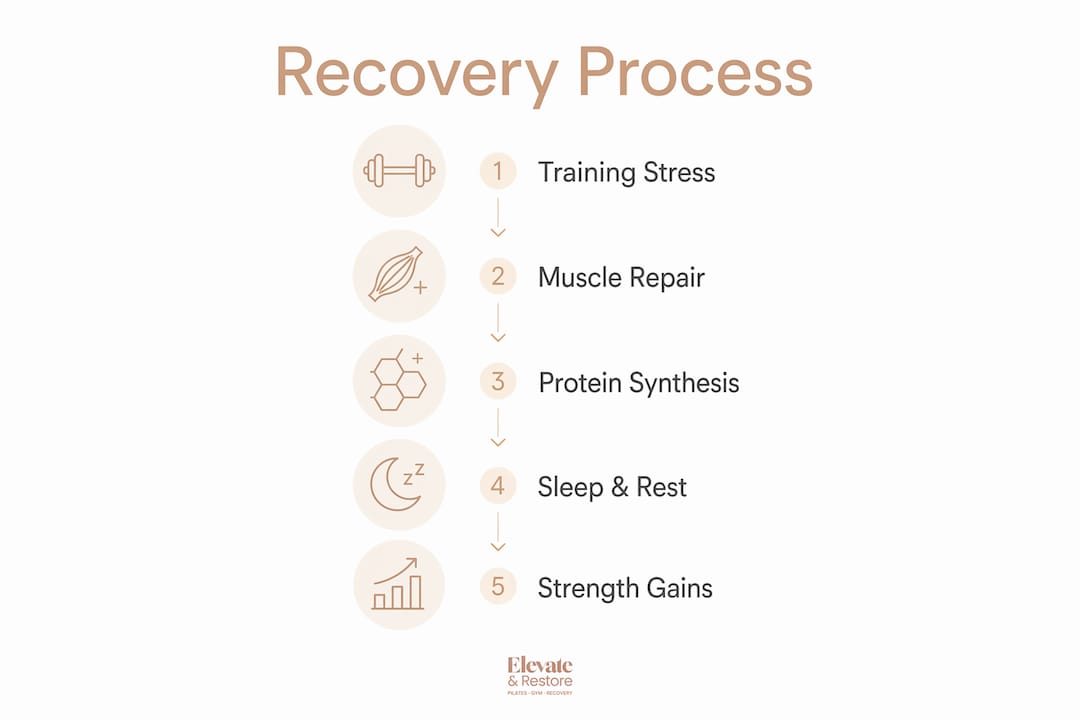
Recovery is the phase in strength training where actual strength gains occur. The body does not grow stronger during a training session. It grows stronger in the hours and days after, when muscle fibres repair, the nervous system resets, and connective tissue adapts to the stress you applied. Without adequate recovery, training is simply repeated stress with no productive outcome. Elevateandrestore works with strength trainers every day who train hard but plateau, and the answer is almost always the same: recovery is the missing variable.
Why recovery determines strength gains: the physiology
Recovery is not a passive break but the key period where training stress converts into usable strength. Three separate biological systems need time to rebuild after a hard session, and each runs on its own timeline.
Muscle protein synthesis, the process of repairing and building muscle tissue, takes 24–48 hours after training. The central nervous system, which coordinates force production across every muscle, needs 24–72 hours to fully restore its output capacity. Connective tissue, including tendons and ligaments, is the slowest to adapt, requiring 48–96 hours after heavy loading. These timelines are not suggestions. They are biological constraints.
| Tissue | Recovery window | Risk if ignored |
|---|---|---|
| Muscle fibres | 24–48 hours | Reduced protein synthesis, soreness |
| Central nervous system | 24–72 hours | Strength output drops, coordination loss |
| Connective tissue | 48–96 hours | Tendon strain, elevated injury risk |
Training the same muscle too frequently raises injury risk by 38%. That figure reflects what happens when you compress recovery windows by returning to heavy loading before tissue repair is complete. The gains you chase by training more often are cancelled out by the damage you accumulate.
How does sleep affect strength and recovery?
Sleep is the single most powerful recovery tool available to any strength trainer. The research is direct: lifters who get 7+ hours of sleep per night add roughly 25% more 1RM strength over 12 weeks compared to those sleeping under 6 hours on the same programme. That is a significant performance gap produced entirely by a lifestyle variable, not by training design.

The acute effects of poor sleep are just as striking. Four to five hours of sleep reduces maximum strength by 5–8% on compound lifts and total reps to failure by 10–15%. You feel it in the warm-up and it compounds across the session. Short sleep also generates only 60% of the growth hormone output of a full 8-hour night. Chronic sleep restriction lowers IGF-1 levels by 10–15% within weeks, reducing the hormonal environment your body needs to build muscle.
Sleep deprivation also cuts muscle protein synthesis by 18–24% within 24 hours. That means even if your nutrition and training are perfect, poor sleep actively dismantles the repair process you are trying to support.
Key sleep habits that directly support strength progress:
- Consistent sleep schedule: Going to bed and waking at the same time each day stabilises hormonal cycles that govern muscle repair.
- 7–9 hours per night: This is the window where growth hormone output, protein synthesis, and nervous system restoration all peak.
- Sleep environment: A cool, dark room reduces sleep fragmentation and improves deep sleep quality.
- Avoid training too late: High-intensity sessions within 2 hours of bedtime can delay sleep onset and reduce slow-wave sleep.
Pro Tip: Treat your sleep target the same way you treat your training target. Write it into your programme. If you would not skip a squat session, do not skip 7 hours of sleep.
Understanding how circadian rhythm affects training can also help you time sessions to align with your body's natural performance peaks, which compounds the recovery benefit of consistent sleep.
Why does recovery matter more as you get stronger?
Beginners get stronger almost regardless of recovery quality. The nervous system adaptations in the first 6–12 months of training are so large that they mask poor recovery habits. That changes as you advance.
Stronger lifters create significantly greater systemic stress per session than beginners. A 140kg deadlift taxes the nervous system, spine, and posterior chain in ways that a 60kg deadlift simply does not. The recovery demand scales with the load, but many lifters keep adding volume and frequency without adjusting their recovery accordingly. The result is accumulated fatigue that stalls progress.
Unrecoverable training volume is the biggest barrier to continued strength gains for intermediate and advanced lifters. Progress depends on balancing the training stimulus with adequate recovery. When fatigue accumulates faster than it clears, performance drops before any physical injury appears.
The shift required at this stage is from "work harder" to "work smarter." The best strength programmes are those lifters can consistently perform and recover from, requiring careful management of volume, intensity, and exercise selection as strength rises. Adding a fourth heavy session when you are not recovering from three is not a path to progress. It is a path to stagnation.
Signs that you are under-recovering include diminished bar speed on warm-up sets, heavier warm-ups feeling unusually difficult, reduced reps at a given load, increased soreness that does not resolve between sessions, and disrupted sleep patterns. These are signals, not weaknesses. Responding to them is what separates lifters who keep progressing from those who spin their wheels.
Pro Tip: If your warm-up sets feel heavier than usual for two sessions in a row, that is a recovery signal. Reduce volume for that session rather than pushing through. One adjusted session prevents weeks of stalled progress.
What practical strategies maximise recovery for strength gains?
The impact of rest on muscle growth is directly shaped by how well you manage the variables outside the gym. Training design, nutrition, hydration, and active recovery all feed into the same outcome: how fully you restore before the next session.
Programme design
Structure your programme to allow 48–72 hours of recovery per muscle group between heavy sessions. Heavy training above 85% 1RM requires at least 48–72 hours for nervous system recovery alone. Rotating muscle groups and managing weekly volume prevents the accumulation of unrecoverable fatigue that stalls intermediate and advanced lifters.
Nutrition timing
Protein intake after training directly supports muscle protein synthesis. Consuming 20–40g of high-quality protein within 2 hours of a session provides the amino acids needed to begin repair. Total daily protein intake matters more than any single meal, but post-session timing gives the repair process an early start.
Hydration
Even mild dehydration impairs muscle function and slows recovery. Strength trainers should prioritise consistent fluid intake throughout the day, not just around sessions. Water supports nutrient transport to muscle tissue and helps clear metabolic waste produced during training.
Active recovery
Light movement on rest days, such as walking, swimming, or mobility work, increases blood flow to muscle tissue without adding meaningful training stress. This accelerates the clearance of metabolic waste and reduces soreness without compromising the recovery window. Elevateandrestore's sauna recovery sessions complement active recovery by promoting circulation and reducing muscle tension between training days.
Fatigue monitoring and auto-regulation
Monitoring resting heart rate provides a reliable objective marker of accumulated fatigue. A resting heart rate increase of more than 5 bpm above your baseline indicates autonomic stress and suggests your body needs more recovery time before the next heavy session. Subjective markers, such as how warm-up weights feel, are equally useful. Auto-regulation, adjusting daily training based on readiness rather than a fixed schedule, is one of the most effective tools for managing recovery without sacrificing training consistency.
Deload phases, typically one reduced-volume week every 4–8 weeks, allow accumulated fatigue to clear while maintaining training frequency. Lifters who use deloads consistently tend to set personal records in the week following them. That is not coincidence. It is the adaptation that was building under the fatigue finally expressing itself.
For strength trainers over 30, recovery methods need to be built into the programme from the start, not added as an afterthought when progress stalls.
Key takeaways
Recovery is the biological process that converts training stress into strength, and without it, even the best programme produces no lasting gains.
| Point | Details |
|---|---|
| Recovery drives adaptation | Strength gains happen during recovery, not during training sessions. |
| Sleep is non-negotiable | Seven or more hours per night adds roughly 25% more strength over 12 weeks. |
| Tissue timelines are fixed | Muscle, nervous system, and connective tissue each require 24–96 hours to recover. |
| Advanced lifters need more recovery | Greater training loads create greater systemic stress, making recovery the primary limiter. |
| Monitor and adjust | Track resting heart rate and warm-up quality to catch under-recovery before it stalls progress. |
The thing most lifters get backwards
After working with strength trainers at Elevateandrestore, the pattern I see most often is this: the lifters who struggle to progress are not the ones who train too little. They are the ones who train hard and recover poorly. They treat rest days as wasted days and sleep as optional. They add sessions when progress stalls, which is exactly the wrong response.
The uncomfortable truth is that your body does not care how many hours you spend in the gym. It cares how completely you recover from each session. I have watched lifters add 20kg to their squat in 8 weeks simply by fixing their sleep and reducing their weekly volume. No new programme. No new exercises. Just recovery done properly.
The other mistake I see is waiting until something breaks before taking recovery seriously. Under-recovery does not announce itself with an injury. It shows up quietly as slower bar speed, heavier warm-ups, and a general flatness in training. By the time most lifters notice, they have been under-recovering for weeks. Start tracking your recovery markers now, not after your progress stalls.
The lifters who build durable, long-term strength are the ones who treat recovery as part of the training plan, not as the absence of training. That mindset shift is the most valuable thing you can take from this article.
— Elevate
Recovery support at Elevateandrestore
Elevateandrestore is a functional training and Pilates studio in West Footscray built around one principle: training and recovery work together. The studio runs small group sessions of six people, which means every session is coached, not just supervised.
The recovery lounge includes a sauna, cold plunge, hot tub, and compression boots. These are not extras. They are tools that directly support the physiological recovery processes covered in this article, from reducing muscle soreness to restoring nervous system readiness. If you are serious about strength gains, adding structured recovery sessions to your week is one of the highest-return changes you can make. Book a session at Elevateandrestore and experience what recovery done properly feels like.
FAQ
How long does recovery take after strength training?
Muscle fibres need 24–48 hours, the central nervous system needs 24–72 hours, and connective tissue needs 48–96 hours to recover after strength training. Heavy sessions above 85% 1RM sit at the longer end of each range.
How does sleep affect strength gains?
Lifters who sleep 7 or more hours per night gain roughly 25% more 1RM strength over 12 weeks than those sleeping under 6 hours on the same programme. Poor sleep also reduces muscle protein synthesis by 18–24% within 24 hours.
What are the signs of under-recovery?
Signs include slower bar speed on warm-up sets, heavier warm-ups feeling unusually difficult, reduced reps at a given load, persistent soreness between sessions, and disrupted sleep. A resting heart rate more than 5 bpm above your baseline is a reliable objective marker.
How much protein do I need after training to support recovery?
Consuming 20–40g of high-quality protein within 2 hours of a session provides the amino acids needed to begin muscle repair. Total daily protein intake is the primary driver, but post-session timing supports the early stages of recovery.
Why do advanced lifters need more recovery than beginners?
Advanced lifters move heavier loads, which creates greater systemic stress across muscle, the nervous system, and connective tissue. The recovery demand scales with strength, so the same training frequency that worked as a beginner becomes insufficient as loads increase.