
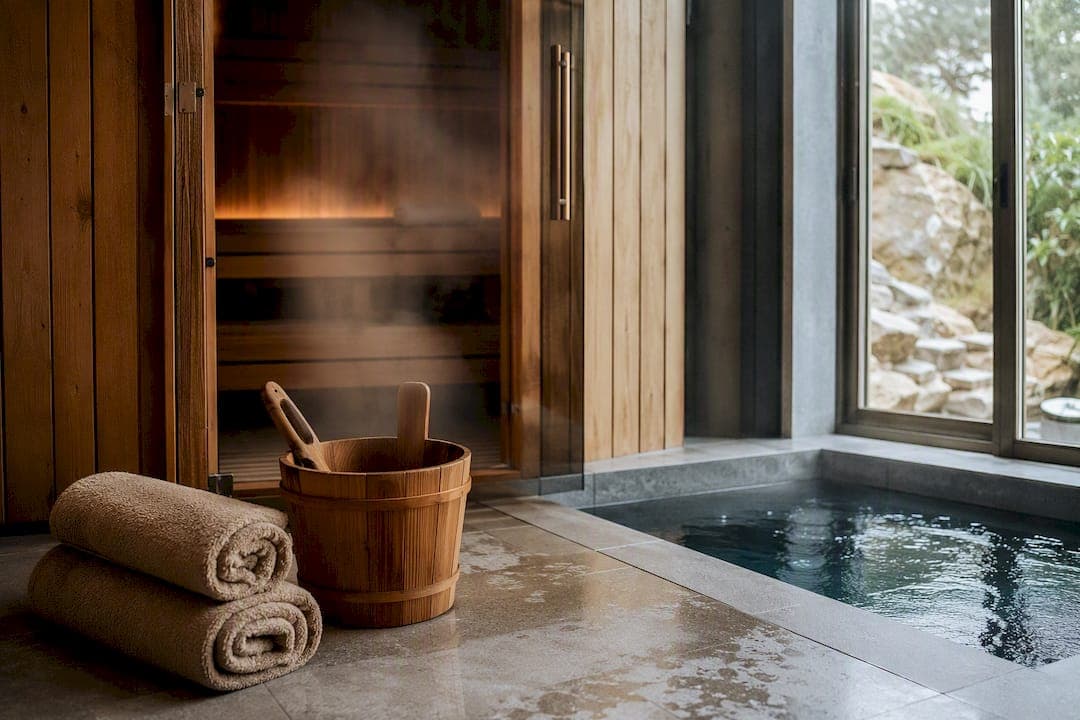
Sauna first, cold plunge second. That's the sequence backed by the physiology of contrast therapy, and it's what we run at our own recovery hub. Heat induces vasodilation, expanding blood vessels, while cold causes vasoconstriction, narrowing vessels. The cycle between these states underpins contrast therapy's circulatory benefits. Starting with cold immersion before heat exposure may reduce the effectiveness of this vascular cycling.
There are exceptions worth flagging before you book your first session:
- Straight after heavy strength training — if hypertrophy is the goal, skip the cold plunge altogether that day, or delay it several hours.
- Known cardiovascular issues or uncontrolled high blood pressure — get medical clearance before combining hot and cold extremes.
- Pregnancy — heat and cold contrast therapy sits in the "check with your doctor first" category, not the "just try it" one.
Key Takeaways
Sauna followed by cold plunge produces a stronger vascular and nervous system response than cold-first sequencing, but timing around strength training and personal health history changes the details.
| Point | Details |
|---|---|
| Default order | Sauna first, then cold plunge, to maximise the vasodilation to vasoconstriction cycle. |
| Standard protocol | 15 to 20 minutes sauna, 1 to 3 minutes cold plunge, for 2 to 3 rounds. |
| Screen before starting | Check cardiovascular history, blood pressure, pregnancy status, and medications first. |
| Strength training timing | Delay cold plunge by 4 to 6 hours after hypertrophy-focused lifting sessions. |
| Try it supervised | Elevateandrestore's recovery hub offers sauna and cold plunge access with on-site staff guidance for beginners. |
Table of Contents
- Cold plunge before or after sauna: the physiology behind the order
- What's the best cold plunge and sauna routine?
- Who should avoid or modify contrast therapy?
- Should you use contrast therapy before or after a workout?
- Common mistakes people make with contrast therapy
- Choosing your finish: cold for energy, heat for calm
- Try contrast therapy safely at our recovery hub
- Frequently asked questions
- Sources
Cold plunge before or after sauna: the physiology behind the order
Sauna primes the body for cold in a way cold plunging alone doesn't replicate. Heat exposure dilates blood vessels, pushes blood toward the skin, and triggers a cascade of heat shock proteins that support cellular repair and cardiovascular resilience over time. Jump straight into cold water without that warm-up phase and you're working with a constricted, under-primed vascular system that has less range to cycle through.
This is where the "vascular pump" comes in. Sauna heat causes vasodilation. Cold water immersion straight after causes rapid vasoconstriction. That swing between wide-open and clamped-down vessels is what drives the circulatory effect people chase with contrast therapy, and it's far more pronounced when the starting point is genuinely warm rather than neutral.
There's a nervous system story running underneath this too. Sauna heat ramps up the sympathetic "fight or flight" response, and the cold plunge that follows pushes that further before flipping into a parasympathetic rebound as your body settles. Cold water immersion also triggers a sharp spike in norepinephrine, which is part of why people report feeling unusually alert and clear-headed after a cold finish. Regular heat exposure, meanwhile, is linked to sustained increases in heat shock protein activity, a marker tied to cardiovascular and cellular stress adaptation.
The vascular "pump" created by cycling between heat-induced dilation and cold-induced constriction is one of the more consistently observed effects of contrast therapy, even though individual responses vary considerably.
It's worth being honest about where the science is solid and where it's still catching up. The vascular cycling and HSP research is reasonably well established. The mood and stress-resilience benefits of cold water immersion are promising but still described by researchers as variable between individuals, not universal.
What the evidence generally agrees on:
- Heat before cold produces a stronger vascular response than cold alone or cold-first sequencing.
- Sauna-driven HSP activation supports long-term cardiovascular adaptation with regular use.
- Cold immersion's norepinephrine spike is real and reasonably consistent across studies.
- Individual variation in cold tolerance and response is significant, so protocols need personalising.
- Broader physiology reviews caution that contrast therapy's inflammation and autonomic-balance effects still need more individualised study before firm claims can be made.
What's the best cold plunge and sauna routine?
A typical contrast session runs 15 to 20 minutes of sauna, 1 to 3 minutes of cold plunge, repeated for 2 to 3 rounds. That's the shape most beginner-to-intermediate routines take, though the exact numbers shift with experience and cold tolerance.
Beginner: Sauna at 70 to 80°C for 10 to 12 minutes. Cold plunge at 15 to 18°C for 30 to 60 seconds. Two rounds, with a 3 to 5 minute rest between each.
Intermediate: Sauna at 80 to 90°C for 15 minutes. Cold plunge at 10 to 14°C for 60 to 90 seconds. Three rounds, 2 to 3 minutes rest between.
Advanced: Sauna at 85 to 95°C for 15 to 20 minutes. Cold plunge at 4 to 9°C for 90 to 180 seconds. Three to four rounds, minimal rest.
| Level | Sauna time | Sauna temp | Cold plunge temp | Cold duration | Rounds |
|---|---|---|---|---|---|
| Beginner | 10–12 min | 70–80°C | 15–18°C | 30–60 sec | 2 |
| Intermediate | 15 min | 80–90°C | 10–14°C | 60–90 sec | 3 |
| Advanced | 15–20 min | 85–95°C | 4–9°C | 90–180 sec | 3–4 |
The transition itself matters more than people expect. Walk from sauna to plunge, don't linger. A gap of more than a minute or two lets your core temperature drop before the cold hits, which blunts the contrast effect you're going for. A full session, rounds included, typically runs 35 to 55 minutes depending on how many cycles you do.
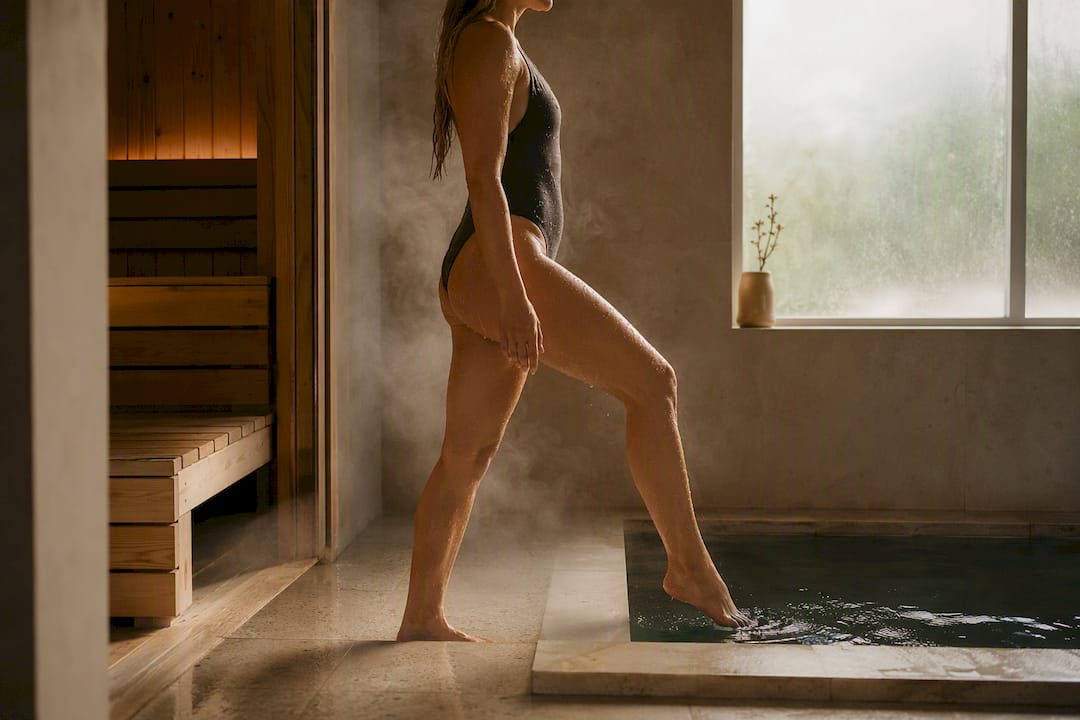
Timing of day changes the finish, not the sequence. Morning or pre-work sessions generally finish on cold for the alertness hit. Evening sessions, especially ones aimed at winding down, often finish on heat, since infrared sauna exposure late in the day tends to support better sleep onset than a cold finish does.
Who should avoid or modify contrast therapy?
Check your cardiovascular history before doing hot to cold contrast, and if you have uncontrolled hypertension, are pregnant, or take medications affecting blood pressure or heart rhythm, talk to a doctor first. This isn't a box-ticking exercise. Cold water immersion causes a real, measurable cardiovascular response that can be genuinely risky for people with existing heart conditions, and moving straight from sauna heat into that cold shock compounds the strain.
The main contraindications, and why each one matters:
- Coronary artery disease or arrhythmia — the abrupt blood pressure swing between hot and cold can trigger cardiac events in vulnerable people.
- Uncontrolled hypertension — sauna heat already raises heart rate; cold immersion adds a second cardiovascular shock on top.
- Pregnancy — core temperature regulation changes during pregnancy, and there isn't enough safety data to recommend contrast therapy without medical guidance.
- Certain medications — beta blockers and blood pressure medications can mask or exaggerate the body's response to thermal stress.
The American Heart Association is blunt about this: cold water immersion carries genuine risks, including cold shock and arrhythmia, particularly for people who haven't been screened. Practical precautions help regardless of your health status: monitor how your heart rate responds during the transition, hydrate before and after, skip alcohol on session days, and don't do a first-time cold plunge alone.
If strength training is part of your week, timing matters here too. Jumping into cold water straight after a heavy lifting session can blunt hypertrophy signalling, so separate the two by several hours if muscle growth is the goal.
Pro Tip: Scale cold exposure gradually over weeks, not sessions. If you notice uncontrollable shivering, confusion, or a racing heart that doesn't settle within a minute of exiting the water, get out, warm up gradually, and treat that as your ceiling for now, not something to push through.
Should you use contrast therapy before or after a workout?
For general fitness, endurance work, or as a pre-workout warm-up, sauna followed by a brief cold plunge is fine either side of training. The exception is strength training aimed at muscle growth. Cold immersion straight after a hypertrophy-focused session can dull the inflammatory signalling your muscles need to adapt and grow.
Practical timing guidance:
- Hypertrophy goal: delay cold plunging by 4 to 6 hours after lifting, or do your contrast session on a separate day.
- Recovery/endurance goal: cold immediately post-session is fine and may reduce perceived soreness.
- Pre-workout warm-up: a short sauna session to raise core temperature and loosen muscles, skip the cold plunge until after training.
If recovery rather than muscle building is the aim, a quick 10 minute sauna and 60 second plunge post-session works well as a Sunday reset. For strength-focused weeks, save the full contrast routine for a dedicated active recovery day instead.
Common mistakes people make with contrast therapy
Finishing hot when you wanted an energy boost is the most common one. Sleepiness and heat don't mix with alertness goals. Entering very cold water too fast is another, spiking anxiety and shortening the session before you get any benefit.
Quick fixes:
- Dizzy or lightheaded — stop, sit down, and rehydrate before trying again.
- Skipping hydration — drink water before and after every round, not just at the end.
- Doing too many rounds too soon — two rounds is plenty for your first month.
- Ignoring health warnings — a racing heart or chest tightness means stop, not push through.
Build cold tolerance over weeks. Trying to hit advanced numbers in your first session is how people quit after one bad experience.
How we run contrast sessions at Elevate & Restore
Our studio protocol is built around one goal: a full nervous system reset and circulation boost without guesswork. The standard session runs 12 to 15 minutes in the infrared sauna, a brisk walk to the plunge, 45 to 90 seconds in the cold plunge depending on experience, then 2 to 3 minutes rest before repeating for two or three rounds.
- Sauna: 12 to 15 minutes at a comfortable heat setting for the client's experience level.
- Transition: under a minute, minimal lingering.
- Cold plunge: 45 to 90 seconds, scaled to tolerance.
- Rest: 2 to 3 minutes between rounds, seated and hydrating.
Pro Tip: We coach clients to breathe slowly and exhale longer than they inhale during the first 20 seconds in the plunge. That single cue does more to settle the shock response than anything else we teach.
Choosing your finish: cold for energy, heat for calm
Sequence should follow goal, not habit. If circulation and recovery are the priority, sauna into cold is the default we'd back every time. If sleep is the actual target, finishing on heat instead of cold makes more sense, even though it breaks the "always end cold" advice you'll see repeated everywhere.
Picture two clients: one finishing a long endurance session who wants inflammation control and a fast bounce-back, versus someone coming in after work who just wants to switch off before bed. The first person should finish cold. The second should finish warm, full stop.
Test both finishes over a couple of weeks and pay attention to how you sleep and how you feel the next morning. Your own data will tell you more than any general rule can.
Try contrast therapy safely at our recovery hub
Reading about sauna and cold plunge sequencing is one thing. Getting the temperatures, timing, and transitions right on your own, in a home setup or a gym with no supervision, is where most people either underdo it or overdo it. Elevateandrestore's recovery lounge gives you supervised access to infrared sauna, cold plunge, hot tub, and compression boots in one session, so you're not guessing at water temperature or timing your first cold immersion alone.
You can book a single recovery session to test the routine, grab a recovery lounge pass if you want to build it into a weekly habit, or add it to a membership alongside small-group reformer Pilates classes. Staff on-site can talk you through temperature and duration based on your health history and goals before you get in the water. Book a recovery session and start with the beginner protocol under supervision rather than working it out solo.
Frequently asked questions
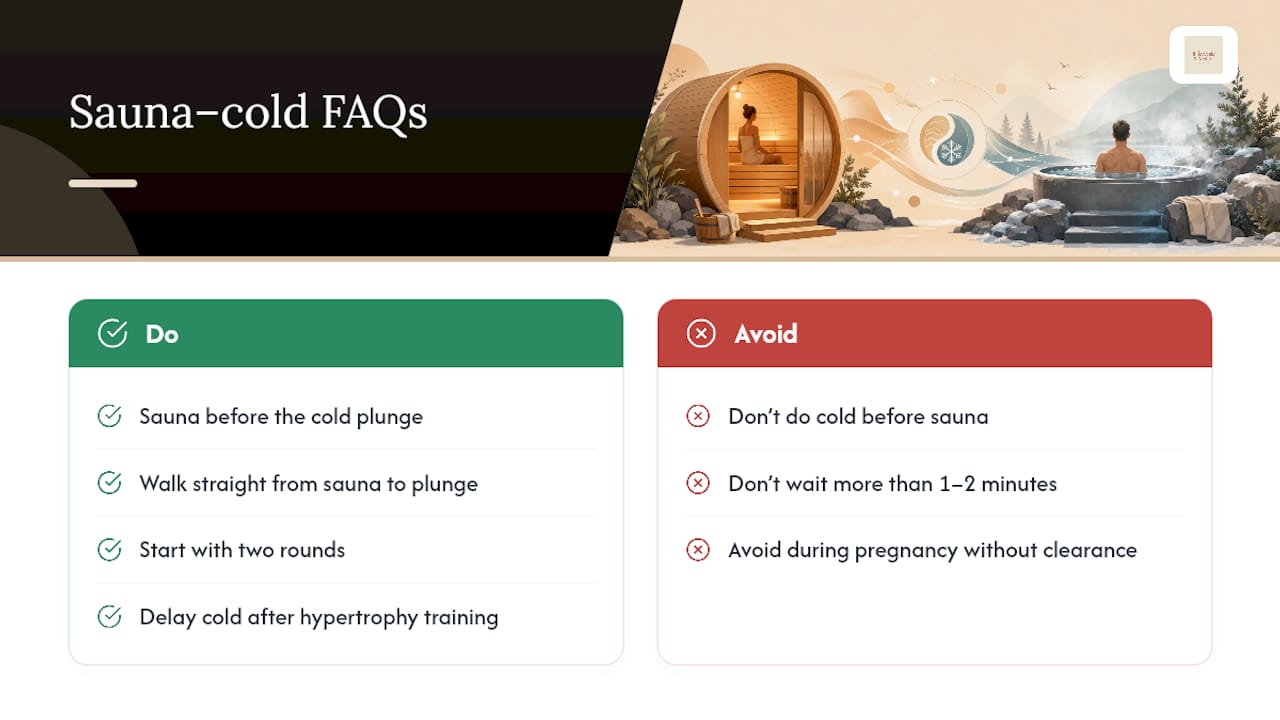
Is it better to do cold plunge before or after sauna? After. Sauna first primes the vascular system through dilation, and the cold plunge that follows creates a stronger constriction response than doing cold first.
How long should I wait between sauna and cold plunge? As little as possible. Walk straight from the sauna to the plunge. Waiting more than a minute or two lets your core temperature drop and weakens the contrast effect.
Can I do a cold plunge right after a workout? For general recovery, yes. For hypertrophy-focused strength training, delay it by several hours since immediate cold exposure can blunt muscle-building signals.
How many rounds of sauna and cold plunge should beginners do? Two rounds is a sensible starting point. Build up to three or four rounds as your cold tolerance improves over several weeks.
Is contrast therapy safe during pregnancy? Not without medical clearance. Core temperature regulation changes during pregnancy, and there isn't enough safety data to recommend the practice without a doctor's input.
This article is general information, not a substitute for advice from a qualified doctor. Consult a qualified healthcare professional about your own circumstances before acting on anything here.
Sources
- PMC article on thermal therapies and vascular response
- PubMed: cardiovascular responses to cold exposure